Midterm Advice

With Midterms coming up/happening, here are some tips to keep you going!

  1. Don’t pull all-nighters (even if you’re dying to play “just one more level” or see “one more episode”)
  2. Set your alarm and WAKE UPPPP!
  3. Plan your day/week at least a day earlier, having at least three goals per day- this will divide your time efficiently and you won’t feel dead all the time. Takeaway: DoN’t PrOcAsTiNaTe!
  4. Make time for some leisure activity or socialness (like reading, writing in a journal, coffee with a friend, or just a nap)
  5. Pick your study spaces wisely! (If you want a quick study space, UgLi probably will be packed)
  6. Do whatever to keep yourself energized throughout study sessions! (Get coffee or take brief walks when needed)
  7. Sleep for at least 5 hours each night (especially the night before, or else you’ll be dumber than if you hadn’t studied on the actual exam)
  8. Think positive! Psychological research shows that people perform 25% higher in scoring if they think positively!

As my advice may or may not be getting those of you who are reading this hyped for exams, here are some of my photos of campus! Relax and enjoy the architecture! (P.S. All images are on campus)


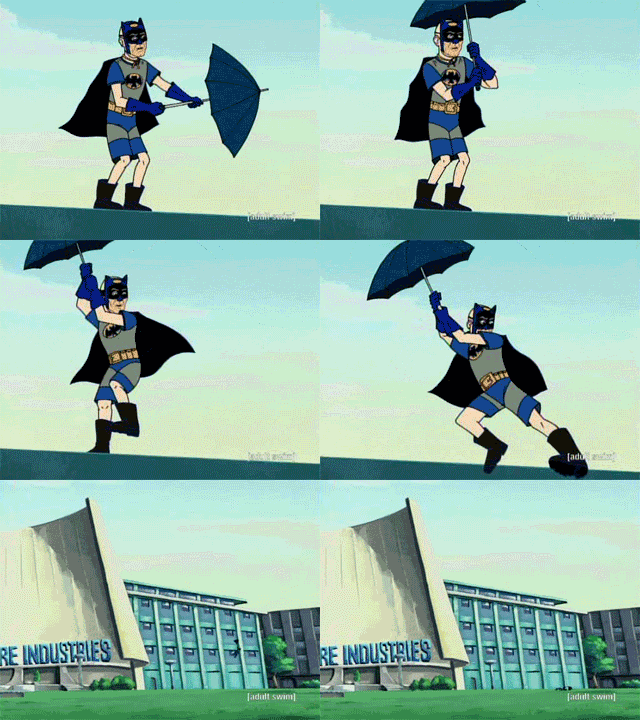
Team Venture


Going through the catalogue of Adult Swim shows, both finished and currently airing, is to delve into the most eclectic series of shows ever produced for television. I remember that moment when Cartoon Network would suddenly switch over to the late night block of animation, when the kid friendly program was suddenly swapped for a swearing meatball or a former Hannah-Barbera superhero turned talk show host. But after a hiatus of TV-show consumption, and returning to an updated Adult Swim catalogue, I discovered The Venture Bros.

I was not hooked immediately. Instead it took the second episode I watched to fully win me over. Initially, the macho-hilarity of Brock Samson (voiced by Patrick Warburton – a voice I never tire of) was what got me to watch the second episode in the first place. But what made me stay for the next six seasons was the unique take on “arching” the show utilized.

Although The Venture Bros. was initially a parody of Johnny Quest following the tradition of repurposing old (and somewhat forgotten) Hannah-Barbera characters (albeit with more original input by not utilizing old animation cells), it quickly becomes a sporadic yet cohesive work, filled with a string of references on the trove of pop-cultural and pulpy goodness geeks treasure: comics, cartoons, you know where I’m going with this. I was hooked because, like Rick and Morty, which came after, the show was open to a series of stories, characters, and relationships that came from a cultural cannon I was incredibly fond of, meaning so long as the writing was good, I would be treated to seasons upon seasons of entertainment.

As I mentioned before, one of the critical structural elements that allow for this system is the mechanic of “arching.” In the world of The Venture Bros. villains and heroes are clear-cut on a vocational level, focusing on the absurdity of adults wearing spandex and fighting each other. Oddly enough, the arch villains hardly kill the heroes or non-heroes they arch. Instead, the show plays it out like a game of cops and robbers between adults – making some characters, like Rusty Venture, jaded by the entire experience.

How could one be jaded by adventure, by a life of villains and heroes? Well Rusty was a child adventurer like Johnny Quest, and now he is just a washed up second-rate super-scientist (and many other things which I will not reveal because…spoilers). Even Johnny Quest makes a cameo experience as Action Johnny. He is a nervous wreck as an adult because his father dragged him along on absurdly dangerous adventures. Sucks to know I’d probably be the same if I ever went on those insane adventures. Really kills the dream. Or does it?

Essentially the arching structure allows the show to consider the absurd world of fictional heroes and villains, never hesitating to utilize legally safe knockoffs of beloved characters like Spider-Man (Brown Widow in the show – he shoots webbing from his anus). Perhaps the meta-effect of the show would be far better aligned had I seen this show when I was younger. But the effect of the creative choices is still appreciated. The Venture Bros. geeks out. It has its fun with all the nostalgic and beloved pop-cultural icons that we all adored. But it is simultaneously giving it all a fresh spin while simultaneously providing a world that is the apotheosis of childish wet dreams and an adult tragicomedy. It is a world of disappointment, a horror-show, which I still kind of wish would exist. Is that messed up? I guess the child never died in me, but the older perspective…that’s new, and if the child in me has lasted this long, I do not see my older self leaving its set of keys on the kitchen counter any time soon. The dream never dies.

Chinese Paper Cutting

“Don’t eat the glue, Marius”, “This looks horrible, Marius” and “Mrs. Lex, your son is utterly untalented… in an endearing way, of course” are quotes from my pre-school days I will never forget. Not because they described me very well, but because they shaped my stance on arts and crafts more than anything else in my life. My teachers concluded I was incurably untalented, after I had made a photo frame to give to my Mom for Christmas. While the other kids had garnished theirs with glitter and bedighted them with beads, I had glued uncooked noodles to my frame.

Even though I realized my teachers had clearly given up on me, I still tried to create something unique, every time we did arts and crafts. A feetless flamingo, a chiseled chestnut and many hours of whacky weaving later, however, I too accepted that I would probably never be good at this. Following this realization, I started, you know… eating glue and stuff.

After pre-school, I went on to elementary school, secondary school, high school and eventually to university and didn’t have to do arts and crafts for a very long time… Until today!

The art of paper cutting is China’s oldest and most popular art. Shortly after paper was invented in the Han Dynasty about 1900 years ago, and became more and more accessible to people, this beautiful folk art emerged. Over the course of hundreds and thousands of years, a variety of new techniques was applied and perfected by the Chinese. Nowadays, paper cutting is still very popular and not only in China. In many parts of the world it is a common type of arts and crafts.

In China, the paper cutouts or “剪纸 (jianzhi)”, are used as decorations, especially at weddings and childbirths. They are usually red and symbolize love and health.

Since no one in our class was pregnant or wanted to get married, we just crafted for the heck of it. It was hard, it was precision work but most of all it was fun. I was still horrible at it, because… let’s face it, it was still me doing it, but our Chinese teacher lied about it being “beautiful” … yeah, right. For the first time in many, many years I had fun arts and crafting:

Depending on how you fold and cut, you can achieve lots of different forms, sizes, kinds, colors and even Chinese characters. When you get the hang of it, you can even cut out large, connected patterns, which do not only look great, but also give you a feeling of achievement. The cut outs make great presents and are very nice to look at, as well. In many regions of the world, they were taped to the exterior of a window, so the light from the inside would shine through the negative space of the cutouts.

These are a couple of our creations. They took me only thirty minutes:

Alright, everybody. St. Patrick’s Day is coming up, so get out your green paper and a pair of scissors and start cutting out dancing Leprechauns!


PS: Remember to be as weird as you can possibly be.

Hunger is Like Happiness

You know those days when you have a three hour lab at lunchtime, or a 12-hour clinical, or a block of classes without break, and you didn’t plan ahead for the moments when the only thought on your mind is food?

You almost feel stuck waiting until you can grab a bite to eat, but you can’t go quite yet because you have to dedicate this time to other things. You can’t be satisfied all the time. Likewise, you can’t be happy all the time. There will be good days and there will be bad days just like there will be times when you’ll be so hungry your stomach feels as though it’s collapsing on itself. When you finally taste food again, that sensation will be far more meaningful and rewarding. There will be times when you don’t understand why the world is against you and why you feel sad, why your favorite old dog is suddenly sick when you’re away, why your grandpa is in hospice…you name it. There’s a lot we can’t control, but I assure 100% that the light in your heart comes back, brighter than ever. Just you wait.  Time heals all hearts. You can’t measure how long it takes to mend a wound, but here are some steps to help you grow from the pain:

  1. Give yourself a day to mope. If your workload is mundane and irrelevant to the large scheme, don’t do it that day. Pick it up when you’ve cleared you mind a little bit.
  2. Write down your thoughts. A week later you’ll be writing about the best night you just had and skim across the words that aren’t so tender anymore. You can gauge your progress!
  3. Stay busy. Pick up a new hobby or follow through with old ones.
  4. Call old friends. Call new friends. See what’s up with them and you’d be surprised how much they can offer whether its a laugh or advice.
  5. Dress how you want to feel. Feel good look good. Feel bad, still look good.
  6. Find a release. Exercise is a good outlet, and you’ll feel healthy and energized. Then treat yourself. It’s been a while since you had Rod’s. Go get a shake and bring a friend. 🙂
  7. Music. Sample to every kind and ask for recommendations. Listen “Blindsided” by Bon Iver for a gloomy, reflective song. Listen to “Take You There (El Bee Remix) by Sean Kingston to start to an awesome night WOO.

Life is good.

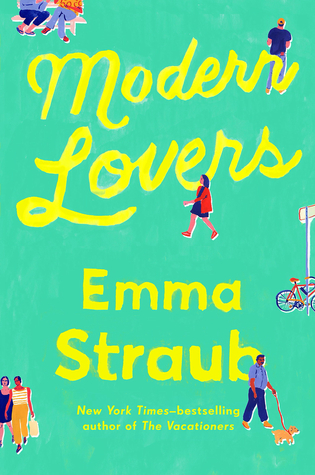
Book Review – Modern Lovers

Modern Lovers is my first Emma Straub book, and I ended up really enjoying it. This semester, I’m trying to really start reading for pleasure again after many semesters when that seemed possible because of all the reading I had to do for class. And this book is pretty perfect for getting you back into that mood to read; it’s light and funny, with short chapters that fly by quickly, but it’s not just empty fluff. It has interesting points to make, and it’s smart.

The first half is a tad slow. The short chapters and fun characters make it enjoyable and breezy, but there’s no one central conflict, which makes the story ultra low-concept; it’s basically a story about two families and their various relationship dynamics, which doesn’t make for a catchy logline, really. You could say it’s about two marriages that are on the brink of failure, one fraught with years of tension and contention and one haunted by a slowly building sense of complacency and buried secrets. You could also say it’s about a teen romance that threatens the stability of the kids’ parents’ friendships. You could also focus on the character of Lydia and the band that she once created with the parents and say that the story is about how it’s difficult to move on from the past, how old events and old tensions can linger years afterward. All of these coexisting stories fit together well in retrospect, but as you’re reading the first half, it’s a bit difficult to see how they’ll build off each other. The first half feels like a time to just hang out with the characters and get to know them a little bit. It’s mostly fun, but occasionally it feels too directionless.

In the second half, the dominoes start to fall, and the conflicts build, and that’s really where the story starts to speed up. Straub is smart about depicting the conflicting ways people view their relationships; Harry views Ruby, for example, as the clear love of his life, but it’s clear to us even without seeing her point of view that she views their relationship differently. Then we get to see her perspective and learn that she really thinks of Harry as a pet project, a fun diversion where she’s able to ‘practice’ saying she loves someone, because all teenage love is performative. It’s sad to see Harry so delusional in his infatuation for Ruby when she looks down a bit at him, but it’s also sweet, and the story sidesteps the big, cliche confrontation scenes where Harry and Ruby might get into a fight about what their relationship means, or have a melodramatic breakup. I like how their story ends, with them agreeing to break up when Ruby arrives at the airport. Their relationship clearly meant something to each of them, and even if those interpretations were different, that doesn’t mean either was wrong. In the end, the story of Harry and Ruby is a hopeful one. Ruby’s flashforward to imagining her and Harry seeing each other at reunions years down the road was one of the most emotionally potent scenes of the book for me.

If I have a complaint with the second half, it’s that the whole thing works out a little too perfectly. To be honest, I was hoping one of the marriages would end, preferably Elizabeth and Andrew’s. I like the idea that the real failing marriage wasn’t the one fraught with disagreement and jealousy (Zoe and Jane), but the one that seemed stable but wasn’t. The other issue, I think, is that I just really disliked Andrew throughout almost the entire book. The EVOLVEment subplot, in which Andrew basically joins a cultish group of hippies who do yoga and drink kombucha, was a bit cringey and annoying for me, even though it’s clear Straub is satirizing the concept and explaining why it holds appeal for Andrew, not endorsing it for everyone. Despite that self-awareness on Straub’s part, though, the EVOLVEment setting took up too much space in the story for me, and I disliked the character of Dave.

In general, Andrew just seemed very selfish and cold to me. Even when he made good points (Elizabeth, of course, shouldn’t have forged his signature to allow the movie studio to use their song), I felt no sympathy for him, because he’d been lying about cheating on Elizabeth with Lydia, because his reasons for turning down the movie deal were selfish. Even when he and Elizabeth got into the fight, Andrew just assumed everything would work out fine for them, and I wished the story punished him more for it. While I’m glad that Zoe and Jane were able to repair their marriage, that, too, seemed a tad too easy; they basically went on one rare date, they had sex, and Jane admitted she was jealous of Elizabeth, and that was it. They were fixed.

There’s also something a bit too perfect about the ending, socioeconomically speaking. Yes, I understand that these people are all well-off, so there are reasonable explanations for how they’re able to overcome their financial issues so easily, but it’s still just…too easy, you know? The fact that Ruby just moved to Mexico and opened up her own pizza place, and Jane and Zoe were able to just open this new pastry shop without any issues…not all couples have the option to spontaneously create a new business together to fix their marriage and start anew. I wanted to see each character find ways to grapple with their issues without throwing money at the problem, and I didn’t really get that.

Still, though I occasionally hoped for a deeper exploration of these characters’ issues and the ways they could fix them, I ultimately really enjoyed Modern Lovers. It’s light, fun, and filled with relatable scenarios and characters. I’ll definitely be checking out more of Emma Straub’s stuff.

Grade: B+
A goddess like woman emerges from the still water…

A goddess like woman emerges from the still water, its calm surface reflecting her face back to her. She has dark brown skin that is highlighted by the vibrant green forest that surrounds her. She looks down at the water, but makes no eye contact as she towers far above the water.

This is IMUA,” one of many water paintings that artist Sean Yoro has created. Using a paddle board and his self taught painting skills he traverses the water looking for interactions between humans and nature that he can use as a canvas. Most of these locations tend to be bridges or walls that separate water from land. Yoro transforms the blank concrete, starting right at the sea level to give the impression that the woman he will paint is rising out of the water. The placement allows the image to be reflected onto the water perfectly.

Yoro isn’t limited to water portraits. He recently worked on project that had him painting on icebergs. Working with North Face he created a film that follows his time spent with the Inuit people while facing the challenges of painting on melting ice. The project highlight the dangers of climate change and combined his love of art and nature to send a powerful message.

Pictures of his murals can be found on his instagram, @the_hula,  as both works in progress and finished products. Yoro shares information about his creative process, upcoming projects, and highlights some of his favorite pieces from his past work. Each photo is more mesmerizing than the last, and the creation of the murals is both impressive and intriguing.

From Hawaii to Florida to the Arctic, Sean Yoro has left his mark as the_hula. In addition to being beautiful, his art is sending a powerful message about preserving the climate and valuing nature. Hopefully one day I’ll be riding by on a paddle board in the Hawaiian sun and see one of his creations. Right now, in the middle of February in Michigan, it’s a really nice thought.