Beauty of Campus

Image result for university of michigan

As students in a spacious university, we often take our diverse environment for granted. No, I am not talking about all of the different ethnicities present on campus, though they are an important constituent of our Michigan identity. Rather, I am talking about the literal “outside world” that exists on our campus. Everyday, we are thrown into following a sort of daily routine: eat, attend classes, study, sleep, (party?), repeat. There’s nothing really wrong with routines, as they are often the most common strategy to success. However, as students, sometimes routines get in the way of our inborn ability to see beauty in the little things that we might usually consider an “everyday occurrence.” Let’s flashback to your day yesterday. Yes, you woke up, washed up, and ate breakfast. Then, you rushed to class at Angell Hall. But wait! Hit the pause button. Let’s say your dorm was Stockwell. From the Hill Residence Area to that first classroom. you rushed past so many things. Remember when you first saw your dorm- how it seemed to glow in your excitement? Today, you might still be happy to return to your dorm, but it is not the same sort of enthusiasm. It’s more like the initial excitement of receiving a new toy as a kid, and then that enthusiasm dying down as you mature. The gorgeous brick structure of Stockwell, somewhat reminiscent of a mini castle, is now overlooked. What else have you overlooked? The same things happen with the CCRB, the Museum of Natural History, East Hall, West Hall, the Chemistry Building, the UgLi. Hatcher, the UMMA, and finally Angell Hall itself.
Buildings, as trivial a topic as they may seem, are much more than what meets the eye. At first, they were just architects’ notions- sketches from imagination. Then, they became the product of the architects’ and engineers’ hard work and successful collaboration. Buildings are the markers of our historic campus evolution. And today, they are the reason why we can attend our classes so comfortably. Buildings deserve more credit than a brief glance, getting their doors slammed, or coffee spilled on their floors. Let’s show some enthusiasm and admiration, the next time we pass by!
It is such a pity that we belittle or forget the alluring effects of our campus environment. At smaller colleges, students do not have this opportunity to marvel at the UMMA’s modern and tradition sides. They also do not have a Diag as awesome as ours. And they most certainly do not have squirrels as confident as ours. We should take pride in our campus and its story, and be grateful for every day that we are able to bask in its beauty. Tomorrow, and on all of the days that follow, let’s perform our routine and allow the beauty of our campus heal us of our everyday wounds.


Limp

The Titters alongside the tree of round-red strawberries and dead eye afro-men, features the stand-up dog, limp and wet, puddles surrounding the stump it lies upon, and a yellow bun sitting atop – heating beneath the light. “Oooooooooooooo,” cries the dog. The narration suggests otherwise, the long, weak, ghostly, sound, slightly edged out by the industrial rectangular text box. What did all these undefined masses of spectators hear during that show? Did they hear the narration or the cry of the limp storyteller? But the dog is never weak; his inner-monologue an instance of assured identity and yearning. The “oooooooooooo,” is just a ruse. The dog is strong in weakness, weakness is strong.
But what of that tree, the tree, the tree? The red of round-red strawberries within the mouth of the black mass composed of cells and sweat and grooves and skin folds. Beneath the black mass or above, lies the face of a woman whose eyes are blue and dead. Vampirism runs rampant in the blue eyes. The triptych woman measures herself from waist to chest. The red lines tell us the measurement from ear lobe to cheek. The entirety of the mass is undefined. Are we but digested masses from a great tree? Droplets of fruity sweetness, cared by the deadeyes, created in the rounded gaze of the watcher. “Ooooooooooooo” cries the limp, “I’d never wanted anything more in my entire life.” To you Deforge.

Groundhog Day… Not!

I feel like on February 2nd, I should write an article about Groundhog Day, one of my favorite movies and an all-time classic of typical 1990s cinema. Instead I am going to tell you about a recent disappointment in my life (I know for a fact that people like to read about other people’s misery). Don’t think for a second, however, that my misery won’t affect your life, as well. I’ve got you scared now, haven’t I? Alright, let’s cut to the chase:

Do you know the feeling when you’ve been listening to “Year 3000”  by the Jonas Brothers your entire life, thinking that they actually came up with one decent song until you find out that even this one good song is a cover? You might be exposed to the same feeling when, after years and years of falling asleep next to your beloved Harry Potter book signed by no other than J.K. Rowling herself, you find out that is was actually your Mum who signed it to bump up your birthday gift from a “Yay” to a “Oh my god, Mum, you’re the best!”. Well, that was the feeling I had watching Disney’s Mulan for the first time on Chinese New Year. Not that Mulan was a disappointment in any way – it REALLY wasn’t – but after this movie I was seriously upset with Peter Jackson. You might wonder: “What does Peter Jackson have to do with Mulan? Wasn’t he just a young guy with very messy hair back when Mulan hit the theaters?” Yes, probably he was. I can assure you that Peter watched Mulan. Because just a couple of years later he would do exactly what the Jonas Brothers did with “Year 3000”. Peter would come to be my Mum of the film industry!

Every Lord of the Rings fan already knows what I’m talking about but for those who haven’t seen the Lord of the Rings or Mulan, I am going to elaborate:

The best scene in movie history (arguably):

After being crowned as the King of Gondor on top of Minas Tirith, Aragorn, Arathorn’s son, slowly walks past the leaders of light and all the heroes who make the Lord of the Rings so unique and had come to congratulate him on being in his rightful place: The throne of Gondor. He walks past Eowyn and Faramir who are now a couple, he shares a bromantic look with Legolas and Gimli and meets up with the love of his life, Arwen, the Elven, before he finally arrives at the place the four Hobbits Frodo, Sam, Merry and Pippin are trying to catch a peak of what’s happening (because they’re small). Polite as they are they get ready to kneel down in front of the new king. Aragorn, however, with tears in his eyes, thinking back to how much the Hobbits had to suffer in order to eventually save mankind from the roaring fires of Mordor, says: “My friends, you bow to no one!” and, in return, bows to them, followed by his entire people, making the Hobbits feel just as special as they deserve to feel.

What a magical scene, right? Wrong! Because from now on it is tainted. To be quite accurate, it was tainted from the very beginning. Why? This beautiful scene that has brought me closer to tears than even my grandpa’s funeral (I love you pops) was basically stolen from Mulan.

This is  what it looks like in Mulan:

Just like in the Lord of the Rings, the king and his people with him, bow to someone who doesn’t expect to be bowed to. Exchange the Hobbits for a Chinese woman and Aragorn for a weird-looking old dude and you’ll see that the scenes are actually very much alike.

Yet, I don’t want to be too hard on Peter, because Mulan just nailed that ending and it’s understandable that other movies want a piece of the pie. Knowing that the ending of the Lord of the Rings is a fraud, doesn’t make the movie any worse or less emotional. This way I have two movies which end the exact same way, giving me twice the emotional potential I knew of before.


PS: Remember to be the weirdest you can possibly be.

An Orchestra Teaches About the Universe

On Wednesday January 24th, Hill Auditorium transformed into an expeditionary vehicle that carried us through the solar system. Emmy-nominated artist José Francisco Salgado created a Science and Symphony performance using his phD in Astronomy to translate astronomical concepts into visual arts. The University Symphony Orchestra guides us through outer space, stopping at each planet with the accompanying sound of Holst’s “The Planets,” Weber’s “Concerto in F,” and Mozart’s Symphony No. 41 “Jupiter”.

Hill Auditorium:

Hill Space Odyssey:

The journey began at Mars, “The Bringer of War” with loud, violent sound. Next Venus, “The Bringer of Peace” with light, uplifting harmony…and so on.

Sitting there thinking about these masses so big and so far away, my mind drifted to a place far beyond the Milky Way. Note the amphitheater structure of the auditorium. The wall behind the screen provides a base to the sound and the extends outward to maximize sound projection. The physics of sound in the auditorium is similar to the physics of placing handheld music devices into a bowl to amplify the sound. After you clear out the matter in the cup (tea, dust, coins), the cup so small can make a big difference in how one enjoys music.

If you look closely, the sideways basin structure resembles that off a cup, almost like the auditorium itself is a cup tilted on its side. So if we explore beyond earth, beyond our solar system, into something far larger than what we know, what will we find? We can see and prove microscopic life smaller than us like the little mindless bacteria. We have yet to understand the life larger than us..what if we are in that cup so small

In reference to the Dr. Seuss story Horton Hears a Who, we know there are no whos, but are there Hortons?

Friday night at the Palace

The Palace of Auburn Hills was filled with energy and excitement on Friday night as the Lumineers brought their Cleopatra world tour to Michigan. Openers Andrew Bird and Margaret Glaspy took the stage first, playing to a somewhat distracted crowd that was still busy getting settled and making trips to the merchandise tables and concession stands. But when Glaspy began to play her electric guitar under the glow of a blue spotlight, the crowd was captivated.

Margaret Glaspy opens for The Lumineers

Andrew Bird played next, his style and sound more closely resembling the Lumineers, fueling the crowd’s anticipation. He swayed at the microphone while playing his violin, alternating between plucking it with his fingers or dragging the fraying bow across the strings.

Andrew Bird opens for The Lumineers

The arena had changed dramatically during the two hours since the doors were open- every seat was filled, the general admission pit was congested with people and the anticipatory energy was palpable. It all culmintated in a powerful roar from the crowd when the large black curtain that had been hiding the stage fell to the ground in a dramatic reveal.The Lumineers were spread across the stage, each with a microphone and instrument in front of them, immediately commanding the attention and adoration of the crowd.

Lumineers percussionist Jeremiah Fraites

But it wasn’t until the first few note of “Ho, Hey!” began to play that the true intensity of the crowd was felt, obviously pleasing the performers. Lead singer Wesley Schultz invited the crowd to sing along, which they enthusiastically accepted. The united voice of the audience soon overpowered Schultz, who continued to play his guitar as he walked out to the edge of the stage. Cellist Neyla Pekarek and percussionist Jeremiah Fraites smiled to each other across the stage as Schultz returned to his spot in the center at the conclusion of the song, the crowd cheering fiercely.

Multiple Choice

I like apples and oranges. They are delicious, colorful, and above all, fruity. One is crunchy and good in pies. The other is juicy and good in popsicles, as well as being considered by many (read: me) as the best candy flavor. I’ll let you guess which is which. I have room to love both in my heart (and stomach), but I still can’t help but compare them. It seems to be a constant refrain in my life. What do I like? And what do I like better? Everything becomes a choice between one thing or another, especially when it comes to how to spend my time. Every minute is precious as I rush from class to class, but I find that can spare more than a few when I curl up to procrastinate on my homework. My economics professor would call this concept, opportunity cost. Every time we choose, we are giving up the value of the next best alternative. Unfortunately, this mindset only sends me down a wormhole of absolute despair. Every situation becomes a loss. Every situation becomes a terrifying game of “what if….”. All this flashes through my head, as I stand in front of the baskets of fruit in the dining hall. The hustle and bustle of my fellow students mock my unmoving indecisiveness as I switch my gaze from apple to orange and back. I sense the impatience building up behind me, and grab a banana instead.

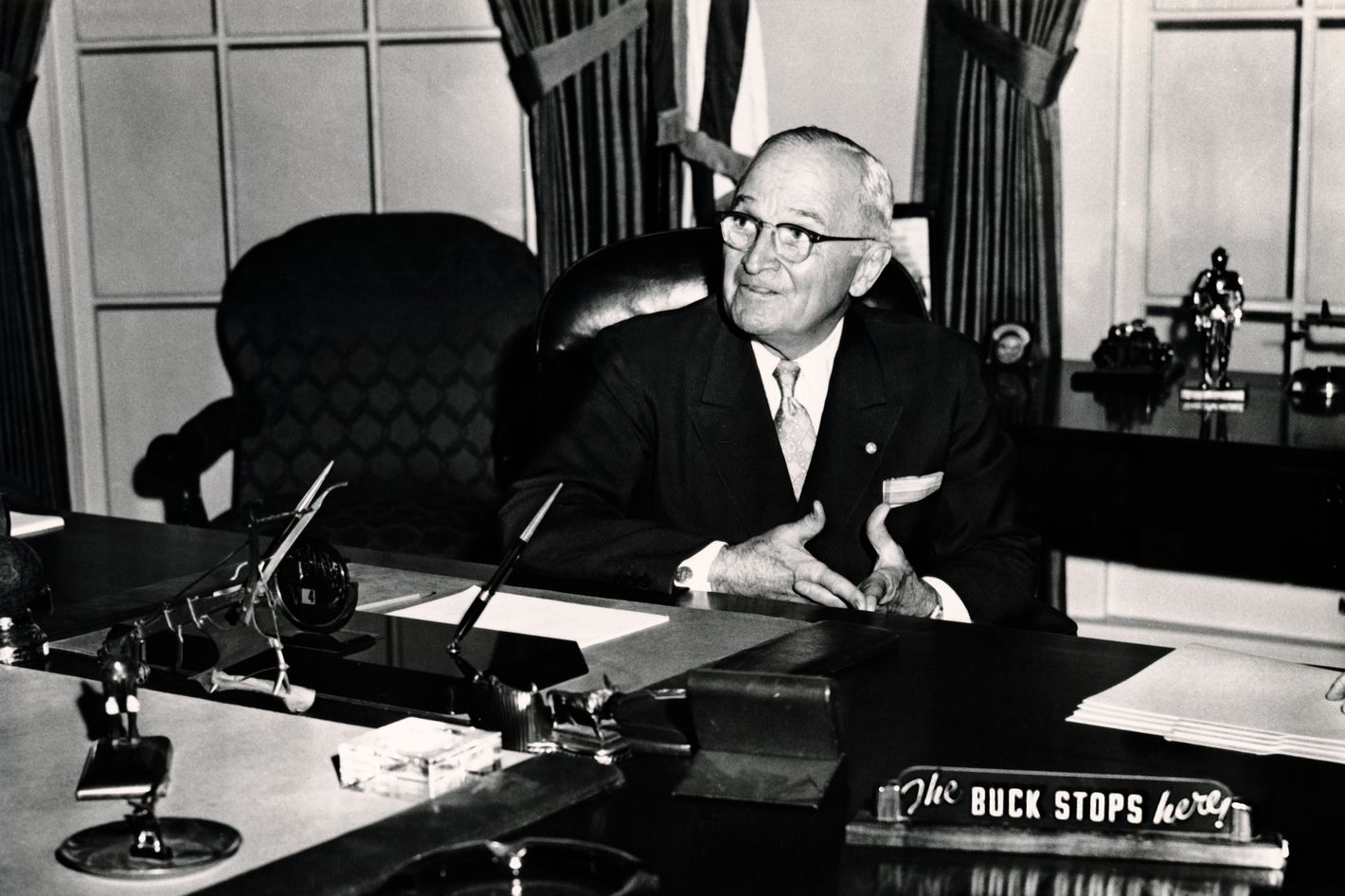
After several unsatisfying bites of banana, I am at another crossroads. Now, I want to go back and grab another fruit. The unknown is the most terrifying effect of choice. Perhaps that is why there has been so many periods of time where people have given up on choice all together. When everything seems bleak, there is an instinct to gift the responsibility and the regret that comes along with it to someone else. Personality driven governments rise because the people believe that a charismatic leader has all the right answers. However, there are times where you cannot shift the blame. President Truman famously had a plaque declaring “The Buck Stops Here” placed on the Resolute Desk. A mere seven months after he took office, he was faced with the most impossible choice of all, whether to drop atomic bombs on Japan. In deciding to go forward with the plan, he set off an unknowable chain of events that would lead to decades of Cold War between the United States and the Soviet Union. Perhaps Japan would have surrendered anyway. Perhaps millions of American soldiers and Japanese civilians would have died during the inevitable land invasion. There is no way to know for sure. That ignorance is haunting.

I think that is why I find time travel so fascinating. It is a device that was made for indecisiveness. If only life could be as easy as picking up a remote control and flipping through the options. But there remains a choice. Even if I knew every possible future, I would still need to make a value judgement on which one was the most worthwhile. I think the critical mistake is thinking that a choice as a definition instead of a fluid thing. Life is a result of continues choices. I can’t just let one stop me in my tracks.