Why do people dress up for Halloween?

On Monday, the Center for Campus Involvement hosted a spooky event in the Ann & Robert H. Lurie Tower on North Campus to recognize the tradition of Halloween. When the clock struck 8pm, the doors opened and so began a night of embarkments on a thrilling 15-minute ascent through the bell tower memorial. Those involved generously dedicated their time to this spectacular project and offered free admittance to UM students.

samhain-festival

This holiday of costumes and candy, ghosts and ghouls, beasts and bonfires originated from the Celtic festival of Samhain dating back nearly 2,000 years. Autumn marked the end of bountiful summer harvest and the onset of a dark winter embodiment of human death. According to Celtic beliefs, the boundary between the living world and the dead world became unclear on October 31st, the eve of the new year on November 1st. They celebrated Samhain by lighting bonfires and dressing in costumes to ward off the ghosts that returned on this haunted evening. Supposedly, the presence of these other worldly spirits allowed Celtic priests, also known as Druids, to make accurate predictions about the future. This history led me to wonder what if spirits really do return to Earth? Since everyone is dressed in character, maybe you are unable to distinguish costumes from true beings. Or what if people like mediums really can communicate with past life to learn about the future? Just some food for thought.

I may not be a Druid, but I would predict that the Center for Campus Involvement will host an event similar to this on a future All Hallows’ Eve based on the turnout for this outstanding performance. Throughout the year, a variety of events such as the upcoming Battle of the Bands, Pixar UMix, and free finals breakfast are made possible by this organization.

History.com Staff. “History of Halloween.” History.com. A&E Television Networks, 2009. Web. 02 Nov. 2016.

Constellations

*Featured image: Setting of “Constellations” – taken from Clarisza Runtung’s Facebook page

The lights dims, a girl and a boy walks through the aisle into the center circle. They are Marianne and Roland, and they tell the story of the two.

Constellations, written by Nick Payne, draws the enchanting life of a girl named Marianne, a physicist and Roland, a beekeeper who thinks she studies “something about space”. They both live in a multiverse – a world where “all decisions you make and don’t make coexist simultaneously”.

The multiverse is a concept of quantum mechanics, where many worlds exist depending on the choices made and actions taken. This interpretation implies that in every world contain a different variation of the life of a person, and the multiverse portrays all possible alternates of the past and the future, existing in parallel. It is described in the play’s accompanying note as many branches of a single tree, and reality is not simply a single footpath.

In many ways, Constellations reminds me of Déjà Vu. This bittersweet fairytale is delivered through various reiterations of the storyline, and the play proceeds to portray one particular course of actions that leads to their relationship and forms their life together. There are many times that Marianne and Roland almost would not have met each other, or would not have known each other, because of the little cues in what they say or their state of mind at the time, or the way they choose to deal with the situation, and their alternate choices would have taken part and existed in another universe. To think about it, the combination of actions that would lead to where they are right now is quite rare.

But Constellations is not just a story of physics. Far from that, it is also a love story. Because through all the randomness of the dice, they learn to live with the present. Even in a multiverse, there is no way to tell if one’s course of actions is better than another, because one does not know what the future will lead to. Every choice you make is the right choice, or that you build it into the right choice, because that is what we do as our responsibility to make us happy. One of the ideas that resonates with me most is the time you have with someone, that there are no more or less time to spend with another person if you learn to appreciate in the present, or to put it in the words of a character from my favorite book – Hazel’s words from The Fault in Our Stars, that even though “some infinities are bigger than other infinities […] I cannot tell you how grateful I am for our little infinity”!


How We Value Art

I think my parents would disown me if I decided to pursue a major in art. Now, this is partially because I possess no artistic talent whatsoever. My drawings mainly consist of stick figures gamboling on some wiggly lines that were supposed to represent hills. I like to imagine myself as undiscovered talent, producing abstract art too intricate to be understood by mere mortals. But the truth is that, even if I was accomplished and brilliant, I would not be encouraged to go into a career in art. It would simply not be economically viable. This is because artistic talent is notoriously fickle and hard to evaluate. It cannot be calculated. Not that people haven’t tried. In 2010, Picasso’s Nude, Green Leaves and Bust, was sold for a record $106.5 million in an auction that lasted a little over 8 minutes. Now, that is conviction! To give a sense of perspective, it took me over 8 minutes to decide that I wanted to purchase some green tea gelato for $4.75. (Author’s note: I would highly recommend to all my readers-now that’s a good joke-to go to Iorio’s Gelatoria on East William)

                 Destruction of Home Tree from the movie, Avatar

Some people have decided that art can only be valuable if it has a definite message. Most, however end up as subtle as a sledgehammer in a china store. Fortunately for the internet, this new goal-oriented art has led to many unintentionally hilarious Oscar speeches over the years. Teary eyed actors and directors declaring to the world that their movie has a higher purpose than even mere art. Now, every movie must have a cause. James Cameron’s Avatar was about saving the environment, all while reveling in slow motion shots of falling trees and tears, and becoming the highest grossing movies of all time. Yum. I love the smell of hypocrisy in the morning. Movies such as this miss the point entirely. It seems that art can only be art when it arouses some unknowable feeling, some unconscious awakening. Something that is much more understated. Picasso, described it as “a lie that makes us realize truth.” The obvious thing to do, then, is to judge it dispassionately, quantify its emotional value with various calculations, and put it up for sale.

The vagueness surrounding how art should be valued is even more complicated by the cultural associations with being an artist. To be an artist, you can never admit that you do anything for money. The idea of art has become so synonymous with deprivation that any sense of practicality is shunned. Art should be done for its own sake. The prophecy is self-fulfilling. Everyone is told that an artist will never make any money. Those who choose to become artists are told that they can only create art if they don’t do it for the money. To be an artist means that not only must you produce something that pleases everyone, it must also sell for millions, while never admitting that you wanted the fame or the money. The muddled definition of how art should be created, prevents it from being created. The barrier is so high that it is expected that those young dreamers who courageously bet on their talent will not succeed, and instead retreat to safer disciplines. Then, perhaps years later, they will spare a glance for that forgotten novel or the unfinished masterpiece, and shake their heads, older and wiser.

No wonder art is so daunting. It must be created in a certain way with the right intentions. It must be about certain subjects. It must surpass a certain profit margin. Yet, these guidelines are directly opposed to the fundamental core of art. The most infuriating and beautiful thing about art is how utterly subjective it is. It will never submit to the rules that we build around it. So, I think I’ll have to be getting back to those stick figures. Who knows? It could be worth millions.

The power of art…and Leonardo DiCaprio

The man on my left shares a Nobel Peace Prize with Al Gore for his work on the Intergovernemental Panel on Climate Change. The two girls on my right share an intense passion for Leonardo DiCaprio. We’re sitting in the front row of the fully packed Keene Theater, waiting for “Before the Flood,” a documentary from Leonardo DiCaprio and director Fisher Stevens, to start playing. Dr. Henry Pollack, the Nobel Peace Prize winner, is here to answer questions after the screening. The girls next to me, aside from being major Leo fans, are here as a requirement for their environment class. I’m here because I’m interested in film, climate change, and, like the girls next to me, Leonardo DiCaprio.
“Before the Flood” documents the journey of DiCaprio as he travels the globe to bring attention to the devastating effects of climate change on our environment. As a United Nations Messenger of Peace, it is his mission to propel the environmental movement forward, and he does so with this documentary.
The audience cringed and scoffed when Donald Trump was shown telling the people at one of his rallies that it was “pretty cold and we needed some global warming right about now.” We shook our heads and laughed sarcastically when a politician said that climate change was the biggest hoax ever created on the American people. We smiled while Leonardo Dicaprio hung out with an orangutan.
The film presented a wide variety of perspectives on climate change. Interviews with astronauts, United Nations meetings, conversations with world leaders, and footage of different lifestyles around the globe were all combined into a 90-minute screening. It was an efficient and effective way to bring attention to the crisis of climate change.
“Before the Flood” provoked an intense passion in me, and I believe that it can do the same in others. Art is a resource that can convey a powerful message to all kinds of people. Whether in the form of a mural, painting, song, or film, artists can capture an audience with their creativity and inspire people. “Before the Flood” is just one example of this, as the convergence of two passions, film and the environment, resulted in a meaningful and relevant message.

(You can stream “Before the Flood” on National Geographic’s website by clicking here …. 10/10 would recommend)

Tomi Ungerer and his Sketchbook

img_1232“The mind, body, and society of men seem fragile containers for violent, centrifugal forces.” This is from the preface, written by Jonathan Miller, to The Underground Sketchbook of Tomi Ungerer. As Miller notes, it is in depicting this force that Ungerer seems to find such artistic potency. The book features drawings of people falling apart or being manipulated by loved ones as if they are but objects. Heads can be screwed off, bodies can be used as vacuums, lamps, yarn for a scarf in the shape of a face, or stitched together with a sewing machine. In these bits of mechanized violence, the inflictor, the aggressor, the woman, the man, all of them have faces empty of any real emotion – they hold the faces of blank indifference much like the manipulated object of a person that lies, sits, stands, beside them.


As Miller states, these drawings may be the result of Tomi Ungerer being a, “derivative of sixty years of modern mechanized warfare. He is the artistic offspring of Passchendaele, Stalingrad, Auschwitz, and Algeria.” But Ungerer is doing more than just pr oducing satire on violence. Instead, the way he depicts these forms of violence suggests something else. This is a parody of the body image. We love our bodies, but to inflict pain to what we hold so dear, is to have absolute power over it. This may take the form of a sadist or a masochist, but either way, the horror is that people are capable of such violence, and have already, for centuries, committed such actions of selfish power.


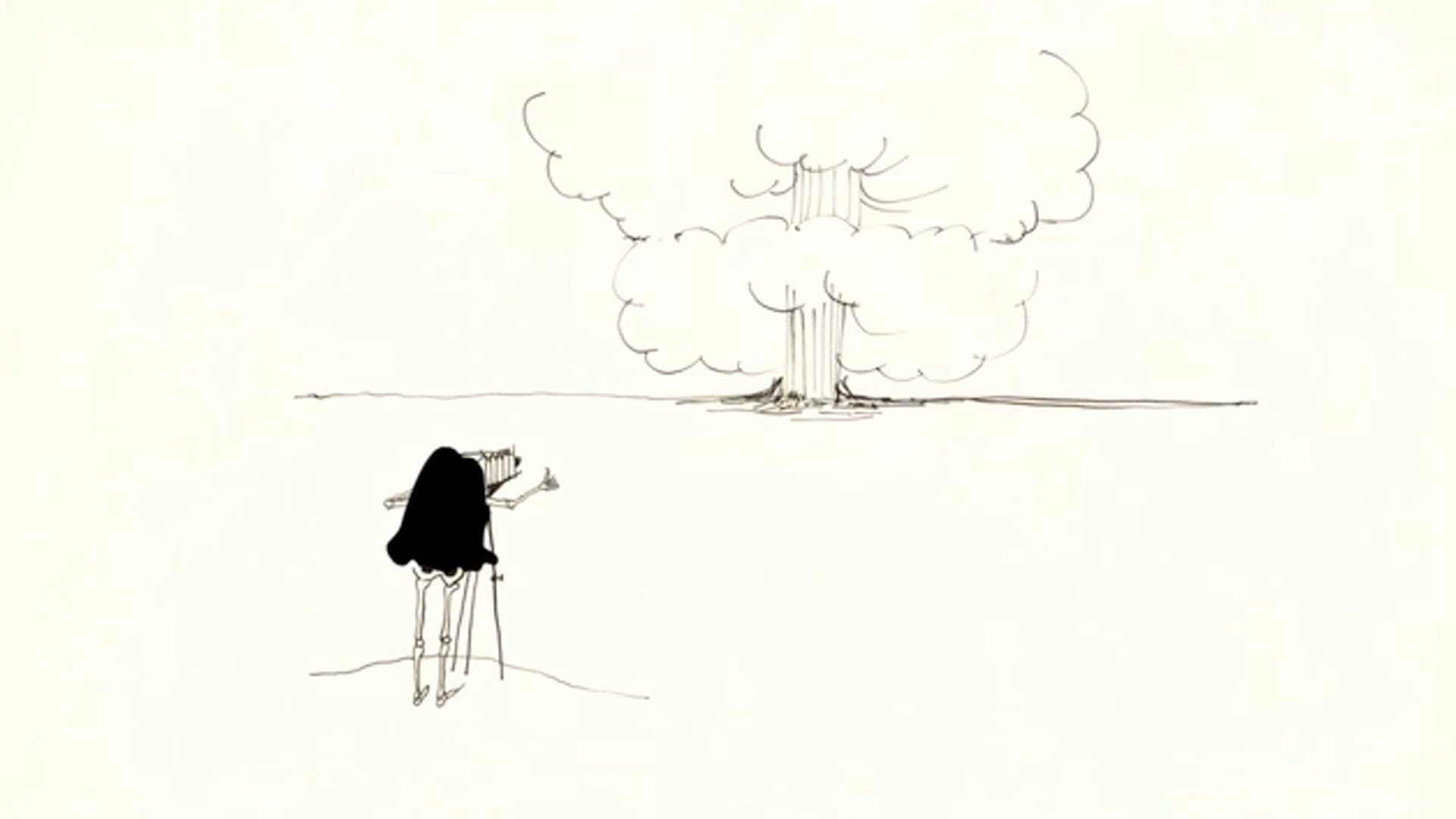
This was the first drawing I saw from the book. I loved it. I loved the line work, how it was able to capture the form of the man, his crooked shoulders, his hunched back, and his contemplative gaze, all with minimal line work. But before I even full realized the form of the drawing, I recognized the one bold black figure in the entirety of the drawing – the bomb and its lit fuse. There appears to be no rush to get rid of the explosive, instead, the man seems to be ready to die. He appears to be stroking the bomb, like a dear object. He holds it with care, as one might hold a wine glass in an incredibly pretentious way. There is no regret – only willingness.

I must admit, I can find no way to spin all of this in a positive light. Perhaps reading Ungerer’s work on children’s books might be the best course to retrieve some optimism. Or perhaps walk away from Ungerer all together. But I’d suggest that that is not the way. I cannot tell you that I relate to where Ungerer is coming from. I’ve never experience war, never been in close proximity, I’ve only gained faint images from the stories my grandpa told me. Even those are not graphic by any means. Perhaps the most haunting bit of war cinema I’ve seen was the John Huston documentary Let There Be Light. However, even that film, with images of soldiers back from the war, physically intact yet mentally broken, will never allow me to get into their headspace fully. So in this particular situation, looking at these drawings by Ungerer, why do I find myself returning to these drawings?

When a child purposely steps on an ant, they may be indifferent to the ant’s pain; however, there is something besides indifference that is present – playfulness. Ungerer is filled to the brim with a playful vigor in the face of horror. It makes me think, whether or not playfulness is that far removed from indifference, or even, being unaware.
However, perhaps there is a victory that can be discovered, in treading the lines of indifferent violence, and finding humor in it. After all, comedy is formed out of tragedy. We just need, to dive into the grave, and emerge with a bone to chew on.


How Peter Jackson cost me my job in New Zealand and other topics non-relevant to human existence.

“Are you crazy? You could have been killed.”, Lee said. She was like my mum, just without the nice bits. She yelled at me but then didn’t give me ice cream to make up for it. She judged me but then wasn’t proud of me ever – or at least I felt that way.
“I’m not going to let my employees be killed just because they are a couple of bloody battlers.”
Oh yeah, and she was Australian which made everything she said sound cute rather than the tone she was going for – in this case threatening.
“I’m being serious! This is no laughing matter! I will fire you if that’s what it takes to protect you from your own baboonery.”
What upset her so much, you ask? Good question. I will take you back in time and tell you the whole story, which eventually led to my dismissal from my first real job. But since it’s quite long, I’m not going to tell it to you all at once but rather piece by piece. Every week I’ll give you one more chunk of the story and believe you me, it’s worth hanging around for.

So how did I loose that job? And what kind of job was it to begin with? Well, lean back and enjoy hearing about my  misery, because if there’s anything I’ve learned in the past months, it is that there is no topic people like to read about more, than other peoples’ misery. Don’t feel bad about that, it’s human. Let’s dive right in:

So it all started back home in Germany when I watched “The Lord of the Rings”. What a great movie! And since it is basically a ten hour tourism commercial for New Zealand, I was dead set on flying over to Kiwi Island and exploring all the places where the movies had been filmed, overlooking vast landscapes Legolas had once overlooked and sitting on trees until they started carrying me around. Isn’t that a great idea? Well let me give you the answer: No!

Don’t get me wrong, New Zealand is a magnificent country and I didn’t regret spending one year of my life there at all, but to go there to check out LOTR places… Might be slightly disappointing. You might now expect the main issue to be, that the places weren’t as cool in reality as they seemed to be in the movies, or something like that. But that’s not the reason for my disappointment. The places looked great from afar but I couldn’t actually get close. It seemed like the entire movie series had been shot on private property.  Many places I couldn’t get into even if I was willing to pay money for it.

Some places on the other hand did take my money and a lot of it, too. How much? Let’s just say the prices weren’t as low as everything else in this place. Get it? No? Ok, what about this one: I wouldn’t have paid this much for a first, second and third breakfast combined. Still nothing? I just wish my wallet would have been as big as their feet but less hairy. I’m sure you know by now where my really bad puns (can you even call that puns) are going: I paid $50 to be chased through the masses of tourists in Hobbiton, by a tour guide so old, he could have been part of Elrond’s Council for all I know. When I saw a boy who was about as wide as he was short, sitting in a wheelbarrow for a picture, next to a pumpkin which looked alarmingly like him, I thought to myself that the Hobbits would have hated this. Strangers coming to their shire and taking pictures, talking, being noisy and annoying… That was not the Hobbit way of doing things and it wasn’t the Marius way either. My visit to Hobbiton did result in a couple of decent pictures, though:

1375900_202509169930488_2098910228_n 1233338_202509296597142_687893422_n 1234947_202509276597144_660403267_n

Long story short: I didn’t purposely go to other LOTR places after this unfortunate incident, but I did see a few along the very long way still ahead of me. And since we received a complimentary drink at the Green Dragon, Hobbiton wasn’t such a waste of money after all.

All of this happened within the first week of having my new job, my first job, a job I would only have for a few more weeks… A job that had surprisingly much in common with Harry Potter, but more on that next week.

I feel like I drifted off topic a bit. Guys, I think I might do that occasionally while telling you this story, I hope you won’t mind.

See you next week and remember to be the weirdest you can possibly be.


PS: Weird people are cool and, by the way, my name is Marius, I’m a German communication major, bla bla bla… nobody cares about this stuff anyway. Cya!