Of Music and Motivation

Raise a hand if you’re a second-semester senior.

Via gyphy.com

Having been accepted to a grad school for the fall term already, FINALLY understanding the treasures and trappings of Netflix, and umm…well, kinda just being burnt out, I’ve been going through some really tough roller coaster rides this semester of high energy studying and frankly, a whole lot of lethargic laziness. A part of me thinks, “I’m in next year, I’ve got a plan. Why does any of this matter anymore?” but my studious, energetic and generally curious side says, “But the things you’re learning are AWESOME! You’ve come to this far and have done SO well!! Don’t give up yet! You’re almost at the finish line!”

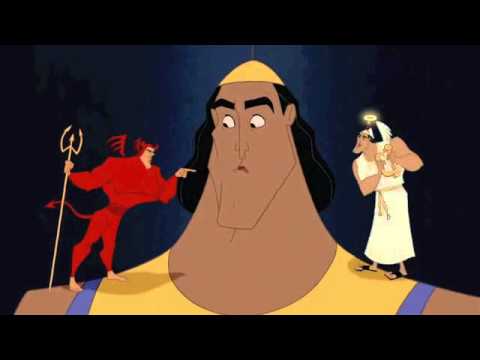
With the angel and devil always weighing down your shoulders and yapping at you, how can you ever do your homework?

Image via youtube.com

I think I have found the solution.

I recently came across the theme song to the video game, Dragon Age: Inquisition. Never playing the game before, I heard the main theme serendipitously on Spotify and felt a rush of sheer invincibility. Imagine the energy of the huns flooding over the mountain in Mulan, the pride of explorers crying Land Ho for the first time, a marathon winner breaking the ribbon at the finish line, and the power of a space shuttle blasting successfully into space, and that’s how I felt as I listened to Trevor Morris’ anthem.

Instantly, after the song, I felt like I could do anything, lift anything, achieve anything, ace anything. I decided to go on a quest to seek out more songs that would give me this sort of feeling. Maybe if I tricked my brain into thinking I could focus and DO ANYTHING (including my homework), I might actually be able to DO IT! The name of my playlist would obviously and aptly be titled: You Can Do Anything! That’s right: I believe in the power of words 🙂

And maybe, we should start believing in the power of music. As Christopher Bergland says in Psychology Today, “music and mood are inherently bound.” He says that “you can dial up a mood, mindset or perception on demand by choosing music that elicits a specific emotional response in you,” whether it’s for athletic benefits , studying purposes, for road trip boredom busting, or to create a certain vibe to match your day.

Image via youtube.com

When choosing your own Motivational Music playlist, keep it authentic and from your soul. So what if you have a song that you might be embarrassed if someone knew you were listening to it? A) You never should have to defend or feel bad about why something resonates with you. And B) That’s why Spotify: Private Session was invented.

Though everyone’s playlist will be different due to personal tastes and styles and motivational needs, I’ll share mine as an example. Because my playlist is for studying purposes, I went with an instrumental theme.

Cammie’s YOU CAN DO ANYTHING playlist!

I’m making no promises that these songs will motivate you as they have done to me. All I know is that I have accomplished a lot already thanks to this playlist and the wonderful musicians who have made music to make my heart soar, my typing fingers fly, and my body feel as if I had the strength of 10 Grinches plus 2. Happy playlist-making and cheers to productivity!

* Next time you’re listening to music, put it on shuffle! Did you know that the randomness of not knowing what song is going to play next actually increases the brain’s levels of Dopamine, your feel-good chemical? It’s time to get happy!

Pushing Daisies S01 E06: Bitches

Summary:

We start again in a flashback to Ned’s boarding school. It is bedtime, but Ned is awake. He is playing with homemade clay dolls of the people back home, but Ned learns that he can no longer imagine. He looks at the moon, while child Chuck looks at it too back at home. We then transition back to the present with Ned waking up and watching Chuck sleeping. Chuck also wakes up and while trying to get up, slips and falls on top of Ned. Chuck surprisingly doesn’t die again. This leads to Ned and Chuck making out and undressing. Chuck then pulls off her skin to reveal Olive underneath. Ned wakes up in fright from his nightmare.

Ned and Emerson are having a conversation in the Pie Hole and Emerson explains that dreams don’t mean anything. Ned, still concerned about the kiss with Olive at the end of the last episode, confides in Emerson. He suggests to Ned that Olive has feelings for him. This distresses Ned even further which delights Emerson.

We then move over the conversation shared between Olive and Chuck. Olive confesses the kiss to Chuck which Ned didn’t mention to her. This upsets Olive , now realizing that the kiss wasn’t worth mentioning. Chuck explains that she and Ned never touch. Chuck says that it’s allergy in order to keep Ned’s secret.

In a scene change, we find dog breeder Harold Hardin dying. Narration explains that his almond flavored coffee was poisoned and after realizing this, Harold spills it on the ground. This causes him to slip and fall on the sharp end of a brush, multiple times. The Kennel Club offers a reward for catching the murderer. Emerson, Ned, and Chuck head to the morgue and find out that Harold’s wife gave him the coffee. Nothing is so simple though, as Emerson learns that Harold actually had four wives: Hillary, Heather, Simone, and Hallie.

At the Pie Hole we see Ned avoiding a conversation with Olive about their kiss. Ned also tries to avoid letting her help with the investigation, but Emerson thinks it is a good idea. Each person (Ned, Emerson, Chuck, and Olive) will visit a different wife to ask questions about the murder of Harold.

Through narration we learn the different occupations and personalities of the three wives: Hillary owns a boutique dog clothing store and is generally happy, but might snap if surprised or ridiculed; Heather is a pet psychologist though we don’t learn much else; Simone is a dog obedience teacher with a strong hunting instinct, like the Jack Russell Terriers she trains; and Hallie breeds seeing-eye dogs and much like her labradors, she loyal but competitively obedient.

Olive goes to visit Hillary, Ned visits Heather, Emerson goes to Simone, and Chuck sees Hallie. Through the investigations of Olive, Chuck, and Emerson, we learn of Bubblegum, the perfectly bred dog that Harold crafted. We also learn a little of Olive’s backstory and how she got to the Pie Hole. Simone says that Bubblegum died after she backed up over him after hearing of Harold’s death. Meanwhile, Ned gets some relationship advice from the mourning Heather. Through further conversation we come to realize that Simone and Harold had a mostly business relationship and all four wives gave Harold coffee that morning.

At the Pie Hole, the wives appear and confront the four. Before they can talk, Emerson asks who gave Harold the almond creamer and we learn that it was Hallie. After she is arrested, Chuck and Ned still believe that she is innocent.They go to visit her in prison and find out that she believes that Snuppy (a rival dog breeder) had killed Harold for Bubblegum.

Meanwhile, at the office of Snuppy, Ned and Chuck discuss the kiss. Chuck sees the possible benefit in polygamy in situations like theirs. Both of them want physical contact, but can’t have it and she believes that sometimes it is okay to hold someone else’s hand, or kiss someone else. Just then, Snuppy enters and we learn that he is the legal owner of Bubblegum against Harold’s wives’ wishes. He plans on cloning Bubblegum from his DNA.

Emerson goes to visit Simone and she also believes that Snuppy is the perpetrator. Emerson believes it was actually Simone, angry that she wouldn’t see any of the money from Bubblegum. Emerson leaves and takes a nap. In his dream state, he realizes that Bubblegum’s collar has moved everytime that he visited Simone and that the dog is still alive. We also learn that Emerson might be falling for Simone.

Ned once again avoids the kiss conversation with Olive and she is clearly upset. Hillary comes to the Pie Hole and Olive reveals to her that Bubblegum can still be cloned from the ashes.

Meanwhile, Emerson confronts Simone yet again and she reveals that she actually has Bubblegum hidden. But she knocks out Emerson before he can ask more. Emerson wakes up bound and Simone reveals that she believes Emerson was actually hired by Snuppy to find the real Bubblegum. This is of course false and across town, we find a dead Snuppy.

In an attempt to sniff out the murderer, The trio bring Snuppy’s body to the funeral to see who will be most shocked by the recently reawakened body. Hillary sees Snuppy alive and starts to run. Ned fortunately catches her. Through narration, we learn the motive: Hillary had never liked polygamy, but adored Bubblegum. When she found out he was going to be cloned, she was angry that Bubblegum would no longer be the only one of its breed. In order to avoid this, she killed Harold and attempted to frame Hallie. She then killed Snuppy, not knowing that Bubblegum was still alive and Snuppy only had a rat’s ashes.

Ned apologizes to Olive and she admits that she wants Chuck and Ned to work out. She only wants Ned to be happy.

Pros:

-Emerson and Simone’s relationship was one of the highlights of this episode. They worked well together as opposite sides of the same coin.

-The other highlight was Olive again. Kristin Chenowith is an amazing performer and it shines through in this episode.

-The mystery was clever and an easy one to follow along.

-Finally hearing Olive’s backstory was great.

– A surprisingly positive portrayal of polygamy as both the narrator and Chuck defend it as real love.

Cons:

-I wish we could have actually seen and not heard Olive’s backstory.

-The mystery did not leave enough clues in the beginning to implicate the murder, it seems to come from left field (though this is somewhat common in the show).

-I love the clever use of dog breeds as metaphors for the personalities of the wives.

Overall:

This was good episode. Not one of the best, but it is a great showcase for the talents of Chi McBrinde and Krisitn Chenowith. This episode only leaves me wanting more from them. The issue of the kiss throughout the narrative is also great as it explores another aspect of Ned and Chuck’s rekationship, rather than leaving it stagnant. It was greatly built up in the last few episodes. This episode provides some relief to the problem, but it does not solve it. It makes the relationship seem much more realistic.

Rating:

7/10 Daisies
Learning How to Breathe

We are all born knowing how to breathe. It’s simple and the moment life begins our nervous system takes over and begins to tell us “inhale, exhale” so quietly that we forget we were ever listening. Even in the moments that take our breathe away we are reminded “inhale, exhale, inhale, exhale”. After a sudden grab of your shoulder or a noise in the darkness “inhale, exhale, inhale”. So how is it that something so natural and so practiced can be so hard?

A singer is only as good as their last breath and lately, the breaths that I have been taking have been shallows gasps desperate for life instead of expansive, “let it all go” breaths that feel like the obvious eventuality, sucking in fresh air without any effort at all. Like most areas of my life, I’m overthinking it. Worried I am not doing enough, I work harder and harder to get a good breath, a counterproductive effort resulting in the tighten up of each and every muscles in my body and pushing through the air rather than allowing it to flow through me.

So why is it so hard? Why can I not simply do less and allow my body to do what it has done for the past 22 years and simply breathe?

Part of it must be mental. The subconscious belief that art is pain, suffering and determination against all odds. That for true artistry to exist one must be on the brink of emotional and physical distress. The misguided belief that Alexandria, just as she is with no frills or fancy footwork, is good enough and strong enough in her technique to simply breathe, engage and sing. The rest then must be a learned habit developed over time. Ingrained in me during hours in the practice room and established as a new normal during performance.

If I am to survive as a singer, as an artist and a human being I must learn to breathe properly. To let it all go so that I can begin anew and to not push when I get to the end, but trust that my technique will support me, is terrifying in all regards but necessary if I wish to move forward. After all, how hard could it be? If I could do it when I was just a few days old why not now?

Why Do You Color?

Yeah I did it. I caved. I got an adult coloring book.

I mean, it’s not like I didn’t want one. My roommate has 6 and counting, and loves to take it out whenever possible. It’s her go-to stress reliever….and I’m often jealous.

But then I’d remind myself that it costs money, that I’d have to buy colored pencils, that I won’t have time and it’ll be a waste of money. And then last weekend, those excuses disappeared as I stood in front of the table at Literati.

Then, all I could think was which one should I get? So I did it. I caved. I had some gift money left over from a return purchase, and I had an Amazon gift card. So I did it. I got an adult coloring book.

The whole idea of adult coloring books intrigues me a lot though. When I was little, I wasn’t a huge fan of coloring. I liked doing crafts more, something where I could be a little freer. And I think, truthfully, I didn’t have the patience for coloring. Even though you can’t really be bad at coloring (and anyone who says otherwise is lying), I wasn’t ever any good at art.

I don’t talk much about art, as in painting, drawing, sketching, molding – anything in that realm, because I’m not good at it. It’s hard to enjoy something when you’re so frustrated with yourself. I’m a dreamer. I imagine things. And when the imagination doesn’t match up with reality, I’m upset. Why am I not good enough?

That doesn’t stop me from roaming around museums and letting my mind wander. Trust me, I do love art. I had to pry myself away from the Louvre this summer, and I had really only seen barely half of it.

Even so, this side of me, the artistic one, doesn’t really come out very often. I do love art, and I certainly respect and appreciate it, but I don’t do it, so I don’t talk about it very much.

But then these coloring books. Studies show that coloring is a good stress reliever. You put any adult in a classroom full of kids, and put in one coloring station and you’ll see the results of that. When working in childcare I honestly loved to color with the kids. In large classrooms, it can be hard to interact with children playing blocks, making their own towers, or zooming around with a little firetruck clutched in their fists. They’re often in their own world, or in the worlds of their peers, and as an adult it can be challenging to enter that world, even as their teacher. But coloring is a way to connect. You can ask the kids what their favorite color is, how their week at school was, what they like to do for fun at home. All the while, you’re sitting (or squatting, if you aren’t four years old) at a desk, with a pretty picture to take home.

I find adult coloring books interesting because of these two things: the connection with art, and the connection with childhood. Maybe it’s a bit strange to have an adult color, or maybe it’s the most obvious thing in the world. Maybe it’s good to have an artistic outlet, or maybe it’s nice just to relax.

Whatever the reason you color (if you do), keep coloring.

The Gift of Friendship

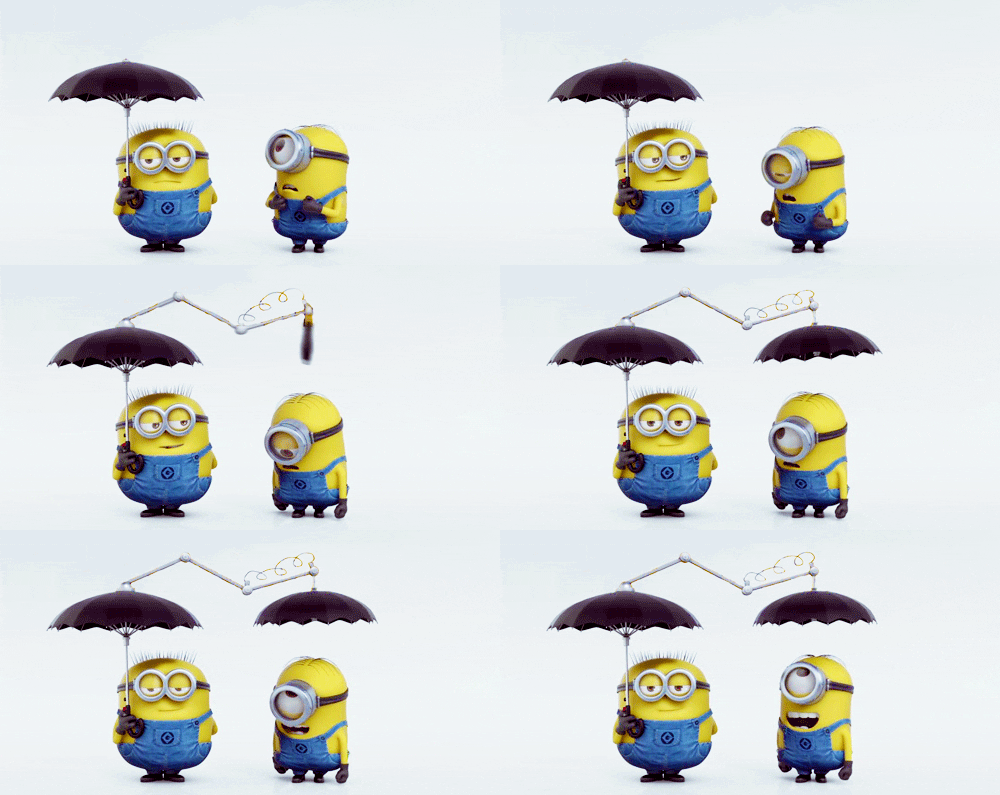
Two minions stand in an open space. One has an umbrella and the other doesn't. The one without the umbrella looks sad, so the one with the umbrella pushes a button and another umbrella pops out of the first to cover the sad minion.

It’s my senior year, and while I’ve lost a lot of friends and gained a lot of friends throughout my existence, it feels strange knowing that the end of this year will mark another time in my life that friends will purposely leave and enter. I’m not upset about that—it’s only life, but because of this, I’ve been thinking about my friends a lot lately.

As it happens, today is Facebook’s 12th birthday, and apparently they’ve been thinking about friendships, too. In an emotionally charged compilation of pictures, Facebook came up with a campaign to showcase social networks, AKA friends. And thus, #friendsday began.

When I went to check out my video, I wasn’t sure if I’d like it. As I said, I’ve been considering my friendships a lot lately and I was a little nervous to see what Facebook thought about the people I surround myself with. I loved my video, though. It showed me people I care about and the moments that I shared with them. And even though I’m not as close with some of those people, or I don’t get to see them as much, I’m still glad they were in my video. Every friendship I’ve ever had has helped me become who I am, and Facebook’s #friendsday video showed a little part of that.

New Girl's Jessica Day scratches Schmidt's back while Schmidt says,

My mom once told me, “friends are like elevators. They can bring you up, or they can take you down.” Now, okay, my mom told me that when my two friends from middle school and I skipped a free ACT prep class to go to 7/11 and Rite Aid and she was trying to explain peer pressure and how friends can affect actions, but that’s not all that sentence can mean. It can be so much more.

Good friends can bring you up and hold you there in a warm hug of love and affection. They can encourage you to shoot for the stars and make you feel good about yourself and most everything you do. They’ll tell you to do things because they know what will make you better and make you happy. They’ll support you and tell you when you’re being an idiot in the best way possible. And, they’ll laugh with you until your sides hurt and eat grilled cheese with you at three in the morning just because you had a craving. These friends are good friends.

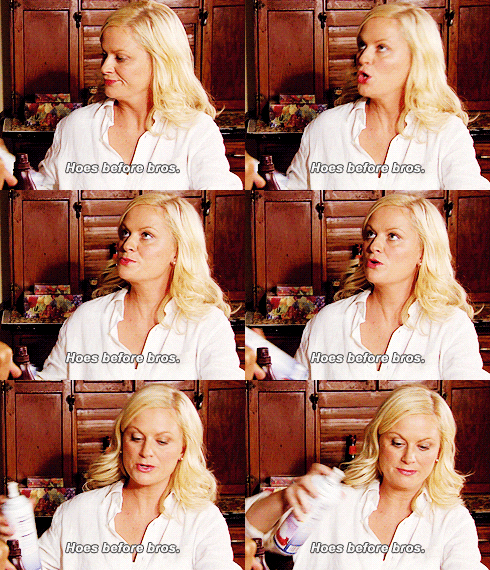
Amy Poehler's Parks and Recreation character Leslie Knope shakes whipped cream and says, "hoes before bros."

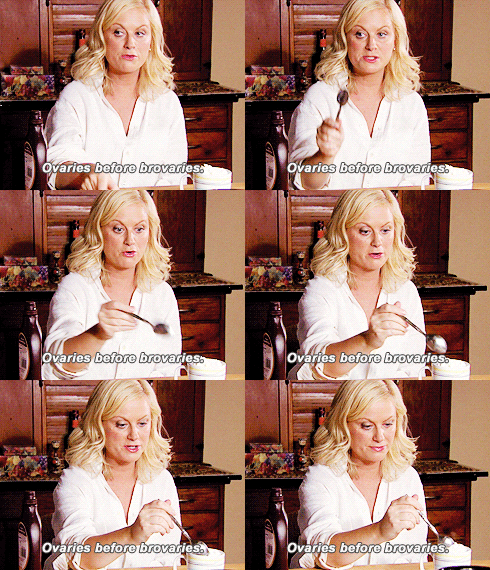
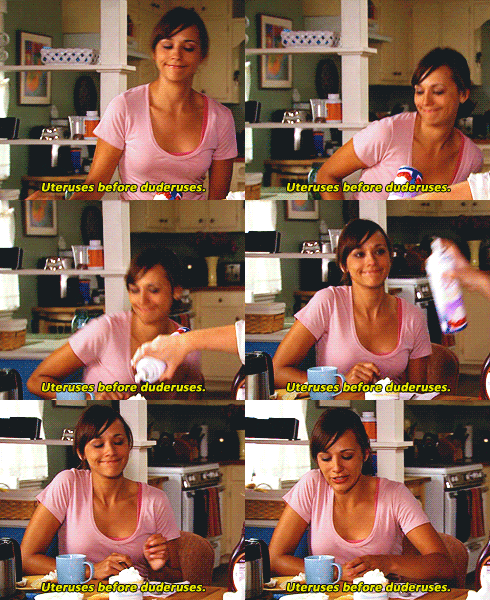
Amy Poehler's Parks and Recreation character Leslie Knope says, "ovaries before brovaries." Parks and Recreation's Ann Perkins sits down while Leslie Knope says, "uteruses before duderuses."

Bad friends, on the other hand, can drag you down to the depths of despair. They can make you anxious and stressed out. They can make you feel worthless and uneasy, like your goals are pointless and shouldn’t be reached for. They can do rude or obnoxious things to you that make you question why you would be friends with them in the first place. Here’s a hint: you’re not. Drop. Those. Friends.

Everyone deserves to have good friends who bring you to the top floor of the Empire State Building. Yep, that’s right, I’m sticking with the weird elevator thing. So, if you find yourself being lowered to some dark and stinky basement by your “friends”, just know that you don’t have to get off the elevator with them. Say good bye and find the people who really care about you. Believe me, they’re out there waiting to journey skyward.

Acknowledging the Flaws of Harry Potter

I am part of the Harry Potter generation, the generation of kids for whom Harry Potter was a formative experience. Harry Potter’s influence has obviously been massive, to the point that it’s its own culture. It transcends art—reading the books isn’t really like reading a book, it’s like being in another dimension, and even watching the movies is the same just because they’re so inextricably tied to the books. Words like ‘Gryffindor’ and ‘Voldemort’ are so familiar that when I hear somebody mention them in public, I don’t think Hey, they’re mentioning my favorite books! I don’t think anything, really. They’re just words that have somehow entered the cultural canon as comfortably as any other name.

And personally, I feel totally shaped by Harry Potter. I respect so much about J.K. Rowling, personally and professionally. Somehow, she created a world. To attain her level of fame and wealth is impressive to begin with, but to attain her level of influence on children everywhere is incredible. And yes, adults love the series too—I just think it’s particularly amazing that she could shape so many young minds. I was one of those minds, and I will always love every book, every character, every word of Harry Potter.

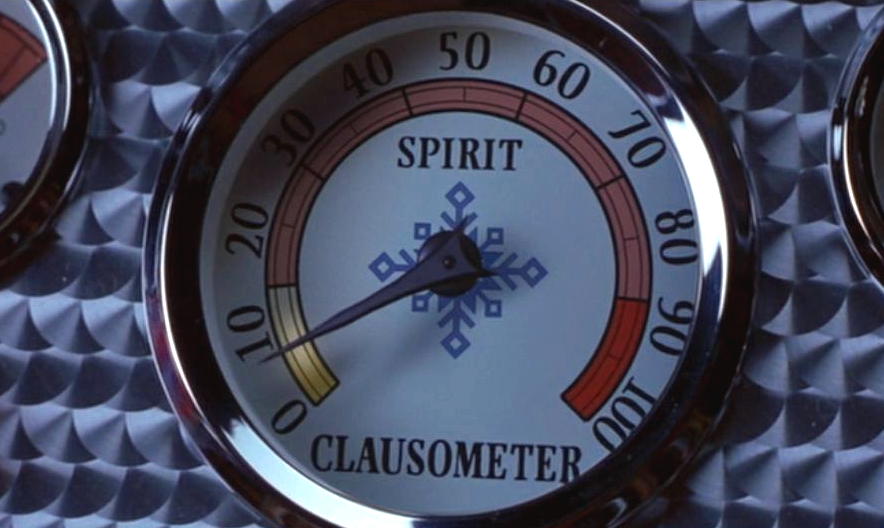
But I’ve always believed that you can criticize the things you love, just like you can like pieces of things you hate. “Elf” was my first favorite movie, and looking back at it now, I find the climax a little problematic. Sure, the scene with Jovie singing to the crowd of people is great, and Walter Hobbs saving the Clausometer by finally joining in is brilliant. The celebration of Christmas cheer is a great thing to focus on, but isn’t it a little cheap that Michael has to get the Clausometer kick-started by blatantly revealing Santa’s list on live TV? The whole point of faith is that you have some internal compulsion to believe. It’s based on your intrinsic belief, not proof. By revealing Santa’s list, Michael isn’t asking people to believe in something they can’t see; he’s forcing them to see the truth. And that’s not as powerful.

But “Elf” still might be my favorite movie, and that thematic flaw doesn’t come anywhere close to undoing the countless laughs, the tear-jerking moments, Will Ferrell’s hilarious performance, and the overwhelming Christmas cheer it instills in me whenever I watch it.

And I feel the same way about Harry Potter. It holds a special place in my heart and can never be tarnished, but I think it has some problems. And I think it’s okay to acknowledge that.

Starting with the first book, the Sorting Hat…doesn’t make a lot of sense when you think about it. By itself, it’s a pretty cool little idea, but does it really make sense to try to categorize people that way in real life? Pretty much everyone I know would be either a Ravenclaw or a Hufflepuff. Maybe a Gryffindor or Slytherin every once in a while, but kindness, loyalty, and intelligence are more visible and common than bravery and cunning. It’s kind of hard to think of anyone I know as ‘brave’—I mean, yeah, there’s casual everyday bravery, but the characters in Harry Potter were able to more easily show their bravery when facing magical death every day.

And let’s be honest: as much as J.K. Rowling and many fans might defend Hufflepuff and Slytherin, they really are the boring house and the evil house, respectively. Claiming that Nymphadora Tonks is a Hufflepuff doesn’t really redeem the severe shortage of characters that the house has, and seriously, it’s hard to say that Slytherin’s defining characteristic is ‘cunning’ or ‘ambitious’ when almost all of them seem to be racist traitor Dark Lord sympathizers. J.K. had plenty of opportunities to make Slytherin more of a morally gray house (she helped a little bit by making Peter Pettigrew a Gryffindor). If Sirius Black had been a Slytherin like the rest of the Blacks, he could’ve been a great example of a good guy Slytherin. But not enough was done to make Slytherin more than the House of Dicks.

Speaking of moral relativism…let’s talk about Snape. Let’s be clear: I love the character. I think he’s the most morally gray character in the series. But J.K. does stumble a little bit at the end of The Deathly Hallows in glorifying him by having Harry name his son after him when there were many more trustworthy, loving people he could’ve chosen (Hagrid, Lupin, etc.). J.K. confirmed in a series of tweets that she was aware of Snape’s bitterness and the horrible way he projected his hatred of James onto his son, but she explained it this way: “Snape died for Harry out of love for Lily. Harry paid him tribute in forgiveness and gratitude. There’s a whole essay in why Harry gave his son Snape’s name, but the decision goes to the heart of who Harry was, post-war. In honoring Snape, Harry hoped in his heart that he too would be forgiven. The deaths at the Battle of Hogwarts would haunt him forever.” Honestly, it’s a great explanation, and explains a lot. I’d totally embrace it…if it had actually been implied in the book. Unfortunately, in the book, we never get to see Harry struggling with post-war guilt. As far as we can see, Harry is honoring two men who continually withheld information from him and behaved selfishly.

Speaking of which, that’s a thing J.K. does a lot: talk about the future for these characters. I didn’t really mind the epilogue of the last book (though it’s unnecessary) because this is the kind of series where it’s okay to skip forward and show a much-deserved happily ever after, but I’m not a fan of the way she still talks about the characters’ futures after the fact. John Green has spoken about this before—the author isn’t necessarily allowed to say what happens to the characters after the events of the book, because that’s not part of the contained story of the series. Just like John simply didn’t know whether Hazel Grace Lancaster dies after The Fault in Our Stars, J.K. isn’t necessarily allowed to just say that George grows up, has a baby with Angelina Johnson, and names him Fred. I also don’t like how she just claims that Harry is an Auror, and Hermione works for the Ministry. If it came out in the epilogue, that’s fine, but it’s unnecessary to draw out this elaborate future for every character outside of the story itself.

In fact, most of my problems have to do with the story’s conclusion. The idea of the Deathly Hallows is super cool, but if you think about it, it’s pretty unsatisfying that the villain’s inevitable demise happens because of a logical fallacy involving who a wand’s owner is. J.K. made Horcruxes feel integral to the plot by setting them up in the previous book (and laying clues throughout the series), but the Elder Wand is something we couldn’t have anticipated playing a role in Voldemort’s death.

Like I said, most of these problems barely affected my reading of it, maybe partly because I was a kid who didn’t understand narrative like I do now. Maybe if I was reading it for the first time now, I’d love it, but I’d be a little let down by the end. It’s hard to tell. But my ultimate point is that it’s okay to acknowledge that everything has flaws, even the stories you love the most. Nothing is perfect. Not even Harry Potter.