
Sewing is No Joke

Fashion has a reputation for being a bit vapid and arbitrary. I mean how can something I wore last week become outdated this week? I will never understand that but I now have some understand of how difficult it is to make some of the things that come down the runway. I learned my lesson through practice. This past summer I worked for a Renaissance festival  and had to create my own pirate garb. It cost me much in the way of money and emotional turmoil. I was given a basic outline of what I’d need to do so that my costume looked period and was held responsible for its creation.
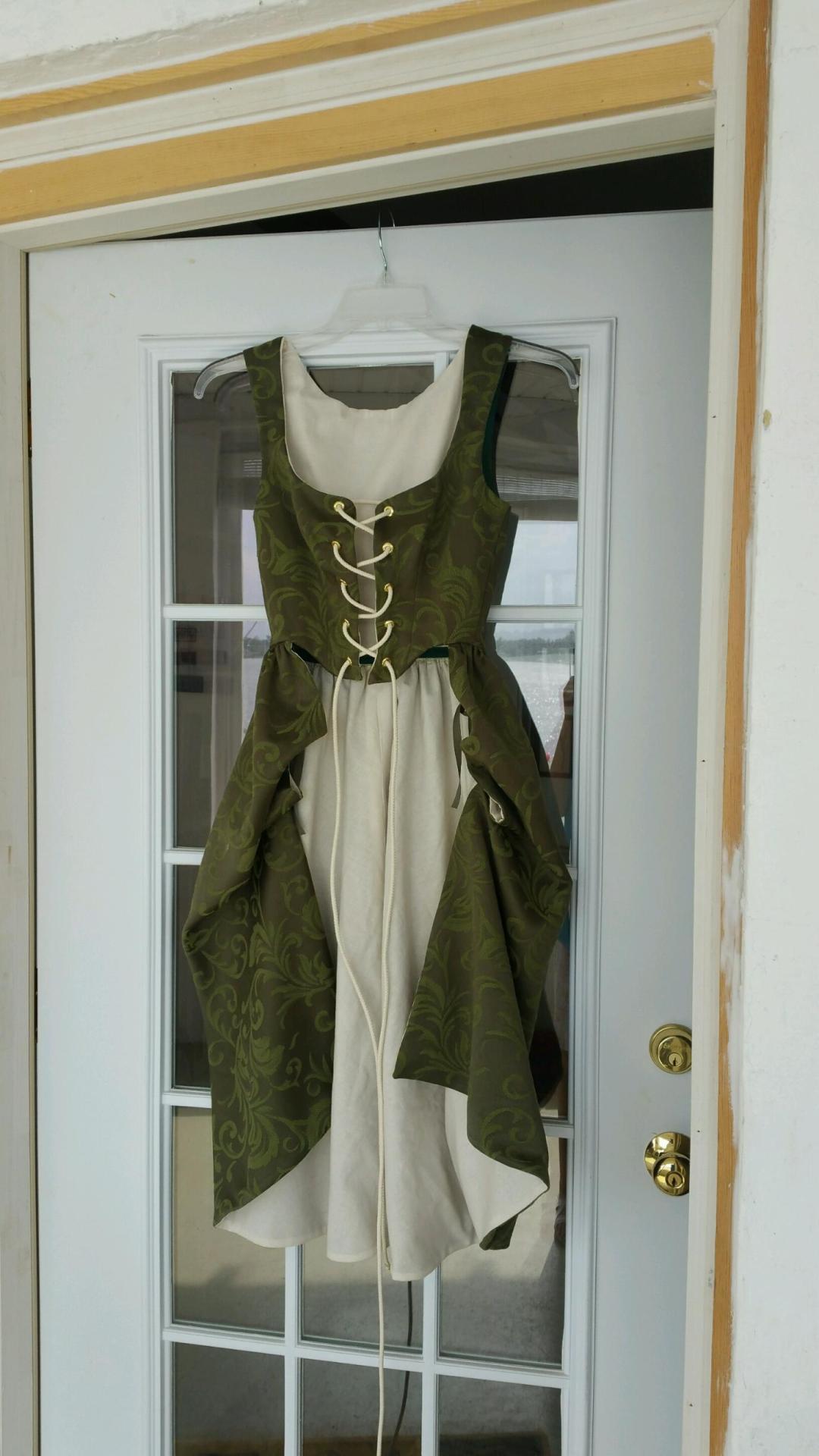


I have been involved in many different art disciplines including metal working, ceramics,and drawing, but I have never been so distraught as when I attempt to sew. Proportionally I have realized that when putting together clothing very little of your time is actually the sewing part. The better part of my time was spent in cutting my upholstery grade fabric. The fabric I was using cost $15 a yard, meaning any kind of mistake that ruined the fabric would be a costly one. I, of course, had a very slippery fabric which made every moment of cutting anxiety inducing as the fabric would try to slither away from my shears. This also required a lot of space, meaning I was laying on the floor with yards of fabric unrolled as I attempted to cut straight lines and not cut the carpet. The whole process didn’t get any easier once I’d finish cutting my pieces.

Then I got to the actual sewing part. Which took a lot of machine prep in treading the machine with the proper color while making sure the machine was clean and ready to use. Then came the actual sewing. Sewing is more a balancing act than I imagined. I had to guide the fabric I was sewing through the machine with my right hand, careful to keep everything even, while holding the weight of the fabric in my left hand. Because my project was so big the weight of the fabric would try to pull the fabric away from the needle making uneven edges. All while controlling the speed of the machine with my foot. On occasion I would have to rip out entire lines of work and redo them due to attaching the wrong sides, running out of thread, or just plane old sloppy lines that I wouldn’t be able to live with. What you might not know is that not all sewing can be done on a machine. I didn’t know this either. I had a few boarders of color that required me to hand sew all the finishing touches.

Now that I had the majority of the work done, I still had more finishings to do. For my bodice I had grommet the front so I would have a way to lace it closed. This involved cutting tiny holes in the fabric to then hammer down metal circles that would be used for lacing. Relatively speaking it didn’t take very long to do, but by that time I was so ready to be done with the project.

At the end of a very long few weeks I had completed my bodice for renaissance festival. The sad part was after all those hours of sewing, and poking myself with pins (I literally bled for this) my garb was a size too small. Somehow I had miscalculated my size creating a bodice that wouldn’t close. I tried for several times to wear it but ended up pulling the grommets out. I wanted to cry. Thankfully, my mother was able to salvage the piece by adding an extra panel to the front to finish it.

After  creating a relatively simple outfit from scratch I have a new found understanding and respect for fashion. It is not easy to get pieces to line up and execute a vision, I couldn’t even manage to make the right size, yet designers somehow do it time and time again.

The Psychology of Fictional Characters: Why You Should Give Your Protagonist a Personality Test

As I sit here today, grading the fabulous work of my first year students from the one-credit Honors Seminar I’ve been teaching this semester, I can’t help but think of the origins of the unique activity that I have assigned them and that they have indeed excelled in the highest degree.

It all started two summers ago as I traveled through highways lined with enough soybeans to fill a hundred Silk cartons, and rows and rows of corn. No, I was not on a quest to find the best farmland in America. I was making a pilgrimage to University of Iowa’s Summer Writing Festival. Hundreds of writers, old and young, filed into classrooms, notebooks and pens in hand, to unleash the thoughts that were somewhere in their brains, buried underneath deadlines, to-do lists, phone calls, and meetings.

Pick Me

Photo Credit: “Pick Me” by Phil Roeder, https://flic.kr/p/axkFzk 

The class I had signed up for was called “Six Characters In Search of A Plot,” a play-on-words of Luigi Pirandello’s 1921 play, Six Characters in Search of An Author. On the first day, we were presented with six pages of black and white eBay pictures, circa 1920. Based on intuition and how a picture ‘spoke to us’ (as pictures are wont to do to us writers), our homework involved choosing a protagonist, antagonist, supporting characters, a love interest, a busy body, and a wise owl. Focusing on the main character for the first night, we were set free to be in ‘daydream mode,’ cogitating on the desires of the character, his/her background and childhood. It’s true that a picture is worth a thousand words, because suddenly, an entire plot-line full of scandal, revenge, love and loneliness, disaster and reunion came together.

                We arrived the next day in class to share our unique results of our individual journeys to the Dreamlands. Many of us had chosen the same pictures to represent a different character in each story. The studious man with the curly hair and the fitted vest was the proud, vain protagonist of one classmate’s story, while he happened to be the neighbor’s stuttering cousin who comes to visit one summer and falls in love with my main character. No two stories were alike, even when we used the same pictures!
Next, it was time to add depth to our characters. As my instructor, Carolyn Lieberg, put it, think of an iceberg. Floating on top of the water is the amount of information about your character that will be present in the specific story you are telling. But under the surface exists the rest of the character. Millions of scenarios and behaviors lurk in the depths of the character’s ocean, a place that only the author herself has dared to travel. But how do you go about learning about your character?

Enter: the personality test.

via giphy.com

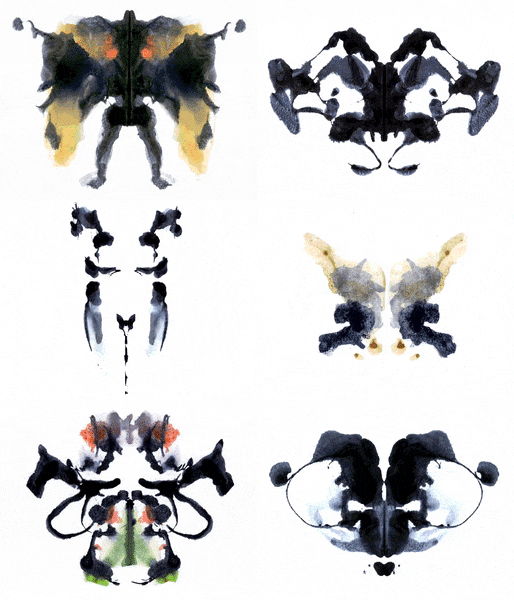
Long used by psychologists to understand their patients’ mental composition, the personality test can also be an invaluable tool for a writer to delve into the minds of their made-up characters and develop them into well-rounded people.

There are hundreds of tests online that I am sure are all varieties of the same ideas. WARNING: These tests are addictive!  Take this quiz or this one or this one and you will see why. In my class, we were asked to take these once as if the main character was taking it him/herself. This was particularly interesting, because even if you (the author) know that your character is a very untrustworthy sort, the character might see himself as honest, or lie to cover up his smarminess. The second time we took the test, we took it as a supporting character, commenting on the personality of the main character. Again, the results were quite different, because other characters may see the main character differently than the main character sees himself.

If you are a writer struggling to create believable and realistic characters, try the personality test! There are no wrong answers. You will be surprised how the character will come through and pick the correct answer for you!

*For an extra challenge, try to journal entry in your main character’s voice about taking the personality test. Devise a reason for his or her having to take it, and write about their reactions to the questions. Happy writing!

David Daniels

The best part of attending the University of Michigan is the plethora of opportunities which are available in such enormous quantities that it is easy to neglect them. It is easy to assume that there will always be another opportunity, to become numb to the significance of each event as it has become a new state of normal and to miss meeting people & attending performances that students around the world have only dreamed of attending.

One such opportunity will take place this Sunday afternoon at 4 pm. At this time David Daniels, a new faculty voice professor within the School of Music, Theatre and Dance, will present a recital – completely free of charge.

For those of you who are not familiar with opera this may not seem like a big deal, after all, it is simply a recital that is being given by a new faculty member at the university. However, for those who are familiar with opera you will realize that this is David Daniels that we are talking about. The same David Daniels who is credited with reestablishing the countertenor as a major force in opera and is embraced as the world’s greatest countertenor. The same David Daniels that has sung at the biggest opera houses around the world where thousands of patrons have paid hundreds of dollars to hear him sing. And this same man is performing a concert free of charge on campus.

As David Daniels has said his “goal is to try to give this as long a life as possible and perform it in as many places as I can. Careers don’t go on forever, so I would like to do it as often as possible. I’ve sung 20 years as countertenor and I don’t feel like I’m slowing down at all. In fact, I now have a confidence level that I didn’t have 10 years ago. I feel like a deeper artist, a better communicator. I actually prefer that to fireworks. More realness, honesty, and…maturity. Yeah, that’s a good word! Maturity.”

The university is lucky to have such a wonderful, mature artist as part of their staff. Let us not become numb to how extraordinary this opportunity is and I hope that Britton Recital Hall is just as full as the other venues that Daniels is used to singing at.

Candy Skulls

The Day of the Dead is a holiday that is celebrated all throughout the Catholic world, but the United States is particularly enamored with the colorful celebration in Mexico. There could be many explanations as to why America is so obsessed with this cultural holiday, but I believe the main reason is that our society likes to take things it doesn’t understand, mystify it, and fetishize it. It is extremely unfortunate that our society does this as this is a very important holiday and we only see the shallowest view of it. So in order to try and alleviate the appropriation that surrounds this holiday, I would like to share a brief history lesson of this holiday and its traditions. (Side note: I am not Mexican nor Latinx. If any of this is incorrect, seemingly biased, or misinterpreted, PLEASE let me know in the comments.)

The Mexican celebration of Day of the Dead is a mixture of ideas and traditions from the New World and the Aztec Empire. Originally, Dia de Muertos (the actual name of the Holiday) was celebrated at the beginning of summer before the Spanish colonization. It was dedicated to Mictecachihuatl, a goddess in Aztec religion, often romanticized to the “Lady of the Dead.” During this time, Aztecs would take time to remember the deceased and create alters in their honor. After Spanish colonization, this holiday was shifted to fit the three day celebration of Allhallowtide (All Saints’ Eve, All Saints’ Day, and All Souls’ Day) and the traditions were morphed to include the traditional practices of the Catholic holidays.

Today, the holiday is highly respected and enjoyable celebration that involves alter creation, visits to cemeteries, and offerings of food and flowers to the dead in hopes that they will visit. The entire holiday has a humorous tones which stems from the Aztecs’ ability to laugh at death. While I would love to go into all the details of the holiday, I don’t believe I have the authority to truly discuss every important aspect of the holiday. Instead, I will be focusing on three important aspects: ofrendas, calaveras, and La Calavera Catrina.

Ofrendas are alters made to honor the deceased. They are often made for an individual and the most common format is three tiers. They almost always contain orange and yellow marigolds as they are believed to attract the spirits of the dead and are called Flor de Muerto (Flower of Dead). The tiers then often contain different items that are specified to the individual. The bottom alter contains candles, a mirror, and washing items so that the spirit can refresh themselves. The second tier contains items that were important to the individual and let them feel comfortable. These include favorite foods, toys for children, tequila or mezcal for adults, and especially pan de muerto, a sweetbread. The top tier identifies the person the alter is for and may contain religious iconography. These ofrendas may be within one’s house or at the grave of the deceased. They are also highly variable and the one I described in this paragraph is only one of the forms. In addition, they are also created in schools and government buildings (without the religious icons) because of the high respect for the holiday.

Calaveras are probably the most recognizable aspect of Dia de Muertos. They are the sugar skulls that appear everywhere during the month of October. Calaveras did not come about until the 17th century when the Italian art of sugar sculpture made its way to Mexico. In addition to sugar, they can also be made of clay in order to be solely decorative. Before the colonization, icons of skeletons were used to represent rebirth, whereas now, the popularity is often attributed to Jose Guadalupe Posada and his political caricatures. While some of the sugar skulls are edible, aesthetics are much more important and the skulls are not meant to be consumed. These skulls are placed on the ofrendas as well.

La Calavera Catrina is the caricature by Posada that popularized the heavily aestheticized sugar skulls. She was created to mock the Mexican people who ignored their heritage and emulated Western Europe. Created in the 1910’s, it is an etching of a skeleton dressed in European fineries. She has become an embodiment of death and she is now revered during Dia de Muertos like Mictecachihuatl was in the original Aztec holiday. She is often matched with a male skeleton, but they are not as popular as La Calavera Catrina. This icon heavily influenced the artistry of the calaveras.

As you can see, there is a lot of tradition and importance placed on this holiday. It is incredibly important that we are sensitive to this holiday and do not appropriate the traditions. It is great to want to learn more about the holiday and to appreciate it, nut our society to often mystifies it and we don’t take the celebration as seriously as we should.

The Footsteps That Came Before Me

So this summer I had the amazing pleasure of leaving the country for the first time and going to England, where I got to study for five weeks at Oxford University, one of the oldest universities in the world. I haven’t gotten to talk much about my experiences there, since I made a blog but never kept up with it (oops), but I’d like to share something that I started thinking about when I came back to the University of Michigan.

It’s weird, because when I got to Oxford, I knew the history behind it, that there were thousands upon thousands of people that had walked the exact same pathways I did, that lived and breathed Oxford. It seemed like every day I learned something new; President Clinton once smoked weed at the Turf, Lewis Carroll taught here. There’s obviously something magical about walking in the footsteps of those who came before you (although, no, I didn’t smoke weed at the Turf – I just got a pint of cider, as per usual).

I’ve thought about this more, too, as the semester has gone on and I’ve been studying the works of James Joyce, who will forever be imprinted in Irish literary history. I had the chance to go to Dublin – there were some other people that wanted to go too – but I instead chose Paris. And even there, I found the quintessential tourist stop for an English major: Shakespeare and Company, the amazing bookstore that you just have to see to believe.

I found out in my Joyce class that Ulysses, his famous epic, was actually first published through Shakespeare and Company, and I had walked those halls, and I had taken a picture of the mural they have on the wall with James Joyce, proud on the wall. Joyce had gone to Paris and written in Paris a number of times – you could say I made that same pilgrimage.

But as I think about these things, about how these great writers have come before me, how I merely spent not even half my summer at this famed university whereas they devoted themselves to it – I don’t necessarily feel special. Sure, I loved it beyond all measure; this year marks the 100 year anniversary of the publishing of Alice in Wonderland. And it’s astounding that I even got accepted, much less had the money to go over there and spend five weeks essentially frolicking across Europe.

But I didn’t feel particularly magical. I know there are people who spend their time trekking across Dublin to find the spots Joyce mentions in Ulysses, or they go overseas to write because that’s what T.S. Eliot did. But nothing’s going to change if I write my novel here or if I write my novel in Paris, emulating some famous author. He’s not going to come back to life and help me revise those 300 pages, or give me inspiration for my next book.

I don’t mean to be too didactic, but I realized that following art isn’t what makes you any better – it’s doing your own art. By having my own experiences in Europe, I define who I am as me, not as someone else. Of course, that doesn’t mean I won’t go back to Paris and perhaps write there (because I loved Paris. I loved it). But I’ll do it because it’s what I want to do – not because Joyce did it a century earlier.

And if there’s any true moral of the story it’s this: travel, get outside your box, go somewhere. It’s totally worth it.

Wolverine Halloween Creativity

Halloween at the University of Michigan. My favorite time of year. Houses are hopping with cliché Halloween playlists and frats are pulling out the big guns with dry-ice drinks (for anyone 21 and over) and spooky spider webs. Everyone’s on their A-game, excited to show off their more creative sides. And let me tell you, the Wolverines are bursting with creativity. No matter who you are, an athlete, engineer, psychologist, or writing major; you’re probably doing everything you can to one-up your classmate for the best, most creative and inspired Halloween costume for the big night, I mean week, of scares.

One way I like to admire Halloween on campus is to stop by Ragstock, the neighborhood place to go for all things costume related. This year, I needed to grab some last-minute essentials for my costume, so I had the perfect excuse to go. While there, I had the chance to see what Michigan students would be wearing this year. Of course, there were the traditional sexy cops and spaced out hippies, but I was more interested in the people hanging out in the “make-your-own-costume” section. There, I found students gathering vests and boots and face paint galore, not to mention fake blood and teeth, anything metallic, and pirate hook hands. I got excited and started paying attention to all of the potential costumes I would be seeing this weekend.

First, I saw a faux fur vest. At the same moment, someone else saw it and shouted, “it’s perfect for my Macklemore costume!” Then, in line I saw someone else checking out with that very same vest. Another Macklemore? I thought. But I was wrong. This person was buying the vest for his couples costume, and I don’t mean a tribute to Macklemore and Ryan Lewis. In fact, he didn’t need the vest for himself at all. Instead, he was picking it up for his friend. They were going as Parks and Recreation‘s popular duo Jean-Ralphio and Mona-Lisa Saperstein, which, if you ask me, is an absolutely perfect and creative use of a faux fur vest.

Next, I saw someone carrying around a big curly wig from the more psychedelic section of the store, but no fringe or bellbottoms. Turns out, this student was going to be the late, great Bob Ross, the iconic PBS painter we all know and love for his small obsession with trees. What a unique way to use a wig! Another girl picked up a gold body suit and exclaimed, “I’m going to be C3PO!” Someone else grabbed some fake blood and explained to her friend how it would turn her shark leggings into a shark attack.

All of these were great ideas, and I left with the distinct feeling that I needed to find a way to make my costume, an ode to Cleopatra, a little more creative. With this thought in my mind, I found myself listening to every Halloween costume idea I heard around campus. These ideas were largely pun-inspired and equally creative, and I loved every one of them. One girl used a dress slip and taped Freudian terms on it to transform herself into a Freudian slip. Another girl found a hard-hat and jumpsuit and wore a shot glass necklace and earrings to be a “miner in possession.” Someone else was going to go with his significant other as robbers who were “partners in crime.”

Thousands of Halloween costume ideas have been publicized online on places like Buzzfeed and Pinterest, and I know I could look at those for some extravagant and creative costumes, but that doesn’t really matter to me. I don’t really care what those people are wearing this year. Instead, I love to take a stroll through the Diag, stumble into Ragstock, or hit up a costume party. That way, I can appreciate the brilliant minds of my peers, the people I surround myself with every day. They are some truly creative people.

Happy pretending, Wolverines!