
A Tribute to Cartoons

The elementary school I went to had a program allowing students to eat lunch at home. So, every now and then, I would sign out at the front office and make my two blocks walk back home. Like a master of timing, my mother would have already finished cooking a nice plate of spaghetti, or some Korean dish, and before I sat down at the table, I would run over to the living room and tune the CRT television to Cartoon Network so I could watch reruns of old cartoons while eating. At which point I would rush back to the table and sit in expectancy for the meal my mother was bringing and the shows that would begin playing.

At the time, there were a slew of great cartoons that were new, for instance, Dexter’s Laboratory, Courage the Cowardly Dog, The Fairly Oddparents, Arnold, and many others. But the show that I probably watched the most during my lunchtime visits, was the Hannah-Barbera classic, Scooby Doo, Where Are You!

But it is only now that I begin to wonder why I liked it so much, the sort of questioning that is lost to a child who is just enjoying it, not dissecting it. But at the same time, I wasn’t stupid back then, I think. I knew that the story had a formula, that the monster would be unmasked after Freddie’s plan went awry thanks to Scooby and that the person would be some man or woman who appeared earlier in the episode. After a while, the show is no longer creepy, but that is okay, because I don’t think that was the point. I think Courage the Cowardly Dog was supposed to be creepy. But the adventures of the Mystery Gang were just that, adventures.

They were mysteries and as a child, I was taken along for the ride each time. I didn’t care about whether or not the monsters weren’t real. All I cared about was that I got to go to a new place, meet new characters, see a new “monster”, and most importantly experience a new adventure. That was the appeal of the series – that in its simplicities was its holistic bundle of entertainment.

So let’s talk about the Looney Tunes.
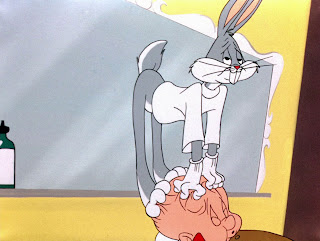
This was never on during my lunch trips, but whenever it was on I was watching it. I would never change the channel, even if I had seen The Rabbit of Seville 10 times already. And thank God that Cartoon Network had the colored shorts at the time. Otherwise, who knows when I would have been exposed to it? I had many Looney Tunes favorites when I was growing up: Rabbit of Seville, Duck Dodgers in the 24 1/2th Century, One Froggy Evening, Feed the Kitty, What’s Opera, Doc?, and Duck Amuck. If you haven’t seen these, please go and do so right away.

If I am going to talk about how simplicity made Scooby Doo enjoyable, then how can I skip one of the most simplistic cartoons of all time? Helmed, of course, by the genius of Chuck Jones. Simplicity and minimalism runs rampant in his work. Everything from the characters themselves to the gestures and expressions they make. Let’s take Wile E. Coyote for example; he wants to eat the Road Runner and his trust in ACME and his faith in his own plans is his undoing. Never is his suffering brought on directly due to the Road Runner. Then, there is Pepé Le Pew; a skunk that just wants love, but when he receives it, he runs from it. Of course, Bugs Bunny is perhaps the simplest in that the one rule he revolves around is that he must be provoked to get involved. I don’t think any show has been able to create such complete characters with such simple guidelines.

Daffy Duck is my favorite character. Ever since I was little, I related to him the most. Bugs was too smart, but Daffy, Daffy was human, he failed, over and over again, but at the same time, he never gave up. He wanted glory, but couldn’t have it, he wanted riches but remained poor – a duck of great ambition yet forever cursed by the animators to never see success. This was what Jones was so good at, creating honesty and thus, believability, in his characters and in his drawings.

The expressions that were featured on the characters, before they got hit by a train, before they fell 10 stories, when the realized something important, and many other poignant yet brief moments of time, are all so minimalistic. And so many of them are done with just the eyes. Even outside the realm of cartoons, how actors use their eyes in film reveals so much. When I was in Korea this summer, as I walked by my mother watching Korean Drama’s I noticed that all the actors did the same thing. They opened their eyes as wide as they could in moments of shock, sadness, horror…basically, the same expression was used for one too many emotions. But Jones had variation in his emotive arsenal. Just look at the episode called Feed the Kitty where the bulldog goes through so many expressions with its eyes.

When it gets caught putting the kitten in the flour bin, he does a “Who. Me?” look.
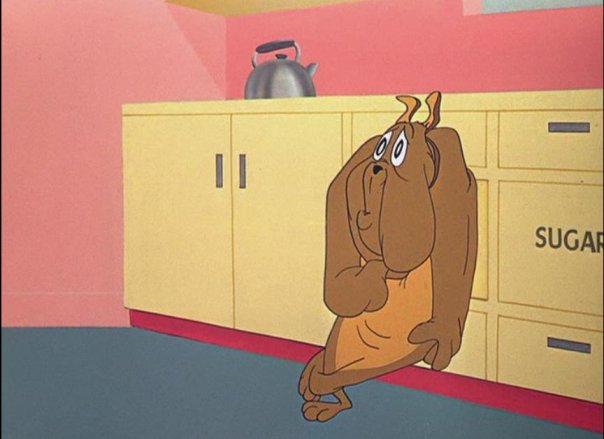
Then there is his worried look as he believes the kitty is in danger of being turned into a cookie…

…that is eventually followed up by his look of complete sadness, as he believes the kitty is dead.

Then there is the happiness of finding the Kitty once again.


Jones was an expert of going through various emotions in such a short amount of time. In the short I just mentioned, I went through laughter to choking up in a matter of a minute! Of course this was in part due to Jones’ masterful use of expressions, but also timing. He was easily one of the most efficient animators in terms of timing (my moms cooking wasn’t the only timely thing I would mention in this post). Especially, with gags. He played with expectancy, so that he would wait for the last possible moment before releasing the build-up in order to get to the punch line. Never did he remain too long on the build-up and never was the punch line too sudden. It was always perfect.

I am talking about these cartoons at this time because I recently finished watching Rick and Morty, which is, I think many people would agree with me, a staple in modern era cartoons, and it got me thinking about the classics and got me asking the most rudimentary question – why does this work?

Does the simplicity found in Looney Tunes and Scooby Doo work in the same manner for the successful cartoons of today? I would say yes. Let’s look at Rick as an example. Rick is a complex character with complex emotions, but that complexity sprouts from very simple human characteristics – he is sad, lonely, and his vast intellect leaves little for him to enjoy. Of course there are some characters in the show that are much simpler, like Mr. Meeseeks (he just wants to die after accomplishing his one task). The humor of the episode Meeseeks and Destroy stems from the simplicity of that character. Although the ones summoned by Beth and Summer finish their seemingly hard tasks quickly, the one summoned by Jerry cannot do the far more mundane task of taking two strokes off Jerry’s golf game – so the Meeseeks goes crazy and summons more Meeseekses (what is the plural of Meeseeks?) to help, making the situation all the more crazy. Although the show can seem, at times, to be the unrestrained and unfiltered imagination of co-creator Justin Roiland, it never fails to remember that what makes a cartoon, or any form of art, succeed, is simplicity at its core and fundamentals. But that is the trick isn’t it? Never in the history of mankind, has it been easy to create simplicity in an artistic medium.

Books of Curiosity: Why Humans Like Surprises

Publishing is hard. Especially when you distribute your magazine for free. There’s a difficult balance you have to find: include enough talent to make it full of substance and variety, but not to the extent that it is so thick that you can only print three copies. We’d like to think that the time and passion that goes into a literary magazine makes it into a valuable object – in other words, a kind of commodity. And with that comes the need for money. If you want more pages, more physical objects, you need more money.

As Editor-in-Chief of the RC Review, a literary and art annual publication that features Residential College students, I knew that we needed to collect more doubloons for our purse in order to print enough for all of the RC and faculty. Poetry should be free for all, but unfortunately, printing is not. Therefore, the fundraiser was born!

A close friend who had recently graduated from the RC was a vital part of the fundraiser’s idea. She was moving to Ypsilanti and had boxes on boxes of old, hoarded books – at least 50 of them! We gladly took them, without a specific purpose in mind, mostly because they were yellowed and powdered with the ripe smell of love and time – the complete Dawn Treader treatment. Many of the books we had never heard of before, many we judged quickly and added to our Never-Going-to-Read list. The fact that we judged the cover so much, with haste, churned in our heads. True, judging a book by a cover is a thing. It has to be – the colors, the words, the font, it all compounds the aesthetic pleasure of a book. The door that enchants you to step inside.

But, what if that door was covered? What if that book called “Loving Your Child Is Not Enough” was wrapped in a brown Trader Joe Bag, its handle beckoning you to loop your hand through it, an alternative quote taken from deep within its rabbit hole written in big letters across the front? What if we gave that book a second chance? Would someone come to knock on this novel adventure?

So that’s exactly what we did. We covered all of the books, some novels, some historical anthologies, some parenting books, one Spanish novella, with identical Trader Joe’s bags and added quotes or goofy one-line synopses to the cover. And Tuesday afternoon, we laid out our goods on a grassy knoll in front of East Quad, predicting that we would walk away with 49 of the books and about 2 dollars in our pocket.

But, to our surprise, we were a magnet to the curious. Most people walked by with their chins hinged toward us, mouth agape, not quite understanding. And then, the curiosity, the thrill, the NEED TO KNOW WHAT IS GOING ON, set in and they approached us. Their eyes scanned the quotes, some smiling, others already pulling out their wallets, struggling to make a choice between buying one or ten of them.

We encouraged people to touch them, pick them up, feel their heft, smell them (one book’s cover quote quite literally said, “I smell pretty.”) It was as much of a social experiment as it was a fundraiser. People were so generous, too, often giving up to 5 dollars extra, just because.

Don’t call it deception. Our Blind Date with a Book was instead a meditation of curiosity. Think back to your birthday or a holiday where gifts are exchanged. There’s an inborn pleasure in being surprised, of not quite knowing what is in your hand. In a way, we also did a service to the books themselves. If donated somewhere where they weren’t wrapped, there is quite a good chance that many of those books would never make it off the shelf, spend a lifetime without being opened, perhaps even be thrown away. We’ve breathed life into them again, to show that they are something of value, they are a useful commodity. Even if the story themselves are less than exciting, they help to create a connection between the humans engaging with them. And for that, they are indeed priceless.

Bill Nye

Growing up, we all were excited for that special day, when the teacher would wheel in a television and pop in the videotape. All the sudden the screen would pop into color and we’d wait for the inevitable theme song to start playing so that we could all scream along. Shouting “Bill!” was the highlight of the day and it turned us all into one collective Bill Nye fan club. What made Bill Nye the Science Guy turn into an icon like he did? It wasn’t because it was a science show directed towards children, there were many of those. It was because of the format and direction of the show. I think it would be hugely beneficial for us to analyze this show and see why it affected us all so much.
First we should look at the “characters.” Bill Nye was certainly the star, but he was never the one to do the work. The kids always did the experiments with his help. They were the ones to initiate the experiments while seeing them through. Often they also took over the job of explaining the experiment while Bill Nye took a true backseat. I believe this is incredibly important because it puts the children in the limelight. It makes them capable, intelligent, and active. As kids, we could see ourselves in them and it allowed to believe that science wasn’t some unattainable subject that only adults could interact with. We could become scientists right then and create our own experiments. These kids on the TV could do it and why were we any different? Being able to relate to them was important and made the show easier to understand and made us more invested in what we were learning.
But there is more to the genius of the television show. Related to the former point, we see in the show that Bill Nye never talks down to the children. As far as he is concerned, they are on equal footing and equally able to be intelligent and make deductions. The children seemed to be as intelligent as Bill Nye. He would often ask them questions as if he truly didn’t know the answers and allow them to take over the show. It was another way for us to see ourselves as capable. It inspired us to become as intelligent as them and continue to seek knowledge in whatever ways were available to us. As before, this was crucially important. Both of these details together made the show incredibly relatable. It was important to be able to see ourselves as part of the show.
Of course entertainment also plays a big part in the show. Looking back at it now, the show seems steeped in 90’s but it is still pretty entertaining. I have to assume that it would be even more entertaining if I was still a kid. The quick jump cuts and crazy camera angles and zooms seem distracting and unnecessary, but, as a kid, I knew that it would keep me invested. We all had much shorter attention spans when we were younger and the quick changes to scene make sure that we were not bored. The songs were quick and a nice reprieve, the experiments were entertaining and highly educational, and the jokes were just good enough (though honestly not very good) to make us laugh. Watching it now, I am still entertained and still learn from it, but I know that if I was younger, it would be infinitely better.
This show is still a hallmark of science television and it deserves every accolade it gets. While it has the crust of the 90’s laying on it, it is easy to overlook that and rewatch it. I am currently studying in a science field and I can’t help but believe that Bill Nye might have had something to do with it. We all love Bill Nye and there are many strong reasons for that. Television should look back on this hallmark and see how that can mold their shows to become as powerful as this one.

Chasing Starkid

Ah. The sweet smell of disappointment.

On the morning of October 8th, I woke up, bound and determined to meet Starkid. My plan was this: get up, eat (since I probably wouldn’t get another chance for a while), get dressed, put on make-up/straighten my hair if I so desired (this dependent on the whole waking up thing), and go to class. After class, I’d book it to my apartment, maybe apply more make-up, then take the first bus to the Walgreen Drama Center. Starkid was holding a panel from 2-3, and I had to be there. I even emailed my professor ahead of time; I’d be missing class for this; this is important, duh.

My plan went flawlessly. I wanted to leave my apartment around 1:30, and that I did, right on the nose. On the bus to North, I pulled up the event on my phone to double check the location.

12:30-1:30, the website proclaimed. I could almost read the Ha! You fool! underneath it.

Whether it was a change in time or I had read it wrong (thought my mind rebels against this idea; I couldn’t be wrong, how could I?), as I walked towards the Walgreen Drama Center I saw Starkid shimmer before me, going up into smoke before my very eyes.

I wondered to myself if this was fate putting pieces together. Hearing no word back after getting a polite “We’ll see” about an interview, I’d been stressing, almost panicking about when and where I needed to be to get a golden 30 minutes to conduct my interview. Maybe this would be serendipity, and Darren Criss would walk out, laughing at something incredibly funny, then stop, pointing me out.

“You’re that girl, right? Who wants to interview Starkid, yeah?”

I’d bat my eyes coquettishly.

“What gave me away?” I wouldn’t be hyperventilating; cool as a cucumber.

“I just knew. Hey, come to rehearsal with us – we’ll be done in 30. Then we can chat.” (I’m not sure what my fascination with 30 is; just a solid number I guess).

A younger me would have been mad crying screaming – whatever made me feel slightly vindicated for being stupid and missing this. But senior year Jeannie decided to just sit and write. So I did.

I continued my day waiting for the email that never came. I think some small part of me is still waiting, like I’ll get the email tomorrow or Saturday and I’ll leave the football game to interview Starkid.

But finally, the time came – showtime. I had my ticket in hand, and me and my friend dressed to the nines. I felt good. Maybe not amazing – I didn’t get that interview, but good.

I won’t spoil the concert (review forthcoming by yours truly), but I had a blast – we went back to Hogwarts, but more importantly I went back to Starkid. Nostalgia had a big part of it, but in reality my memory had failed me – I had forgotten how fun Starkid was. The concert ended, and my friends begged me to try and get an interview somehow, someway with the Theatre 100 press pass I had.

Tyler Brunsman, bless his heart, was in the reception room talking to his parents. I waited a good distance away; I wanted to talk to him but I wasn’t about to be so pushy that I interrupt.

After he finished, I stopped him, introduced myself. I was slightly shaking – I’d only ever seen him on screens and now here he was in front of me. Maybe he noticed, but hopefully he didn’t.

The conversation? Well….

Me: *oh gosh oh gosh be cool* How was it to come back to Michigan? *good job Jeannie you got this*

Tyler: It was, like, out of this world…everywhere you walk on campus is, there’s so many memories associated with this campus, so coming back here, it’s really been a magical couple of days. It was like second nature, just being back home.

hoMe. I know the feeling. We kept talking, I asked about his favorite memories, and got an amazing anecdote involving ranch, Pizza House, and a late night mix up (moral of the story – always buy Pizza House. Always.).

For a moment, I slipped back into my old days – I used to be big in the Starkid fandom, talking to girls thousands of miles away from me who bonded over this silly, fantastic group of people. Embarrassingly, I told Tyler that he responded to a Facebook post of mine one time, and little high-school Jeannie died. High School Jeannie died again, shaking hands with Tyler, hearing him say he would stop and talk to me when I thought the closest I’d get to Starkid was the view from Row K in the Power Center.

Even though it was embarrassing, even though it was super unprofessional, in that moment, it was okay. Everything was okay. I left the show, two friends beside me, one freaking out over taking a picture with Eric Kahn Gale, the other begging to stalk Darren Criss (sorry Darren – I tried to curb them as much as possible).

All that mattered right then was I was fresh off the high of an amazing concert, and I had my friends beside me. And I’m sure, walking off the Power Center stage tonight, Starkid felt the exact same way.

Dropping the Needle

Vinyl LPs have been back ‘in’ as far as trends go for a few years now, and whether it be dusting off your parents old Bruce Springsteen records (thanks Dad!) flipping through Louis Armstrong and Johnny Cash at record stores, or buying new releases of contemporary artists at Urban Outfitters (and getting the stink eye from other music fans), there are plenty of ways to get in on the game. It is absolutely true that vinyls have a richer sound, and that the pops and feedback add to the experience, though it’s not for everyone. It is also absolutely true that Crosley record players are awful and should be avoided at all costs – it is way better to save your money and make an investment, unless you really dig hearing skips throughout a whole playback of a record you just dropped a pretty penny on.

Building a record collection is pretty fun and also nostalgic – there is something special about holding an old piece of plastic in your hands and realizing that someone opened it for the first time 60 years ago and had the same emotions you did when you played it for the first time. There is something really cool about taking the Beatles ’65 album you stole from your mom out of its sleeve and seeing that someone had filled out an order form for the Beach Boys that was probably denied by their parents. There is something downright hilarious about flashing the cover of The Monkees at your dad at a barn sale and hearing him mutter about how ‘they didn’t even play their own instruments’ because he is still in denial that he LOVED watching their show when he was a wee boy. (Side note: IFC plays The Monkees sometimes on weekend mornings, and you can see just how hard Davy Jones tried to talk himself out of many a pinch with that British accent.)

There are so many things to explore in the world of vinyl, and one of the coolest things that I’ve been into recently is colored vinyl. It’s been around forever, but is much more rare than the traditional black and also much easier to stare at for hours. In recent years it has resurfaced as a cool medium for ‘limited edition’ releases, which is even more exciting because if you got it you’re one of a proud few, and if you missed the original release you’re just SOL. I just got a double colored LP of Noel Gallagher’s High Flying Birds that came in electric blue and pink, so in case you’re having trouble picturing just how rad this is, I’ve got a pic:

Displaying IMG_4388.JPG

How cool is that? If this doesn’t make you want to buy more records, I don’t know what will.

Beach House at the Royal Oak

On Sept. 19, I experienced Beach House live and the performance was nothing short of spectacular. One thing that I was immediately surprised by was how loud the band was. Listening to their records on your phone or computer with headphones doesn’t measure up to the bass that leaves your body weak and the wall of sound created by Alex Scally’s melodic guitar and Victoria Legrand’s vocals – that reach tones on both ends of the spectrum with such power and rocking ferocity – forcing you into a trance. It was a concert that was so visceral it left you wondering how the time went by so fast. But you feel rejuvenated and excited. The experience is virtually ineffable. As one person at the show put it, “You guys are fucking killing it!” And to give you a context of the vibes of the show, Victoria responded to all the praise at one point by saying, “This is gonna be a four hour set.”

For a moment, I want to talk about the lighting on the show.

But before that, I will make a brief aside and say that the Royal Oak Theater (the venue where the concert was held) was absolutely beautiful, I highly recommend everyone to check out their website for future shows (they have acts varying from Beirut to stand up shows by Craig Ferguson – a man who, with absolute genius, deconstructed the Late Show format).

Anyways, back to the lighting. On the stage, there were three white rectangles that were made from some light thread – for the light easily went through it. Behind those rectangles were lights on the floor that could change color along with the lights from the top of the stage. The combination of these transformed the stage from deep red, to a rich sea blue, to a starry white. Complimenting these colors was the lights in the backstage, that were filled with dotted light bulbs that lit up for certain songs to emulate a starry night. Here is a link to some professional pictures of the show.

Beach House at Royal Oak Music Theatre

It is quite interesting that their album jacket for their new album, Depression Cherry (for the vinyl anyways, I assume that the CD cases are the same), is covered in deep red velvet. The comfortable feeling of the velvet doesn’t account for their visceral live show. The two are so considerably different and perhaps that is why it is so special. This is only the second concert I have ever gone to, so although such conclusions may seem late, it is only because of my lack of experience that I am just now beginning to realize the power of concerts.

Here is the set list for those that are interested.

Levitation
Walk in the Park
Lazuli
Gila
PPP
Beyond Love
Norway
On the Sea
Other People
Space Song
Myth
Wildflower
Wishes
Sparks

Encore
Wherever You Go
10 Mile Stereo

Here is a full stream of my favorite Beach House album, Teen Dream, for those who have never experienced the majesty of this band (but honestly all their albums are amazing – hard to pick a favorite – so I included all the streams provided by Sub Pop).