
Eric Bogosian

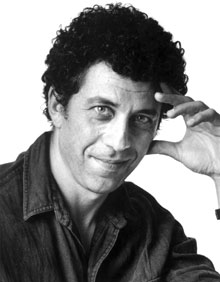
A couple weeks ago I had the pleasure of seeing Eric Bogosian perform at the Helmut Stern auditorium in the UMMA. I must have been one of five or ten undergraduates in the whole audience, an unsurprising fact given that Bogosian’s period of relative fame peaked a decade or two ago. Still, I recognized his face on some posters and figured it might be worth a watch. How unsuspecting and unready I was.

Bogosian performed a series of monologues from his many years of writing and acting in a one-person Off-Broadway production. Over the past few years, he has enlisted his actor and actress friends to perform these monologues as well; each week they release a new video to the project’s website, and will continue until they hit one-hundred videos. The project, aptly titled, “100 Monologues” provides a vast array of characters, problems, situations and contexts with which the audience can grapple and seek to understand. Some of them are familiar (a frustratingly pleasant but unhelpful flight attendant at an airport, a detached and existential teen hitchhiking across the country) and some are not.

During the performance, Bogosian moved from character to character and scene to scene with unforgiving swiftness and elasticity. Although he sometimes offered his own commentary between sketches, I found it impossible to know if the thoughts were coming from Bogosian himself or yet another character. He proved his commitment to staying in character within the first three minutes of his performance; while taking us through the distorted and rancorous and extremely boisterous thoughts of a drunk man on the subway, he suddenly started yelling at an invisible woman taking photographs. For a moment I thought this must be part of the skit, until he began pointing and clearly moving off script. The photographer was in fact not invisible; she was real and standing just in front of the stage. While maintaining his voice and character, Bogosian (in no pleasant terms) instructed her to leave the auditorium. No questions, no hesitation, no return to the actor. Later on in the performance he made a few comments about the occurrence, apologizing slightly in an agitated tone, defending his right to perform without distraction.

This seemed to symbolize Bogosian’s stance on his show. No mercy. He did not try to spare us from the socially ugly characters he decided to bring into the room. He demonstrated a keen tendency to suspend all formality and to discuss any idea or scene, regardless of how crude or crass it may be. Indeed, one of his characters talked of nothing but the enormous size of his penis, and the ensuing sexual escapades he had experienced because of it. This is Bogosian’s wheelhouse; he moved from a coked-out drug dealer to a recovering male sex addict to an overworked law enforcer. They are not overtly attractive characters, far from it, and their harsh language and abrasive tones make for an uncomfortable viewing experience.

But perhaps this is where Bogosian’s brilliance lies. In each of these characters– people we would have no trouble writing off as deranged or ignorant or unsuccessful– is a degree of truth, a moment of wisdom. The hopelessly lost boy wandering in the woods pondering his karmic movement from human to acorn to lion sperm is not a reliable character, and yet the end of his speech sparks a profound thought. He attests, “It won’t matter that nobody will know where I am, because I’ll know, and that’s the most important thing.” If nothing else, Bogosian’s performance teaches us all to be a little more tolerant to the voices we’re accustomed to writing off as lunacy, and that in exploring the lives of people pushed out from conventional society, we can find brilliance in places we never thought possible.
http://100monologues.com/

Finally Seen: the Heidelberg Project

Ever since the first time I volunteered at the storytime at UMMA and read the kids the story of Tyree Guyton and his Heidelberg Project, I have been longing to see this neighborhood in person. However, two years passed and I went to Detroit several times, and never got a chance to see this project. Sometimes it was because I went with a class field trip; sometimes it was because I had to catch the train before it got too late. There were just always excuses and schedule changes. Finally this past weekend, I went to DIA with my friends and managed to see this neighborhood afterward.

As most of you probably already know, the Heidelberg Project was started by Tyree Guyton. Encouraged by his grandfather, the artist began to paint and decorate the neighborhood where he had grown up. With the help of other residents in the area, Guyton revived this neighborhood by painting lively and colorful dots on the houses and on the roads, decorating the street with dolls and shoes, and putting his paintings and artworks in the front yards. Most materials he used were collected from the streets and many toys were thrown away by their previous owners. That’s where the book I read to the kids during storytime got its title: Magic Trash—Guyton recycled these discarded objects and drew his inspirations from them.

When I actually saw the dotted house, the first impression I got was, delight. I was surprised to see how the simplest geometric form, the dots, could energize the house when the artist have painted them all over in different colors. There are dots on the surface of the road, too, and walking on it was a pleasant experience. As aforementioned, the artist has also decorated the front yards with found dolls and shoes. To me, they created an eccentric atmosphere because some dolls were broken or defaced, and the shoes hanging on the trees seemed quirky. There was a setting of TV station, where the artist put two dolls in the bathtub in the middle of a frame. They appeared to be an old couple, but the head of the old men was deformed. Thus, putting yourself within the frame and taking pictures seemed to be a somewhat creepy experience, but I did it anyway.

Other common seen motifs were clocks, wheels, and faces. I wonder if there are any symbolic meanings behind these recurring themes. For the faces, I once heard that they are the faces of the god. The mouths often appear to be smiling whereas tears come out from the eyes, as shown in the painting we have at UMMA. I attempted to find such faces in the neighborhood but, to my surprise, I actually did not find one—most faces appeared to be smiling instead of having a mixed expression. Maybe the artist changed his style? Anyone knows?

Tenet Returns

Well hey they done it again –

on Saturday the 25th day of October the movers and groovers of this so-called Tenet Collective went and struck these Kerrytown Streets once more, Mr. Leg Champii and all the various Special Knees once again beginning at the Mail Box early with a low key acoustic jam session on the floor and drawings on walls, all kinds of landscapes, the clock stretches and the word spreads and the crowd gathers, everybody warmin up and the Zines and the CDs laced with incandescent sounds all dished out, the house hums and you can see it in the air all quivering anticipation in the dim intensifying Night –

and off they went, destination Ingalls Mall, the band and dancing hoop of flame leading crowd to fountain where there was a hush into quiet, a gloomfaced seer sat waiting, severe and still and here he told the fortunes of him and her and them from cards, a sphere glowed whitely on the end of his holy Deck, there were whispers and everybody craned on their toes and leaned in –

and onwards back to them Fuk Boys’ Lair, there was a lost drummer and fellow wanderers standing there to bring em in for the screening of a short film by Champii Himself, a cinematic story affectionately titled A Womb to call Womb; downstairs the music plays softly and the screenfolk murmurs and discusses sweet mysteries in low tones, showed it twice for all to see, the crowd shifting in the LCD lowsun panorama basement and bubbling upwards to surfaces of cool dank hardwind and the moon’s echo in the cloudy vast –

and here the final stop, the crowd all boomerangs back to the Box, the Knees tapping on drums and stuff, whisper taps and flicks of little beats, the whole thing a whisper party (in attempt to avoid or at least delay the appearance of cops), the main room now dim and tense, a massochistic ritual about to go down where one man stands all blankfaced and glassy empty eyes, another man takes his staple gun and chunks and chunks away at Man One’s stomach, kichak kichack kichak is how it went and both of their faces remained a shroudy blank and it was raw and brutal even and the congregation flinched and most kept watching all cringing –

and here is where the night was meant to end by fading into whispers as it began but this is not that story, instead the corner lamps are out and all that’s left is Technicolor watersurface ripples and golden neon sound, the night erupting into kicks and celebrations of successful journeys, halloos and smoke, smashing of small porch things, the crowd believing the performance carries on – THIS being the electric thread began last time, last month, last year, keeps going, everybody keeps humming and the vibes are back like they were never gone, everybody diggin it all and wanting to be involved and wanting to see things happen, all riding this wave of creative happenings and makin it happen together, makin things happen –

so til next time keep the heads up and the eyes open and the ears at the ready and when you see us marching by just hitch a ride – One and All

A Double Post – Cinema and Music

This week, I was planning on going to see “The Rocky Horror Picture Show”. Ignorantly, I did not consider how many people would want to go see a movie that the state would only play twice this year. So I ended up just watching another movie with my friends instead.

However, although I was unable to go to the screening with my friends and have, what I would assume, a fucking blast, the fact that the state has these interesting screenings got me thinking – how fucking awesome is it that we have theaters like the State and Michigan on campus. To a certain degree I have been taking them for granted.

Not only will they be playing movies like “Birdman” and “Interstellar”, two upcoming movies that I really wish to see – they also have special screenings such as the “The Rocky Horror Picture Show” as well as the current series of Studio Ghibli films. On top of this they are doing a speaker series as well.

This isn’t really what I want to talk about but…I don’t know, it was just a cool (epiphany? – of incredibly low merit).

Instead, I want to talk about the new Foxygen record, because it is just too fun.

I never thought Sam France (Foxygen’s front man) was a particularly great singer in the sense that all the talent shows and vines (or instagram videos – I don’t know what the fuck they are I don’t use them) of people singing suggest as ‘good’ singing. Rather, France’s singing was far more stylized, evoking the voices of his influences throughout the bands songs, switching with such vigor that some songs make you feel tired as it reaches the end.

I was first introduced to the band through their album “Take the Kids Off Broadway” which got me hooked right away, because they sounded like they had so much fun recording it. Of course, this also made me have fun listening to it. It featured great songs like: “Make it Known”, “Take the Kids Off Broadway”, “Middle School Dance (Song for Richard Swift)”, and “Waitin’ 4 U”.

Then came their far more successful album, “We are The 21st Century Ambassadors of Peace and Magic”. A fucking mouthful of a title. I’ll be honest, I love every single song on this album, it is one of the few albums were I am not bored throughout the whole play through. There is no moment where I feel like skipping or just not listening to. To a lesser extent, I felt the same way about their last album as well. But to be fair, both of these albums were short, ‘Broadway’ being seven songs long and ‘Peace and Magic’ clocking in at nine songs. But honestly, who cares, they are awesome records.

Actually maybe they cared, or other people pressured them? Theories…all theories. But their new album, “…And Star Power” has 24 songs making it a double album with 82 minutes of material.

Do I love all the songs on this new album? No. But for some reason, this album works for me best when I have the time to listen to the whole thing, instead of just picking songs here and there – which I could do for their last album. Some songs on this album that I would probably not enjoy as much were I to listen them on their own, sound so much better when I listen to them in conjunction with the songs before and after it.

Is this a good thing? I don’t know because by all means I am no music expert. I mean I quit violin when I was young and I never really got into the whole high school band life. Ask me about notes and musical theory now; I won’t know a fucking thing. But that doesn’t mean that I don’t know what I like.

I like this new album. Certainly not as much as the previous two, but I like it in its own way. It is quite different in terms of the influences and there are more noise pieces in this album – pieces that I normally don’t like that much. But the songs “Cold Winter/Freedom” and “Can’t Contextualize My Mind” are pretty fucking cool, and it comes back to the same word…it is fun (and kind of terrifying regarding the former – that adolescent voice of France pretending to have a radio channel is edgy and scary to a certain extent).

Speaking of fun, I only recently found out, but it turns out Foxygen released, as a free download, their recordings that were not studio albums. The core duo of Foxygen, Sam France and Jonathon Rado, met in (middle school) I think. So they messed around and recorded a bunch of stuff before they were a band with a studio record.

(here are the links to the downloads if you want to check it out)

Jurassic Explosion Philippic
(They recorded this one ^ when they were 15 apparently)

Kill Art and Ghettoplastikk!

(they posted it themselves, it isn’t illegal)

I can’t say this band is for everyone but check it out, you might be surprised by how much you like them, or maybe you will just find a couple of hidden gems and take away a couple of songs you really like. Maybe San Francisco?

Happily Ever After and Then Some

My current guilty pleasure? I love reading romance novels. Yes, I’m that girl in your local Barnes and Nobles scouring the desolate section of cliched romance books, picking up novel after novel of Fabio and damsel in distress covers. I enjoy the steaminess, the fantasy, the heartbreak, the passion, the fairytale, the conflict, and overall, the idea that love can happen anywhere at anytime. I know it’s cheesy but I can’t help but be drawn to these novels as a place of comfort in my days filled with with classes, work, and piles upon piles of homework. It’s my way to escape into a world in which a realistic love story will never be a thing, but the idea of happily ever after comes with some sticky, drama-filled ups and downs.

I’m going to be really PG here and say what captures my attention the most in these novels is the crazy storyline that fills the holes of the actual romance. I’ve been enraptured by storylines of love hardships due to secret societies, arranged marriages, murders, business corporations, evil fathers, and so much more. When I first began reading my now hefty collection of romance novels, I never understood what the point of these random secondary plots were, when there was a steamy storyline between the two lovers and their always present resistance to be together. But then I read The Blackstone Affair trilogy by Raine Miller. It wasn’t my favorite love story, but the conflicts that arose that put their love to the test, made me yell, punch, and gasp all in one page, and those are pretty varied emotions to have after reading your average romance novel.

After finishing my 50th novel in a span of two months, I began wondering, what is it about these books that has made me disregard any other genre  for so long? I’ve disregarded The Alchemist and the last Divergent installment on my kindle for some months now. Why do I find this excitement to lay back and read about unrealistic happily ever afters, instead of novels that I could actually be proud to say I’ve read in a job interview. Well…I can get lost in them. Yes, the almighty escapism triumphs again! These romance novels, with their cheesy lines, amazing passion, unrealistic hardships, and cute endings of marriage or kids, are lives that I enjoy reading about, and I’m not ashamed of that.

I started thinking about my guilty pleasures and what really gets me thinking creatively today, and this seemed to resonate most with me. Through your guilty pleasures you can find a means to better understand and express yourself. Don’t be afraid to proclaim what you love to read, watch, or do when you want to escape from your everyday lives. I know I’m not.

Interpreting the Subtext

After a week that seemed like it took centuries to put behind me, I finally made it to Friday night, when I trekked to the Power Center to see Théâtre de la Ville’s production of Luigi Pirandello’s Six Characters in Search of an Author. The actors were superb, the set design was great, and the story itself had just the right amount of absurdism for the laywoman (me) to feel artistic, while still understand what was going on. What I really want to talk about today, though, is the use of subtitles in theatre.

First, to provide some context of the venue if you’ve never been there — the Power Center is large for a local or university theatre. According to the School of Music, Theatre, and Dance website, the proscenium (the area in front of the curtain) measures in at 55 feet, 3.75 inches by 28 feet. And this is where the subtitles were projected — at least 20 feet away from any of the actors’ faces.

If you look at this picture, the screens were hanging from the ceiling in the center and sitting on the stage on the left and right…

PC-house_000

Although I was able to follow the French quite well last night, a couple of years ago, when I had considerably less education and work experience in the language, I went to see this same company perform Eugène Ionesco’s Rhinocéros. Throughout the production, I found myself staring at any one of these screens for about ninety percent of the two hour span. I walked out of the theatre really wanting to rave to the world about how much I loved the play and how it enlightened me, because I did love the writing, but I couldn’t. It took me a while to pinpoint why, but sooner or later, I realized that I was frustrated because I wasn’t seeing the movement on stage and the emotions on the faces of the actors. Of course, I could hear the notes of joy, pain, excitement, and terror in their voices; however, I didn’t feel immersed in the experience because I couldn’t rely on the sense upon which I depend most to read people in my everyday life — eyesight. The situation is different with film, I think, because the subtitles are right under the actors. If you read them quickly enough, you can usually switch your focus back to the images above and still catch the visual action unfolding. Twenty feet of distance to travel, though, was a bit too much for my eyes to handle.

After the play last night, the University Musical Society actually hosted a Question and Answer session with the director, Emmanuel Demarcy-Mota. Sitting in a folding chair on stage, this slight man embodied every positive stereotype of a Frenchman. Fitted navy blazer with black everything else. Chic. Check. Impeccable posture and only using his hands to accentuate the important details of his speech. Elegant. Check. His voice increasing to a vigorous tone whenever he really cared about something. Passionate. Check. And he really cared about those subtitles. He kept repeating that he loved how the author could be present through them, complementing the acting, how text can serve as a bridge between the literary and the theatrical worlds of a play. His argument was very fair, and he was very persuasive, but I was still not crazy about them in this venue.

At the same time, I have to admit that without subtitling, this show would have probably never come to the university. The people of the Ann Arbor community, bilingual or not, would not have had the opportunity to welcome a culture so beautifully unique to their own.

And that would have been a shame.