Solar Engineers Without Shoes

Every Thursday I go see the Penny Stamps lecture series at the Michigan Theatre – partially because attendance is mandatory for all Art & Design students, but also because it’s really great and the only lecture of its kind in all the land, and these terrestrial creatives come talk to all us college asteroids floating aimlessly aspiring to their level of planetary gravity, and they say grand inspirational moving things and remind us that BFAs aren’t useless after all. It’s a shame that most of the people there would rather be somewhere else, hence all the little glowing rectangles that can be seen glittering in the sea of chairs, mostly the back seats, where thumbs are twiddled and absent minds discuss social media in undertones and the rebels huff and scoff and always find imaginary or otherwise flaws in the person on stage even if they radiate with the intensity of a hundred suns. It’s a shame that the only reason people don’t want to go is because they’re forced to go, but what can ya do.

This particular Thursday’s speaker was Sanjit ‘Bunker’ Roy who founded the Barefoot College in Tilonia, India, which among other things teaches illiterate grandmothers in Africa to be solar engineers and pass on this knowledge to their villages and show everyone how to be sustainable and generate light from the sun and not just wood and gas – grandmothers because they say males have a tendency to head out to big cities and leave families once they’ve got diplomas – grandmothers, however, are dedicated to the childrens, neighbors, friends, farmers, tradesmen all of whom could really use more better light. The college only accepts students who don’t have a degree or diploma of any kind, favoring instead the hands-on knowledge of experience, competence, and confidence. The reasoning for this is to protect and enhance traditions and practices that have been used for generations, resulting in specialized skill sets that can now be shared across cultures and spaces. When the grandmothers return from their crash course, which lasts about six months, they become the teachers and soon enough every hut has it’s own little glowing piece of sun and they don’t have to burn so much and life generally becomes at least a little easier.

I think this idea of teaching only with the hands and no books or exams or theories is one with great potential, one that makes me think of guilds back in the day, of passing on a different kind of knowledge than academic proficiency, tacit knowledge, skill trades, how to do things and change life and not just talk about it like stuff’s gonna happen on its own. Of course, in an ideal world everyone can read and write, but this kind of education has the ability to transcend the invisible barriers of language and culture that conceptual education has constructed. The ability to make things with one’s own hands seems to be overlooked these days, what with so much of the open space for innovation existing in the digital universe. I vision a future where these kinds of experience-based institutions could work together with the academic centers based on theory over practice, every university consisting of two halves, one for books and one for hands. I see a time when we can admit that we all have something to teach each other, always something new to learn, things that can’t be taught in a book or on the computer. After all, there are hundreds of grandmothers all over Africa that can now build solar lamps, which is something I can’t say I could do with four fifths of an undergraduate degree under my belt. Could you?

Barefoot College: Solar Training Workshop

Calling “Timber”!

Given the great sunny weather we’ve been having this St. Paddy’s day weekend, I expect that all of you have been out and about jigging to your heart’s content (or at least to the content of the leprechaun who lives inside each of our hearts ((mine’s name is Steven))). This has got me to thinking about dancing, which I want to dedicate this article to because even though I don’t really have any sort of professional training or experience with discussing dancing on a technical level–when has that ever stopped me?

In a stand-up show, Jim Carrey said something to the effect of anything that makes a human being want to do this…

is okay with him.

So many people seem to bow out of the dance floor with the excuse, “I don’t know how to dance.” Well, neither do I and it doesn’t really look like Jim Carrey does either, but damn does he (and I, for that matter) look good doing it! And even if you (or I, for that matter, cause it does happen) end up looking like a dork, at least you’ll look like a dork having a grand time!

I think of dancing in much the same way that I think of T’ai Chi in that you’re aligning your body with your mind, emotions, and spirit and in that way expressing something perhaps even greater than all four. Once at a restaurant that was focused on being fancy to the point of being invasive (nobody needs to be laying napkins on my lap, it’s just not right), my family was celebrating my father’s birthday. At some point during the meal, he decided to ask us all a question that would reveal one of the three lessons he had decided upon becoming a father that he would pass on to his children. “What is the symbol of universal harmony?” We, of course, said all kinds of things: love, the infinity symbol, Ghostbusters 2, etc…but none of these would do. No, the symbol of universal harmony, he said, is dancing. Because everything is dancing all the time, from the smallest protons and electrons buzzing around to the planets and stars whirling around each other in a galactic tango.

So why would anyone be afraid of connecting themselves to that?

There’s an intriguing distinction I read attributed to Paul Tuitean that “the difference between a soldier and a warrior was that soldiers march, warriors dance.” What do the warriors of today look like? That drive and passion still exists in many people, but in today’s world there isn’t as much opportunity to go over and pillage the neighboring town. We find all sorts of ways to funnel that sort of frantic kinetic energy that propels the burning hearts of warriors: sports, mixed martial arts, and obviously dancing. But the war waged on the dance floor now is generally more dedicated to peoples’ drive for sex, which is okay because isn’t sex just another type of dancing? Dancing is a way of connecting, with self and others (since others seem to exist simultaneously in, out, and with the self). When you’re a soldier, you’re in the army, but when you’re a warrior–you are the army. So I hope you have a great weekend, I hope you move, I hope you dance.

TEDxUofM Poster Projects

Yesterday our campus saw the 5th annual TEDxUofM conference– a showcase of ideas, energy, innovation and new ways of learning. The full-day long event drew in over 1,000 people and featured over a dozen different speakers and performers, talking about everything from curing diseases to puppet-theater workshops in public high schools. Each year, several seniors in the school of Art & Design create a poster that relates to the conference’s theme, to be shown on the day of. This year’s theme was “Against The Grain,” and the following artists contributed posters: Cori Lewis, Dave Eppig, Ellen Wolbert, Leah Backo, Leah Whiteman, Madalyn Hochendoner, Margaret Hitch, Mary Clare Harrington, Meggie Ramm, Sarah Brennan, Tarah Douglas, and Taylor Ross. See all of their amazing work below!


Cori Lewis_TedxUofM Poster Project 2014 TRossPoster tumblr_inline_n2g4cqwuJe1r5u0a9 SONY DSC tumblr_inline_n2g4buAcf71r5u0a9 tumblr_inline_n2e8saANFa1r5u0a9 tumblr_inline_n2e8rqpLG81r5u0a9 SONY DSC tumblr_inline_n2e8qheyfW1r5u0a9 tumblr_inline_n2cdkhK0Qy1r5u0a9 Untitled-2 SONY DSC

When Creativity Strikes, Let It In.

Currently I am obsessing over the ways in which I can be creative. My Instagram, for example,  has endured a recent transformation, going from cropped and filtered-down pictures to me wanting more colorful and spacial images. Even my blog has been a focus of visual and audio transformation for me. I’ve added a music tool, a new layout, and have begun being critical of the kinds of images I decide to add to the site. Through my current obsession of transformation with my creative outlets, I’ve begun to realize that my taste is changing as well. No longer am I drawn solely to refined fashion choices or 90’s music artists, but now I’ve begun to drift more towards more flowy styles and new-age music. This has got me wondering, when and why did this change occur?

You always hear that you won’t be the same person that you are right now compared to when you’re 30. Of course you won’t like the same things, but I never knew how sudden the change could occur and, most importantly, how freeing it feels. When it comes to the way I want to decorate my room or style my hair, it feels more like shedding an old skin than forcing myself to be something different. This new found creativity pushes me to expand my reading material, wanting to learn more about the world and the various other creative people out there.

In being open to different creative outlets or possible change, look to expand how you immerse yourself into the world. The weather is getting nicer here in Ann Arbor, and the streets are literally filled with people, artists, and culture that are incredibly eye-opening to the way we see the world. Even in expanding your creative taste, look at the blogs or people that catch your eye and don’t be afraid to say, “that is something I like, and I want to try and achieve my own version.” It’s all about following your gut, as Olivia Pope would say, and opening your mind.

Enjoy the lovely spring that is ahead and stay creative.

Rise of the Action Heroine

I love action movies. I can talk about Fellini and Godard, I can admire French new wave, and I certainly do love the auteur golden age of cinema – but whether steered by a gangster, superhero or cop, I’m always drawn to a good action movie vehicle. I discovered the silly, fantastic trinity of Die Hard, Speed, and The Matrix when I was making daily trips to the neighborhood blockbuster at the age of 10, and quickly fell in love with the concise sweep of the well-executed action movie. “What’s a good action movie?” I would ask my parents as I trolled the action aisle at our (dearly departed) neighborhood Blockbuster, and they suggested in turn James Bond, Indiana Jones, Miller’s Crossing, The Untouchables, The Usual Suspects, and The Bourne Identity. My sister and I would get sugary snacks and watch and rewatch the X-men series, while I would drag my friends to see the new Spiderman movie the day it was released.

And I haven’t grown out of it. The new Star Trek movie was fantastic (though the sequel was slightly disappointing), I followed the Bourne trilogy to its end, and though I’m getting fatigued of superheroes I still watched every Batman, and have kept up to date on the (increasingly tiresome, but still mostly fun) Marvel hegemon. My sister moons over the Grand Budapest Hotel release, but I’m already excited for the new Guardians of the Galaxy in August.

But in order to love action movies, I’ve had to accept that I’m never going to see myself represented in them. I don’t expect to see compelling, non-idiotic female leads – and I do expect to see women treated as rewards, as plot devices and romantic pawns, and generally created as undeveloped, flat characters. With the entire Hollywood movie industry generally characterized as men making films for men – with women only holding 18% of behind the camera roles, and many films failing to feature enough women to pass the simple Bechdel test – it might seem unsurprising that the most testosterone-fueled of the movie genres is short on female leads. It could be argued that we should focus our attention on incorporating women as complex characters in more dramas and comedies, and surrender the action movie to male domination – but I disagree. We need more female action heroes.

The action genre may be generally simple, but it’s a kind of simplicity that can be indicative of broad social and cultural norms. The form of the archetypal  ‘bad guy’ has always told us a lot about the western mindset, as he evolved from a Russian-accented evil mastermind during the Cold War to a modern ideologically motivated and often vaguely middle-eastern terrorist (or, reflecting our modern fears, even a natural disaster or post-apocalyptic baddie). And while the action movie villain reflects what we’re currently afraid of, the hero reflects what we aspire to be, and what we trust to conquer our fears. When these heroes are all men, it damages our perception of what’s possible. I certainly don’t look to action movies to tell me what I can and can’t do – if I did I’d have pretty warped perceptions of physics and gun safety – but I can’t help but look at blockbuster movies as major cultural signals, as indicators that the cultural monolith affirms or denies my ability to be a ‘hero.’ Lupita Nyong’o’s recently spoke about this kind of cultural affirmation in her moving ‘Black Women In Hollywood’ acceptance speech, explaining how the international success of dark-skinned model Alex Wek helped her to embrace her own dark complexion as beautiful. The fashion world’s embrace of Wek was an important signal to Nyong’o, a cultural affirmation of non-white beauty. In action movies, we need signals affirming non-male strength and power, not only because female leads will affirm our own strength and give us female role models, but because movies will be better for it. Even the most fantastic scenario or the most ridiculously costumed hero must in some way be analogous to the consumer’s life, and when more than half of movie-consumers are female, it pays – both artistically and literally – to make these analogies align to the lives of women.

And these roles are out there. La Femme Nikita, Luc Besson’s post Professional movie about a female spy, was the first action movie with a female lead that I remember watching. Though Nikita might be a druggy psychopath at the beginning of the movie, I loved the development of her secret agent skills, her sexual authority, and especially the idea that a woman being dragged off to die would scream her own name. Kill Bill, True Grit and Alien all come to mind as past examples, but it may be the enormous success of the Jennifer Lawrence driven Hunger Games series that ultimately marks a turning point in Hollywood’s relationship with female action leads. With The Hunger Games proving that women and men will turn out, in droves, to see a female kick ass, the movie industry would be foolish not to capitalize on this broken ground and make more non-chick-flick roles for women.

I still love a lot of movies that ignore women. It’s hard not to, since some of the best movies do. But I also recognize how I’m culturally minimized by the industry. So while the otherwise-excellent True Detective series may have been meta-criticizing its leads’ relationships with women, making some kind of easily ignored point that ignoring women leads to death and destruction, at this point I’m so exhausted with shows that use similar scenery – the fetishized, ritualized murder of women – without engaging female perspectives that I’m not really listening anymore. It’s the same fatigued, misogynistic landscape that women have been bored by for centuries. If you want to get our attention, make roles that recognize us – as paying consumers, and as capable humans.


Death of the Artist

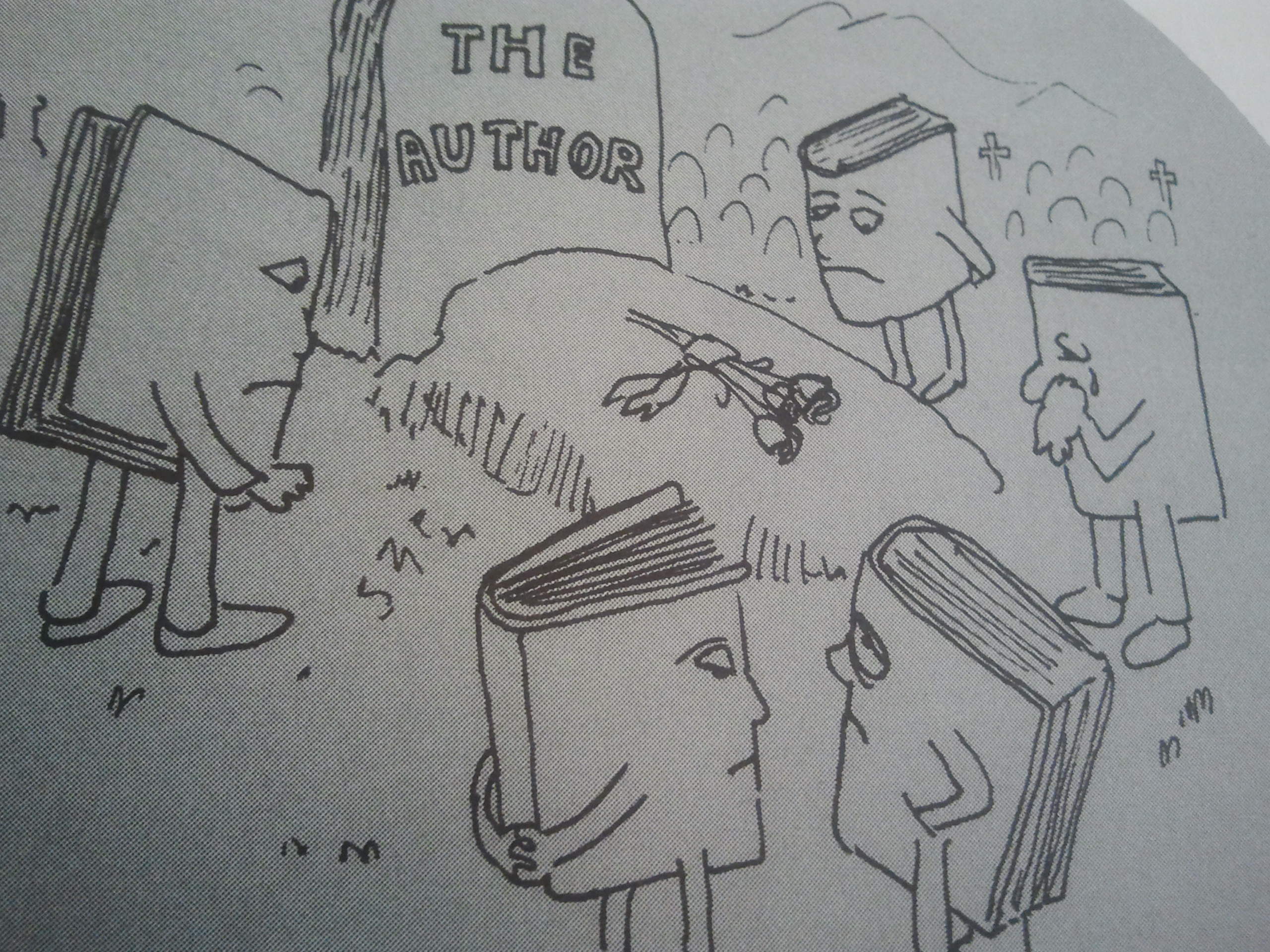
Cartoon by Donald D Palmer 1997

I’ve recently been giving a lot of thought to an essay I read during my freshman year at New York University entitled “The Death of the Author” by Roland Barthes. The gist of the article is that “to give a text an Author is to impose a limit on that text, to furnish it with a final signified, to close the writing.” At first, I disagreed that any piece of writing or art could be considered without an understanding of the author’s intentions, but as I continue my journey in the world of art and writing, my views are beginning to line up with the idea of a self-governed piece of writing. Once the character is on the page, it is she/he who is doing the thinking, acting, developing, not the author. Once the painter frames his work, it is no longer his, but an autonomous presence inviting the world to engage with it in diverse ways. An example of this is the art of Jackson Pollock.

Jackson Pollock “Autumn Rhythm” 1950

As with any artist, there is an unquestionable amount of control exerted as a means to facilitate the art. However, Pollock invites a certain amount of chance into his works by using methods such as splattering and dripping paint onto the canvas. As soon as the paint is released from his brush, stick, or can, it has a life of its own and flies to the canvas without any certainty where it will land or how it will splash. This is a very literal example of the larger point, but recognizing the autonomy of any work is crucial to understanding it. The world of the painting, the musical composition, the work of literature, or any  other completed work offers an escape into the fantastical for anyone willing to engage with the piece and allow it to take them where it will. Much of art criticism and review comes back to this. In the end, it is just people talking about how they engage with art. The author or artist’s intention is only as important as you make it, it doesn’t have to taint the way the work speaks to you. When I was much younger, my school would take us on field trips to hear the local symphony orchestra. While they played, I would make up stories in my head to the tune of whatever song was playing. I can almost guarantee that the composers and the musicians were not imagining their piece playing out to my juvenile narratives, but that doesn’t mean that my connection to the piece is not just as valid as say Stravinsky’s vision in composing The Rite of Spring (though undoubtedly less complex or sexually charged).

I used to be so intimidated by art, fearful to develop an incorrect understanding of it when facing it down without the artist or a scholar guiding me, but thanks to my return to Barthes, I now realize that I am not helpless. By freeing art from the constraints of an artist’s intention, we open ourselves up to a whole new way of engaging with all of the art around us. In Barthes’ words: “thus is revealed the total existence of writing: a text is made of multiple writings, drawn from many cultures and entering into mutual relations of dialogue, parody, contestation, but there is one place where this multiplicity is focused and that place is the reader, not, as was hitherto said, the author.”