
The Cyclical Passage of Time

The animated .gif, or simply GIF, has come a long way from its flashy pixelated beginnings of the early internet. Now used to illustrate concepts, used to register any and every manner of sentiment, lifted from every second of video as soon it hits the internet, it has proliferated, its use commonplace, normalized. Recently, a variation dubbed the cinemagraph has tentatively appeared. The movement in the image is usually very isolated and very small, leaving the remainder of the image still while the subject flutters or flickers or flows in part of it. The movement, moreover, is smoothly looped in a way that the movement seems seamless and continuous. Most of easily found cinemagraphs on the internet are the work of several photographers who developed the format and coined the subsequent term, but others are out there too.
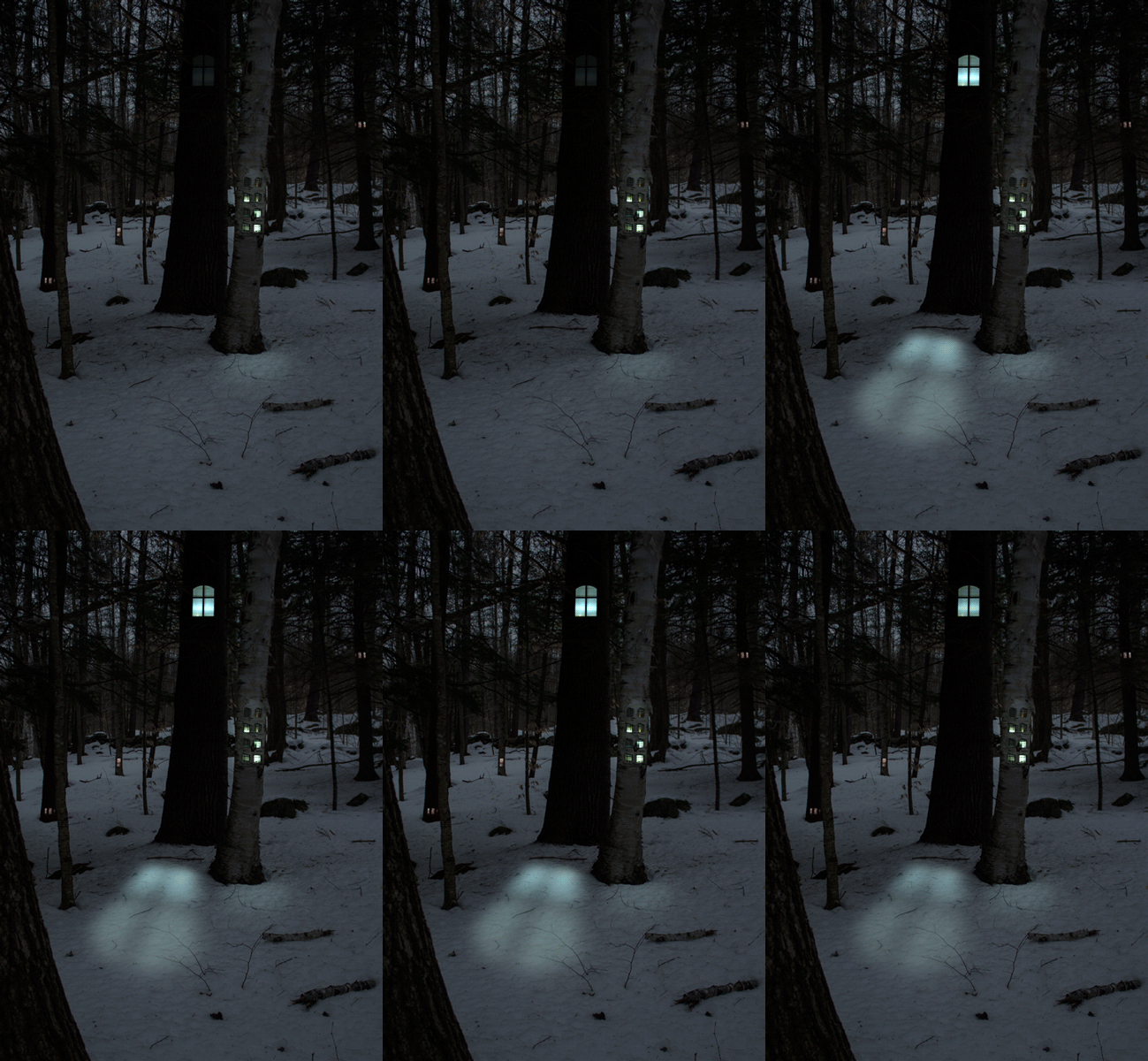
One such is artist David Barreto, who recently created a series of photomanipulations entitled Woodhouses. Parts of houses— windows, doors— have been grafted into the bases and trunks of trees as if they belong there. What should look so very artificial instead looks natural, integrated, organic. The trees themselves are unremarkable, one of many in a wood, standing often in the half-light of predawn or dusk. At first glance, that is all there is to it. But then the windows’ fluorescent lights flicker, dim, and flicker again, casting cold rectangles out onto the still snow.

There is something about the scene that is very much reminiscent of the streetlight at night and the flashing neon sign of the corner shop, the 3am car alarm and the sudden quiet after it is shut off. A man’s muffled curse and the distant sound of a door slamming shut, and then the silence resumes, a thick blanketing silence that the darkness corroborates. The harsh light, greenish, or orangish, perhaps, cuts into it oddslot, revealing, intrusive, but nonetheless silent, wordless. And that is what Woodhouses embodies, it seems. The nature of the medium demands silence; it is an image, not a video. We are intruders looking into lit windows at night, and the abrupt light is an intruder upon the darkening winter landscape outside.

The isolated animation is crucial to the effect. Because the environment is static, its details remain important. They will not pass out of frame as they might in video. And yet some part of it slips the moment, the singular moment in which an ordinary photograph might be captured, and it moves. It catches us by surprise. We cannot be too complacent, too unobservant, because something happens. Time cannot travel too far, however, because then the motion circles back on itself, and we are again suspended in the moment, preserved.

Out of Our Pores

Hair is said to be stronger than rope. When wrapped together, strands of hair can become unbreakable bonds of keratin. Whether it be on our heads, faces, arms, legs, chests, toes, or any combination of these, most of us have this substance seeping out of our pores. It is strong, it is powerful, and it has potential. Whether or not we employ this potential for the sake of expression, it remains. We call it hair.

As humans, we are mammals, and unlike many of our kind, evolution has carried us to become significantly less hairy creatures over time. Despite the fact that we have so little hair in comparison to our comparable animal species, such as dogs, gorillas, and woolly mammoths, much time and management goes into the industry of caring for and dealing with hair. We care about the color, the length, the texture, the way its shaped, its thickness, its volume, its body–and how it represents us as members of a civilized culture. The social constructs behind hair, this natural part of our bodies, are pointlessly complex and restrictive. Women are expected to shave their legs and wax their bodies, becoming relatively hairless besides the hair on the top of their heads–of which they are expected to keep well-maintained and styled. Men are typically viewed in the opposite sense–to have hair on their bodies but short hair on their heads. While modern times have been able to minimize the stigma behind this constructed “rule,” as women are typically seen to have hair of any length while some men sport long hair, there is still a clear distinction between the hair lengths and styles of men and women. Regardless of length, women are expected to have their hair styled and well-maintained, while there is no expectation for men. Breaking from this gender normative lens, additional constructs and expectations are formed for people who may be gender non-conformist. Also, despite this U.S.-centric lens, other cultures have different values behind body hair and acceptable hair styles. With all these factors playing into the boundaries for style, true expression over the artistic medium stemming from our bodies is censored by the culture we live in. In order to truly express oneself via hair, the individual must be willing to break the mold and not fear the snap judgments of other members of society who may fear this deviation from the norm.

Whether it be a woman letting her leg hair run wild or a man taking a curling iron to his beard, hair can become an expressive medium if given the chance to grow.

Xylem Release

On Friday, March 29 2013 while strolling down State Street, full of grilled cheese and veggies from Mark’s Carts, the commotion and bustle of the Work Gallery captured me. Low and behold, the perfect post-dinner snack for the mind’s eye lay before me in the form of the Xylem Release party.  Select writers were chosen to perform their pieces during this release, personal works that I only dare to scribe.

The most striking piece was a poem written by Seth B. Wolin. I do not know Seth B. Wolin. And yet, his piece spoke volumes to me. He spoke of the simultaneous individuality and anonymity of the masses, as well as the simultaneous cultural preservation and gentrification balance that most cannot seem to hit correctly. He spoke without excess drama and perfect smoothness.

Wolin explains his poem to be about a man he encountered in New York City, one that he would never meet again.  I truly respect the lack of narcissism in this piece, the ode to observation, and the understanding of the cultural struggle that is so prominent and often escapes those who are not overtly foreign.  He perfectly taps into the thought process I constantly experience on the subway in NYC, running into

biletul zilei cu meciuri din fotbal biletul zilei biletul zilei de azi la pariuri sportive

strangers and wondering what their story is, and how they ended up here. The poem reads:

Figure on the Five Train
5’9” fresh-faced

transplant from Ukraine.
Where is your father?

Here, there is no province.
Only concrete asphalt red win
sky – starless, bounded monolith of

sky.

Not like home. And yet, neither
are you.

Short, precise, and powerful. Just the way I like em.
“Xylem Literary Magazine is an independent, student-run literary magazine at the University of Michigan that annually publishes original undergraduate student writing and art, including poetry, fiction, creative nonfiction, artwork and photography. The journal exclusively features the creative work of University of Michigan undergraduates, and all aspects of the journal’s publicity, production, and publication are student-run.”

Opera Splashes and Sparkles in ‘Ariadne auf Naxos’

I went to the opening night of ‘Ariadne auf Naxos’ and without reading about the libretto beforehand, I expected something that was stuffy, long-winded, and probably involved corsets or women dressed like this….

Boy was I wrong. What I saw on Thursday night more closely resembled this…

For those unfamiliar with the Greek mythology behind the Strauss opera, Ariadne was a human abandoned by Theseus on the island of Naxos, who spent her days bemoaning his loss and refusing all company except that of Death.

But contrary to my initial impression, this was not the only storyline.  In fact, it served more as a story within a story.

In the prologue of the play, two troupes (a dramatic opera cast and a burlesque show) prepare to entertain a duke and his guests.  However, amidst the hustle and bustle that comes before any performance, both troupes are informed that due to time constraints, they will no longer be performing one after another.  Instead, the duke demands that they combine their arts into one cohesive performance.

What results and forms the bulk of the opera, is the tragic tale of lonely Ariadne on the desert tale of Naxos who is greeted by the funny and flirtacious Zerbinetta and her fellow comedians, who show Ariadne how to pick herself up, dust herself off, and start all over again when the Greek God Bacchus shows up.

The set design closely resembled 1920s Art Deco, with simple, clean lines and flashy costumes.  Most of the men wore suits or tuxedos apart from the comedians, who donned bathing suits and flippers upon learning that they were going to a desert island.

Although every piece was eloquently executed (I was very impressed by the performer’s elocution with the German libretto) my favorite piece by far was Zerbinetta’s operatic version of ‘All the Single Ladies’ aka ‘Grossmachtige Prinzessin!’.  In this rendition, Zerbinetta wore a glimmering red flapper dress and sang about how every time a new ‘god’ comes along in her life, she is dumbstruck.  It wouldn’t be a burlesque show without a parade of tuxedo-ed men who each got their chance to dance with Zerbinetta before she changed her tune and moved on to the next one.  This number made me realize just well-trained opera singers are.  Apart from dancing and interacting with the other performers on stage, Zerbinetta made her laugh sound absolutely melodious, like a group of bells trilling underwater.

When I laugh, it either sounds like a horse or a dying moose.  But never like bells trilling underwater.

I left the performance feeling like I had gotten my money’s worth and to top it off, I was handed a pamphlet for one of the performer’s senior recitals coming up in Kerrytown.  This performance gave me every reason to see more great vocal performances and to continue my support for one of the oldest performing arts still in business.

Go opera!

Image credits: http://wodumedia.com/chicago-2002/catherine-zeta-jones-in-miramaxs-chicago-2002/ and http://www.music.umich.edu/ContainerBridge.php?path=%2Ffmi%2Fxml%2Fcnt%2Fdata.jpg%3F-db%3DRecital_Form%26amp%3B-lay%3DCOE_Fall_2008_Layout%26amp%3B-recid%3D7499%26amp%3B-field%3Dimage(1)

Pysanka, Hampstead, and the New Hunt for Egg Art

As a kid, some of my most vivid memories were Easter time when I was given the opportunity to hijack the cartons of eggs in the refrigerator, and create dozens of pretty pastel or neon colored treasures. The worst part was waiting for them to boil and harden, yet when they were ready for my eager hands, I jumped at the opportunity to get my markers, dyes, and glue stick out, so I could use my imagination in creating some of the most original Easter eggs ever.

For some this tradition is unchanging. Kids continue to enjoy the artistic freedom of recreating meal-worthy eggs to original artwork, and many adults still hold on to this time as an opportunity to showcase the possibilities that can come with the spherical blank canvas.

Pysanka (you may have encountered some of these Ukrainian beauties recently) are Ukraine Easter eggs made with wax resist and dye. These eggs mirror some of the traditional Ukrainian folk designs and can bear any design imaginable. The ancient Ukrainian’s viewed eggs as sources of life, and as the time progressed the ideology remained intact, and many Ukrainian families practice the tradition of Pysanka each Easter. These marvels open up the endless possibilities with egg designs, and are open for those willing to learn.

Traditonal Ukrainian Pysanka Eggs

Within the Hampstead School of Art in London, England, the egg hunt is for a different purpose. Sarah John, operations director of the school, created her giant Easter egg in hopes of reviving the fun of the Hampstead neighborhood, and the fun that art can be. The Egg stands at 3ft, and seems to have brought some light into the districts troubles. For more info check out the Hampstead Egg.

Artist Sarah John who made the giant egg for the Hampstead Easter egg hunt. Picture: Nigel Sutton

Artist Sarah John: Nigel Sutton

The new hunt for egg art has quietly taken over and brought a dynamic take to the tradition of egg decoration. Given the beauty of the new movement within egg art, from the detailed colors and designs, to the overall grandiosity, I judge the the majority of egg recreation will stray from a mushed up marker, color dye, and a glue stick, to some of the endless options developed in kid’s imaginations.