The other day, I went home for the weekend and to catch up on sleep and on Saturday night, catch up with my older sister. Â We were sitting on her couch contemplating what to do for the rest of the night when suddenly, she got this mischevious look in her eyes that made her look like a third-grader with a secret to tell.
“What is it?” I asked.
“Oh nothing,” she said, like there was definitely something. Â “Just…I feel like watching a really girly, really sappy movie. Â Would you be up for it?”
“You bet!” I remember saying. Â I was relieved that she didn’t tell me she had cancer or something. Â But afterwards I thought about the trepidation she must have felt before asking me about what to do for the night.
And it got me thinking, as an avid cinephile and bibliophile, why are some people so ashamed of watching films or reading books that are in a genre? Â What’s so bad about chick-flicks and chick-lit that makes normal people scrunch their faces and avoid asking you to watch them?
Does calling a movie a ‘film’ elevate it to some sort of high status? Â Does ‘Literature’ confer a sort of sacredness to texts that ‘Thriller’ does not?
As someone who loves serving up some Austen, Tolstoy, Baudrillard, or Borges from time to time, I will also admit that I have read ‘Bridget Jones Diary’ waaay too many times to count.
And I’ve laughed out loud every time.
Gets me every time.
That is something that reading Baudrillard has never made me do (except when I’ve laughed at Baudrillard to avoid crying because I have no idea what he is saying).
Never gets anyone laughing, but is lauded for dissing Disney World.
I am not saying that one is better than the other. Â From time to time, I NEED challenging literature in order to assure me that my liberal arts brain can still function. Â But from time to time, I think even the liberal artsy should get down from their marble column and descend into the pages or film clips of the genre book or movie and not be ashamed of it.
In response to “The Circus of Fashion†by Suzy Menkes, I’d like to address the “seriousness,†or lack thereof, of fashion moguls and the level of austerity that is expected of the truly fashion elite.  Menkes explains that those truly dedicated to the art of fashion are, and should be, adorned in nothing more than black looks head to toe, in contrast with the fire-heeled, Margiela masks, and intergalactic sweatshirts of late.  The forefront of fashion, according to Menkes, has shifted from these serious types “into a zoo: the cattle market of showoff people waiting to be chosen or rejected by the photographers,†referring to the recent surge of Street Style celebrities captured by Tommy Ton, Scott Schuman, or Leandra Medine.  It seems as though Menkes believes that shows are meant for those of true fashion professionals: editors, buyers, and stylists;  those who peer off Style.com or Nowfashion are not worthy or fashionably educated enough to offer critique .
Yes, I agree that much of fashion “blogging†and amateur attempts at influencing fashion via the web are lackluster (read lookbook.nu and the oceans of unoriginality and sponsorship that follow). And yes, the successors of Project Runway type shows do follow a somewhat ridiculous “American Idolâ€-style initiatives, in which a public vote selects the fashion winner.â€Â But to criticize the public availability and creation of opinion of fashion is itself even more ridiculous than all the rest.   What would art be if it were only meant for art collectors, and those “truly serious†about craft? Isn’t the purpose of all artistic forms to express a feeling or emotion, and emote that to the world? And aren’t all collections ultimately at judgment of the public?  Yes, those who have been in the industry may be able to understand the originality or cohesion of a collection “better†most. However, this should not change the fact
that I am also entitled to view and form personal judgment. Without Style.com or NYMag or Refinery29, I, someone who is interested in fashion, would never have access to something that I am passionate about. The rise and importance of the social media generation has only helped to quickly spread information worldwide. How can fashion then be mutually exclusive from this sphere, where technology rules all, and anything remotely public spreads virally?
In that same light, aren’t those who blog about personal or street style attempting to tap into their own artistic expression via sartorial means? If an aspiring artist were to show the world her newest painting on the web, would she be subject to similar sentence?  Menkes contrasts the “circus-like†showing of show-goers outside fashion tents, those sporting high contrast prints, sky-high shoes, and surreal headgear,  with “the opposite of look at me fashion,†wearing the most basic but craftfully structured pieces.   But who is to say that fashion is meant to be entirely serious? What is the point of it all if we can’t live our lives in it? As a person entering the fashion arena, why is it that the Dedicated pros†must only be “dressed head to toe in black?†It seems to me that Menkes, and those who criticize, are missing the point.
After my second workshop with high school students as a part of the Hip Hop Academy, I officially feel outdated in the Hip Hop world. Not to say that I do not stay up to date with the current Hip Hop releases and activities, but it is clear that the same artists and music that caused me to fall in love with the culture are irrelevant, if not unheard of, according to teenagers just four or five years than me. Common, Talib Kweli and Jay-Z have been replaced by Meek Mill, Drake and Kendrick Lamar. While there are positive qualities to be discussed regarding these contemporary rappers, (particularly in terms of Kendrick) they distinctly lack the 1990’s style of early Hip Hop that defines the genre. These rappers helped establish true Hip Hop, and albums such as Mos Def and Talib Kweli Are Black Star, Reasonable Doubt, Illadelph Halflife and Resurrection embody the fifth and most essential pillar of Hip Hop: Knowledge, more than anything Drake or Meek Mill has produced. So even though Biggie Smalls and Tupac are still synonymous with early Hip Hop, Nas, The Roots, and the A Tribe Called Quests of the 90s are no longer discussed or noticed.
Comparatively, this is a shame. The majority of Drake and Meek Mill lyrics focus on drugs, money and women, and the glorifying fame this lifestyle brings. Of course, Common, Nas and the rest were rapping about these topics as well, but they were doing it in a much more socially minded, creative manner. For instance, one of Common’s most famous tracks, “The Light†serves as a platform for Common to discuss how his love for a woman extends beyond a purely sexual relationship, and how he would never use sexist terms such as “Bitch†directed at her. Meek Mill’s song “Amen†featuring Drake features lyrics like, “Shorty wanna f**k me, I say get on top and roller coast.†Not the most intellectual statement about women ever delivered in music. The same topics of drugs, women and fame have transitioned from forms of economic hustle, entrepreneurial spirit and meaningful relationships to testaments of power, success and male dominance, which perpetuate the negative stereotypes against Hip Hop culture. Any critic examining Hip Hop today would obviously assume that the genre of music promotes taking advantage of women, abusing drugs and alcohol and irresponsibly partying, as that is what the majority of Hip Hop says today. This is a shame, because Hip Hop has always, and always will, stand for so much for more.
However, it is not surprising that today’s youth idealizes Meek Mill and Drake. They produce catchy, attractive music that offers an identity and culture to which to attach; and not all of it is bad. Meek Mill promotes a life outside of prison (having gone to jail and sworn never to return) and Drake has said something intelligent here and there. Kendrick Lamar, while producing aesthetically different music than the 90s rappers, preserves their habit of writing creative, intelligent and socially conscious lyrics. As much as I would love to share my love for the artists that, for me, define Hip Hop, I unfortunately cannot force 10th graders to see it the same way. I am left with the only prospect of finding the same values, creativity and genius in today’s rap if I hope to support Hip Hop’s last and crucial pillar.
I’ve always found it interesting and amazing that the portraits of the (debatably most) important Hindu goddess, Durga, differed region to region. Before you roll your eyes, frown from incomprehension, or click at some other link, let me explain myself.
India is a wee bit complicated. The country itself doesn’t have one unified identity; there are many regions that have their own languages, ways of dressing, cuisines, ideologies, and traditions. To bring that into perspective, imagine going to Indiana, right downstairs, and everyone speaks a radically different language, the art and architecture look completely different from Michigan’s, the men and women wear togas rather than jeans, and you can’t recognize anything that they’re eating.
Yep.
So, in a sense, the word “Indian” doesn’t really mean anything in terms of summarizing a culture because… well, an “Indian” culture doesn’t exist.
Which makes the art throughout the country so interesting. Like so many other cultures around the world, art and religion are inextricably linked. Hinduism especially relies on art because it places such high importance in the visual aspect of religion. Stories of famous mythologies are painted on the streets and temples and images of gods and goddesses are omnipresent. I mean everywhere. Bumper stickers, posters on restaurant doors, statues at business entrances and every empty crook and cranny on the streets, walls in houses. Literally everywhere.
My dad’s job had us traveling throughout India so I couldn’t help but notice how radically different the images around me were, despite depicting the same figures. Durga is particularly interesting. She’s an Indian goddess in some sense because many Muslims and tribal people also worship some form of her, not just Hindus. She is hailed as the Supreme Goddess and the origin of all energy and life in the universe, a timeless maternal spirit that pervades everything, transcends time and religion, and ensures that the world remains in balance. Think Eywa, from the movie ‘Avatar.’
Here’s a statue of Durga from my home province, Andhra Pradesh.
A Priestess in Tirupati, Next to a Painting of Durga
Note how colorful and vivid it is. Also, note what the Goddess is wearing. A fairly simple sari. The people of Andhra are traditionally farmers, very rural people. Though we’re known for having a beautiful and poetic language, we’re simple people who toiled away in the lush lands of southern India. Hence, the folksy, bright colors and fairly simply draped sari. Juxtapose this with the sophisticated refinery that is the North.
The Goddess Durga, Kicking Ass
Northern India has seen far more attacks and conquests, from the Muslim Mughals to the Christian British, and has been more directly placed under their rule than southern India. Thus, the depictions of the Goddess tend to be more anglicized and highly influenced by what is considered beautiful by that region of the country. Her body is generally made of white marble to reflect the more appealing (to them) aesthetic of having lighter skin. Her garlands are made of roses, as opposed to native flowers such as the hibiscus or the marigold flowers. Her jewelry is also more intricate and contains many gemstones and pearls whereas in southern depictions, She wears extremely ornately designed gold due to relative abundance of gold and lack of gemstones in the south.
The Bengali Durga
Depictions of Durga from the state of Bengal are radically different from all other regions, especially in terms of Her distinct facial structure. Also, while northern India generally depicts Durga as marble white and southern India depicts Her with a more flesh-colored tone, Bengalis depict Her with yellow skin. I mean the yellowest yellow of all the yellows you’ve ever seen. Her bindi (the marking on her forehead) is also more intricate than the standard red dot and her jewelry is out of this world.
The Yellowness of Durga
Durga is the Bengal’s most loved deity and Her festivals are celebrated with more pomp than any other.
A depiction of Durga from Tamil Nadu, the southernmost state of India:
Tamil Durga on a Random Street in Tamil Nadu, Also Kicking Ass
Her skin color is a lot darker. It is also common to find Durga statues made of black marble in these parts of India because they more accurately depict the darker pigmentation of southern Indians. Also, Her bindi is completely different (three horizontal lines and a red dot in the middle) to reflect a more popular strand of Hinduism in Tamil Nadu. The usage of animals more prevalent in this region, such as buffalo, is common in imagery associated with Her.
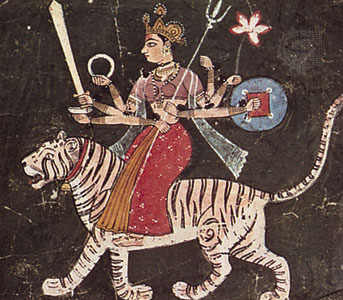
The following depiction is from Rajasthan, a state in the north that perhaps had the greatest association with the Muslim Mughals. She has on a blouse and a long skirt and drapes Her sari over her shoulders rather than tying it around her body, like the women of Rajasthan. The way She’s painted, with Her head facing the side but Her body facing the viewer, is a direct influence of the Mughals, who also painted their figures this way.
A Rajasthani Painting of Durga
In the coastal Orissa, where peacocks are especially used as a sign of beauty and majesty, silver is abundant, and jewelry is designed after the beautiful conches and seashells found along the beaches.
Durga from Orissa
In Assam and Tripura:
Common Depictions in Assam and Tripura
Depictions of the Goddess are endless. There are paintings and statues of Her naked, clothed, blue, green, black, orange, with bindis of all shapes and sizes, with Oriental features, with blue eyes, etc, etc, etc. But this post is getting way too long and I’ve realized now that none of these pictures do justice to Her or to the beautiful statues and paintings they’re portraying.
She screams at my face and my heart beats faster, my hands get sweaty, I can’t breathe, I can’t think, all I want to do is cry and cheer and love and “kill mother-fuckers who stay stupid shit to me.â€
She says everything I have ever felt. The way she growls her pronounced “r’s†and “ow’s†and kills with her “c’s†and “k’s†hit me like capitalism hits me every day. Like homophobia hits me like the garbage from car windows. This time, however, it isn’t trash or consumerism or money but it is solidarity. Her fist is up in the air and her words light the flames to everything I have ever wanted to burn: society and the faux-leftist agenda of assimilation to create people as people as humans and not as queer or black or working-class or woman or undocumented or disabled or. . . the idea that our humanity brings us together rather than our different lived experiences.
“the new fangled fallacies / of sexual and racial freedom for all / these under-informed / self-congratulating / pseudo-intellectual utterances / reflect how apolitical the left has becomeâ€
–
6pm. I step into the room as a role call of identity rings out and my ears begin to bleed. I hear calls for [marriage] equality and my ring finger shrivels away to fall off by my aching feet. I feel awkward yet alive in a space that I worked to build 2 years ago, but today it is another’s. I inch closer to the man in all leather and rubber and platform boots and red hair, soaking in the past quicker than the room realizes that MBLGTACC 2013 is here. Right now.
We sit together in the Lansing Center amidst our intersex, transgender, lesbian, bisexual, gay, gender-non-conforming [etc.] identities. This chance comes once a year and it is in this moment when I realize that I better pay attention. Pay attention to what is said what I agree with what I actively hate what I love. Pay attention to the space and the community and the environment because come 48 hours from now I will be in a different society. Breath it all in till my lungs fail.
–
“the time to act is now! / Now! while there are still ways we can fight / Now! because the rights we have are still so very few / Now! because it is the right thing to do / Now! before you open the door to find / they have finally come / for youâ€
The ending to her poem scares me. My thoughts are radical, my thoughts aren’t normal, my thoughts will get me into trouble. Future tense. I want to run out of the room and fight for everything I believe in, but I stay seated. I want to protest and burn and educate and learn and be checked, but I hang out with friends and dance at a club. I want to scream at the top of my lungs–so instead I’ll write at the top of my lungs.
Good poetry is aesthetic–sure. Good poetry performs well–not always. Good poetry gets you out of your seat, makes you throw a book or strip naked, and makes you come alive–yes.
Good poetry is truth.
Staceyann Chin is my poet of choice. She comes on stage from flying with her baby and lays it all out. She acts along with her poetry, she performs her emotions, and she screams as if she is dying. Never in my life have I been so affectively affected.