REVIEW: I, Tonya

To be perfectly honest, I had only the vaguest background knowledge on the infamous Tonya Harding scandal before I saw this film. I knew that the affair had something to do with competitive skating and foul play, but was ignorant of the details. I came across a recent New York Times interview with Mrs. Harding Price, which is what piqued my initial interest in the film.

I wasn’t sure of what to expect. If anything, I anticipated a sober, first-person account of the events surrounding “The Incident” (as the scandal is referred to in the film). However, the audience received a quirky, almost playful set of mock-interviews from the actors portraying different figures in Tonya’s life, from her ex-husband to her mother (think: Emperor’s New Groove- esque). There is dark humor prevalent in this film, sardonic and bitter, which draws the viewer into Tonya’s backstory, from her first encounter with the ice rink as a three year old. The dark comedy extends to make the people in Tonya’s life, from her abusive mother to her abusive ex-husband, more human.

Tonya Harding led a difficult life. From a childhood devoid of parental affection to a violent and toxic relationship with her ex-husband, all she really longs for is to be loved. In fact, later on in the film, after completing her famous triple-axel, she relishes the cheers of the audience, reveling in how finally, she feels loved and adored. In almost every aspect of her life, Tonya is denied of a concrete expression of validation from the people in her life, and this makes her beaming response to her achievement hard to watch.

In many ways, I, Tonya is a film about classism. From her early years on the ice, Tonya struggled fiercely with her background as a child from a poor, working-class background in the world of figure skating, which nearly requires skaters to exude airs of luxury, to be princess-like in speech, manner, and dress. Tonya’s unconventional music choices for her routines, as well as her hand-made skating outfits, branded her as an outcast, a label she worked hard to overcome. However, the film is also about love and violence, and how the two coincide.

This film has caused me to view Tonya Harding in a more sympathetic light. Without spoiling some of the best scenes in the film, I would like to point out that while her role in The Incident is true, it does not stop me from empathizing with her and everything she has been through. Margot Robbie did a fantastic job portraying Tonya Harding, and I found myself laughing, weeping, and wincing, sometimes all at once.

I, Tonya will be screened at State Theater until January 18. Student tickets are $7 and can be purchased here.

Image credit: Rolling Stone

REVIEW: The Shape of Water

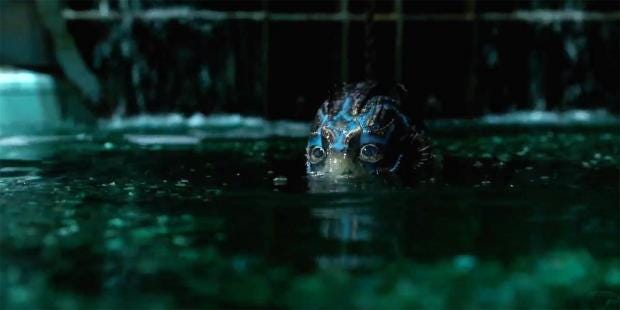
Water has always held a mysterious place in our collective imaginations. It simultaneously acts as a healing, life-giving force while having the power to sweep away all our proud civilizations in one thundering wave. Perhaps no movie has done a better job of embracing the paradoxical nature of water than Guillermo del Toro’s new film, The Shape of Water. It is, after all, a film of many contrasting forces. Man and woman. Land and water. Human and inhuman. Silence and sound. At the center of it all is Elisa Esposito (Sally Hawkins). She lives a quiet life in a small apartment building near Baltimore. By night, she is an overlooked cleaning lady in a government laboratory, reduced to, by most of her work fellows, as the ‘mute woman’. By day, she spends her time delightfully consuming musicals with her neighbor, Giles (Richard Jenkins). Elisa’s life takes a turn when the drab laboratory gains an exotic new asset, an amphibian humanoid closely guarded by the sinister Colonel Richard Strickland (Michael Shannon). Strickland regards the creature as only as an opportunity to spite the Soviets and gain an upper hand in the Space Race, but Elisa’s sympathy soon leads her to a different conclusion.

Del Toro brings the audience into this world with his typical stylistic flair, transforming Baltimore into a land of marshy greens and greys. The color scheme makes the reds and yellows stand out like warning flares in the night. The film is full of these bold colors from the theater sign that lights up Eliza’s apartment building to the stop lights of the streets. Even the occasional factory fire is rendered into a beautiful, distant painting. It is a past that is both nostalgic and fantastical, a thematic approach that is echoed in every environment of the film. For example, the laboratory may be extremely mechanical with its dials and rivets, but it also houses an otherworldly creature from the Amazon. Elisa and her friends are perfectly imperfect for this strange place. Elisa’s inability to speak and Giles’ repressed feelings for other men render them as much abnormalities to this society as her new friend. It is an America, so afraid of Communism, that it demands absolute standardization among its citizens. Thus, the fantasy element of the movie serves to reinforce the real world instead of undermining it.  The world around Elisa is already a surreal place, a planet on the path to nuclear self-destruction. It is does not take too much imagination to place a strange fantasy creature in the middle of it all.

Cleverly, del Toro also inserts sound at every opportunity. Elisa, as mentioned repeatedly to ignorant coworkers, is not deaf, but mute. Her life is filled with noisy alarm clocks and crooning records. She even first interacts with the ‘asset’ by carefully tapping the glass of its container. Both Elisa and del Toro understand the importance of sound. It is a powerful, but oft-ignored force, just like her. Elisa’s may lack a voice, but she makes up for it by using sound in many other ways. It is yet another element that makes the world feel expansive and important.

The movie falters, however, when it takes one predictable step too many. Elisa and Strickland were always destined to collide. Their views on what constitutes humanity were simply too divergent, each informed by the lives they have been given. Strickland, privileged by his power and his all-American nuclear family, sees difference also as error. Elisa appreciates and even grows to love those that accept differences instead of judging them. However, these complex and interesting characters are done a disservice by a plot that feels overly familiar, especially when compared to del Toro’s first success, Pan’s Labyrinth. In that film, he mixes environment, character, and plot in just the right amounts. In this one, some elements are vastly more original than others, leading to a final confrontation that feels trapped by convention. It was an attempt to amaze and shock that fell flat. Despite what I consider a rather lackluster ending, I thoroughly enjoyed this film that immersed me (pun intended) into a world that was full of detail, color, and life. The Shape of Water manages to capture the elusive elegance, the seductive power that can only belong to water.

PREVIEW: Aftermath: Landscapes of Devastation

Aftermath: Landscapes of Devastation offers an unflinching look at environments wrought with decay and destruction. Opening at UMMA this Saturday, the exhibition forces viewers to search for traces of beauty amidst landscapes of despair.


On view January 13th – May 27th at the University of Michigan Museum of Art (525 S. State St).

Presented by the Herbert W. and Susan L. Johe Endowment, with support by the University of Michigan Department of Screen Arts and Cultures and the School for Environment and Sustainability.

REVIEW: Accidental Photographer: Seoul 1969

Dr. Margaret Condon Taylor’s snapshots of 1969 Korea offer a glimpse of a nation on the brink of rapid transformation—a moment of stillness before the spectacular growth to come. The U-M Nam Center for Korean Studies’ presentation of Accidental Photographer: Seoul 1969 showcases Taylor’s work from this period, revealing the beauty of a Seoul in transition.


Taylor’s focus is attuned to the humans that make up the city, whether confronting or turning away from the camera. Her shots capture opportune moments through muted tones; ethereal Ektachrome whites and blues transfix viewers. Despite the images’ presentation without object labels, the exhibition is remarkably clear. Each image teases a hint of a hidden-away historic Seoul.


In her photographs, Taylor documents a Korea that is now inaccessible in many ways. Her visual archive of the capital city, however, can still be visited. Accidental Photographer presents the human essence of a Seoul that we as viewers pray still persists today.

PREVIEW: Red Circle: Designing Japan in Contemporary Posters

Explore the 1980s work of three Japanese artists who shifted outside opinions of their country with their striking graphic designs. Red Circle: Designing Japan in Contemporary Posters presents the pioneering joint efforts of Ikko Tanaka, Shigeo Fukuda, and Kazumasa Nagai.

On view January 6th – May 6th in the Jan and David Brandon Family Bridge at the University of Michigan Museum of Art (525 S. State St).

Presented by the E. Rhodes and Leona B. Carpenter Foundation and the University of Michigan Center for Japanese Studies.

PREVIEW: The Shape of Water

Guillermo del Toro has the knack of tackling unsettling subjects. Whether it be depicting the Spanish Civil War through the lens of a twisted fairy tale in Pan’s Labyrinth or a bleeding, haunted house in Crimson Peak, del Toro has never shied away from showing the beauty within the ugliness. It certainly seems as if he has done so again in his newest film, The Shape of Water. The Shape of Water puts del Toro’s skills to good use, by focusing the story around a mute cleaning-woman named Elisa who discovers the existence of a mysterious aquatic, human-like creature from South America. Her friendship with him is quickly endangered by emerging threats from the government and the science lab that houses him. I am looking forward to yet another del Toro film that centers around a woman. He does an exceptional job depicting characters that are often marginalized or unheard. With del Toro, it is just another stale romance. It is always something different and decidedly strange. The Shape of Water is currently showing at the Michigan Theater. Purchase tickets ($8 for students with ID), online at the Michigan Theater website or at the box office.