We are rapidly approaching the end of the semester which means I only have a couple of posts left. This week I’m posting a day late because my organization, MUSIC Matters, held our biggest event of the year. If you attended SpringFest day festival or the night concert featuring Hippo Campus – I just want to say thank you. We all appreciate it so much and hope that you enjoyed it.
Moving on, this week we are talking about Mentality Magazine! I had the opportunity to speak to Liz Hoornstra, the current editor-in-chief of the publication. She explained that the magazine aims to do two main things: 1. Create a sense of community for its members and 2. Destigmatize mental health through writing. As someone who has been focusing on taking control of my mental health for the past year, I was really excited to learn more about how the magazine has done this and how others can support their mission!
Mentality Magazine typically publishes digital issues, with a printed copy done once a semester. This semester marks an exciting milestone for the organization: 10 printed publications (and 5 years of being an org on campus!). Some of the topics they’ve been focusing on most recently deals with the impact that the pandemic and racial injustice towards the BIPOC and AAPI communities have had on peoples’ mental health. This follows in their larger commitment to diversifying the magazine’s staff and writing focuses, including highlighting marginalized voices in mental health discussions. I was excited to hear that they’re taking on these topics so directly, as they have affected us all in different ways over the past year and are, in many ways, directly tied to some of the most widespread mental struggles on campus.
Mentality Magazine has also recently partnered with steps wellness, “the mental wellness platform for college students”. The platform helps connect students to licensed therapists, provides safe, private spaces for them to have therapy sessions in person or through video call, and allows them to share and read about their peers’ experiences with mental health. This is something that I found incredibly important. Especially in college living situations with many roommates and with most therapy sessions being virtual right now, it can be hard to find a space where you can talk about your struggles without worrying if others will overhear or barge in. This partnership shows that Mentality Magazine is really committed to helping students at every level of their mental wellness journey.
Liz also explained to me that COVID has sparked some important conversations regarding mental health equity and accessibility, things that people were sometimes skittish to talk about before.
“We welcome any and all members to Mentality, but we also are very open that mental health is not a topic that you can be apolitical about and we have to recognize that, holding a space in the mental health community here at Michigan means that there are certain times when we cannot stay silent. I hope that going forward, that is something that we are prioritizing.”
If you’re interested in getting involved in Mentality Magazine, you are welcome to join at any point! They look for writers all through the year, so you don’t have to join at the beginning of the year or semester. You can visit mentalitymagazine.org and fill out the contact form and a member of their exec team will get back to you about the next steps. If you don’t have enough time to be a writer, or that’s not your personal skill set, you can still do other things to help support the magazine and its important mission on campus! Reading and sharing articles is so important – de-stigmatization can’t happen without conversation.
That’s all from me this week! Thank you so much for reading and I will be back next week with my last post of the semester featuring a capella group 58 Greene!
So you’re at the door to a concert, anticipating a night of beautiful music full of romanticism and grandeur. Someone stops you at the door. They give you a booklet. What is this?? Reading material for the concert? Will the concert be so tedious that the audience is handed a short story to occupy themselves with? At the top it reads “a listener’s guide to Schumann’s Davidsbündlertänze”. Hm, a program note, how precocious!
Program notes help contextualize music and are helpful to even the most educated of audiences. For unfrequent concert goers, these program notes ground unfamiliar music to real life, the conception of the piece and what the composer might have wanted to get across. In most cases, program notes are welcome. Only in exceptional cases are program notes unwelcome, cumbersome and hindering the many different interpretations of the music. However, Schumann demands Program Notes!
Here’s Why:
Background
Schumann is a German romantic composer, pianist, and influential music critic who lived from 1810-1856. He wrote a prolific amount of piano music, chamber music, songs, and symphonies. Despite his notoriety as a composer today, during his lifetime, he was mostly known as a music critic. He brought many prominent composers to fame including Chopin and Brahms. That being said, his writings were very important to him and the public. He was very well versed in literature and often would incorporate them into his works. Schumann was a romantic at heart and would include descriptive titles like, “Entirely redundantly Eusebius added the following, but his eyes spoke with rapture” which is the title of the last movement in Davidsbündlertänze. Without program notes, the audience is left in the dark about the context of his various titles.
Titles
I think the Schumann’s most inventive and descriptive titles come from his piano music. Since both him and his wife are pianists, this genre was probably the most accessible genre for him to write. It is also one of the most intimate instrumentations to write for as he generally wrote them for his wife to perform (he could not perform due to a hand injury). Generally, his titles for his movements reflect the tempo or speed at which he wants it to be played at. However, there are two key instances where he deviants from this in Davidsbündlertänze, the last movements of each book
no. 9 Here Florestan stopped and his lips trembled
no. 18 Entirely redundantly Eusebius added the following, but his eyes spoke with rapture
two sides of Schumann
An average program note on Davidsbündlertänze would explain who Florestan and Eusebius are. A good program note would explain why they are placed at the end of each book. A great program note would explain how Schumann’s writings pertain to the piece and bring meaning to this romantic masterpiece.
Other depictive titles would include movements in Kinderszenen such as “child falling asleep” or “the poet speaks”. These types of titles only need a translation and any other explanation would be extraneous.
However, titles in Carnaval are names and an explanation of the event and who these people are would be necessary to give the context of the piece.
(one of my favorite movements from Carnaval)
Literature
Sometimes we need to include program notes to notify the audience of what is written before the piece. In both the Fantasy in C, op. 17, and Davidsbündertänze, there is an epigraph.
In the Fantasy, he prefaced the work with a quote from Schlegel:
Durch alle Töne tönet
Im bunten Erdentraum
Ein leiser Ton gezogen
Für den, der heimlich lauschet.
“Resounding through all the notes
In the earth’s colorful dream
There sounds a faint long-drawn note
For the one who listens in secret.”
Davidsbündlertänze is prefaced with this “old saying”
Alter Spruch In all und jeder Zeit Verknüpft sich Lust und Leid: Bleibt fromm in Lust und seid Dem Leid mit Mut bereit
Old saying In each and every age joy and sorrow are mingled: Remain pious in joy, and be ready for sorrow with courage.
Both are quite poetic and foreshadow much of the music to come. But are these meant to be read to the audience? Are they to be privy of the communication through the score from composer to the performer? Without a program note or a direct reading of the epigraph, the audience would be left in the dark, none the wiser. Is the inclusion of these simply to help the performer find a clearer aural image of the piece? I am of the firm belief that these poems while not necessary for the audience, can add a lot to their reception and conception of the piece. It adds meaning and draws out even more romanticism from the music. It can guide the listener in search for that “faint long-drawn note for the one who listens in secret”. That being said, I would advise to include a translation in the program notes rather than read it aloud before the piece. Any reading of the poems would fade from an audiences mind by the end of the piece.
Musical allusions
As I mentioned before, Schumann was an avid music critic. He consumed music voraciously. Schumann would plant little Easter eggs in his music, quotes of melodies from other pieces, either quoting himself from the same piece, a past piece, or entirely new music.
In Davidsbündlertänze, he uses quotes the entire no. 2 Innig (inward) in no. 17 Wie aus der Ferne (as from the distance). Any audience member paying attention will recognize the tune right away and it’s such a magical moment anyway that mentioning it in the program notes would spoil it.
In Carnaval, he quotes his earlier piece Papillions op. 2 in no. 6 Florestan. I think it’s worthy to note because this quote gives more context to Carnaval as a piece. The inclusion and recognition of the quote would place the audience in a masquerade ball.
My last example of a musical allusion is the most poignant. In Davidsbündlertänze, Schumann uses the theme from Clara’s Mazurka to start the entire 30 min piece. He pays homage to her and signals that Clara is the starting point and inspiration of the piece. Schumann writes in another Clara homage in his Fantasy op. 17. Written for the Beethoven Monument, Schumann pays tribute by quoting from Beethoven’s song cycle An die ferne Geliebte (to the distant Beloved) at the very end of the first movement. He quotes the melody in Beethoven’s last song “Nimm sie hin denn, diese Lieder, die ich dir, Geliebte, sang.” (Take these songs/which I to you/Beloved/sing), unifying his love ode to his Beloved, Clara Schumann.
~
So, now you’ve found your seat and settled in for the concert about to happen, waiting for some beautiful Schumann melodies to wash over you. Read through those program notes and slip into the mind and shoes of Robert Schumann. Listen to the rhapsodies of love and desire with astute ears, a well-informed mind, and an open heart.
In case you aren’t tired of seeing my amateur paintings yet, here is one I created today. I’m not sure of the title yet, but I’ve been thinking of calling it “Assimilated.”
I hope you are able to take a moment for yourself as the semester winds down. If you’re looking for something to do, I highly recommend turning towards art – such as painting – for stress relief. As evident by my work, you don’t need to have experience or artistic ability to enjoy it!
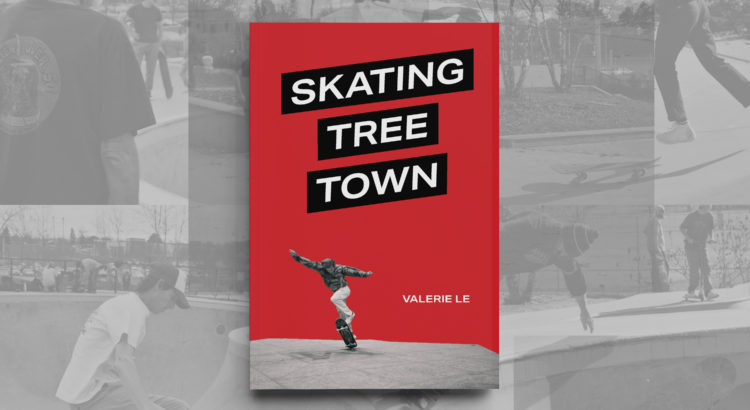
As you may know, I’ve been working on a book about Ann Arbor skateboarding culture for the past year. I posted a few images from it on arts, ink. before, and I’m so excited to announce that it is finally out and available to purchase! All proceeds from publication sales will be donated to All Girls Skate, an Ann Arbor Skatepark initiative that gives instruction to young female skaters of all experience levels in a welcoming environment. I hope you enjoy it!
Skating Tree Town is a publication that chronicles Ann Arbor’s rich skateboarding history and culture. For this project, I wanted to step out of my comfort zone and meet new people, to delve further into Ann Arbor’s history, and to develop my own love for skateboarding. Having been enticed by skate culture for years and only recently dedicating actual time and effort to learning, I was pleasantly surprised to discover Ann Arbor’s ties to skateboarding. Over the course of several months, I sent out countless texts and emails, and met strangers at their favorite skate locations to interview and photograph them. Almost everyone I contacted was gracious and friendly, genuinely stoked to share their love of skating with me. As the culmination of my undergraduate studies, I applied my design training to produce a book for others to read–showing the diverse and vibrant skate culture present in Ann Arbor.
Using visual design, photography, interviews, and historical archives, this book attempts to synthesize Ann Arbor skate culture and its community in a tangible way for skaters and readers to enjoy. Although this is not a definitive archive of Ann Arbor skateboarding’s history, it is a small glimpse of its culture through my eyes. All proceeds from publication sales will be donated to All Girls Skate, an Ann Arbor Skatepark initiative that gives instruction to young female skaters of all experience levels in a welcoming environment.
PURCHASE OR DONATE BELOW!
Purchase or donate online (free shipping in US): Valerie Le – Skating Tree Town
Purchase a book for local Ann Arbor pickup: DM me or email valtle@umich.edu!
It is undeniable that David Lynch is one of the most groundbreaking filmmakers of all time. His trademark style has influenced countless creatives since his 1977 debut film Eraserhead. Though his films initially found popularity as midnight movies, his reputation has risen to incomparable status. Rumors of a new series in the works for Netflix has stirred my excitement about his body of work once again, so below are my top three Lynch masterpieces.
Twin Peaks
Twin Peaks changed television forever. Before the landmark 1990 series, television and film were considered entirely separate, but with Twin Peaks Lynch proved that TV could be cinematic. The show takes the typical murder mystery and flips it on its head, ranging from pure camp to moments that are nearly incomprehensible. Promotional material for the show’s first season simply asks “who killed Laura Palmer?” but quickly Agent Dale Cooper (Kyle MacLachlan) and the Twin Peaks Sheriff Department discover the case is more complex and sinister than they could have ever imagined.
The range of styles is what I love most about Twin Peaks. Seasons 1 and 2 are filled with quirky interactions over donuts, cherry pie, and damn fine coffee, and of course the goofiest sandwich-eating scene in history. In contrast, episode 8 of 2017’s Twin Peaks: The Return could easily be considered a stand-alone surrealist short film. Contributing to these styles are some of the greatest environment-building soundtracks of all time. Ominous droning, jazz, and a range of modern musicians (ranging from Nine Inch Nails to synthpop band Chromatics) each contribute to the multitude of atmospheres created throughout the three seasons.
Between the distinct characters, twisting storyline, fantastic music, and extensive amount of lore (thanks to three seasons, multiple books, and a feature film prequel), it’s easy to fall in love with Twin Peaks — and keep falling deeper and deeper into the impossibilities of the mystery. The series is funny, disturbing, emotional, and everything in between, but more than anything it is a demonstration of the power of good storytelling. No matter the medium, Twin Peaks succeeds, and after five years of being a fan I have yet to uncover every secret it holds.
Blue Velvet
Blue Velvet is perhaps my personal favorite Lynch work of all time. It is somehow both cozy and creepy, familiar and frightening. This film, similar to Twin Peaks, takes a traditional mystery format and injects it with a dose of depravity. If you were to dive into Lynch’s filmography, this film is possibly the best entry point for newcomers because it still has a comprehendible plot, but with signature surreal moments. This film kickstarted the careers of Kyle MacLachlan and Laura Dern, who play Jeffrey Beaumont and Sandy Williams, two young people attempting to expose criminal activity after the discovery of a severed ear and an encounter with a singer.
This is my favorite Lynch film for so many reasons. Lynch loves to emphasize the singular strange trait of a character, and each of the characters in Blue Velvet is a prime example of this emphasis on the weird at its finest. On top of the general weirdness, the dark moments of the film genuinely get under my skin. When Blue Velvet was released, it was one of the most daring films to be marketed toward a general audience due to its violent and adult content. It tackles topics that are still difficult to stomach, but each moment — comedic, dark, romantic, or otherwise — is placed in just the right moment of the story to ensure the viewer feels every high and low. Blue Velvet puts me on a rollercoaster of emotions, somehow remaining simultaneously grounded and bewildering.
Mulholland Drive
Mulholland Drive is truly Lynch’s magnum opus. It manages to balance a compelling storyline and surrealist, dream-like sequences. For a while, it feels like a story that is fairly easy to follow: a girl moves to Hollywood to become a star, but her plans are interrupted by the presence of a mysterious woman with amnesia. Over the course of the film, outside characters intertwine with the lives of Betty (Naomi Watts) and Rita (Laura Harring), and reality and imagination start to collide.
Trying to wrap my head around Mulholland Drive is impossible. Everyone I know has a different theory about the film’s meaning, and with each viewing I simultaneously find more questions and answers. It’s the type of film to make you break down the minutiae of each frame until you’ve gone crazy trying to figure it all out, but that’s the magic of it. I will most likely never know, but the constant feeling of discovery is what keeps me coming back. It is a gorgeous, mind-bending portrayal of the Hollywood dream gone dreadfully wrong.
Other Work
There are many other Lynch films that are equally incredible — Elephant Man is a straightforward tear-jerker, Inland Empire is a nonsensical nightmare, and Wild at Heart is a black comedy starring (of all people) Nicholas Cage. David Lynch is also more than just a filmmaker — he’s also a musician, artist, and Transcendental Meditation advocate. If, after watching his films, you’re as puzzled as I am about what happens in Lynch’s brain, the 2016 documentary David Lynch: the Art Life provides a glimpse into the life and mind of the artistic legend.
Writing “Weird and Wonderful” has been one of the highlights of my semester. Whether I continue the column as is or transition it in some way, look forward to hearing from me again in the fall! In the meantime, stay weird!

 Moving on, this week we are talking about Mentality Magazine! I had the opportunity to speak to Liz Hoornstra, the current editor-in-chief of the publication. She explained that the magazine aims to do two main things: 1. Create a sense of community for its members and 2. Destigmatize mental health through writing. As someone who has been focusing on taking control of my mental health for the past year, I was really excited to learn more about how the magazine has done this and how others can support their mission!