Hi everyone!
I’m back again, to discuss this week’s topic: methods to become a better designer.
Honestly, I was a bit hesitant on how to title this week’s discussion topic… mainly because I wasn’t sure if there was an actual, formal title for it, other than just “practice” in preparation for architecture as a professional discipline in the real world.
Precisely, unlike medical students, who have cadavers to poke and cut into, or computer science students who have actual coding websites to get some very realistic, representative practice, we architecture students don’t have such a staple medium to “practice” being designers with.
In a way, yes, assignments and projects can be considered “practice” since we are expected to use our designing minds to create our own unique creations out of each given prompt, but they’re more of the education aspect of design school. We design things, get critiqued, and keep coming back to produce our own hypothetical solutions to design problems. However, I oftentimes this is more educational, because this process seems to be more about meshing our minds in a certain way as designers. Design school is meant to shape our thinking process (which I find leads to more aesthetics than technicality in problem solving in design, rather than shaping how we should be critically thinking as designers. However, this seems to be the case in most design schools now, as there seems to be a sort of identity crisis within architecture; almost like an argument about what power we do or should have as architects, and our place in the world.
Aesthetics is the way to the eyes of the consumers of buildings, which I often find is the way to build initial intrigue about the building; it’s essentially the same with people. Take Tinder for instance, you swipe left on either seemingly boring people, or unattractive people, and you swipe right for those you find as a match for your values, or physically attractive- it is our eyes that decide the initial interest. I find that this is the same reason why designers seem more concerned about the aesthetics in design. In design, aesthetics of your proposal representation not only softens critics’ hearts, but also serves quite effectively in capturing the interests of those outside of design who say, “I don’t know what that is or what it means, but it looks cool!” Our representation not only serves as the communication mechanism between us and our critics, or clients, it also serves as our method of marketing ourselves as a brand in the real world (in terms of applications to jobs, internships, and graduate schools). Perhaps it seems this way because of my limited experience as an undergraduate. From the glimpses of graduate students’ work, it seems more technicality comes in graduate level education, but even then, I find it should still be necessary to have a cohesive educational experience in terms of always being thoughtful about our designs and staying true to what real-world consequences they would have in the real world. Perhaps our undergraduate experience is suppose to serve as just an introduction to the mechanics behind being a designer, and its purpose is just to market ourselves to get jobs in either firms, or appear as attractive candidates in graduate school applications.
I have always thought about this topic, but only gotten more critical in views after my current experience of “rodeo reviews” in class, where everyone in our third semester studio had to pin-up for presentations, and we we basically split into halves and rotated around so we could have the experience as the presenter, but also critics of each other’s work. Sounds kind of fun and casual, right? You get to show your friends your cool work, and even speak with other sections’ professors… which isn’t an incorrect description of what it was. I just spoke with classmates and gauged two types of mindsets about this whole presentation method: critical (not finding it that useful), versus positive (thought it was a nice new, different experience). Of course, there is the factor that it really depends on your luck and what students you had as your critics, or maybe even what region you were assigned to pin-up in. But, generally, it seemed that the issue was that we were just sprung onto this unfamiliar role of being forced to give specific people feedback- the selections were completely random, so most people found that they were reviewing the works of students they never really got to know, and just being put on the spot to say useful things to help others improve their work.
It was then that it struck me that being a designer is not just about being good at communicating your own ideas to the world, or making your own work look cool. It also includes the ability to understand unfamiliar work from just reading their drawings, or listening to their one presentation and asking them a few questions. What’s its relevance? Well, I’m sure at one point you’ll be forced to reflect on a colleague’s work, and it’s not too great if you just blankly stare at them or their work. Or, say you’re working with someone new and they’re not able to be there to tell you about their work and just left you to read their work temporarily. It’s good to be independent and have the ability to understand other’s work, and have a view that you can offer. I find that this ability often coincides with our own abilities to understand our own work and be able to concisely portray it in a compelling manner.
Oftentimes, I’ve found difficulties in reading others’ work from their drawings, or maybe even an uncompleted model that they have. And, it’s still something I need to work on, even though I recognized my own (ever-improving) growth in my own project’s proposal representation. But this rodeo review really opened up my eyes to that observation, and the way that I was really glad that my improvements in my own representation seems to have opened my mind to this newfound ability to understand others’ work and what they have drawn or modeled, and draw upon my own experiences to give them helpful feedback to improve the way they can further portray their ideas more effectively and clearly. I used to find reviewing other people’s work a bit boring, and super irrelevant to my own work, but now I am grateful to say I can finally understand why our education is designed in such a way to allow for this sort of learning to occur.
It also occurs to me that this isn’t the only way to become a better designer. I can continue learning and applying these skills to real firm’s proposals, and perhaps offering memorable and helpful insight to firms during interviews or the actual internship. And it would circle back to helping me step back from my own work, and be able to see flaws in my representation rather than having always been so dependent upon my professors’ feedback to help me decide on what views to produce for my proposals.
***
Well, that’s all for this week!
So excited to write again next week!
Ciao 🙂


 Devilman Crybaby is an original Netflix anime adaptation of the original manga by Go Nagai, and although I highly recommend watching it, I’ll try to save some of my praise for another post. The essential story is about a young boy named Akira who gets wrapped up in an emerging world of demons by his mysterious childhood friend Ryo. It features existential and dark themes, and raises questions about humanity, society, and love that make you think long after the show is over. It’s a tragedy to be sure; be prepared to cry when it’s over, but it is not without its moments of hope. The soundtrack to the show mirrors this so accurately and poignantly, making it the perfect complement to the show and adding something that makes it entirely unique. The aesthetic of the soundtrack perfectly fits the artistic style of the animation; it’s primal and pounding at times, matching the intense scenes of chaos, and other times it’s subtle and futuristic, setting this iconic tone throughout the show that lasts long after its over. My favorite tracks however are these long orchestral pieces, featuring these solemn and mourning grand piano melodies that are absolutely haunting. They contrast so well, both on the overall album and in the show itself; they provide these thoughtful reprieves from the chaos, where both the characters and audience are forced to reflect on the tragedies of humanity. Overall, I find this soundtrack incredible in how it affects the story, and how well crafted it is that it can stand alone.
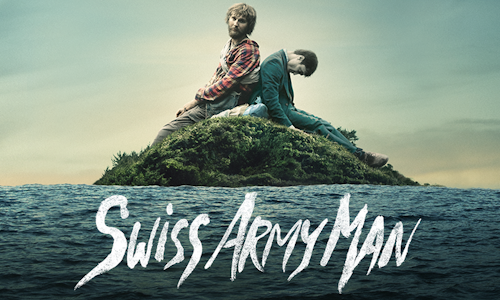 Another great example of a stand out soundtrack is Swiss Army Man, a small indie film featuring Daniel Radcliffe and Paul Dano. Again, one of my favorite movies; a little quirky and hard to swallow at first, but it leaves a lasting impression and is just genuinely fun to watch. Similar to the Devilman Crybaby soundtrack, this soundtrack stands out for its aesthetic and style: it is fun and folky, featuring a lot of vocals and accapella, accompanied by simple instrumentation and haunting chords. All of the vocals are performed by the two actors as well, which is ingenious, especially during the film when the characters are quiet and the music speaks for them. The movie mostly takes place in the woods and is an unusual love story, which is reflected well in the soundtrack. It features a variety of unusual songs, mostly focused on the relationship between the two main characters, and tells its own story in a way that the film itself can’t. In this way, the soundtrack adds an important element to the story and can’t be ignored. These reasons make the soundtrack stand out, and as a result I still find myself listening to it, reliving the great moments of the story through music.