What Is Art?


earth-without-art-cropped


What is art, you ask?
Well, thank you very much.
This question is as important,
As it is unanswerable.

Anything can be,
But nothing must be.
Some of it shouldn’t be,
And some of what isn’t, should.

But who is to say what is art,
And what’s not?
Nobody can,
And everyone must.

If you can’t differ art,
From what’s not,
You can’t differ the smart,
From the lot.

In art,

We can only be critics for ourselves,
But not our own critics.
I mean, is this art,
Just because it is written in verse?

It is up to you to decide.
I for myself, can’t answer that question.
Why?
Because I to myself, have asked that same question.


Remember to be the weirdest you can possibly be.

What’s your talent and what to do with it?

For Parents and Family Weekend, there was a tailgate before the Maryland Game in the Oosterbaan Fieldhouse for all umich families. Here, everyone was provided with great food, essential maize and blue game-day accessories, and entertainment by campus group performances. Many of which I had not gotten the chance to see until this event shed light on them. Featured student groups included Angels on Call, Harmonettes, GROOVE, FunKtion, RhythM Tap Ensemble, TAAL, Leim Irish Dance, Maize Mirchi, 58 Greene, U-M Dance Team, U-M Cheerleading Team, and the U-M Marching Band. Each act expressed completely different energies from a variety of cultural blends, music, and dance styles. While some, in addition to their voices and steps, harmonized their appearances with uniforms, others distinguished their personalities with their outfits. The synchrony of the groups and the layering of unique sounds complimented the idea of individuality molding with togetherness to produce incredible sound. I recognized a few faces from classes, my living complex, and friends I see around all the time. Little did I know the talent they had. That’s my favorite part about talent; it’s usually a surprise.

To keep your talents to yourself: Is it modest or is it selfish?

talent

Modest: Holding a special ability under the surface could be like a treasure hunt; only a few people ever know you deep enough to find it. More introverts prefer to be the observers. They conserve the electricity with which they have the potential to illuminate an entire room. They astound people with their unassuming excellence.
Selfish: It would be a shame to keep such gifts hidden from the world. If it makes you happy, do it. If it makes others happy, even better. More extroverts prefer to be the performers. Ultimately, having the talent is like having the electricity to light the bulb. If you have power, turn on the lights. If you can play the harp, the allegedly the most difficult instrument to master, I would be disheartened if I never got the chance to hear you.

I suppose it’s how you carry yourself, but tell me what you think. Regardless of stance, you’re special whether your talent is eating six Saltine crackers in sixty seconds or carving Mount Rushmore into a Styrofoam cube with a spork. People like you keep the world interesting.

The Comfort of Public Readings

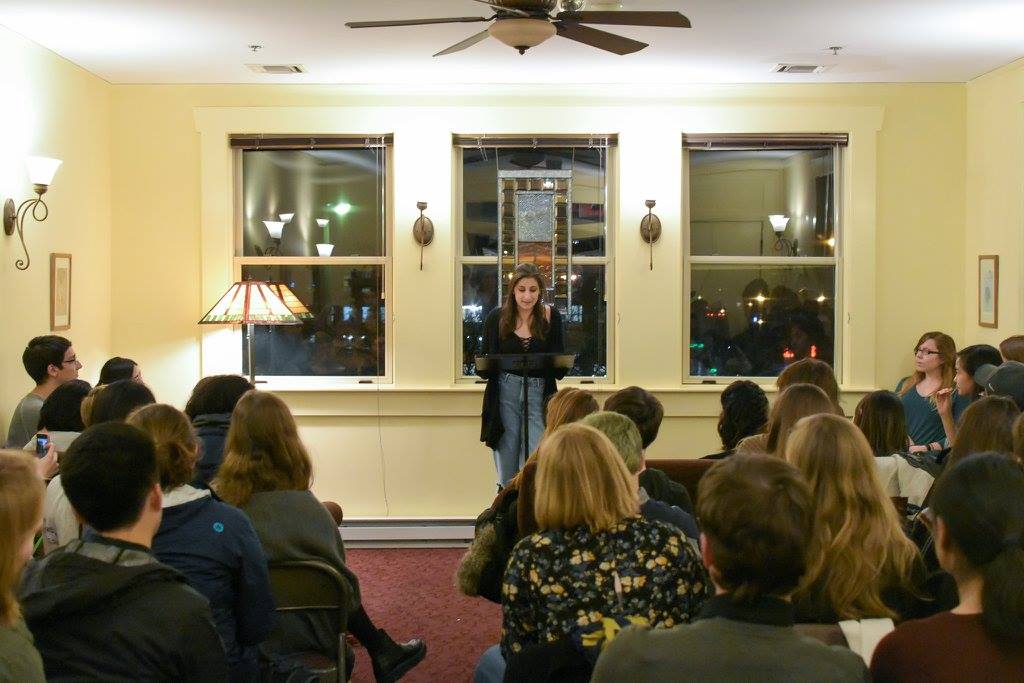
Last Friday, my friend Karen invited me to an open mic night for anyone who wanted to share their writing—poetry, fiction, creative nonfiction, or even songs. Karen’s the editor-in-chief of Xylem, an independent, student-run literary magazine on campus, so some of the staff shared their work, but most of the readers were just people in the audience who decided to share.

Almost every reading I’ve been invited to I’ve gone to, but it’s a weird thing, because I don’t really love them. Okay, to be specific, I don’t love listening to people read. I’m not always the best auditory learner—my mind drifts, and I end up thinking about whatever’s going on in my life, in the same way your mind wanders during a particularly boring lecture. It makes it harder that I’m not super good at understanding poetry; sometimes I can work out the meaning (either the dramatic narrative or the emotional symbolism) if I sit down and concentrate hard and reread the poem a few times, but it’s almost impossible for me to figure it out when it’s being read aloud.

Even if I could carefully pay attention to every single person reading, I’m very bad at telling when poetry is actually good. Every student reading I go to, I hear poems that I sense are pretty good, since there are some decent images and cool words being used, but I have no idea what they actually mean. I know the point of poetry isn’t to figure out what it all ‘means,’ per se, but it still can be frustrating when you feel like you’re not getting much out of a poem aside from the sense that it sounds kind of interesting.

There were some stories and poems I really liked on Friday, when I was able to fully engage. One girl shared a ‘letter to all the guys she kissed,’ which involved a lot of wordplay with numbers. It was pretty hilarious, and well-read, and everyone was laughing with every line she read. One guy sheepishly read a short piece about the couch he owns, with all its mysterious and questionable stains—also very funny.

I thought a lot that night about why I continue to go to events like these when I’m only fitfully entertained and engaged in the reading itself. Well, for one, I go for my friends, like Karen. I want to support them, to hear them read their writing or see what they’ve dedicated their time to outside of class.

But I go mostly for the community. When I sat there in that room—the cozy back room on the second floor of Crazy Wisdom Bookstore and Tearoom—I felt, momentarily, at peace. It came at the end of a long week dealing with the results of Tuesday’s presidential election, and for a moment I wanted to just stop talking and thinking about it all and just sit and be with people who I felt understood me—even if I didn’t actually know most of them. One essay mentioned the election, but most of the pieces were about other things. When you’re dealing with what we all dealt with this week, poems about regular old teenage heartbreak are downright comfort food.

Even when an open mic night doesn’t come in the middle of a politically cataclysmic week, though, it provides comfort. There’s something about looking around and seeing English majors you vaguely know—that girl who talked a little too much in my Shakespeare class, that girl whose writing I was always jealous of in my creative writing class, those five people I recognize from The Michigan Daily. Even the people you don’t recognize can make you feel at home; some of the students sharing their work were STEM majors, and there was something endearing about seeing them timidly prefacing their reading: “I’ve never done this before,” or “I haven’t really looked this over yet,” or “Sorry, I’m kind of nervous.”

I looked out the window while one guy read, noticing the lights of the Ann Arbor News building across the street, the cars flitting by on the street below. I wondered if I’d have a similar, but larger-scale view a year from now, maybe living in New York and going to a reading like this one, with more people I didn’t know but who felt like my people. I wondered if I’d go to any Trump-related protests in Manhattan, if I’d have a group of liberal, revolutionary-type friends like me who wrote poetry and drank tea in cable knit sweaters and clapped and cheered for one another, even when the poems weren’t that good.

Maybe it was too romantic of an idea. Maybe we could all use a little romance right now.


Check out Xylem Literary Magazine here. The above photo was taken from Xylem’s Facebook page.

Days of Our Lives

Dear friends,

Do you remember the time…?

Do you remember the time in that English class,

the one when we first met, sitting quiet not knowing what to say

we didn’t know then what we know now

sunrise of our friendship, the six of us, that day

Do you remember that time when a guy kept picking on one of us

he ended up confronted, a year later he told me

boys, we girls still think you were silly doing that

but our hearts warmed, you were being protective, you see

Do you remember the time when we camping on a summer night,

the night was chilly, the first time we drank wine

parents don’t have to know, kids

far away from where we were, we found ourselves right

Do you remember the late phone calls,

those that chewed up the electricity bills

sorry mom, we are doing homework

(for like twenty minutes, then “there’s this new album just released”)

Do you remember the sleepover right?

they said girls’ night out were really the best

they were right, all the talk, the laughter that never end

and finally dozing off at 4am

Do you remember the time, when two of us fell for one another

the purity, awkwardness, shy blush

oh the innocence, away it rushed

seventeen, holding hands on the changing verge

Do you remember riding motorbikes that Saturday

to an orphanage we volunteered, the good-heartedness we had

one of us bled the knees as the scooter slid

smiled and stood up, yes we stood up above pain

And the last days of school, do you remember

and the flights and distances that follow it

different seats at the table turned to continents apart

leaning my head against the window, I dreamed

I remember our lives, loves, mischief and friendship

“in that moment I swear we were infinite.”[1]

in that moment we had it

the world in our hands, youngsters always think

These are the days of our lives,

the bright, laughter-filled, sun-lit moments that thrive and flourished

in our little hearts, every time I think of us,

again, I see the sunrise.


[1] Stephen Chbosky (1999). “The Perks of Being a Wallflower”.
Still We Rise

It has been five days since America elected Donald Trump to be our next president. The shock was apparent to all (I think that even Trump supporters were surprised by his win) and has caused a significant amount of debate across the country. But, if there is anything positive to be taken from the turmoil that the election has caused, I believe it is the passionate reactions of the people.

Messages of hope, love, and solidarity are everywhere. People are uniting together by expressing themselves with words, art, and music.
The Diag, which was once an empty canvas, has now become a vibrant visual representation of the student mentality in response to Trump’s win. Messages are written in different fonts, colors, sizes, and languages- all showing solidarity, hope, support, and unrest within the campus. “Estamos juntos,” “Still with Her,” “You belong here,” “You are loved,” “Love can still win,” “Hope must live,” and “Michigan Loves You,” are just some of the many chalk messages that have been left. The Diag represents the heart of campus and this is truer now than ever.
Around the country we are seeing peaceful protests, with chants calling for justice and tolerance: “Hey, hey, ho, ho, racism has got to go,” “My body my choice, her body her choice,” “We reject, the president elect,” “Si se puede.” The photographs and videos from these marches are powerful, showing an American that is standing against bigotry, racism, and hatred.
Artists around the world are expressing their discontent as well. Bastille, a British alternative band, has written a song called “The Currents,” inspired by Donald Trump and his rhetoric.
“I’m swimming to the surface
I’m coming up for air
Cause you’re making me feel nervous
I need to clear my head
I can’t believe my ears
I don’t wanna believe my ears
Swimming to the surface
Coming up for air
How can you think you’re serious?
Do you even know what year it is?
I can’t believe the scary points you make
Still living in the currents you create
Still sinking in the pool of your mistakes
Won’t you stop firing up the crazies?”

When performing the song on Wednesday, lead singer Dan Smith made an alteration to his lyrics:
“Won’t Trump stop firing up the crazies?”
The rhetoric that Donald Trump has been using really has fired some people up, as more and more incidents of hate and racism have occurred in the days following his win. Even on the Michigan campus a Muslim woman was forced to remove her hijab. The Rock, which is commonly painted by different student organizations, was vandalized with racist comments. Donald Trump’s win has validated and encouraged this behavior and resulted in a fearful America.
But this hateful behavior has not been condoned by this campus or this country.

When students learned about the rock, they immediately painted over it with messages of love and encouragement. When students learned about the woman who was attacked, groups were formed to offer assistance to people who were afraid to walk home alone. When Trump encouraged violence and hate, Americans protested with messages of love and inclusion.
A video of Maya Angelou has been circulating social media in the days since the election. In it, she recites her poem, “Still I Rise.” In the beginning she introduces the poem by saying,
“Everyone in the world has gone to bed one night or another with fear or pain or loss or disappointment. And yet each of us has awakened and risen, seen other humans and said ‘Morning, how are you? Fine, thanks. And you?’ It’s amazing. Wherever that abides in the human being there is the nobleness of the human spirited. Despite it all, black or white, Asian Spanish or Native American, pretty or plain, thin or fat, we rise.”
To the many of disappointed Americans who fear for their life in this country under a Trump presidency, this introduction is inspiring and encouraging. Her words are being spread online to empower people to keep rising, even in the face of hate. And that is what we have done and will continue to do. We will rise.

A Waking Dream

"Sleep" by Salvador Dali
“Sleep” by Salvador Dali

There is a surreal quality to waking up. The world transforms in an eyeblink from darkness to color. From vague, meandering dreams to vivid life all around. The mind doesn’t adjust quickly enough and it seems, for a moment, that this world, with all its confounding complexity and striking beauty, can’t possibly be real. Then, you remember: You’re in your bed, laying on your sofa, or dozing off in the math classroom (the worst of the three). Truly, sleep is an amazing thing. It is interdimensional travel, a trip to a different realm and restorative all at once. It can be disorienting to return to a world that seems infinitely more ordinary and logical than your dreams. Sometimes I prefer the infinite possibilities of sleep and other times the orderliness of consciousness is safer and preferable. However, during the last few days, the boundaries between imagined fantasies and reality seem to have blurred more than ever. If anything, this election cycle has proven to me that anything is possible even in the real world.

As I watched the final hours of the election tick by, I could not help but feel as if I was dreaming. Last Tuesday night passed in spurts, at first very quickly and then mind-numbingly slow. On CNN, the reporters seemed to be in a state of panic themselves, unbelieving. They cut frantically from the map to the individual states to the main panel sitting at their desk. Everywhere there was flashing updates, yet they, too, were helpless, waiting for the final polls to close. Some states would never be called. They did not want to fall silent lest they be forced to reflect on what was truly happening. It was a paradox that could have driven anyone insane. By the time Pennsylvania was declared for Trump, it was 2:00 am. I had neither the time nor the energy to contemplate the vast changes that had passed me by. Somehow, the world had changed entirely, but I could not yet see how. Only time would reveal the alterations to come.

Even throughout the next day, the sheer implication of the change was impossible to confront. The election made me realize that the world I thought that I knew so well was only an illusion, a fleeting dream. In fact, my world was in complete contradiction with what others wanted. My foundational values were not, in fact, universal laws. It was as if every physicist had suddenly told me that gravity no longer applied. I had been rudely awakened and could not seem to adjust. We always see the world in half-realized glimpses from severely limited perspectives, beautiful bubbles that need to be popped. Even when moments of clarity are gained, it is far too easy to lose them in the following hubbub.

You don’t get to wake up many times in this world, not nearly as many as you think. More and more, people talk only to those who share the same opinions, only click on the articles from certain publications. There is always an “us” and a nefarious “them”. Democracy represents a choice and the people’s voice, whether we like to hear it or not. This election was not only a mere wake-up call, it was a blaring fire alarm. There are serious problems in the real world and there is no point in seeing it as only a bad dream. No more hiding. It can’t be worse than realizing that your entire math class has been staring at you while you’ve been asleep.