What Animal Do You Want to Be? (The Lobster)

So a woman is driving down the road. She stops, gets out, and we see her through the front window as she shoots one of three donkeys grazing in the rainy field. As she leaves the other donkeys crowd around the dead one.

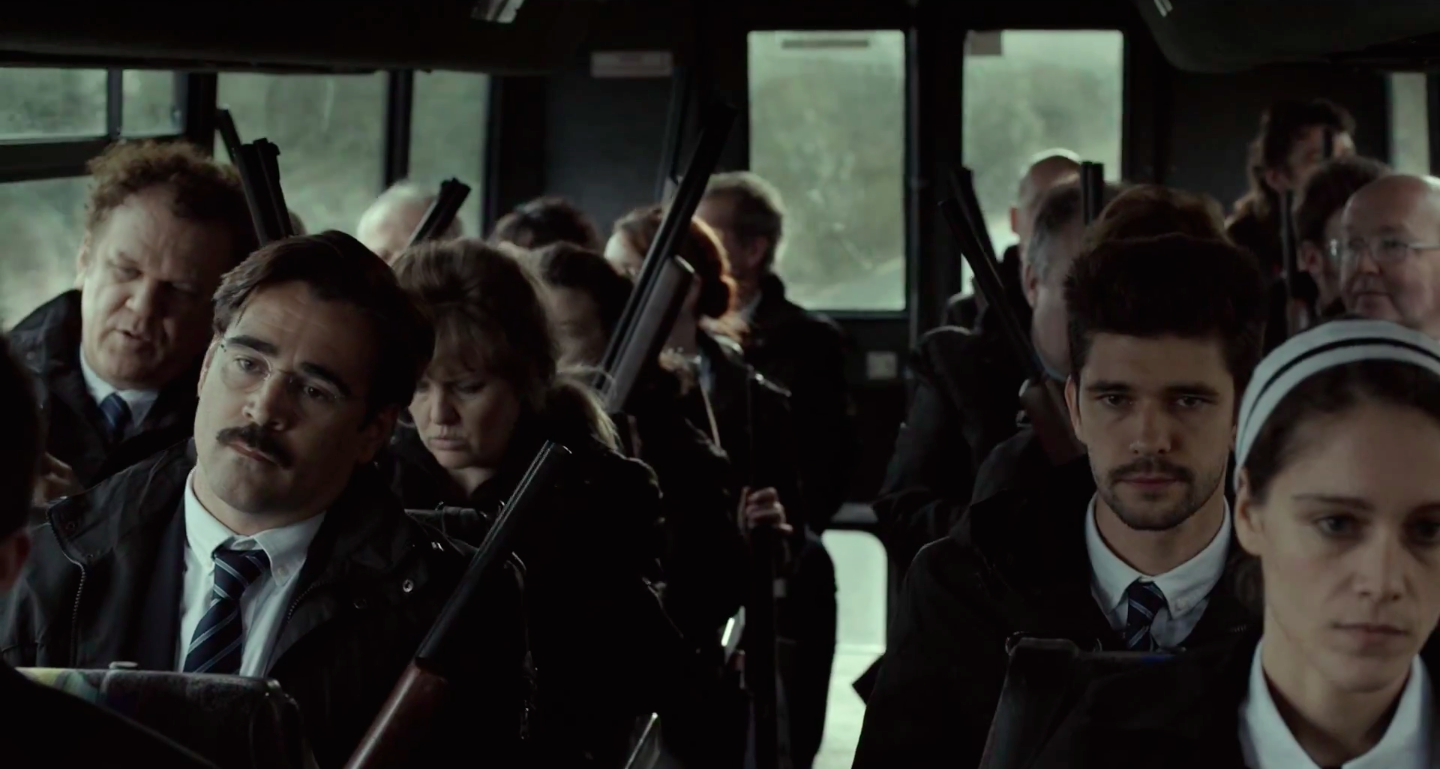
This is the opening scene from the 2015 film, directed by Yorgos Lanthimos, called The Lobster. The film follows David (Colin Farrell) as he checks in at a hotel where the primary purpose is to find a mate. Should you fail to do so in 45 days, you will be turned into an animal of your own choosing. Interestingly, David brings a Border Collie with him, he tells the staff that it is his brother who had failed to find a mate at this hotel in the past. There are other instances of quirky dark humor spattered throughout the film. But instead of specific moments, the comedy of the film is developed through the details/world building (and boy is it bleak). The patients take part in hunts where they go into a nearby forest to search for guests that ran away, should they find someone, they shoot the “loner” with a tranquilizer. Should you find runaways, you are rewarded with an extra day for each person captured.

I know the whole single versus couples thing is overplayed on Valentines day, so I decided to talk about this movie months in advance. The film is quite obviously critiquing modern notions on what love and more precisely, contemporary emphasis on the importance of sticking to a couple based society. It is incredibly rigid. To fit into society A, you must follow rules 1-100 and to fit in society B, you must follow a new set of rules 1-100. So inevitably, should you choose to run away from the hotel and live your life amongst the “loners” then you have to exchange an old set of rules for entirely new ones. In other words, escape does not equal freedom in this world.

What is particularly interesting to me about this world however is that despite the lack of choices, there is an odd moment of freedom amidst the film and the title lets us know right away. David chooses to be a lobster, just like his brother chose to be a dog. Imagine if you believed in reincarnation and your preference actually mattered in what you came back as. Obviously, this choice is given in the contextual parameters of doom and gloom. But is it all that bad? For some reason, I felt it such an odd form of punishment. The hotel manager suggests in the film that becoming an animal is a second chance at love. However, other than the donkeys living together at the beginning, there is no evidence of animals living together in any social manner. In fact, when we see the forest, we see lone animals wandering about – like a camel that just casually walks in the background of one of the more important narrative scenes.

In that sense, I suppose being turned into an animal is terrible, given that all evidence seems to point towards the fact that once you are alone, you will always be alone. Also, although it is not quite clear, I believe you retain your human consciousness as an animal (in which case becoming an animal is a horrible notion). But if you do not retain any semblance of human cognition, then perhaps I’d want to be some form of predatory bird, because who does not want to fly?

But invariably, the animal we choose is highly reflective of who we are. The hotel manager even notes how everyone picks a dog, and that is why there are so many dogs in the world. The primary way that people select mates at the hotel is through “defining characteristics.” For instance, if a man has a limp, he must find a woman who has a limp. So if picking a dog is being a predictable and rather boring individual, is that particularly defining if so many people do the exact same thing? I’d imagine that the hotel manager would say, “Well that is why they are alone.” I guess the choice does not really matter in the end.

But who does not like dogs? Fuck this movie. Just kidding I love this movie.

Let’s Potter It Up.

Last Thursday I promised that there was a bit of Harry Potter in the story of how I lost my first job and after explaining how Peter Jackson got me there in the first place, it is now time to potter it up:

The beautiful landscape passed by the window and left me speechless. Lakes reflected the yellow sunlight and entire forests swayed in a crisp autumn breeze. I was on the way to my new home. I had made a friend already. Ron was sitting right next to me. Since he didn’t have too much money, I had bought some candy. I just came from a place where the people are grumpy and you are not accepted for who you are: Germany. And as cool as it would have been, I do have to admit that my new friend’s name wasn’t Ron but Nico and I hadn’t bought candy for him. Technically he wasn’t even my friend at that point. But we were on the same bus and that was the start of something special…

When the bus pulled into the station and the passengers streamed out of the doors and through the steam, towards the bright, warm brick building, the sun had set and left the outside cool and dark. As my feet touched the ground I heard a loud voice shouting through the hustle and bustle. I walked a little further down the platform to look for where the voice was coming from… It was shouting my name. Not only mine, a couple of other names, too. I grabbed my backpack and as the voice got louder and louder, the silhouette of a massive, black-bearded man emerged from the darkness. He was wearing a moleskin overcoat and was about twice the size of all the people around him. Ok, actually the guy wasn’t screaming our names but had sign with our names written on it. And he wasn’t wearing a moleskin overcoat but a Merino-Sweater. And he wasn’t exactly a huge guy, but a skinny, old lady with grey hair and a funny face. And obviously there was no steam, come on, where is the steam supposed to come from at a bus station?  So basically we got out of the bus and this lady with the sign just stood there, waiting for us. We hopped into her car and she took us to the place we would live at from now on. Our new home.

Shimmering lights glimmered through the darkness of the driveway. They became increasinly bright as we climbed the hill our residence was located on. Getting closer I could see narrow, high towers and walls made from stones which seemed to have watched over the valley to our left for many hundred years. It was a castle. An old, beautiful castle. We passed a gate with two majestic boars sitting on each side, watching over whoever entered the grounds they were guarding and… You see where I’m going with this. There was no castle. I’d say you could even barely call it a house. It was four walls with a roof on top and far too many people inside. It was in a valley, not on a hill and it smelled. It was my and my companions new home, though. The old lady gave is numbered keys and pointed towards the ‘house’. I looked for my room number. When I finally got to the number plate with the number “13” on it, I realised someone else was right behind me, waiting for me to open the door: Nico, my not yet friend for a lifetime. He nodded at me. I nodded at him and we both entered the room that would change our lives forever…

Next week, a mystery will be solved in a way, that would make Miss Marple proud. It includes Nico, me and… a knife!

See you next week and remember to be the weirdest you can possibly be.

Why do people dress up for Halloween?

On Monday, the Center for Campus Involvement hosted a spooky event in the Ann & Robert H. Lurie Tower on North Campus to recognize the tradition of Halloween. When the clock struck 8pm, the doors opened and so began a night of embarkments on a thrilling 15-minute ascent through the bell tower memorial. Those involved generously dedicated their time to this spectacular project and offered free admittance to UM students.

samhain-festival

This holiday of costumes and candy, ghosts and ghouls, beasts and bonfires originated from the Celtic festival of Samhain dating back nearly 2,000 years. Autumn marked the end of bountiful summer harvest and the onset of a dark winter embodiment of human death. According to Celtic beliefs, the boundary between the living world and the dead world became unclear on October 31st, the eve of the new year on November 1st. They celebrated Samhain by lighting bonfires and dressing in costumes to ward off the ghosts that returned on this haunted evening. Supposedly, the presence of these other worldly spirits allowed Celtic priests, also known as Druids, to make accurate predictions about the future. This history led me to wonder what if spirits really do return to Earth? Since everyone is dressed in character, maybe you are unable to distinguish costumes from true beings. Or what if people like mediums really can communicate with past life to learn about the future? Just some food for thought.

I may not be a Druid, but I would predict that the Center for Campus Involvement will host an event similar to this on a future All Hallows’ Eve based on the turnout for this outstanding performance. Throughout the year, a variety of events such as the upcoming Battle of the Bands, Pixar UMix, and free finals breakfast are made possible by this organization.

History.com Staff. “History of Halloween.” History.com. A&E Television Networks, 2009. Web. 02 Nov. 2016.

Constellations

*Featured image: Setting of “Constellations” – taken from Clarisza Runtung’s Facebook page

The lights dims, a girl and a boy walks through the aisle into the center circle. They are Marianne and Roland, and they tell the story of the two.

Constellations, written by Nick Payne, draws the enchanting life of a girl named Marianne, a physicist and Roland, a beekeeper who thinks she studies “something about space”. They both live in a multiverse – a world where “all decisions you make and don’t make coexist simultaneously”.

The multiverse is a concept of quantum mechanics, where many worlds exist depending on the choices made and actions taken. This interpretation implies that in every world contain a different variation of the life of a person, and the multiverse portrays all possible alternates of the past and the future, existing in parallel. It is described in the play’s accompanying note as many branches of a single tree, and reality is not simply a single footpath.

In many ways, Constellations reminds me of Déjà Vu. This bittersweet fairytale is delivered through various reiterations of the storyline, and the play proceeds to portray one particular course of actions that leads to their relationship and forms their life together. There are many times that Marianne and Roland almost would not have met each other, or would not have known each other, because of the little cues in what they say or their state of mind at the time, or the way they choose to deal with the situation, and their alternate choices would have taken part and existed in another universe. To think about it, the combination of actions that would lead to where they are right now is quite rare.

But Constellations is not just a story of physics. Far from that, it is also a love story. Because through all the randomness of the dice, they learn to live with the present. Even in a multiverse, there is no way to tell if one’s course of actions is better than another, because one does not know what the future will lead to. Every choice you make is the right choice, or that you build it into the right choice, because that is what we do as our responsibility to make us happy. One of the ideas that resonates with me most is the time you have with someone, that there are no more or less time to spend with another person if you learn to appreciate in the present, or to put it in the words of a character from my favorite book – Hazel’s words from The Fault in Our Stars, that even though “some infinities are bigger than other infinities […] I cannot tell you how grateful I am for our little infinity”!


How We Value Art

I think my parents would disown me if I decided to pursue a major in art. Now, this is partially because I possess no artistic talent whatsoever. My drawings mainly consist of stick figures gamboling on some wiggly lines that were supposed to represent hills. I like to imagine myself as undiscovered talent, producing abstract art too intricate to be understood by mere mortals. But the truth is that, even if I was accomplished and brilliant, I would not be encouraged to go into a career in art. It would simply not be economically viable. This is because artistic talent is notoriously fickle and hard to evaluate. It cannot be calculated. Not that people haven’t tried. In 2010, Picasso’s Nude, Green Leaves and Bust, was sold for a record $106.5 million in an auction that lasted a little over 8 minutes. Now, that is conviction! To give a sense of perspective, it took me over 8 minutes to decide that I wanted to purchase some green tea gelato for $4.75. (Author’s note: I would highly recommend to all my readers-now that’s a good joke-to go to Iorio’s Gelatoria on East William)

                 Destruction of Home Tree from the movie, Avatar

Some people have decided that art can only be valuable if it has a definite message. Most, however end up as subtle as a sledgehammer in a china store. Fortunately for the internet, this new goal-oriented art has led to many unintentionally hilarious Oscar speeches over the years. Teary eyed actors and directors declaring to the world that their movie has a higher purpose than even mere art. Now, every movie must have a cause. James Cameron’s Avatar was about saving the environment, all while reveling in slow motion shots of falling trees and tears, and becoming the highest grossing movies of all time. Yum. I love the smell of hypocrisy in the morning. Movies such as this miss the point entirely. It seems that art can only be art when it arouses some unknowable feeling, some unconscious awakening. Something that is much more understated. Picasso, described it as “a lie that makes us realize truth.” The obvious thing to do, then, is to judge it dispassionately, quantify its emotional value with various calculations, and put it up for sale.

The vagueness surrounding how art should be valued is even more complicated by the cultural associations with being an artist. To be an artist, you can never admit that you do anything for money. The idea of art has become so synonymous with deprivation that any sense of practicality is shunned. Art should be done for its own sake. The prophecy is self-fulfilling. Everyone is told that an artist will never make any money. Those who choose to become artists are told that they can only create art if they don’t do it for the money. To be an artist means that not only must you produce something that pleases everyone, it must also sell for millions, while never admitting that you wanted the fame or the money. The muddled definition of how art should be created, prevents it from being created. The barrier is so high that it is expected that those young dreamers who courageously bet on their talent will not succeed, and instead retreat to safer disciplines. Then, perhaps years later, they will spare a glance for that forgotten novel or the unfinished masterpiece, and shake their heads, older and wiser.

No wonder art is so daunting. It must be created in a certain way with the right intentions. It must be about certain subjects. It must surpass a certain profit margin. Yet, these guidelines are directly opposed to the fundamental core of art. The most infuriating and beautiful thing about art is how utterly subjective it is. It will never submit to the rules that we build around it. So, I think I’ll have to be getting back to those stick figures. Who knows? It could be worth millions.

The power of art…and Leonardo DiCaprio

The man on my left shares a Nobel Peace Prize with Al Gore for his work on the Intergovernemental Panel on Climate Change. The two girls on my right share an intense passion for Leonardo DiCaprio. We’re sitting in the front row of the fully packed Keene Theater, waiting for “Before the Flood,” a documentary from Leonardo DiCaprio and director Fisher Stevens, to start playing. Dr. Henry Pollack, the Nobel Peace Prize winner, is here to answer questions after the screening. The girls next to me, aside from being major Leo fans, are here as a requirement for their environment class. I’m here because I’m interested in film, climate change, and, like the girls next to me, Leonardo DiCaprio.
“Before the Flood” documents the journey of DiCaprio as he travels the globe to bring attention to the devastating effects of climate change on our environment. As a United Nations Messenger of Peace, it is his mission to propel the environmental movement forward, and he does so with this documentary.
The audience cringed and scoffed when Donald Trump was shown telling the people at one of his rallies that it was “pretty cold and we needed some global warming right about now.” We shook our heads and laughed sarcastically when a politician said that climate change was the biggest hoax ever created on the American people. We smiled while Leonardo Dicaprio hung out with an orangutan.
The film presented a wide variety of perspectives on climate change. Interviews with astronauts, United Nations meetings, conversations with world leaders, and footage of different lifestyles around the globe were all combined into a 90-minute screening. It was an efficient and effective way to bring attention to the crisis of climate change.
“Before the Flood” provoked an intense passion in me, and I believe that it can do the same in others. Art is a resource that can convey a powerful message to all kinds of people. Whether in the form of a mural, painting, song, or film, artists can capture an audience with their creativity and inspire people. “Before the Flood” is just one example of this, as the convergence of two passions, film and the environment, resulted in a meaningful and relevant message.

(You can stream “Before the Flood” on National Geographic’s website by clicking here …. 10/10 would recommend)