Remakes: Cultural Re-iterations for Make Benefit of America

With Baz Luhrman’s new adaption of The Great Gatsby due in May, I got to thinking about the notion of the filmic remake and why Hollywood seems to be so saturated with things of the past that it tries to polish and transform into things of the future.

If I am honest, most times I see that a film is being remade, I roll my eyes and ask why Hollywood didn’t just get it right the first time?

But the other day in my British Romantic Poetry class (which is a lot more intense than it sounds, believe or not), my professor told us that the role of the poet was not to invent new truth, but rather to create a new iteration of truth that resonates with modern cultures.

And isn’t that what a remake is?  A new, culturally resonant iteration of old truths?  As I sat in class, my former negative views towards remakes began to fade away.  Although many remakes fail to be half as good as the original, I thought I’d highlight some that in my opinion are better.

1. Ben Hur (1959)

While, in my opinion, any talkie is going to be better than its silent counterpart, this contribution by Cecile B. Demille highlights the best of the best in the Golden Age of Hollywood and especially Hollywood ‘Sword and Sandal’ films.

2. Ocean’s Eleven (2001)

After viewing several of his films, I would say that I have definitely acquired a taste for Steven Soderbergh.  If you haven’t seen any of his work (he’s also known for ‘J.Lo’ and most recently the surprisingly dark and gritty ‘Magic Mike’) the Ocean’s franchise is probably his most accessible to date.  Like many of his other films, it is very self-contained, non-meta, and visually seamless.

Okay, Soderbergh gushing over.  The reason I think this film improves upon the original, is that it creates its own self-contained team dynamic, whereas the original relied upon an extra-textual dynamic of the Rat Pack franchise.


3. Pride and Prejudice (The 1995 Version with Colin Firth in the best wet T-shirt scene in history)

Yes, this film was re-made ten years later with Keira Knightley (which seems waaaay too soon in terms of cultural updating.  Honestly, how much do British period films change in ten years?).  However, much like the upcoming Hobbit re-boot, this film is very, very long and its length does justice to its source material.  There is also a simplicity to this version that I find refreshing.  While I am a HUGE Keira Knightley fan (Is there a film that she doesn’t look stunningly gorgeous in?) I found that the story was second banana to the Keira Knightley brand, the great score, and the stunning visuals.  I was less focused on the story/characters and very aware of the fact that I was watching a film.

4. Romeo + Juliet (1996)

Talk about cultural relevance.  This film took something that I don’t think had been culturally updated for five hundred years and gave it Hawaiian shirts, love at first sight through the fish tank, and 9mm ‘broadswords’ that could do more damage than any stage weapon ever could.  Good move, Baz Luhrman.  I am looking forward to every film you ever make (and commercials too).

5. Hairspray (2007)

A vast improvement upon the original film (although the 2006 version was more of a Broadway-to-Cinema adaption.  In terms of directors, it moved from Jon Waters to Adam Shankman.  In other words, the story moved in terms of cultural appropriateness, from ‘Pink Flamingos’ to ‘A Walk to Remember’.  I think this was a turn in the right direction.

Did you know these were adapted?

1. O Brother Where Art Thou? (Homer’s Odyssey)

2. West Side Story (Shakespeare’s Romeo and Juliet)

3.  Clueless (Jane Austen’s Emma)

4. The Lion King (Shakespeare’s Hamlet)

5. Strange Brew (Shakespeare’s Macbeth)
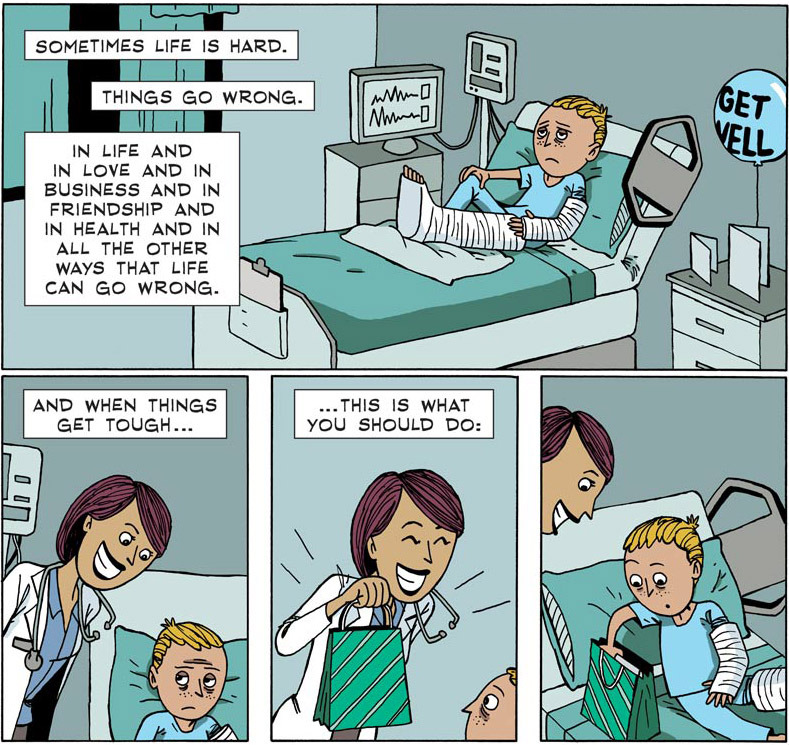
When The Road Gets Rough, Make Good Art

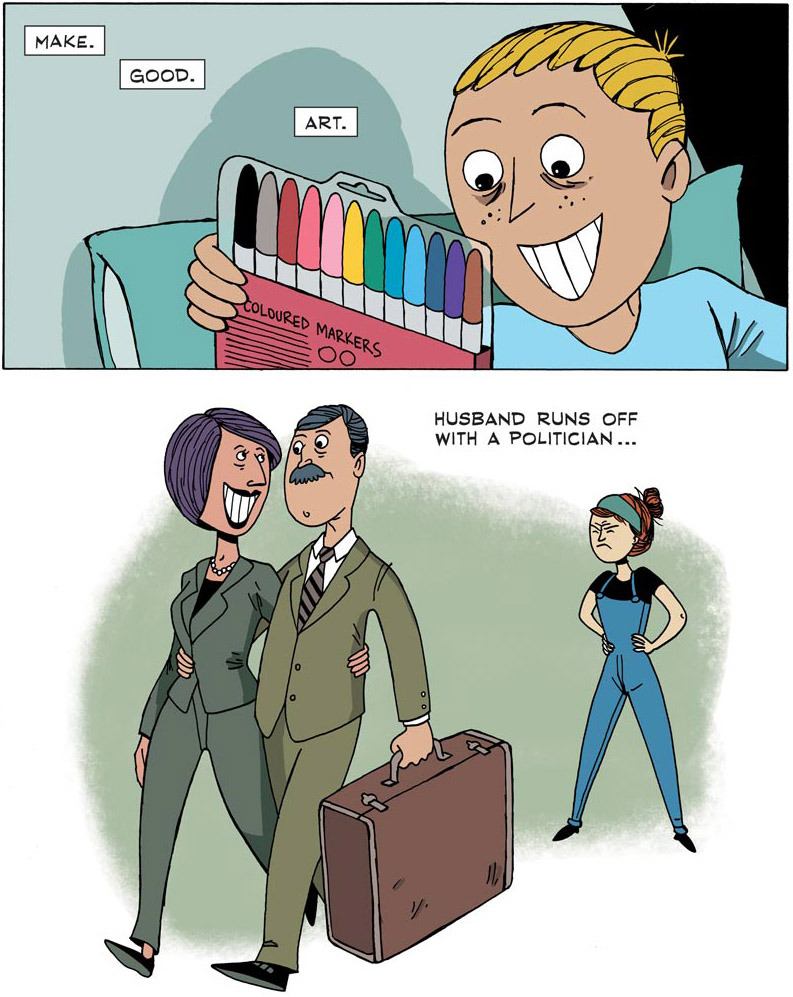
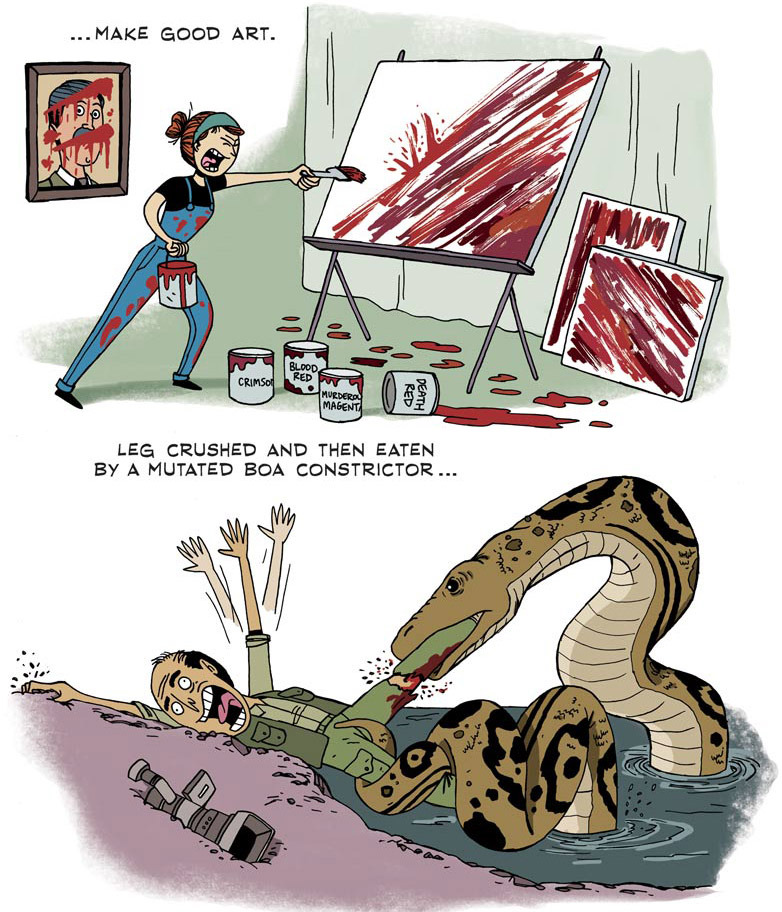
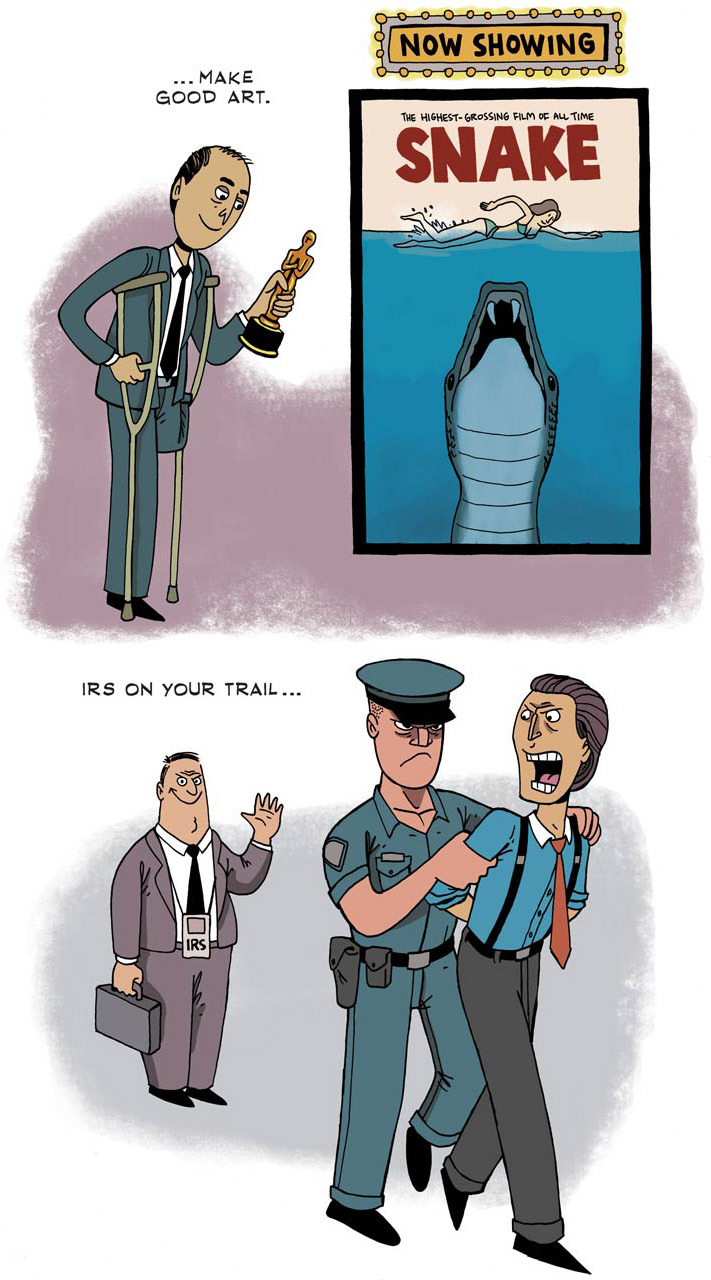
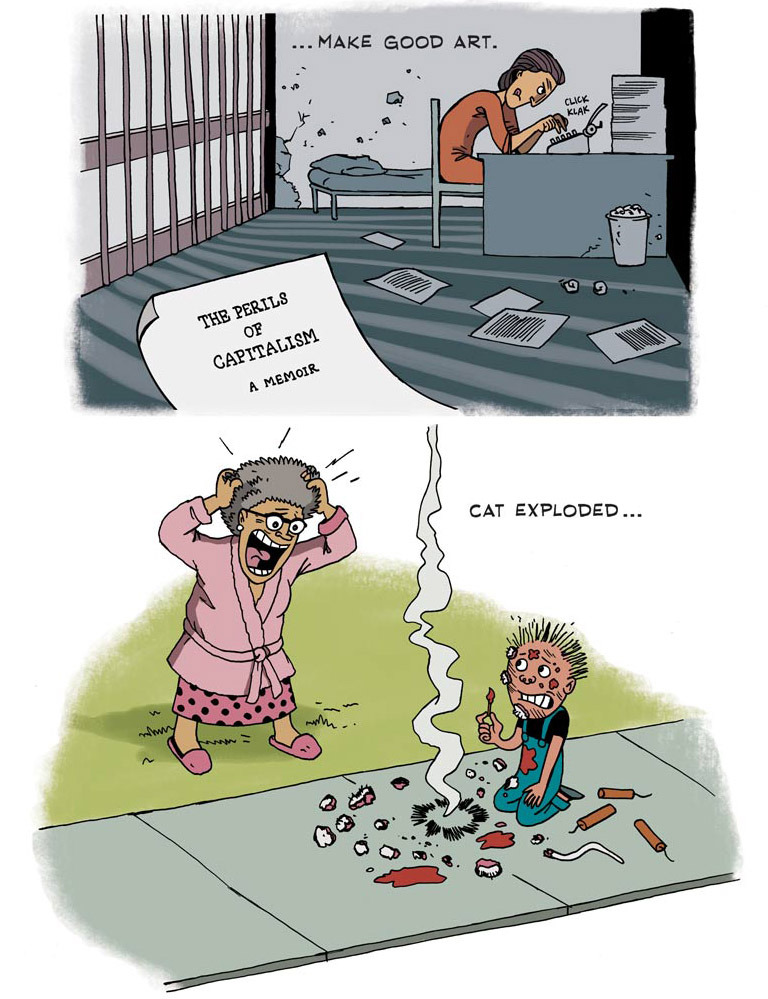
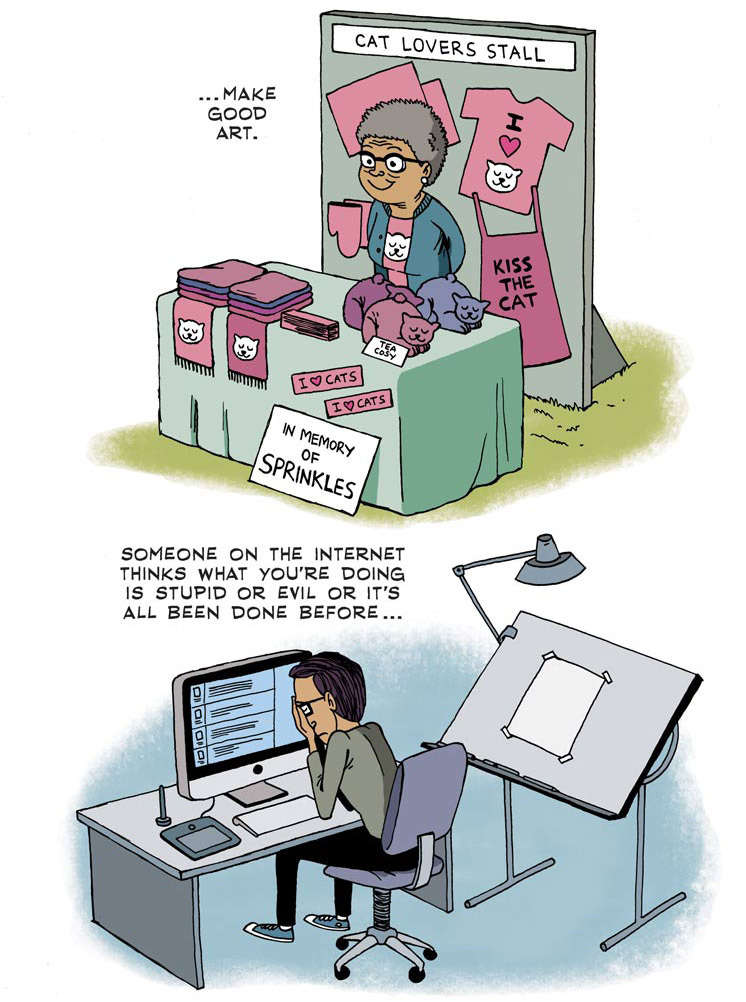
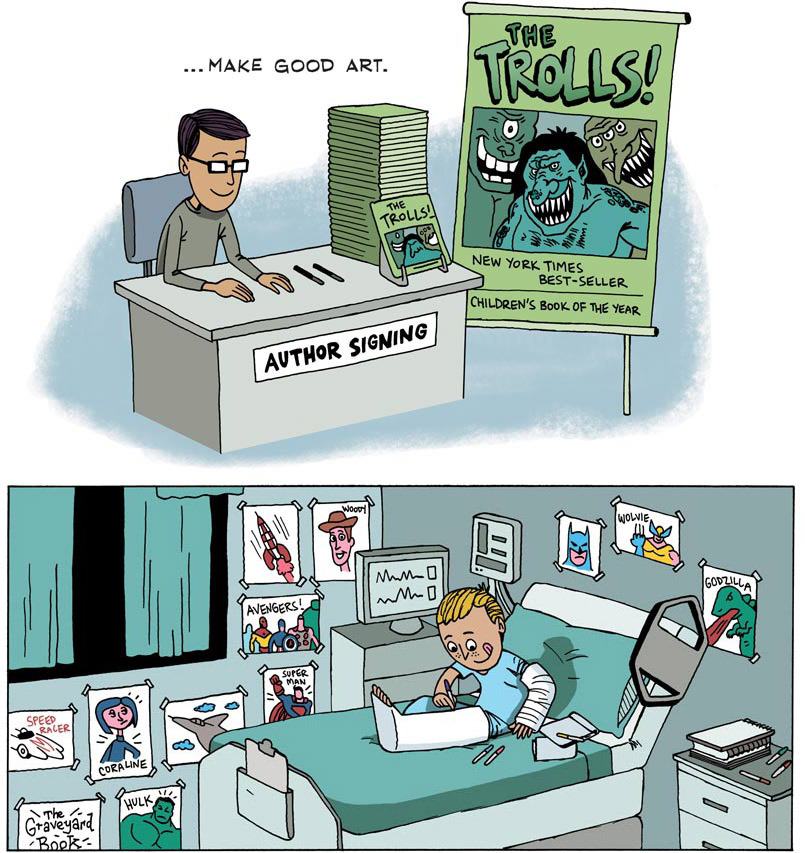
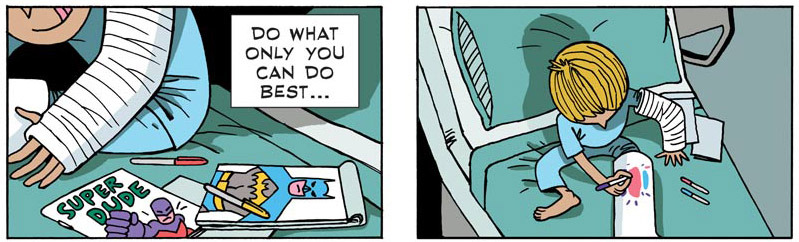
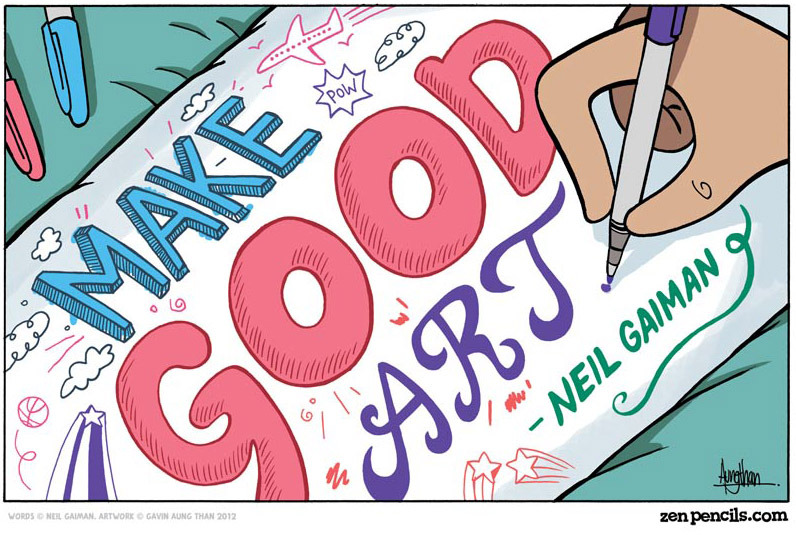
As I sat on my rock-hard dorm bed, completely unmotivated to continue on with what I needed to do (homework, homework, and more homework), I came across a comic strip whilst I surfed the Internet. It was titled Make Good Art. It gives off the message that when you are struggling with something difficult in your life, art can be used as inspiration to propel you to do something positive with the negative situation.

I thought about my negative situation: not receiving my new phone in the mail and having to wait another two weeks for it (I know can you spell materialistic and doesn’t matter?). But granted, I’ve been putting all of my anticipation and happiness in receiving this one electronic item, and to my great disappointment it’s going to take longer for it to come. Then, as the tears began to stream down (a little exaggeration, but hey), I mustered up enough energy to read this strip, and suddenly I was enlightened by my situation.

After seeing this comic strip I was really able to put into perspective, not only the good that I have in my life, but also the positivity that art can bring to any bad experience. After this realization my spirits were lifted. I became more willing to be productive and more inspired by the outcome. Not completely saying I jumped right into my mountain of homework with enthusiasm, but I did wipe away the dramatic tears, and I was able to find the vast opportunities that could busy me as I awaited my beloved phone.

Comic Strip credited to Neil Gaiman from zenpencils.com

The Sons, and Their Father, Mumford

A conundrum I’ve always tried to elucidate is whether an acoustic/folk album comprised of songs that essentially sound the same is a display of the artist’s ability to produce specific, cohesive and polished music, or whether it should be seen as a disability of the artist to diversify their creativity. I’ve struggled with this quandary with practically every Jack Johnson record, the Avett Brothers, a lot of John Mayer’s music and (although I don’t at all agree with this) I’ve heard Bon Iver be criticized for it as well. I am presented with this problem most recently by the Mumford & Sons release Babel, which is their second studio album. In my opinion, both of Bon Iver’s albums are similar, but not identical in sound; their variances are easily noticeable due to the array of instruments used and definitive stylistic deviations throughout the albums. Even Jack Johnson records incorporate different methods to the point where I can readily distinguish between the individual tracks. Try as I might, though, I cannot say the same for Babel.

Although it is easy to identify one or two of the songs without looking at the track list, the majority of this album sounds almost identical. It seems as though the chords and rhythms progress without alteration throughout the entire piece. This happens not because the band fails to utilize a wide array of instruments- in any given song there can be a combination of guitar, drums, mandolin, keyboard, accordion, dobro and, of course, banjo- but because they use all of these instruments in practically every song. With the exception of “Babel,” “Ghosts That We Knew” and “Hopeless Wanderer,” it took me a substantial amount of full listens to be able to differentiate between the tracks; they simply all sound the same.

The important question lies in the significance of this resemblance. Does this mean that Babel is a weak album? Or that Mumford & Sons are only capable of creating one type of music? In my opinion, the answer is definitely no to the first question, and for the most part no to the second. Babel is undeniably an impressive record; despite this flaw the songs all still sound marvelous. In an “If it ain’t broke don’t fix it” mentality, I don’t mind listening to songs that sound similar as long as I still enjoy listening to them. I particularly appreciate this music while studying as it drowns out any disruptive, outside noise but changes so minimally that it does not distract my focus away from the work. As to the second question, I think it is important to clarify that although Mumford & Sons have only ever produced stylistically similar music, this does not mean they are not talented artists or that they are only capable of composing a single genre of music. It just means they know what they are good at and have become extremely successful within that category. Granted, it is more impressive when artists show some sort of growth and development, but as this is only the band’s second album I think there is still potential for this maturation. In any case, as long as it continues to sound as fantastic as this piece, I’ll keep listening to anything they produce. The magic of this music is that it never gets old- I will always have a hunger for some soothing folk, bluegrassy tunes to accompany me in the library.

What is Art?

My first post on this blog, The Irrelevance of the Artist, spurred some debate with an intellectual friend of mine. He insisted that the artist was integral to the art because so much of art is its meaning and intention, which is derived directly from said artist. I disagreed: once the artist is done creating his work, his intention and his opinion matter no more than any other observer’s. Very quickly, I realized the foundation of our argument was not disagreement regarding the role of the artist as much as it was a disagreement on what art is.

To him, I gathered, art was something deliberately created to carry the artist’s intent. To me, such a definition was too limiting. It meant art could only be man-made and have a specific purpose or statement in mind. To me, art is an interaction and a provocation. Not necessarily something meant to elicit anger and frustration but something meant to elicit. Period.

Therefore, in a way, everything is art, n’est-ce pas? From the laughter of a child which inspires awe to the cockroach which sparks repulsion. From Picasso’s The Old Guitarist to the strum of a guitar of an old man on the street. Even intangible concepts such as the incomprehensible infinity of the universe and unimaginable promise of the future are art. Art is thought and emotion and physicality and dirt and nonsense and sense. It is human consciousness and everything the consciousness reacts with. The idea that something that vast could be narrowed down into something physical, created with an intention in mind is ludicrous, perhaps even blasphemous.

While art is as old as the human race itself, the need obsession with defining exactly what it is has come about fairly recently (that we know of). I will not pretend to know why nor will I publish my thoughts with a possible why if and when I do come up with one. Because it doesn’t matter. My opinion – this entire blog post – is not fact. It is truth. It is art. You, reading this, what is happening right now is art. And as the artist typing this blog post, I want to let you know that it’s almost done. So I’m about to step back now and let you think and feel what you want. Maybe I’ll leave you with a Herman Melville poem because… hey, why the hell not? It even rhymes.

Art

In placid hours well-pleased we dream

Of many a brave unbodied scheme.

But form to lend, pulsed life create,

What unlike things must meet and mate:

A flame to melt – a wind to freeze;

Sad patience – joyous energies;

Humility – yet pride and scorn;

Instinct and study; love and hate;

Audacity – reverence. These must mate,

And fuse with Jacob’s mystic heart,

To wrestle with the angel – Art.

Epiphany as Performance Art

[At some point, I might write about actual “art” as described by society or by textbooks, but until then I will write about art in its many manifestations in my life. And I will make sweeping generalizations, per usual, to, possibly, further talk about “art” as this new form so that everyone can see art in ways that are completely self-taught and self-learned through lived experience. I see everyday as art, aesthetically, call me A (as created by Kierkegaard), call me what you may…]

Epiphany. Realization. The light bulb turns on. Things start to click. Anyway one could say it, this is the moment where everything stops and one learns something that could actually, maybe (without sounding terribly WRONG or misdirected or too entrenched in the enlightenment or western thought), be “objectively” true.

This week, magically, had two moments of Epiphany. TWO.  Thus, this week was a success. Even if I continuously paper-cut myself, if I had a head cold, if I stayed up late working over logical derivations, it doesn’t matter. This week I had moments that changed my life. This week was worth living.

First. I love to go to the Edgar Reading Series that the MFA in Creative Writing program puts on. It’s usually in a cool space (e.g. Work Gallery, Potbelly’s) and is filled with writers, which are some of the best type of people. I thought I had almost seen this event in a cute Independent film because the plot of the night almost aligned to any cute movie (where cute, yes, is banal and cliché but nonetheless like cups of coffee—you can’t help but to keep them coming): After waiting in the cold because Work Gallery closed early (#unprofessional, where the event was supposed to be) we eventually went to Potbelly’s to the top floor. With smells of sandwiches, and Ann Arborites, and failed plan A and a successful plan B, we all got seated and chatted. Some recounted past parties, others wrote notes, and others (me) read The History of Sexuality, Vol. 1 by Foucault.

The space was dripping in what most would call hipster creativism, but what I would call nothing of the sort. It was a space where I thrived and felt at home.

Epiphany, begin!

After listening to a fiction writer whose resume was beyond imagination at the age of 24, a poet went to the stand. He happened to be in my Foucault seminar but we’d never talked, never really made eye contact. Then he started and I swooned for his word. There is nothing more personal, nothing that can connect you more to a human than to listen to their poetry.

This moment wasn’t just an epiphany of the space or of an unrealized friendship, but of poetry as form. While poetry is to be read, more so it is to be heard, listened, took in. For many weeks this semester, I had thought, “what is the purpose of my own poetry?” Will my copies my poems be trapped in shelf, in hard drive? Most likely yes. But this event inspired me to get my word out—even if it is yet to be at the smooth register of Ginsberg reciting “Howl.” My epiphany was one of action. Take my poetry and bring it to the streets. Recite it to people and form these connections. Poetry is to be sung and to be engaged with.

Second. My future necessitates Academia. My degrees are in writing nicely and thinking pretty. I love theory. So: graduate school is calling. In my attempts to situate myself in any discipline or in any type of study (post-colonialism, feminist theory, queer theory) I found myself clinging to issues of race and feeling unsatisfied.

Last night, in the midst of a great debriefing session, my friend introduced me to Frank B. Wilderson III and to Afro-Pessimism. “Afro-Pessimists are framed as such…because they theorize an antagonism, rather than a conflict—ie. they perform a kind of ‘work of understanding’ rather than that of liberation, refusing to posit seemingly untenable solutions to the problems they raise” (http://www.incognegro.org/afro_pessimism.html). Because I cannot describe the theory in one post and do it justice, read what they think. Although this, in and of itself is problematic in tabling the view, it is also in attempts so one does not misinterpret them (or I).

Blackness is theory in its most unapologetic form, in its most objective form. Wilderson’s ideas are not ideas, they are truth. My yearning to work with race is growing at an exponential rate after being exposed to this and I’ve yet to feel like an area of theory has ever been completely spot on. Until now.

Epiphany inspires performance art. It changes the way in which one acts and thinks about life. Thus, this art makes one produce things that one loves. Be it actions, thoughts, words, theories. Epiphany necessitates change of self, and this change is the most beautiful of forms.

An Online Museum?

For any art lover who has yet to experience art.sy, I plead you to log on and register for what may be the holy grail of art repositories. The website is an online collection of both current artwork and the masters’. With the ability to follow certain artists you can build your own library of art work – scrolling through the website and building your personal art collection (mine includes Banksy, Van Gogh, Matisse, and Pollack…among 25 other artists!) In addition to having the ability to buy current works, the website also sends daily inspiration to one’s inbox with high-res images and updates on works and artists.

This website marks a trend in the art world, one where digitization is becoming the norm. Inarguably, something is lost when images are transcribed online – no photograph can possibly render the beauty and power that one feels when they are face-to-face with a work of art. Some art feigns would even argue that the putting of images online distorts the works.

Yet, I beg to differ. Often, while sitting in class, I am wishing I could be in Manhattan, strolling through the halls of MoMA or the Met. However, this is an impossibility while stuck here in Ann Arbor. So, the next best thing (I figure!) is having my own online museum to get lost in – to spend hours scrolling through the gorgeous images that I wish I was able to see and surround myself by in person. While an online museum of sorts may not be the artists’ idea way of displaying their work, it is the perfect solution for those who are unable to spend hours losing themselves in a museum. The transportability and transience of an online art museum is, I’d say, pretty invaluable.