
Scribble #5: Can’t Be Sure

Did you know desire’s a terrible thing?”

After a fun weekend of Halloween festivities, I am confronted with the reality of having multiple 10-12 page papers assigned and due by mid-December. A group project worth 20% of my semester grade is due in less than a week. There are only 22 days until Thanksgiving and only 37 days until the last day of classes. I’m still meeting new people on a near-daily basis and trying to juggle the many clubs I joined with the return of in-person classes and activities.

“It makes the world go blind.”

My semester has flown by. Maybe it’s because we are finally doing things in person, maybe it is because I already have a year of college under my belt, or maybe it’s because I’ve been incredibly busy ever since I moved in. 

“But if desire’s a terrible thing,”

In my experience, among my favorite things at the University of Michigan are the endless opportunities at my fingertips. I have no shortage of clubs to join, events to attend, jobs to apply for, and people to meet and spend time with. Unfortunately, this creates a challenge for me. With a course load of fifteen credits or more per semester and in-person activities resuming, I have to ask myself an important question: How much is too much?

You know that I really don’t mind,”

It is not a failure to step back and do less. It is not a sign of defeat to admit that I am not able to do everything. I am not letting myself or others down by acknowledging that I am in over my head. It is okay to say no to events and opportunities, and there is no shame in doing so. After a year of nearly nothing, it is not a reasonable expectation that all of a sudden we would be able to do more than we ever did in our lives prior to the pandemic.

“And it’s my life.”

Like Harriet Wheeler, lead singer of The Sundays, says in Can’t Be Sure, knowing what is best for you and what you want doesn’t have to be instant. Desires and passions can change, and there is no problem with that.

“And though I can’t be sure what I want any more, it will come to me later.”

Sometimes, I don’t know if I’m making the right decision when I choose to start a new activity or reduce my participation in an old one. Fortunately, I also trust myself to do what is best, and when I doubt myself, I have a network of people who I can talk it out with. Regardless, I’ll be able to see that it all works out for me eventually. There will be no shortage of future opportunities for me to engage in if I so choose.

Listen to Can’t Be Sure here: https://youtu.be/yARVs1ZNLjU

LOG_003_DISHWORM

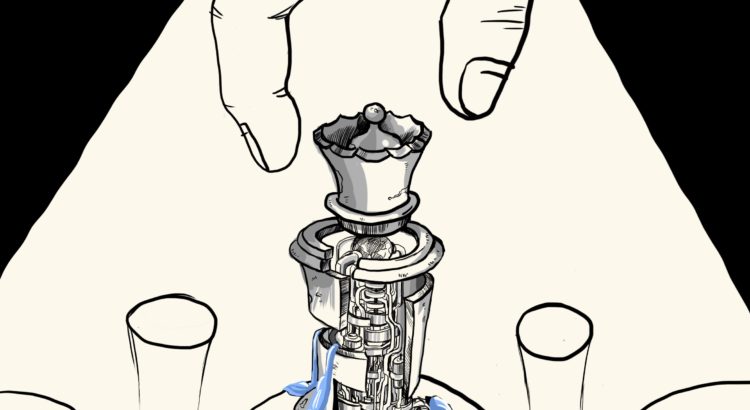
Illustration from Irma Beumer’s field notes of the dishworm’s life cycle.


Text transcribed from the notes of xenobiologist Irma Beumer:

The dishworm, so named for its dish-like carapace, is a small organism native to planet Khepri-1b. It lives in the dirt of temperate forests in the twilight zone. In addition to energy obtained from the photosynthetic cells on its “dish,” the mobile forms burrow and forage in detritus for food.

Its lifecycle is a complex one: the dishworm appears to be gynodioecious, consisting of female and hermaphrodites. Current research suggests that all members of the species start as females and later become hermaphroditic. Adult females are mobile and their eggs develop parthenogenetically into female offspring, while adult hermaphrodites are sessile and self-fertilize eggs, not unlike the life stages of Earth organisms of ferns or cnidarians. Early xenobiology research mistook the two adult stages as entirely unrelated organisms.


#1 spore/egg — small, scattered by winds — can be fertilized (egg) or self-fertilized pseudo-spore

#2 young dishworm stage (sessile) — undergoes embryonic development, suggested main nutrient sources are from the soil and photosynthesis

#3 juvenile dishworm stage — similar to stage 4a, but with a much shorter tail that grows additional segments with age

#4a adult stage — wormlike, the first recorded observations of this organism. Its anterior has four appendages for shoveling and combing dirt, while the heavy tail and the tail’s claws serve to anchor the organism in high wind conditions

#4b adult stage (sessile) — hermaphroditic, self-fertilizes eggs that are dispersed via wind forces. The soft “body” of 4a is not visible.

+KHAOS II+ EP.28: INTO PANDORA’S BOX

+KHAOS II+ EP.28: INTO PANDORA’S BOX

+KHAOS II+ EP.28: INTO PANDORA’S BOX

Dr. Claymore and Dr. Harper lead Milo and Kira into a secret room deep inside the underground base of SALV, where a set of rocks from Ellea have been recovered after the day of the disaster. One absurd discovery has been made: a fresh pair of lungs that were embedded and safely kept inside a disintegrated particle of Ellea. The pair of lungs attracted every form of life around it, making small plants around it flourish with fresh green leaves and beautiful flowers and even giving life to small butterflies. This breathtaking and incredible scene further inspires the crew to unearth the secrets behind who Ingenium is and what his intentions are.

Remember that the world keeps spinning in circles 

That you are slowly responsible for the sisters who can’t speak 

Remember

That in silence you sleep

You sit

And settle with someone sliding past you

Remember that the world keeps spinning and circles 

And you are really responsible for you

Live in the present and likely 

Lead a life that’s lonely 

Looking for and leading with tasks 

That limit you lowly in the present 

Remember that the world keeps spinning and circles 

And you fear for the future 

Fear in the future 

Focus fondly on the far 

Forgetting the present 

While you’re supposed to stay present 

And the world keeps spinning 

And you’re running in circles 

Until you run out of breath