
Why Our Lives Are More Perfect Than The Movies…

Last week I discussed why rain will never be as romantic in real life as it is portrayed in the movies. I discovered that movies romanticize a lot of things. This led me to the following question:

Do movies sell us standards no one will ever be able to live up to?

This question is very hard. I mean, it is not hard to answer: Yes. Yes, movies definitely sell us standards no one can live up to. A hilarious number of shattered first date expectations, “proposals gone wrong”-videos on YouTube and emergency room admissions for brides who were danced away by their back flipping dads can prove that.
The tricky part of this question, however, is to explain what these high standards mean for our real life. Do high standards have a large impact on our expectations? Does the lack of fulfillment of these expectations make us less happy with what we have?

buddha-3

Let’s answer the last question first. If we consult Buddha – you know the guy most of our parents have in their backyards – we will find that expectations are the  one thing that makes us unsatisfied and therefore unhappy. Buddhism basically says: ‘Have no pleasure and you will have no pain’ and ‘the expectation of pleasure most likely brings nothing but pain’. While this attitude is rather hefty and made Buddha want to spent most of his life in strict ascesis, he has a point. Expectations are what can ruin a perfectly good thing. We all know this phenomenon. Movies, to stay on topic, are a great example:

So, your friend is talking up a movie she recently watched in the theater. “Oh my gosh, it was like, the best movie like eveeeerr” –  yes, your friend is in a sorority. She keeps talking about how brilliant this movie is and convinces you to finally watch it with her. Pumped up by the expectations, you are totally let down by the movie. Sure, it’s ok, but not nearly as good as your friend promised it to be. Had you seen the same movie on a rainy night on your couch with no expectation towards it whatsoever, you probably would have liked it a lot more!


In order to answer the question whether movies have a large impact on our expectations, we have to go personal. Since a movie’s impact will vary from person to person, it is hard and  maybe not wise to generalize. If I consider myself, though, I can tell you that movies have a major impact on my expectations and my entire worldview. “Love actually…”, for example, had such a huge impact on me that I actually wrote my feelings for a girl in my class – I was in elementary school – on a piece of paper and delivered it to her doorstep. Unfortunately, I only wrote something weird like ‘Ich find dich irgendwie total super’ and ran away  awkwardly after handing the paper to her, instead of bravely awaiting her reaction like Andrew Lincoln did. This ended up in me never talking to that girl ever again and why? Because my expectations were too high and her expectations were too high and admittedly because I was an awkward, clumsy baboon. But also the expectations thing.

to-me-you-are-perfect

No matter how romantic a first date, how touching a eulogy and how empowering a motivational speech is, you will always be able to find a movie which does it better. Why? Because they can have as many takes as they want. Because they have 6 people thinking about what one person is going to say. Because they have adequate music in the background for any situation imaginable and because they are not real! What actually is real is a grandpa who cannot deliver the eulogy for his wife, because she touched his heart for a lifetime instead of just 90 minutes. What actually is real is a couple to be, who have sweaty hands and behave awkwardly because this shows that what is happening is really important to them and may be really important to the future and not only for 90 minutes. What actually is real is the motivational speech that never has to be held because your motivation is your social environment in which you invest so much effort, so much tears and so much more than 90 minutes.

Real life is longer than 90 minutes. And many emotions are delivered over a very long time. They don’t have to be discharged in a heart-breaking period of 20 minutes. What happens in the real world is much more meaningful, just less intense. And  it certainly is less perfect… less planned… less thought through. But isn’t this imperfection the thing that makes what happens in the real world unique? Isn’t this imperfection the one thing that sets us apart most from the movies and that the movies will never be as good at as we real people in the real word? Isn’t this imperfection the thing that makes our lives the most… perfect?


PS: Remember to be as weird as you can possibly be.
Weekend Watch – Florence Foster Jenkins

In children’s literature and children’s programming, there sometimes seem to be a few core themes and lessons that are hammered home over and over. “Be yourself.” “Don’t care what other people think.” “It’s not about being the best; it’s about having fun.” Children’s narratives are certainly capable of more nuance than that—the children’s-young adult hybrid series Animorphs, for example, explores the ramifications of war and the pain of PTSD, concepts that are unexpectedly sophisticated for their target audience—but children’s stories tend to be inherently more simplistic than adult narratives. (I say this as a huge fan of children’s and young adult literature and programming.)

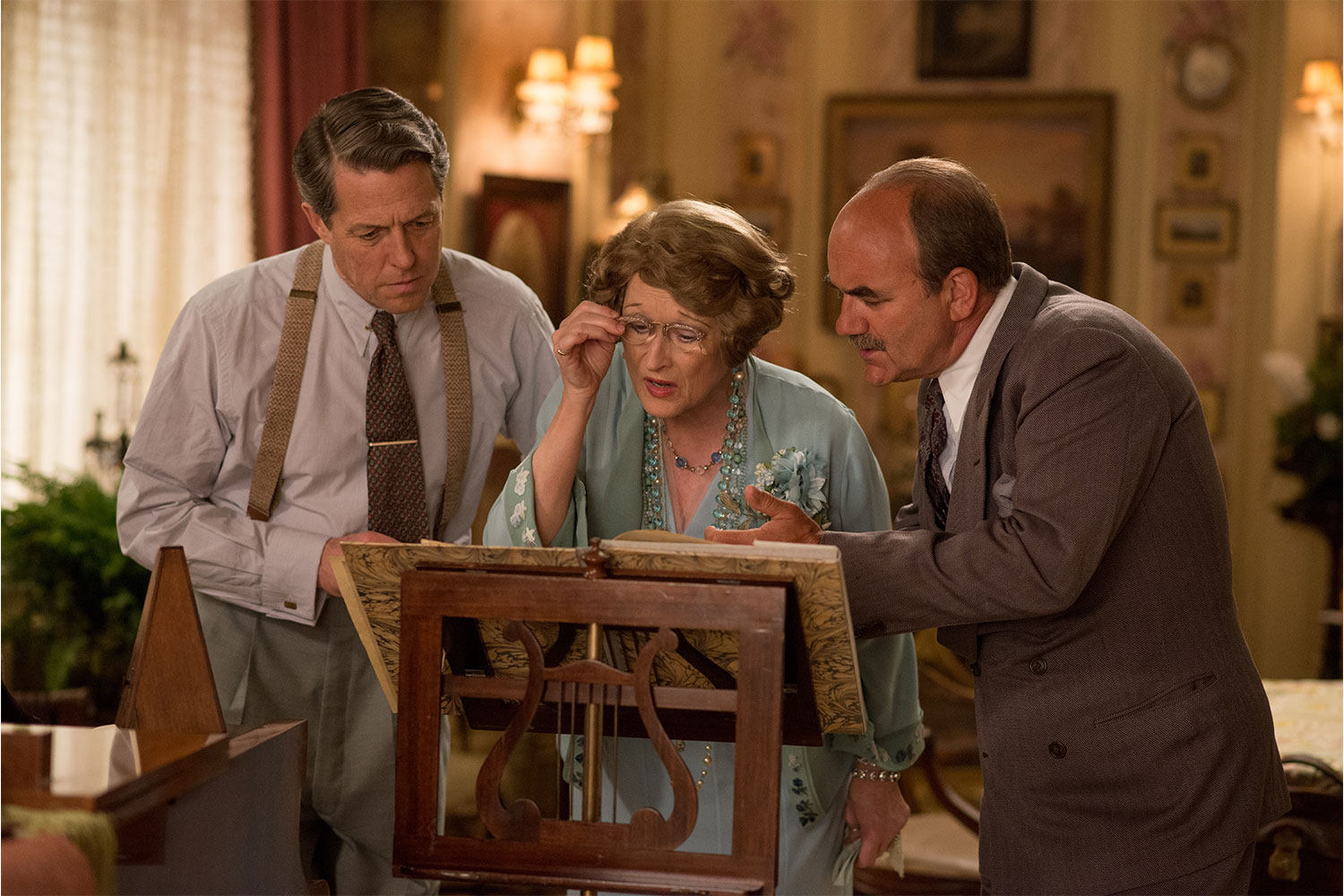
This week I watched Florence Foster Jenkins, a film that is certainly entertaining, but whose central themes are about as sophisticated as a child’s fable. The plot concerns Florence Foster Jenkins (Meryl Streep), a real-life New York City socialite who devoted her life to celebrating opera and music. The premise (based in reality) is a bit sitcom-y; as Florence resumes her singing lessons, everyone around her lies to her about her talent, afraid to be honest with her about how terrible of a singer she is. Florence’s husband and manager, St. Clair Bayfield (Hugh Grant), most blatantly encourages Florence’s delusions, hiring a new accompanist for her lessons and warning him not to criticize her.

Most of the movie proceeds how you’d expect. Bayfield and accompanist/audience surrogate Cosmé McMoon (Helberg, whose erratic facial twitches are funny, though a little too much for me) bend over backwards to cover up the truth. When Florence proposes performing to a wider audience, Bayfield and McMoon hand-pick members of Florence’s Verdi Club, hoping that paying people off will prevent the truth from coming out.

florence-1

There are numerous close calls, like when one socialite named Agnes Stark (Nina Arianda, animated and funny) erupts in uncontrollable laughter at the first recital, but for the most part Florence remains oblivious to her vocal shortcomings until the very end, at which point the movie goes full optimistic crowd-pleaser, laying on all the cheesy lessons you’d expect: be yourself. Don’t care what other people think. It’s not about being the best; it’s about having fun.

Look, I know that these are lessons that can still be helpful for adults to hear. But you can’t blame me for wishing there was something a little more there. It reminds me of all the cookie-cutter biopic endings when the main characters spew inspirational quotes seemingly designed to generations to come.

There was Alan Turing, in The Imitation Game, being reminded that “Sometimes it is the people no one can imagine anything of who do the things no one can imagine.” In Florence Foster Jenkins, it’s Florence proudly pointing out that “Some may say that I couldn’t sing, but no one can say that I didn’t sing” only moments before she succumbs to sickness and dies. It doesn’t really matter that these historical figures really did say those things; movies have to find a way to make those quotes feel like more than empty faux-inspiration, and I’d argue that neither quite succeeds.

Besides, it’d be easier to enjoy the simplistic lessons for what they are if the film really made you invest in Florence, but she isn’t challenged nearly enough for her schmaltzy breakthrough at the end to hold much emotional weight. At her final concert at Carnegie Hall, the audience breaks out in laughter, and for a moment, Florence is stunned, afraid, confused. But even that moment is quickly reversed when Agnes yells at the audience to be quiet, and everyone ends up giving Florence a standing ovation, encouraging her to go on. She carries on in delusion.

The only real challenge to Florence’s pride occurs with less than 15 minutes left in the movie, when Bayfield fails to prevent her from seeing a copy of the New York Post, which contains a scathing review of her performance. Florence is upset, but by limiting the negative reception to just one review, the film’s lesson momentarily shifts to the idea that there’ll always be someone who doesn’t like your art, and that you have to accept that not everyone will like you.

This is an equally disingenuous lesson, because Florence is unquestionably a bad singer. If there’s an argument to be made in her favor, it’s that she does what she’s passionate about, not that she’s an objectively good singer. Limiting the negative reception to only one review makes it feel like one unreasonable outlying opinion.

Indeed, the few people who are honest to Florence are treated as cartoonish villains. The writer of that Post article is angry and vindictive, the kind of critic that movies like Birdman love to demonize. He seems to relish tearing Florence apart, hyperbolically calling her the worst singer in the world. The film paints him as an evil man who wants to ruin everyone’s fun, even if his criticisms of Florence’s singing are fairly accurate.

florence-3

The movie does have hints of nuance in its subplots. There’s a genuine warmth to Florence’s interactions with McMoon, who she occasionally treats like the son she could never have. The heart of the film, though, lies in the love Florence and Bayfield have for each other.

At the beginning, when Bayfield’s mistress (Rebecca Ferguson) is introduced, you start to suspect there’ll be a predictable series of scenes culminating in the truth coming out about Bayfield’s infidelity, tearing their marriage apart until a third-act reconciliation. The reality, though, is that Florence and Bayfield have an unspoken understanding; due to Florence’s syphilis, they abstain from sex, and Bayfield finds satisfaction elsewhere. The movie doesn’t delve too deeply into the implications of this arrangement, but it’s refreshing to see Nicholas Martin’s script avoid the trappings of the cliché infidelity plot.

And the movie in general is pretty fun, bolstered by typically strong acting from Streep and Grant, a pleasantly light tone, and expectedly meticulous period detail. It’s an enjoyable experience, even if it mostly fails to come up with anything deeper than “Do what you love and don’t care what other people think.”

Grade: B-

The Movies of 2016

There has been a strange trend recently at the cinema. The growing struggle between escapist, populist, entertainment, and grim, but practical realism is apparent especially as awards season culminates with the Oscars show later next month. The two frontrunners, “Moonlight” and “La La Land”, are fundamentally different movies in their depictions of the world. “Moonlight” revolves around the struggles of Chiron, a young African American, as he comes to terms with his own sexuality and identity in a society that openly despises him. Brilliantly shot, vibrantly lit, it never shies away from the reality of Chiron’s situation. His father is never seen and his absence is never explained. It is simply how things are. The movie revolves around Chiron as he accepts himself as he is. Thousands of miles from the humid neighborhoods of Florida where Chiron resides, two dreamers in Los Angeles refuse to accept anything as it is. In a city filled with fallen hopes, Mia and Sebastian are rejected at every turn. The movie La La Land, matches their stubborn, romantic idealism with its own whimsy. One spectacular sequence even sees the two lovers fly into the sky and dance among the stars. Every moment is filled with a sense of hope, of a brilliant future awaiting If they could only stretch a little further. “La La Land” is loud and sun drenched. Its heart is singing. “Moonlight” lives on the quiet beaches empty of the usual tourists, filled with only the sound of the waves. They are as different as night and day. Yet, in the end, both movies confront the necessity of sacrifice in realistic terms. The level of realism is expected. Both are films with smaller budgets that do not need to pander to audiences to make money. They have the freedom to tackle difficult issues faced by everyday people. The truly interesting phenomenon has been as blockbusters have followed suit.

Star Wars Opening Weekend in 1977

In 1977, “Star Wars” was released. To say that it was well-received would be an extreme understatement. It was the first true blockbuster and it revolutionized the cinematic experience. Suddenly, every studio wanted to follow suit. At its core, Star Wars was always an idealistic fantasy with a handsome rogue, a daring princess, and an evil empire to be defeated by the heroes. It was the perfect, escapist package. Yet, this year, a new film in the Star Wars universe was released and radically diverged from the squeaky-clean path established by the previous films. The result was not entirely satisfying. Conceptually, it was an interesting idea. I’m sure that the everyone in the corporate boardroom nodded enthusiastically. “Let’s make Star Wars, but dark.” This new Star Wars movie tackles the desperate hope of a rebellion. Instead of focusing on a maniacal emperor, it focuses on the ordinary people opposing him. In this ground-level approach, “Rogue One” becomes far more like “Moonlight” and “La La Land” than any of its predecessors. This chameleon-like effect has largely occurred because one studio characteristic: They love proven brand names. Rather than risk investing in a new project, they’d rather paint on a coat of fresh paint. This has happened repeatedly. It worked in 2014, when Marvel changed “Captain America: The Winter Soldier” into a political thriller of the 70s and again in 2015, when the ridiculous sounding “Ant-Man” became a surprisingly fun heist film. Previously these types of plots would have been reserved for middle to low budget movies. Now, they are slipped like medicine with our spoonful of escapist sugar.

Ashton Sanders as teenaged Chiron and Jharrel Jerome as Kevin in “Moonlight”

These two types of movies, the prestige flick and the blockbuster, define the current cinematic landscape. There is little to no middle ground. Most are simply priced out of the market. Their profits are simply too small to justify their larger budgets. Now their plots are given to the superheroes and jedis. It has been especially interesting as franchise films aim to be more than merely popcorn entertainment. Either way, I’ll be eagerly buying my ticket.

The Sensational Spy

Tinker Tailor Soldier Spy is a film often credited with removing the sensationalism from the spy film genre. This is not to suggest a subsequent removal of the sensational from every spy film following its 2011 release. However, the film’s departure from the blockbuster epic filled with hyper-kinetic action was heavily emphasized by some of the coeval films. The Bourne Ultimatum was released four years before and Salt just a year. Of course there were the Bond films, Quantum of Solace releasing three years before and Skyfall appearing in 2012.

Regarding cinema of the 21st century, it would appear as if the Tomas Alfredson’s (Let the Right One In) film was a blip in a series of spy films that seemed to be primarily focused on spectacle – even if the action scenes attempted to ground themselves in brutish reality. Through the entire run of Tinker Tailor, there is one punch landed, and it occurs between two coworkers over annoyance/anger rather than any murderous intent. There are only three people who get shot, all of whom were standing still. There are no chase sequences. There are no explosions. There are no sexy cars. There are no gadgets. There are no fight scenes. Death occurs almost entirely off screen, leaving only the brutish result behind.

But a bloodied, disfigured, or in one case, disemboweled corpse, is in itself sensationalism within the context of the cinematic experience. The large lambency casts the horrific in an arguably digestible light. It does not remove the grotesque from the sordid realm, but the diabolical is relatively contained within the verisimilitude – we know it is not real. In the case of Tinker Tailor, suggesting its separation from sensationalism is an understood statement; it is not a form of absolute. Simultaneously, to enter a discourse on the effects of violence, although rare in this film, albeit grotesque upon arrival, is a perambulation I do not wish to go about.

Instead, color seems an interesting subject. The film is muted. It is filled with brown and grey tones, a dully-colored wardrobe, and thick layer of cigarette smoke acting as an opaque veneer for scenes with groups of fellow Circus (MI6) members. It is possible that a muted visual pallet will act to de-sensationalize a film – a visual sobering. Yet, paradoxically, since it creates a stronger verisimilitude, the shock increases upon seeing death. Sometimes, it is nicer to see the cartoonish red spray of Tarantino. Hence, it is more shocking and it lingers for a greater period, the violent result sitting deep in the pit of your stomach as if you have seen something you really should not have.

“But it is made to feel more accurate right? It was not produced to create excitement. It was produced to create horror perhaps. Hence, by definition, it is not sensationalism!” Well, if Alfredson’s intention fit exactly as per description, then perhaps yes, it is not sensationalism on his part as the director. However, the problem lies in the communicative practice of cinema – an audience unfortunately shares it. The horrific can produce excitement within the setting of fiction. Perhaps the best Tinker Tailor can do is be a muted form of sensationalism and the only immoral way to escape it is to actually kill the actors. Which is perhaps why certain documentaries are able to escape the horror/excitement dynamic – purely because the accounts of violence within them, should they exist in the film, are unquestionably real leaving the viewer in a desolate emotional seat.

Outside the realm of the visual, the film ends with a Julio Iglesias’ cover of La Mer playing over a montage that wraps up some loose ends. It is an instance of the perfect moment where film and music match. It is pretty sensational. But perhaps not in the way you would expect from a spy film. Although the track features clapping that matches with the action of the montage in a climatic way, it also plays over scenes of deep emotional value, one of which is coldly unresolved. Hence, this sonic movement is incomparable to the Bond theme playing in the last scene of any Bond movie ever, or Moby’s Extreme Ways coming on at the end of a Bourne film.

To call Tinker Tailor Soldier Spy a practice of distancing from the sensational is undoubtedly anchored in the films that came before and after it. Evoking the old adage of there is no purity without impurity, there is no sensational with banal accuracy on deceptively banal subjects. Obviously film started with as a rather sensational experiment, one early film featuring a train coming towards the audience only to terrorize everyone present. Then is Tinker Tailor a tasteful response to the Hollywood progression? Is the subtle form of the sensational better?

Will rain ever be as romantic as in the movies?

The rain falls on her dark hair, runs down the sides of her beautiful face and drips down from her chin onto her warm bosom. You lose yourself in her eyes and you see that she is lost in yours. The cool drops seem to pull you toward her until her slow breath tickles your lips and then… you kiss her. And just like the rain, you fall and you just keep falling. Falling in love, falling for this girl, who twists your world upside down.

That is how rain works right? Or does it? If I recall correctly, nothing in my life has ever even come close to being as romantic as this scene. I don’t know about you but my first kisses usually involve sweaty hands, a mutual feeling of insecurity and just a bit of awkwardness. Just imagine rain adding to these already miserable circumstances. I often ask myself why rain is portrayed so differently in the movies. Not only when it comes to romance, but in general. Let’s look at some examples, shall we?


Spiderman Upside Down Kiss

spiderman_upsidedownkiss

This one is a classic. In the 2002 version, Spiderman’s sweetheart, Mary Jane, is attacked by thugs in a dark alleyway. Spiderman hesitates at first, because he doesn’t have his spider mask, but eventually comes to the rescue. After Spiderman has retrieved his mask and suspended himself upside down from one of his spider strings, Mary Jane, portrayed by Kirsten Dunst, kisses him romantically in the rain.

Have you ever imagined what would happen if you helped out a lady getting attacked by four thugs in a dark alleyway? Exactly. You wouldn’t do it in the first place. You would hide, call the cops and leave the scene before things get icky.
Let’s say, however, you actually mustered the courage to attack the thugs and let’s assume, through some kind of miracle, you actually defeated them. Would there be a romantic kiss? The rain is freezing and alleyways are usually rather windy. Also, there are four unconscious men lying on the ground and the smell of the garbage cans you knocked over in the process of fighting the attackers slowly but surely takes over the alleyway. You look up the  buildings surrounding you and realize that kids are pointing their video cameras at you… That’s just a mood killer!

I vote: Wouldn’t be as romantic in real life!


Friends Before The Battle

legolas-and-gimli

In Peter Jackson’s epic milestone of a trilogy, the Lord of the Rings, the battle of Helms Deep is the climax of the second movie. Not only men are trying to hold back the evil powers of Isengard, but also Elves and a Dwarf. Although Elves and Dwarves tend to dislike each other due to their complicated past, Legolas and Gimli bury the hatchet right before joining the second most epic battle in movie history. Just before they confess their liking for each other, rain starts pouring down on them. They look at each other in a way that says nothing but “I love you”.

Obviously, it doesn’t make any sense to imagine being in the exact situation described above. Think of it more like bros confessing their love for each other before a massive change in their lives. I’m not going to lie here: I did confess my love to my best bros. A couple of times. If you have done the same for your best bro or best brosephine, then you probably know that standing in the rain would significantly  decrease your level of perceived intoxication, meaning you probably wouldn’t end up confessing your love at all. Not only doesn’t rain not improve this situation, it even prevents it from happening.

I vote: Wouldn’t be as bromantic in real life!


One thing that one can notice about movies, is the fact that there is always music in the background making funny scenes more funny, melodramatic scenes more melodramatic and crazy scenes more crazy. Turns out that doesn’t work in real life. Every time I got romantic with someone and started humming a mellow song, they started laughing… at me. I do not recommend you trying that.

So what does all of this tell us about movies: That they are a lie? That they are unrealistic? That they sell us standards no one will ever be able to live up to? We can answer the first two questions with a clear and easy “Yes!”. I think I have proved that extensively here. Answering the third question, however, is a bit more tricky and I shall address it in a detailed manner next week. If I want you guys to take anything away from this text, it is: Don’t think rain will improve anything in your real life, unless you’re a farmer!


PS: Remember to be as weird as you can possibly be.

Storytelling Without Words

img_3956

You can tell a story…

(Last night in the Moore Building on North Campus, the Britton Recital Hall housed the Piano Department Faculty Recital. The beautiful instrument with which they performed once belonged to Russian-born American classical pianist and composer Vladimir Horowitz. The Steinway Gallery of Detroit provided this piano, the same Horowitz Steinway Piano he played in the 1986 show in Moscow and his concerts around the world.

I didn’t know the language in which each pianist spoke off stage. Does that matter? No. I did know the language in which each pianist taught. After all, music is a language we all understand.

They conjoined with the instrument to deliver a story that didn’t require words or symbols, a history or a future. They spoke in the melody. They spoke in the moment. Some of the pianists explained the piece from the perspective of the composer before they began to play, while others left the piece open for interpretation. Each of them told a unique story. Whilst they explored their stories, it did not seem like the pianists were playing an instrument. Rather, they fused with the piano to become an inseparable pair.

Christopher Harding executed “Arabesque in C Major, op. 18” of 1839 by Robert Schumann with delicate hands. With a gentle yet masterful touch, he created sounds both loud and soft.

Amy Cheng and Martin Katz demonstrated piano four-hands with “Fantasia in F Minor, D. 940” of 1828 by Franz Schubert. The three units, Cheng, Katz, and the piano, formed a whole. Each note stitched together to form a quilted song. Cheng cued Katz while the pattern of her breath to create flawless seams in the sound. Their fingers bounced off the notes and then feathered back down to the keys to pick up the consecutive notes with eloquence.

Logan Skelton amazed the audience with his rendition. His hands brushed across the keys and painted a vivid setting from the piece. Sound is usually accepted through our ears, but his musical explanation engaged all of the audience members’ senses.

Arthur Greene glided through the measures of Frédéric Chopin’s “Etude in A-flat Major, op. 25, no. 1.” of 1837 and his “Barcarolle, op. 60” of 1846. His face began to flush with red as he charged the piano with another level of intensity, bringing character and passion into the piece.

Matt Bengtson performed Conlon Nancarrow’s “Canon B” from Three Canons for Ursula of 1989. First, he played solely with the left hand, then the right hand, and then brought the two together. The way he played, it sounded as though he disassembled and analyzed each note individually with artistic brilliance.

John Ellis translated “Sunday: Evenin’,” “Tuesday: Sugar Hill,” and “Wednesday: Apollo: Touch the Tree (for Fats)” from Arthur Cunningham’s “Harlem Suite” of 1970. I say translated because it’s like the piano whispered to him and he amplified its voice. He took the listeners back in time to Harlem years ago.)

…Without a single word.