Why “Girls” Understands Us

At this point, so many think pieces have been written about Lena Dunham and her show “Girls” that this post is completely redundant. Still, I continue to see and hear inflammatory stuff about her whenever her name comes up in conversation with my friends, and whenever I read comments about her show on the Internet. So I’ve been thinking about her a lot, and I feel like sharing.

It is so clear to me that Lena Dunham is incredibly self-aware. It was confirmed for me when I read her great book, Not that Kind of Girl, which included such self-deprecating quotes as “I would be a horrible girlfriend at this point in my life, because I’m both needy and unavailable.” Dunham is a deeply insecure person who clearly knows her worst qualities, and contrary to popular belief, she’s aware of her privilege. By creating “Girls” and creating the character of Hannah Horvath, Lena Dunham is poking fun at the flaws she knows she has.

So even though Hannah Horvath is completely lacking in perspective, Lena Dunham isn’t. Dunham’s portrayal reminds me of how Louis CK described his character on “Louie.” He said something along the lines of “Louie is me, but amplified and with worse luck.” CK is purposely portraying a version of himself, but with less professional success and less self-awareness. Dunham is the same way, playing a woman with a similar background but with professional turmoil and a severe lack of perspective.

“Girls” is, in part, an exercise in empathy, testing the audience’s patience to see how much we’ll put up with. The characters of “Girls” are almost all seriously unlikable, and that’s not because Dunham realizes how terrible the characters are. Do you really think Dunham is trying to convince us these characters are always good, funny, likable people? Do you think Dunham could really portray characters this hilariously unlikable if she was a terrible person herself?

Good people tend to be the ones that know how to depict bad people. It reminds me of a comment on the AV Club about the new Netflix series “Love,” featuring Paul Rust as the terrible fake ‘nice guy’ Gus. One commenter said something along the lines of, “People think Paul Rust is writing this show as his wish fulfillment, trying to convince people he’s a nice guy. But Rust realizes that Gus is just a ‘nice guy,’ not a genuine nice person.” Both Rust’s acting and his writing of Gus require the eye of an actor/writer who understands that the character is a unique brand of terrible.

Similarly, the cast and writers of “Girls” are able to succinctly establish the unique brands of terrible that each character inhabits. This is especially true in the show’s current fifth season. There’s one particularly brilliant, short scene in “Japan,” when Hannah Skypes with Marnie (Allison Williams), who hasn’t been seen since her wedding two episodes ago. Through one simple gesture—Marnie’s guttural, quasi-cultured pronunciation of ‘Ecuador’—Williams instantly reminds the viewer of all of Marnie’s worst qualities. It’s amazing how such a short clip can epitomize Marnie’s pretentious, self-congratulatory nature, while simultaneously doing the same for Desi (Ebon Moss-Bachrach), Marnie’s insufferable husband. Desi showers completely nude in the outdoor shower in the background, and somehow you can just tell how fucking cool he thinks he is. As Amber Dowling from Indiewire said, Marnie and Desi are “two privileged people pretending to be struggling artists,” and this scene is the perfect short, sweet scene to remind us of how hilariously awful they are.

Really, the only wholly self-aware characters on the show are Ray (Alex Karpovsky), Elijah (Andrew Rannells), and, increasingly, Shoshanna (Zosia Mamet). And even those three are fucked up in their own ways. Still, their existence shows that Dunham does have the outside perspective of the other characters’ faults. Just look at Shosh’s hilarious, unbelievably cathartic drunken monologue in “Beach House” as she, one by one, tears Hannah, Marnie, and Jessa (Jemima Kirke) to pieces. Co-written with Jenni Konner and Judd Apatow, that episode should be yet another conclusive reminder that the writers are completely conscious of these characters’ worst qualities and what makes them that way.

That’s not to say that “Girls” is flawless, or that the characters are all perfectly written. Sure, there should probably be more actors of color in the show for its diverse New York City setting (although Hannah and her friends are the types of people who probably would have mostly white friends). Jessa, despite being played by one of the most engaging performers on the show, has been a very inconsistent character, flitting between a stereotypical hippie free spirit and an incredibly cruel, borderline sadistic woman throughout the show’s entirety. Last season in particular, Jessa acted so viciously to Hannah, and there was no real reason to explain it.

This season has sought to rehab Jessa’s character a little, though. We see her actually trying to be a good person by putting Hannah’s desires above her own when she finds herself developing feelings for Hannah’s ex-boyfriend Adam (Adam Driver). This finally reached a head in the latest episode, “Old Loves,” in which Jessa finally gives up trying to be kind and pushes Hannah away so that she won’t feel as bad about sleeping with Adam. Jessa acts cruelly here, bluntly agreeing when Hannah half-jokingly suggests they stop being friends, but at least the motivations behind Jessa’s behavior make sense this time. It’s unclear if these same motivations could partially explain the way Jessa acted last season, when she was first becoming friends with Adam, but regardless, this season is thankfully allowing Jessa to grow up a little.

All the characters are growing up, step by step. Marnie is sure to finally get it through her head how awful Desi is this season, and as joyful as it is to watch their trainwreck of a marriage, you have to feel a little bad for her—she really doesn’t realize how terrible this guy is. Hannah, too, may behave inappropriately by deleting the nudes of Fran’s exes off his phone without asking him (and by confronting him in the middle of school with one of her students watching), but she’s generally sympathetic because her insecurities and issues are relatable and justified. And Shosh’s journey this season is the most pleasantly surprising—her decision to remain in Japan instead of running back to New York (à la Hannah post-Iowa) shows that the writers aren’t afraid to let their characters learn from past mistakes and actually grow into newer, happier, healthier people.

Maybe this new willingness to allow the show’s characters to progress comes as a result of the recent announcement that this will be the second to last season. Much of “Girls” has seemed a little too meandering and unfocused for my tastes, and a big part of that is the 30-minute runtime; the show’s quick pace makes it easy and fun to digest, but it’s difficult to accomplish much character development with those constraints, especially with seven main characters (the girls + Adam, Ray, and Elijah). As each of the characters move into new positions this season, though, it seems like the show is finally building towards a logical endpoint.

Bringing it back to Lena Dunham herself, there’s one more big reason the show sticks with me, one more reason why I find Hannah a relatable character, one more reason why I’m convinced Dunham knows what she’s doing. Many of the criticisms of the show seem to take issue with Dunham’s view of New York City; it’s an overused setting that’s often romanticized by young writers and artists, and people view the characters of “Girls” as those hopelessly romantic young people who think New York will be this life-changing place that will act as a catalyst for their professional and romantic growth.

Those people are right, and once again, it’s intentional. There’s a tendency among us young writers—writers like me, Hannah Horvath, almost all my English major friends, and my fellow writers at the Michigan Daily—to be obsessed with making a narrative out of our lives. We view years like seasons of television, our gradual changes like character development, our new jobs and new romantic relationships like new plotlines. We are desperate to structure our lives like the art we take in, to act like everything taught us something and everyone mattered and everything has its discrete role in influencing the rest of our lives.

Young writers are desperate for that “New York” setting, that magical far-off place where we spend a summer or a year or the rest of our lives in the hopes that it will change us and show us how big the world is and be the real place where we can flourish. You can tell that Lena Dunham has felt this idealism before, this young artistic desire to understand the narrative of her life. It’s there from a time before the pilot episode even took place, when Hannah moved off to New York City. It’s there when she starts working at GQ, and when she moves away to go to Iowa, and when she visits home. Everywhere, you can see Hannah’s mind turning to whatever new thing she thinks will make her happy, will fulfill her. The arc of her life that she conceives is rigid, and when reality disrupts it, the arc molds into a new shape to compensate.

Maybe I’ll go to New York City and be a famous writer and live with all my best friends and have the time of my life, Hannah thinks at the start of the series. Or no—maybe I will move to Iowa and become the Great American Writer I truly imagine myself to be, and when I come back to New York, everyone will be waiting for me. When Hannah makes the choice to stay away from Adam and be with Fran at the end of the fourth season, she’s making a bold new step—not to once again fall into the role that she assumed was required, but to acknowledge what the actual right choice for her is. This season, though, has shown that even that isn’t as easy as it sounds; ‘healthy’ isn’t always what it appears, and it’s not as simple as choosing to embrace the new when the new is so terrifyingly ambiguous.

Hannah, though self-absorbed, isn’t fundamentally a selfish or vain person. She just wants the life she thinks she’s supposed to have. The life all of us writers think we’re supposed to have when we’re 20, with the skyscrapers, the quirky neighbors, the loving romantic partners, and the close-knit group of friends. Lena Dunham knows how attractive that fantasy is. She knows how close we can get to achieving it. But she also knows how dangerous it is to be so enamored with that preconceived notion of success when you place so much weight on it.

I see Hannah Horvath everywhere. I see her around campus, in media, and, most frighteningly, in myself. Maybe that’s what’s so terrifying about how unlikable she is. It’s like seeing a reflection of yourself and laughing, crying, and cringing at it. We can be annoyed by the unrealistic dreams Hannah has and the unorthodox way she has of straining to achieve them. But every once in a while the smile fades and we wonder that same thing: what if this happens to us?

Realism Must Fall

Last night, I saw the UMS show “Nufonia Must Fall” by DJ Kid Koala. What initially began as a wordless graphic novel has now turned into a full-on performance, complete with puppets, live music, sound effects, and even a pre-show Bingo game.

Image via amazon

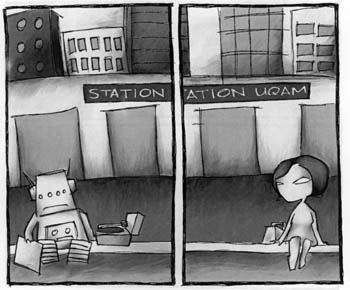
The plotline changes significantly between the text and the filmic version (especially the ending), but the basics stay the same: a plain and “old-school” robot repeatedly is bested at his work at the deli by the new and improved, faster model called Hexabot who can make ten times the amount of sandwiches that our protagonist (let’s call him Plainbot) can. Plainbot meets a humanoid woman, Malorie, who is also lonely and works all the time with little satisfaction. After getting fired, Plainbot enters a contest, hoping to write “the best love song of all time.” He’s writing them for Malorie. But SPOILER! He’s super bad at writing songs, to the point of making people throw up upon hearing them, as seen in the novel. But Malorie likes Plainbot for how he is, and they go on dates together (dinner, ice skating, movies, all the old fashioned tricks).

The comic ultimately comes down to being a feel-good love story, as creator Kid Koala and director KK Barrett explain in this video.

In minute 2:23 of this video, KK Barrett remarks on something I’d like to stop and think about. He says that because of the silent novel, silent film, and puppet characters, “You don’t project onto them, but right into them.” This is what Scott McCloud would call “masking” : the use of simplistic, archetypal characters with familiar and minimal details that allows for a stronger emotional connection and easier identification (Wikipedia’s definition).

By using little details, no color and no dialogue, the characters themselves are masks for the “everyman,” save for Malorie’s gender and Plainbot’s android nature. The reader supplies the psychology, the emotion, and the connections between characters and frames. We can even create our own dialogue and background sounds. We are active participants in the creation of the story.

Image via Metroactive

But, then again, I can’t say that I’ve ever been able to empathize with a robot before.

And if you actually slow down and think about the story itself, it’s kind of insane! A girl is basically falling in love with a robot and vice versa. If this happened in real life, serious exams on the woman’s mental stability would take place. The robot’s chip would be taken out to be analyzed, and maybe his body would be sacrificed as “research” at the next DARPA competition.

So why, at the Power Center, were the folks around me “awwing” when Malorie and Plainbot held hands for the first time, when they know a human-robot relationship is obviously weird and a little wrong? Why do we gasp “Oh no!” when Plainbot discovers that Malorie created the Hexabot? Why did I myself feel a flutter in my heart when Plainbot writes on his mixed tape “Lovesong for Malorie <3”? He’s JUST A ROBOT!

The funny thing is that I never questioned the relationship of Malorie and Plainbot while I read the graphic novel, alone in the quiet of my apartment. To me, they were both just characters in a story. Even though Malorie worked in an office cubicle, her lack of a nose and mouth and eye irises blurred the lines between being human and robot. This artistic choice within the novel made it easier to see them as simple, flat, masking characters. It was only until I was sitting amidst the hundreds of other viewers, hearing their responses that I began to be aware of the relationship on the screen in front of me. Suddenly, I saw 3-D puppets who could move their arms up and down, just as I do. Malorie had an expression and was obviously human. There was motion, there was life on that screen.

nufonia must fall production

Photo Credits: AJ Korkidakis

We always are engaging with stories and characters differently depending on the medium it’s shown to us. But in “Nufonia Must Fall,” it was the emotion and “realism” of the piece itself that was altered from paper to film.


On the Bookshelf

Because of my love of literature and the power that I believe it can have over people, I have decided to compile a list of 5 novels that I believe should be read and have a place on everybody’s bookshelf. These aren’t even necessarily the my favorites, but novels that I believe have an importance, whether that importance be to individual growth or to literary history. These are in no particular order. Perhaps, I will construct another list of important novels in the future.

  1. Invisible Man by Ralph Ellison
    • This novel is one of the most powerful novels one can ever read. It details the life of a Black man and his complicated position in a both overtly and subtly racist world. This is perhaps the best novel to read if you are interested in Black history. It’s set in the 50’s and gives the reader a true look into the struggles that people of color have had to and still have to face. In additon, the prose is beautifully rich and complex. It weaves metaphors into absurdities into ideologies.
  2. The Vagina Monologues by Eve Ensler
    • This is a great introduction to feminism. While it certainly has issues in the type of feminism it portrays, it still has an overall powerful message. It holds nothing back and forces the reader to face the issues that we would prefer to ignore.
  3. Frankenstein by Mary Shelley
    • This novel is the beginning of science fiction and it is beautifully written. In contrast to how the movies portray the story, the narrative is much more philosophical than given credit. I wouldn’t even consider it a horror story, like it was originally intended to be. It asks a lot of important questions about what it means to be human and when violence is appropriate.
  4. Catcher in the Rye by J. D. Salinger
    • This is actually a novel that I don’t personally like. I dislike this novel because I cannot stand the character of Holden Caulfield, but I appreciate the novel for its beautiful plot construction. The emotional journey that the character goes through is great, even if the character is insufferable. It’s a great look into the effects of emotional isolation.
  5. The Bus Driver Who Wanted To Be God by Etgar Keret
    • This book is actually a stand in for any short story collection written by Etgar Keret. His stories are surreal looks at the everyday lives of everyday people. They’re wonderfully strange without immense purple prose weighing it down. Instead, Keret chooses to use common, colloquial, and sometimes vulgar language to narrate his stories. This creates a powerful sense of realness, and when mixed with the absurdity, causes the stories to be a joy to read. In addition, a lot of his stories tap into something deeper. He looks at the small things in life, but makes them important. This is definitely an unusual genre, but one that should be experienced.

Countdown

In my room I have a white board hanging on my wall. It stares at me during the night and it is the first thing I see when I wake up. Today it reads 98. Tomorrow morning I will wake up to the sounds of Nessun Dorma (for some reason my iPod always defaults to that song) and I will lie in bed looking, but not comprehending, the 98 that is still sprawled across the board. The moment will come (typically around the third or fourth repeat of Nessun Dorma) where the warmth of my bed overpowers the knowledge that I must get up, update the countdown to 97 and begin my day.

Deadlines are a constant consideration of an artist. Memorize Songs my Mother Taught Me by Friday, perfect the triplets in Si suoni la tromba for Sunday’s rehearsal, prepare word for word translation of your audition materials by Monday – the list goes on and on. This is no different than any other career, every productive member of society has a list of things that they must accomplish by set dates, but as an artist I have found that deadlines are a lot more fun because the stakes are so much higher.

In my engineering class my deadlines are for 10 page homeworks, projects, exams and the odd paper or two, but as singer my deadlines are performances. This also makes my artistic deadlines a lot scarier. If I am feeling particularly lazy I will fantasize about not completing a homework set or even not turning it in at all. Worst case scenario in that situation is that I get a 0 on one of ten or so homework sets for the entire semester which all together make up about 10% of my final grade. No one other than me, my professor and my GSI needs to know and the deadline can pass without the world coming to a halt.

As a musician it is a completely different story. I cannot memorize half of a piece and call it “good enough” because I am tired, lazy or just not in the mood. My deadlines do not pass uneventfully; rather, they culminate in me walking up to the front of the classroom or out on stage, hearing the piano play the first few measures, seeing the blank stares of those in the audience, and opening my mouth to sing. I cannot sing only half a piece since I did not have time to memorize the rest, because our deadlines are final, public and set a nonnegotiable minimum amount of work required.

While all of this makes a musician’s life a little stressful it still ends with the chance to share our preparation and craft with those around us. At the end of the day, sharing my music is a lot more rewarding than scanning my written homework and uploading it to Ctools so while deadlines can be daunting, I will keep updating my whiteboard counting down to the next big performance.

Because of P’ansori: Thoughts from Places

So because I don’t really know how to introduce this blog post, I’m just going to launch into my story..

If you’re like me, you didn’t even know p’ansori existed until last semester, and you definitely couldn’t say what it was if someone asked you. But because I saw it in a movie a couple of months ago, I kind of knew what p’ansori is. It’s a traditional folk music style originating in Korea, and it’s definitely performance art – the performance is everything in p’ansori. Typically, there’s one drummer with his drum, and one performer, either a man or a woman, singing a song that tells a story. Easily the most famous p’ansori song is the story of Chunhyang, and there is an excellent film made by Im Kwon Taek based on this p’ansori, available to watch for free on YouTube if you’re interested.

But until this semester, when I signed up for P’ansori: Text and Performance, I don’t think I really knew what p’ansori really is. I definitely didn’t know what I was in for, thinking that the class would cover the historical and cultural background of p’ansori and that we’d watch a couple of movies and filmed versions of performances. No, I knew I was wrong when on the first day of class Professor Park pulled out her own drum and started teaching us the first sori (song), Era Mansu.

But right now I’m sitting in a hotel bed in Columbus, Ohio, and I can tell you that I would have never guessed I’d be sitting here writing a blog post about a class I took to finish my Asian Studies minor. And I can tell you that I love p’ansori.

Or maybe it isn’t the p’ansori that I love. True, I didn’t love it at first, when I watched Im Kwon Taek’s other movie, Seopyeonje. I thought it sounded scratchy and harsh, not at all like I expected it to be. But taking this class has made me realize how much I enjoy and appreciate Korean culture. All of it. Not just the food, not just the K-pop idols, not just the nice people I meet. I love everything about it. And I love the people I met because of it.

So the reason why I’m in a hotel room in Columbus, Ohio is because our class, typically taught at Ohio State by Professor Park and taken in Michigan via webcam, was able to travel to OSU in order to participate in the 2016 Wind & Stream performance, a combination of a few different types of traditional Korean arts.

Yes, yes, I know – we crossed over into enemy territory. And I was hesitant at first. Sure, it was nice to get a day off of classes and work to go somewhere new, but there was three of us (four including our procter/friend Megan), and a lot more of them. And they were Ohio State. Surely they would hate us, or maybe just ignore us.

That wasn’t the case at all. Not only were all the students and faculty and special guests friendly, they went out of their way to make sure we were welcome. More than once one of the students would tell us that they were so happy that we were able to come, that they couldn’t believe we drove all the way there just for the performance. Over and over they told us “good job” or something like that, during rehearsals and after they show. They gave us the most amazing food for free, and even the other faculty, the seongsaengnim that came to support their students, encouraged us too and even told us to come get even more amazing food after the show (they provided kimbap and tteok, the most delicious thing you will ever eat).

So maybe it wasn’t necessarily the p’ansori that I loved so much. Maybe it was the fact that when I told my professor I’m trying even harder to learn Korean, she just smiled and said “of course you’ll learn it, just like that!” Or when I asked for a picture with one of the guest artists, Kim Eun Su, she took the hand at my side and held it close, like we were friends. Or when leaving the performance area we’d been cooped up in for seven hours straight, I wasn’t happy. Or maybe the fact that I feel like I just made 10 new friends and I already have to leave them.

No, maybe it wasn’t the p’ansori, but it was because of p’ansori that we were able to come together and make an amazing performance, and a precious memory that will last me a lifetime.

Things You Can Do With Girl Scout Cookies

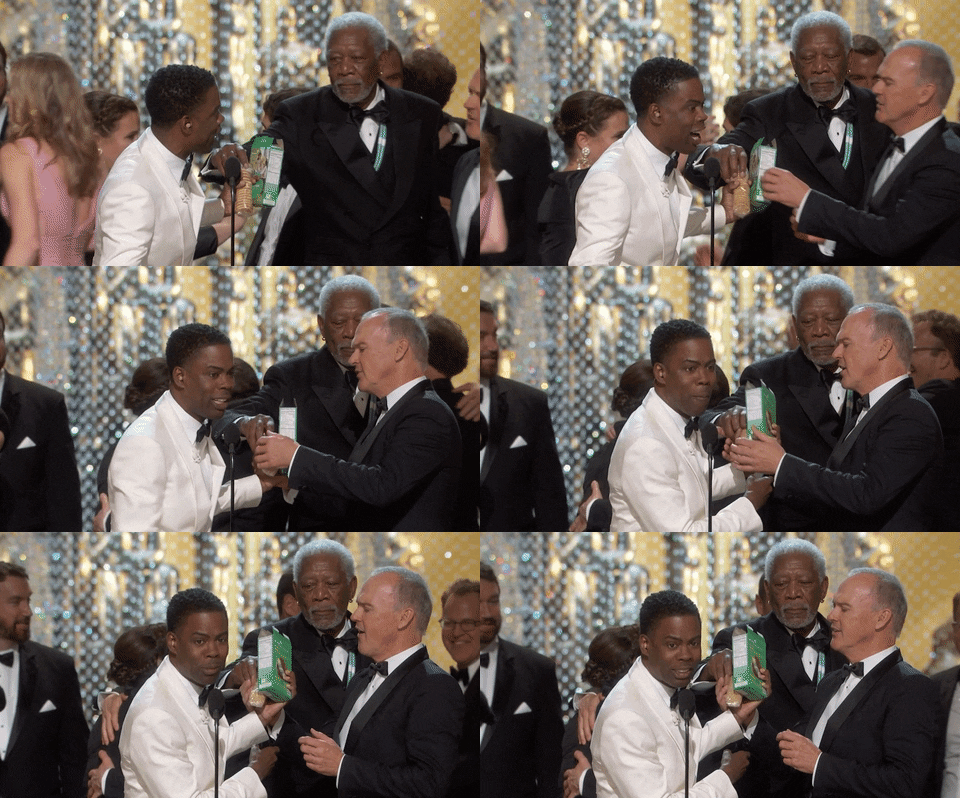
Morgan Freeman takes some Girl Scout cookies at the 2016 Oscars.

You’ve seen them in your grocery stores and at your parks. You’ve turned your head to avoid eye contact, but everywhere you look, there they are. They’re sweeping across the nation to take your money and there’s nothing you can do about it. Who are these fiends? Little girls in vests and sashes. That’s right. Girl Scouts.

This spring break, we all thought we’d be returning to massive piles of cold, wet snow, but we were wrong. Instead of being greeted by the abominable snowman, springtime greeted us. And there’s only one thing that can add to the happiness of springtime: Girl Scout cookie season.

Sure, you’ve waited for them. You’ve talked about them. You’ve bought them. You may have even watched John Mulaney beg the troops to share these delicious snacks all year round and nodded in emphatic agreement. You’ve eaten them and savored every bite. But, did you know all of the creative things you can do with Girl Scout cookies besides stuffing them in your mouth?

You can…

  1. Lick them and stick them on your face as a fun mask
  2. Freeze them before you eat them (Best for Thin Mints)
  3. Build a shrine to them and worship them
  4. Give them to your mother, father, or other family member
  5. Give them to your crush or your significant other. They’ll love you forever.
  6. Cry over them and let your salty tears help to wash them down
  7. Put them on your forehead and try to get them in your mouth without using your hands
  8. Make a castle or a tower out of them
  9. Do some creative art projects with them
  10. Make ice cream flurries and milkshakes with them
  11. Throw them at people
  12. Use them as chasers (If you’re 21 and over only! Suggestion: Bailey’s Cream and Thin Mints)
  13. Hide them from your friends
  14. Buy so many you risk your roommates seeing you as a hoarder
  15. Use them to bribe people to do your chores for you
  16. Bake with them (Suggestion: Girl Scout cookie pies and brownies)
  17. Give them to people as birthday presents
  18. Create a picture frame with them and put a picture of you smiling with a box of Samoas inside the frame
  19. Use them to make a fun necklace that doubles as a snack for later
  20. Decorate your house with them
  21. Put them in your bunker for the end of the world
  22. Time yourself to see how fast you can eat an entire box of them
  23. See how high you can stack them
  24. Play Jenga with them
  25. Build a fort out of them
  26. Make a friendship bracelet out of them
  27. Carve pictures into them
  28. Determine which cookie you identify with best. Example: Do you like your cookies covered in chocolate? Did you know chocolate is peanut butter’s best friend? Do you like to tag along on adventures? You might just be a Tag Along!
  29. Tile a floor or wall with them
  30. Make ice cream sandwiches out of them
  31. Make a sculpture with them
  32. Build a home with them
  33. Play catch with them
  34. Write a message with them so the rescue team can find you when you’re stuck on that desert island
  35. See how many you can balance on your head and then eat that many

Oh, and one last thing! Grab them and eat them before someone else does!