How Many Words is a Piece of Art Worth?

If a picture is worth a thousand words, how many is a statue worth?  Or a cathedral or an expertly crafted acqueduct?

While writing about the political messages conveyed by the triumphal statues of Roman emperors the other day, I tried to come up with reasons why someone in 2012 should even care about these crumbling relics from a time long passed.

Why do people create visual art?  Paintings, sculptures, architectural feats of greatness.

I think it is because there are some feelings so deep, some convictions so intense, that no words can adequately convey them.  (Or, in the words of my art history professor, “Constantine needed something BIG to proclaim that he was emperor.  So his triumphal arch is kind of his way of saying, “I won! Ha-ha!  HERE’S my statue!”  Standing at 21 meters high, with a collage of spolia from previous emperors on its facade, the arch is quite imposing.

I win! HEREs my statue!
"I win! HERE's my statue!"

In addition to empowerment afforded by three-dimensional space in art, I also think that the pre-Colombus, flattened globe of words and text is confining.  Bound by the gated contrasts of dark and light, with no in-between.

No pools of color, no jutting shards of spears, and no three-dimensional transcendence.

Sometimes, you just need to experience a great painting to feel and know the comfort that someone, somewhere else has experienced the same feelings as you.  And not only have they experienced these feelings, a gifted artist was able to capture them and immortally frame them in something beautiful.

I think art and art history, is not something to be looked down upon.  Rather than a frivolous and superfluous study of line and color, it is the fibers of humanity, expressed in line, color, and three dimensional spaces that let our souls breathe.  It is the liberation of our thoughts from the confining jail cells of text.

Although Marcus Aurelius could have written more books of ‘Meditations’ and philosophy, even he deemed it fit to immortalize a facet of his personality in three-dimensional marble with a powerful cape and commanding horse that doesn’t exactly come across on crumbly second century papyri.
Hip-Hop Dug Up

In the grand plant of hip-hop lies so many stems that lead to the root of its existence. Take into consideration the art, the poetry, the dance, the culture, the beats, the lifestyle. We hear lines from over-played rappers on the radio testifying the same word of wisdom, sometimes words of irrelevance, but what really originated these rappers are their predecessors. From Notorious B.I.G., Tupac Shakur, Nas, Run DMC, Public Enemy, Warren G, Wu-Tang Clan, Common,  Melle Mel, Salt n Pepa, to so many more my brain could explode. All of these people have left seeds into the art of what we call hip-hop, and are waiting to see the flower flourish.

Many misconceptions come with the understanding of what hip-hop music is, it having no substance being one of the biggest misconceptions, and I would whole-heartedly have to disagree with that. I know of only what I listen to and watch when it comes to the hip-hop world, and what really cements this music into the hearts of so many people I believe is its culture. From Jazz to Blues, hip-hop grew from the lyric-less tunes of the 20’s, 30’s, and 40’s. The soul  and vision that was made from such a simplistic music genre gave many lyricists the drive to paint the picture through words for audiences. Hip-hop reminds me of some of the most powerful and complex poetry that could have ever been spoken aloud. When you hear Kanye West begin a rhyme about college drop-outs and ending it with odes to sunny days and good mornings, it’s understandable that confusion is one of the first feelings you’ve felt. Just like poetry hip-hop music serves a purpose, to illustrate what the writer feels needs to be illustrated however befuddled it may seem.

Hip-hop music rides a beat that poetry has a difficulty in creating. Beat-makers, break-dancers, dj’ers all showcase the flow that hip-hop brings. The intricacy of one note, the power of one sound, the softness of a song’s ending, all are a part of creating some of the greatest art-forms of all time.

What keeps hip-hop growing is its fan-base. Its much-deserved appreciation is because of its reality and understanding that people experience when listening or dancing to it. The lines of hip-hop connect people to a centralized feeling of understanding, translated through that head-nod, or that hand-move, hip-hop has grown within us.

“House” Music

Last night I had the distinct pleasure of attending a party with a live band, a Michigan tradition that despite occurring frequently remains a lovely surprise each time it happens. The differences between a DJ and live band are numerous, but they also share a surprising amount of similarities. Both of them can serve as great dance music, despite the obvious assumption that a DJ would be the best option. A live band, when done well, can get the crowd grooving just as much as a great playlist, possibly even more so. Pre-recorded music lacks the intimacy and the personality of a band, and offers little to no opportunity to interact with the artist. However, in order for a band to reach the same level of entertainment, it has to perform the right way. It can be so easy for a band to sound frankly, terrible, if the mics are not operating and the singing sounds more like screaming, not to mention if the music lacks any discernable melody. When done right though, a band can instill a part spirit unlike any DJ. Last night, the local band “Popliteal Fossa” (shown below) did just that.

Comprised of just three musicians, Popliteal Fossa is a rock/folk band that embodies what a good house party band should: they are fun to watch, easy to listen to and most importantly, incorporate an extremely danceable rhythm in each of their songs. This atmosphere is optimal for old-school, non-invasive dancing that, when performed by the right crowd, will make any 2013 house party feel like a 1965 celebration. Having a band is also just a wonderful testament to student talent, and a great opportunity for peers to showcase their passions and work. The same could be said about DJs, however there is much less variation in this area of music. Nowadays, anyone with a laptop can be a DJ, and even pass for someone who is actually spinning two records on a turntable, which makes the degree of skill harder to identify. It is easy to immediately tell if the band has any skill. The question remains, then, if a live band at its best is more fun than a DJ at its best. It’s a tough call to make, because in all honesty there is not a right answer. Each offers a different type of environment; live bands require independent, somewhat more embarrassing dancing, and few opportunities to sing along with the music, while DJs allow the dancing to resemble high school homecomings, but run the risk of having soundtracks similar to high school homecomings. As DJs are far more prevalent, however, this is not really a choice we have to make often. Live bands continue to impress because they come at such rare times, and always offer a refreshing taste to the House Music scene.

Falling Down: The Paradise Edition.

My bones jolt backwards. “I’m lying in the ocean singing your song.” The ground seems wet, too hard for rain, disappeared. “Ah-ah-ah-ah-ah-ah-ah-ah-ah-ah-ah-ah.” My other foot lurches behind the other, legs rigid, now back is against ground. I hear the crunch of my computer—might’ve just been my pride—and the stars and snow shine overhead: dark paradise.

Her foot seems to quiver. Up 7 inches higher than any really intended, her feline tendencies begin to fail her. Tail as tool swishes between her limbs and the ground begins to quake as faces make an “O” and before long she is in ruins. Ankles in angles skin turns green-blue.

The stars still shine, people still pass by. She still sings. Phone case broken and computer maybe dented more. More. Moar. Moore. Clothes not ripped skin not—too—bruised. Someone lent her a hand and she seems to wobble like those newborn deer before they were trapped in appropriated film for kids to laugh at. No one laughs, they lend a hand or a look—sometimes that’s all you need.

Ice sheets the pavement like butter on a cookie sheet—what is Paula Dean doing right now? Remember when she made that donut—sausage patty—egg—sandwich? What if, as she was beginning to put it in her mouth, the sausage fell out? Hit the floor? Would the cameras stop? Would the reel unreel?

Needing things is a bit too strong. Liking things? Wanting things? People? Things seem so temporary, broken by pavement where people are less apt to crack. Crack like the limbs you think Bambi will but then doesn’t. Bruises fade and mine still isn’t gone completely. Its like distant music that always stays distant because no one stops and the earth still moves.

Blue-green like her eyes like the clouds mixed with trees when she resurrects her stance upwards 6 foot 4 inches from where she lay.

A bright hell brought about by time still moving leafs still crunching and people still talking. One foot in front of the other and it won’t ever end.  “You’re no good for me, baby, you’re no good for me.” Cement into dirt into espresso into awake. “Do you think we’ll be in love forever?” My eyes can’t close.

Pages and Pages

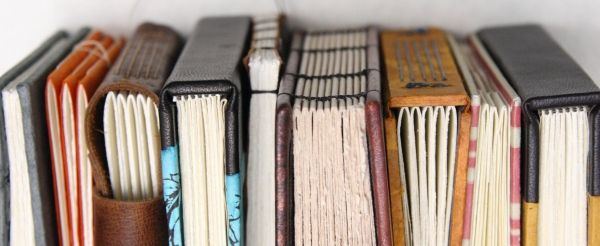
A properly bound blank book is something you can hold in your hand, you can ruffle the pages of, something you can put pen or pencil to and to which you can do whatever you like. It acts as a repository, of a sort, for one’s experiences. It’s a very different medium from the digital sort we are now accustomed to. It’s more personal, in a sense. More at hand, quite literally. A tome. A slim volume. The words themselves have a physicality to them, sounds that you hold in your mouth, a solidity you cradle with one hand, hug to your chest.

Blank pages are powerful. A blank word processing document, for instance, instills a very different feeling (anxiety, the pressure of things to be done) than does a blank page in a journal or a sketchbook (pristine, awaiting undefined possibilities).  The physicality of paper, of a well-bound stack of fresh paper, has always held an undefinable attraction. It’s the same thing, I suspect, that makes us continue to love physical books despite the practicality of e-readers. We love them because they (in the words of a professor today) “look like books, smell like books, (ruffles pages) like books.”

Somehow, I’ve always harboured a sort of hoarding tendency towards blank journals, notebooks, and more especially so if they were hardcover or boasted unlined pages. I’d be afraid to use the pages, be afraid of besmirching them with things that didn’t actually merit being transferred to nice paper. (I’ve been trying to get over that- I recently splurged on a oddslot Moleskine, very nice indeed, and have been forcing myself to write in it, in pen.) And so every now and then in a fit of determination I’d try my hand at gathering together my own blank pages into little booklets.

Bookbinding turns out to be an art that satisfies such cravings. Rather than a purely methodical process of production, it’s a skilled craft, a flexible craft. There are proper tools, materials, techniques, and I am yet an outsider. But with plain cartridge paper, some cardboard, a bit of glue, and very rudimentary sewing abilities, anyone might be able to gather paper into a bound form, a tangible block of pages, something that you yourself have created, and can now use, and which no-one else has.

Those with more skill can, of course, turn out books that are not only things we’d like to grasp in our own sweaty paws, but that are things to feast one’s eyes upon. And if you’re feeling a bit adventurous, there is a wonderful collection of DIY books here, complete with instructions, collected from users all over the web.

UMMA’s Technological Gem

As a Student Docent for UMMA, I have found that there are far too many exciting elements of the museum that are unbeknownst to the student public. Primarily, the DialogTable is among the greatest of hidden gems that the museum holds.

The table is only one of four of its kind, and by using a “pinch” method (you pinch your fingers above the table to signify the image that you want to learn about) you welcome endless learning possibilities. Attached to the images are further information about the object as well as, for certain works, videos that allow for further exploration and evaluation. While at the table one can create their own pool of works, bringing together items of particular interest that immediately gets saved to UMMA’s website, allowing the viewer to curate their own personal collection of favorite works.

The table also allows for “tags,” using key words and phrases to connect different objects together. While the museum groups objects by location of origin and time of creation, the DialogTable allows the viewer to create thematic ties between the works that are far more complex and personalized than a geographic region. For example, a viewer may feel that there is a strong female narrative being woven through various works and can then tag each work with “female”. By doing so, future viewers can see these same links, opening their minds to new and different interpretations.

The purpose of viewing art is undoubtedly personal. Some people go into a museum to lose themselves in their thoughts – allowing endless rumination on not only the art but also life. Museums, in such a way, can act as a great escape. However, there is also vast exploration and intellectual investigation that can be done at a cultural institution with collections as pertinent as those at UMMA. The DialogTable allows those who visitors who want a deeper experience from the museum to not merely explore the collection, but to think creatively and analytically about how the different works at the museum connect, differ and build off one another.