Picking Away At Colossal Goals

After reading the ancient texts of Roman Kings and Empires, such as Caesar’s de Bello Gallico and the Res Gestae of Augustus, a common theme seems to have risen. Both of these leaders, pivotal individuals in the construction and flourishing of the Roman Empire, relied heavily on the support of their peoples. They conquered many lands and built a vast civilization over the long years of their lives. While these individuals were at the pinnacle of this movement, they were but orchestrating the continued construction of something far greater than themselves. They were contributing, bit-by-bit, to the construction of a multi-generational project–the civilization of a nation.

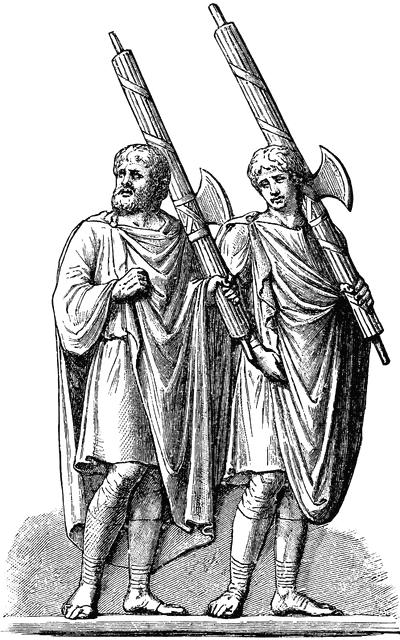
These accomplishments are a reflection of the honorable fasces–a symbol of strength through unity among the Roman people. These consisted of an axe encircled in birch rods bound by a leather cord, and were carried in procession of people of power as a representation of their leadership. The bundle of birch rods is a metaphor passed down through the generations to represent the strength and potential of the collective. While one birch rod can be easily snapped, as a single individual can only progress so far in his accomplishments, a bundle of these rods remains unbreakable. Caesar and Augustus would not have achieved much of anything without the strength of their people. In having a collective working toward a goal greater than any one individual, colossal potential can be reached.

The Pyramids of Giza, the Hanging Gardens of Babylon, the Lighthouse of Alexandria, and all other tremendous accomplishments of ancient peoples were accomplished through an adherence to a lofty goal and respect for a potential greater than one’s personal scope. With the current improvements in technology, accomplishing goals has become a more rapid process. Skyscrapers seem to go up overnight and cities appear within a few years, due to improved infrastructure and fast-paced lifestyles. In this increased speed of construction, people tend to lose cognizance of higher powers. Individuals tend to neglect the power of the collective (unless you consider the poorly infrastructured but highly effective hackivists, Anonymous) in regards to patience. Whatever does not incite immediate pleasure results in avoidance. As opposed to striving after ambitious goals outside the scope of quick completion, people settle for things in which they can see the end. However, true inspiration and accomplishment comes from looking past the scope of ready achievement. Be it in novel writing, empire building, or art, delayed satisfaction can yield truly breathtaking results.

One individual, Scott Weaver, has represented the strength of dedication and progress toward a lofty goal in his 100,000 toothpick kinetic sculpture of San Francisco–Rolling Through The Bay. While the project has already taken him over 35 years to construct, he is not finished. Weaver has represented, in the video below, that he is not finished. While the balls move down the tracks, he comments on how the speed is not perfect, and as one falls off the track, acknowledges that he must fix that. There is still work to be done and that work may never be finished. Just looking at the sculpture inspires a sense of wonder. A simple toothpick is so small, so mundane, but when coordinated with ten of thousands of its kind, it becomes something greater. I believe Weaver understands the idea of delayed gratification and the power of the collective. While he may have been the only individual working on building this monumental sculpture, the continued period of time he has spent in its construction is a different form of unity. It is the adherence to dedication, a trait that is not as largely expressed in modern times as it has been in the ancient world. With the advancements in technology, the application of this one trait–this prolonged perspective–would yield results unfathomable to our current minds.

Just as birch rods bound together cannot be broken, a journey of 100,000 toothpicks results in a legacy that cannot be forgotten. Toothpick-by-toothpick and person-by-person, the colossal can be possible.

Check out the video here!

Shear Shock

Few fashion trends during the French Revolutionary period were able to create the same reaction as la coiffure à la Titus, a haircut that evoked both amusement and outrage.  Its extreme shortness was purposefully masculine, having been appropriated from an earlier male fashion trend meant to imitate ancient Roman busts.   It was also a style that was considered incredibly natural, standing in contrast to the highly powdered and structured wigs of the ancien regime.  Women who cropped their hair in such a way were aggressively targeted in pamphlets, cultural journals, fashion prints, caricatures, books, and at least one play.  This condemnation was, as one might expect, an overwhelmingly male exercise, with one contemporary critic going as far as to say that the women who wore the Titus were “disfigured.”  Regardless of the deprecation, many prominent women wore the blatantly masculine hairstyle well into the first decade of the 19th Century, continually amending it to fit changing definitions of femininity.

An example of a Titus, by Boilly

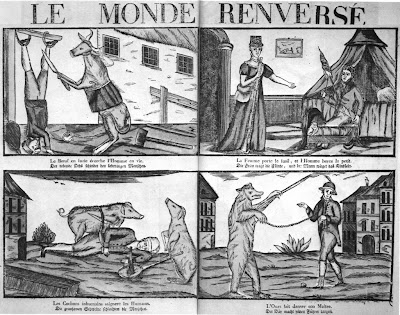
In 1804 the author of the Toilette des dames ou Encyclopédie de la beauté railed against the Coiffure à la Titus, questioning why women would forsake what was universally regarded as their most beautiful feature and opt instead for bare heads.  This was something typically associated with punishment or shame.  Women’s decision to sacrifice an accepted sign of femininity begged an association with cross-dressing. According to critic Rothe de Nugent in his 1809 Anti-Titus pamphlet, one of the principle aspects of revulsion found in the female Titus was the conflation between male hair and female dress, as though a Roman emperor’s head were on the body of a female.  Worries over cross-dressing, long standing in Western culture, signaled that male authority could be overtaken simply by a woman’s supposition that she was not confined to gendered clothing.  This criticism followed in the tradition as le monde renversé.  Le monde renversé was a common theme created in 16th century children’s books meant to illustrate basic societal norms and morals through a carnivalesque inversion of hierarchies. One such image shows a woman about to go on a hunt while the husband stays at home with the children. These publications did not generally show cross-dressing, instead the emphasis was on the

top uk online casinos welcome bonus codes and promotions ukcasinowelcomebonus.co.uk uk online casino welcome bonus at first deposit

reversal of one’s purpose in society, which was made entirely readable through appearance and costume by the time of the French Revolution. This print of the king combing out the queen’s hair bears clear thematic influence from le monde renversé. It not only makes Louis XVI a servant to Marie-Antoinette and a pawn in her own political desires but that her hair had become equal to and interchangeable with the crown, as indicated by the caption “Coeffure pour Couronne”.  Regarding the verdict for Marie Antoinette’s guilt, historian Lynn Hunt wrote “the revelation of the Queen’s true motives and feelings came [above all] from the ability of the people to ‘read’ her body.”  Or, at least, the belief that her body could be read.

The Inverted World
The Inverted World

The implication of Le Monde Renversé, and bear it in mind that these were meant to be taught from an early age, was that when a human pulls a cart instead of the mule, the world goes crazy.  When children punish their parents, the world goes crazy.  When a woman assumes the visual presence of a man, the world goes crazy. Le Monde Renversé has its origins in medieval carnival culture, where institutions like government and religion were suspended and social roles were inverted, including gender roles.  What made the coiffure à la Titus a problematic image was that it was not on carnival day; it penetrated everyday life.  Ultimately, the coiffure à la Titus failed to establish itself as a style that could be separated from its highly charged connotations of gender dynamics.  Continual compromises with ideals of femininity robbed it of its once shocking starkness, though criticism followed the Titus to the very end.

Manifesto on the Rain: Prelude

I think writing is good for an artist. I think language is a great way to communicate ideas about a piece, make difficult work more accessible, and is vital in a relationship between art and the world. It seems rather simple, but it might not be as apparent to people actually involved in artistic work. For instance, to me, time spent writing words is time I could spend doing any number of other things that would relate more explicitly to the craft I’m going to school for. But I’m going through a bit of an artistic crisis where I know neither my medium nor my method, so all of these ideas are getting a bit more jumbled that I had intended. And now I am here writing. And I think I’ve come to one of the best benefits of writing-clarifying ideas for both the world and myself. In a way, I think I need to write a manifesto for myself, as my way of introducing my artistic self to the world and to myself. Its something that numerous people have told me to do, so I think I’m gonna do it. And I think I’m going to use this public forum to do so, and hopefully the results are interesting! But first, I feel like I should share a bit of myself and explain this artistic ‘crisis’ of sorts.

When I was a senior in high school, I went to have a lesson with the wonderful Evan Chambers, the professor I’m studying under now. At the start of the lesson (which was filled with such an enormous amount of incredible advice that I was overwhelmed and have now forgotten most of it) he paused for a minute or two. He was looking over my scores and he turned to me, looked me in the eye, and said “Yes. I think you should be a composer.” I was…well I was very surprised. I had no idea that such a decision was weighing on those few glances at my poorly written music. I was flattered, of course. But I was also very, very surprised. But then I knew that I could be a composer, I knew that I could call myself that.

But now I don’t know what that word means anymore. Or if it applies to me anymore.

I am a composer, yes. I spend time every week writing music. I spend time in rehearsals with musicians that are playing my music and I spend time working with my colleagues in the creation of new music. But more and more I’m writing music that doesn’t fit in with what ‘music’ is. More and more I’m drawn to alternative forms of musical expression or maybe artistic expression.

Recently I’ve been drawn to music that doesn’t follow a linear structure, that finds new ways of thinking about time or architecture, that incorporates spoken word or written word, that explores visualization, or that explores the highly personal and the entirely specific. My work has shifted in a new direction that is not putting notes on a page, but instead working with text, movement, and the oddslot visual. It might not even be music anymore. And so I’ve been drawn to performance. You could call it performance art, alternative theatre, or maybe even dance, but I still like to think of it as music.

Art has exploded in terms of definition and scope in the last century, and I consider myself a proud follower of the avant-garde, the radical, and the new. And it is within that that I am creating my work. But there is so much to define when nothing is definable, so I’d like to take some time on this blog to explore this and explore my own personal ideas when it comes to art. Dear reader, you may not agree with me, and that is okay. I don’t want you to. I want you to push me and I want you to push yourself.

I’m excited to see where this leads me. I hope you are too.

Modern Discrimination

On whole, the movement to diversity in corporate, educational, political, and institutional bodies has increased immensely in the past few decades. After all, we have elected our first black president for a second term in the land of the free, let a Chinese-American basket ball player run headlines for months, and decreased the contempt toward affirmative action.

And yet, why is it that discrimination against those of other races is integrated into the way people perceive others, despite their overt openness and even push toward cultural diversity?

In a recent Chinese-speaking practice session with a native Chinese speaker from Taiwan, studying literature in the school of education, I realized the inherent judgment I held from the moment I met her.  I had so quickly stereotyped her as a socially incompetent, not so smart, small awkward Asian female; a profile that I have tried so hard my whole life to separate from.  She was quiet, had broken English, and led to me to the room with another white female where I assumed would be a perfectly nice, and slightly awkward, hour and a half.

However once the gate was open to her native language of mandarin, with idioms she could use ad sarcasm at her disposal, her personality bloomed. She was so personable, funny, outgoing, and intelligent.   She was well travelled, participated in philanthropic education events in countries I had only dreamed of, and was studying classical Chinese literature at a Masters level. I loved her company and completely forgot the preconceived notions I had about her “social incompetence.” If anything, I was the one who was inept and unable to communicate. While I tried to show my slightly extroverted personality, explaining what I meant in detail and color became increasingly difficult. Frustrated, I began to withdraw from the conversation for fear of embarrassment that I couldn’t express myself properly.  I became quieter, until

biletul zilei cota 2 cu meciuri din fotbal biletul zilei cota 2 biletul zilei cota 2 la pariuri sportive

finally I seemed unintelligent and unable to communicate properly, awkward because I didn’t know how to properly enter the conversation, and instead focused on the piece of paper in front of me.  This retroversion to a much quieter state is against my natural state, and was caused by a mere language barrier.

Too often do we judge others intelligence and personality types because of language barriers.   Regardless of what true personality types may be, barriers to expression and embarrassment from them result in awkward encounters where people leave themselves vulnerable to judgment, and then withdraw entirely from uncomfortable social situations.  As a result, cultural groups form so that they can relate and be their true selves, and express themselves in the way they most comfortable. This results in a cyclical pattern where similar and comfortable people find each other, avoid those that are “awkward” based on preconceived and invalidated notions, and form further judgment of others because of cultural seclusion.

With regard to my personal observation, minority persons who defy their cultural stereotypes are the most critical of their less culturally integrated counterparts, and actually denounce those who haven’t adapted to American Culture.   It’s the perception of being accepted as a “true American,” without any of the negative connotations that come with the stereotypes that are rewarded and reinforce the built-in discrimination today.

While we want those of other cultures in our work environments and admitted to our schools, I think it’s time for us to push further, open our social circles, and discover the true personalities of those who we may have judged and passed on.  We need to eliminate the integrated modern-day racism that we don’t even recognize, and allow ourselves to break the next frontier in racial equality.  Discomfort may arrive and we may not be used to cultural differences or interacting with people who don’t understand the latest Girls reference you made, but it is the discomfort and push outside of a comfort zone that leads to improvement and change.    The discrepancy between what many so strongly believe in, social and racial equality, and how they act, unintended racial discrimination, is something that I don’t believe I stand alone in.   However, through recognition and resolve we can change the way we think, and make many new friends.

Martha Graham Performance Review

Last weekend, I had the privilege to attend a Martha Graham performance, with dinner and a lecture beforehand all for $15.  I was more than willing to scrape fifteen dollars together to see a dance performance by a company founded by the Andy Warhol of dance, Martha Graham.  A household name that I have known for years and years, without really knowing about her contributions to her art.

This was an offer I couldn’t refuse.

Having never been to a modern dance performance, and having little knowledge about modern dance in general, I wasn’t sure what to expect (although I had heard something about a large, gray sock…).

The Infamous Giant Sock Thing

But the lecture prior to the performance shed a lot of light on one of the few artistic facets of modernism that piques my interest.

A few key things that I kept tucked away in my mind about Martha Graham was that she did not add male dancers to her company until several years after its inception.  This female-centricity was extremely foreign to me, compared to the historically male-dominated world of theater.

So male-centric, that an actual woman had to dress like a man in order to play a pretend woman

This was because many of her pieces are centered around female psychology and the female gaze (e.g. ‘Night Journey’ which I saw later that night).

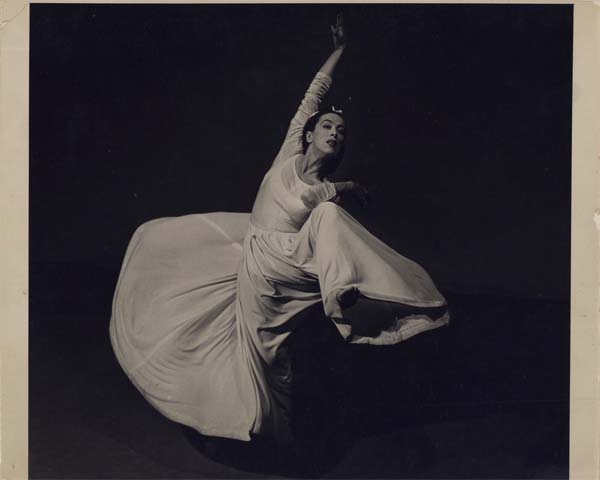
Aesthetically, Martha Graham’s dancers place a heavy emphasis on gravity.

Martha Graham Experiencing Gravity

They do not always point their toes or convey a sense of lightness when they are in the air.  Instead, their limbs are contorted and broken to convey the weight of gravity and the human body.

“Huh,” I was thinking, “That doesn’t bother me.  Or does it?”  I’m not a pointed toe nazi.  But I wondered how this heaviness would effect me later on.

Musically, something I found very interested and was a little afraid to experience, was the fact that Martha Graham’s dancers always dance a little bit ahead of the music. Later on, I found that this out-of-sync movement did exactly what Martha Graham wanted it to do, it made me focus on the movement of the dancers.  It made me view them as moving entities unto themselves as opposed to visual expressions of beautifully composed music.

All throughout the dance professor’s lecture, she had everyone in attendance change their body position.  She told us to stand up, sit down, lie down.  Basically do anything we felt comfortable doing.  Some people did lie down on the floor and when the professor was done with her lectured and everyone had changed positions multiple times, she asked us about the experience.  I was amazed at how aware I became of my body and how it influenced the way my mind paid attention.  Some of the attendees who laid on the floor commented on how much easier it was to pay attention to the speaker when they were allowed to be comfortable.

Once the lecture was over, we watched a short clip of Martha Graham getting ready in her dressing room, circa 1959 for her role as Jacosta in ‘Night Journey’.

Martha Graham Getting Ready

When it came time for the actual performance, I was scared and excited.  I didn’t know what to expect, besides contorted bodies, non-synchronized movement, and simple costuming, from what I had seen in publicity photos.

What proceeded was an amazing tour de force that made me marvel at everything the human body is capable of.

What surprised me most was how beautiful the dancing was.   Given that the Martha Graham company is a modern dance company, I was expecting something wretched or confusing.To be honest, I was sure how excited I was to see people contort their bodies out of time to music.   And there were times when I was confused, but it made me more engaged in the process of creation.

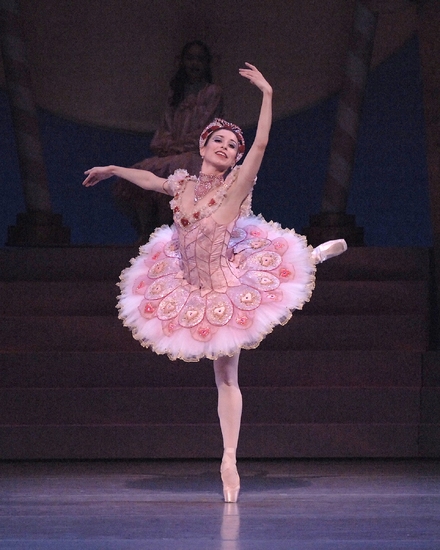
In the past, when I have been to ballet performances, I have loved the frilly, glittery costumes….

Glittery costumes!
Glittery costumes!

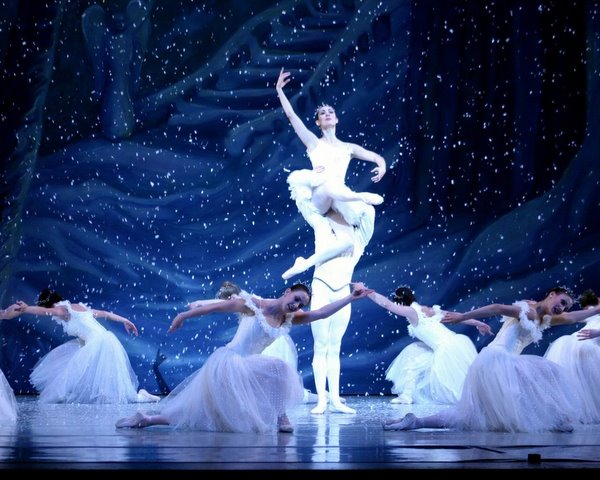
I have loved being taken to a fantasy land….

The Wonderful World of The Nutcracker
The Wonderful World of 'The Nutcracker'

And I have loved being swept away by the beauty of Tchaikovsky’s music and Marius Petipa’s choreography.

Martha Graham was not Marius Petipa.

And I didn’t spend the entire performance reveling in candy drop ecstasy.  In fact, most of the time I was uncomfortable and constantly asking questions.  I asked myself questions like, “Why don’t I move like this more in my every day life?  Why don’t I express myself with my whole body instead of just my facial muscles?”

There were some scenes that expressed such raw emotion, I wondered why no one had ever tapped into this emotion before.

The company performed several pieces by other choreographers (one of which, was my favorite of the night) but my favorite Martha Graham composition was definitely ‘Night Journey’ which is a psychological examination into the emotions of Jacosta after she realizes that she has slept with her son Oedipus.  On an average day, incest does not sound like a great premise of a story to me.

But when danced by the Martha Graham company, this story became something that illuminated my emotional interior.  Although I did not relate to the characters’ incestuous relationship, I found that I did relate to the emotions of Jacosta.  Who hasn’t regretted something they’ve done and wanted to kill every object related to that horrible memory?  And it was a journey.  At the start, Jacosta is enthralled with Oedipus…

Jacosta and Oedipus in an embrace

But after finding out that she has just spent the night with her own son, Jacosta is dumbstruck and horrified.  She runs across the stage, staggering to catch herself from falling deeper into madness.  It gets pretty intense.

After the emotional and psychological confrontation of ‘Night Journey’, my other favorite component of the performance was three variations on Graham’s original ‘Lamentation’ piece (arguably her most famous piece).

The first variation was comprised of three male dancers and one female, all in nude skin-tight costumes that showcased their bodies and movement in ways that glittery tutus never would.

Sheer, unadorned beauty.

The second variation was a solo.  A woman in a black dress spent most of her time alternating between avoiding and reaching towards a banner of light from the side of the stage.  The attention was almost exclusively on her torso; on the way she arched her back away from the light and then strenuously crouched forward as if her soul couldn’t bear the weight of her shoulders any more.

A one-woman glass case of emotion

Last in the ‘Lamentation Variations’ was a piece that used the entire company performed, dressed in street clothes.  Slowly the whole company crumbled to the floor until only one couple was standing and grasping on for dear life.

A whole company of feeling (and body suits)

As a whole, I was very engrossed throughout the performance.  It was very awkward at times.  There were points where I didn’t know what to feel.

But it has left me thinking for days.  Why wasn’t I able to reciprocate the dancer’s visceral performance with a more intuitive response?  Is it because I have become so out of tune to instincts, so bent into shape by society’s emotional postures, and so sterilized by logic, that there are depths beneath my surface, that even I am unfamiliar with?

Lastly, I loved learning some biographical information about Martha Graham (including her romance with Erick Hawkins) and look forward to any future Martha Graham performances that I get the chance to see.

Graham and Hawkins looking like a God and Goddess

What Indie Movies Do to Me

After my first viewing at The Sundance Film Festival last Thursday, I’ve come to realize what Indie movies truly do to me. They make me feel like a puppet. Like a stuffed doll in which they can take hold of me and make me laugh, cry, scream whenever they wanted me to. I sincerely had no idea this was possible.

I went to the Michigan Theater to view the showing of The East, an “eco-thriller” about a an agent named Sarah (Brit Marling,) whose job took her undercover to expose an anarchist group called The East. Their mission was to perform “jams” that attempted to expose large corporations who have silently abused people with their products. The group wanted to give an eye for an eye by treating the corporations with a dose of their own medicine, no pun intended. Overall I liked the movie, It was nothing that I’ve ever seen before, and I liked that because I feel like we see some of the same stale story lines in the theaters. The movie did leave me feeling a little emotionally disconnected near the end, I didn’t quite feel like I knew who the characters really were or their personal motives given the story.  However, what this indie film did to me, going back to the point of this post, was make me feel completely confused about life, not that I wasn’t already confused of course. It exposed me to a realm of society that I knew existed, but I still didn’t quite understand.

I love independent films though. They thrive on getting a reaction from their audience, opposed to simply entertaining them, and that’s brave. I guess you could say I’m a romantic, reality-driven indie movie lover, but then again all indie movies have that aspect somewhere within them. They are so raw, awkward, and real, and regardless of how unwillingly I am to succumb to the grasp of the independent films I watch, I will forever love the what they do to me.