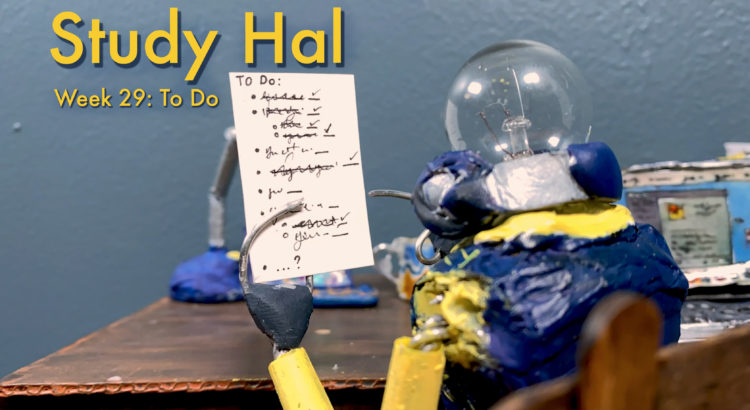
Study Hal: Week 29 – To Do

Today was the last regular day of classes! How are all the students out there feeling? Hal thinks it’s bittersweet. He’s happy to be done with his hefty schedule, but he’s going to miss seeing his classmates over the next month.

The strangest thing about today, though? Hal realized today he only has four assignments left this semester. And now that classes are finished, the assignments don’t keep coming! Hal and I are both a little dubious about this. What are we gonna do if we’re not pouring all our time and energy into homework??

Hal sends his best wishes for the students starting finals now. New here? Hal is a U-M student studying remotely for the 2020-2021 school year! He’s back on the Study Hal tag every Tuesday, so come back next week for more.

What is a Hook?

This week’s post is going to be a bit more informational than creative. As I’ve been messing around with my own music in the past few months, I’ve been trying to experiment with a specific aspect of my songs: the hook. Though ‘the hook’ is usually singular when people talk about it in reference to songwriting, in all honesty a song can have one, three, four, or fifteen hooks depending on what the artist is going for.

But what does this term mean? Why is it so important?

Most people associate the hook with a song’s chorus. This can be true, but it isn’t always the case. Examples of hook-y choruses can be found in many modern pop songs–these are the ones you hear on the radio and for some reason can’t get that one line out of your head. Hint: that’s probably a hook. A classic for me growing up was “We are Never Ever Getting Back Together” ( https://www.youtube.com/watch?v=WA4iX5D9Z64 ) by Taylor Swift. The “never ever ever ever”s repeat multiple times throughout the song and stick in your head for hours after listening to it. They’re interesting and memorable enough where the song becomes something you want to listen to again. They’re also relatable for many teenagers who’ve gone through similar situations to the one Swift is describing in her lyrics. This is crucial for a lyrical hook.

But hooks don’t have to be lyrical. There are musical and rhythmic hooks as well.

A great example of a musical/rhythmic hook is the classic Queen song “Another One Bites the Dust.” Though I could not repeat the lyrics back to you word for word, I can immediately identify this song if it comes on in a restaurant or supermarket or wherever else. The bass line is iconic and functions as a hook within itself. It is recognizable, reproducible, and helps a listener identify the song within seconds. ( https://www.youtube.com/watch?v=NVIbCvfkO3E ) Other examples of songs with rhythmic or musical hooks include: “Sweet Caroline,” (BUH BUH BUH) and “Mamma Mia.” These both have specific musical passages which are catchy and memorable.

Hooks can be produced with percussive beats as well. The best example I can think of off the top of my head is “We Will Rock You.” ( https://www.youtube.com/watch?v=-tJYN-eG1zk ) There’s a reason Queen is such a successful music group. Their hooks–lyrical, melodic, rhythmic–are all fire. Each song stands apart from the others in a good way and is interesting within itself.

Many record labels encourage artists to focus on adding multiple hooks to a song. Lyrical hooks are the first step–you need words which people will relate with and catch themselves singing on their way to work. But the other types of hooks are just as, if not more, important. They are the small musical passages which will have a song stuck in someone’s head even when they don’t know the words. They’re not quite sure when they even heard the song, but because of the different hooks at play, it will be hard for them to forget it.

We Are Queens Music Video Production

I was able to attend the We Are Queens music video production day before Thanksgiving break. I was so excited to see what it takes to produce a music video in a one day mass production setting. I took a back seat, as well as a helping hand, for the choreographer and creative visionary. Every precaution was taken in order to ensure everyones safety and health involved- the video was shot inside the dance building, in the Betty Paese Studio Theatre. Everyone was wearing masks and 6ft apart.

We Are Queens has created a community outreach program through these music videos. This is their 6th successful video in the year and half of first forming as a nonprofit arts organization. To begin, a statement is released on their social media platforms, as well as, their website; they advertise that they are now beginning to accept applications for dancers, choreographers, and creative visionaries (director and person behind the message of the music video). The creative visionary and choreographer do not need to be dancers or even artists, they just need to be people looking to get involved in a welcoming organization, and share an empowering, personal message. Once selected, the choreographer and creative visionary meet and discuss ideas, location, message, and choreography with Tal (the founder), creative director, music editor, and videographer. After the initial meeting the choreographer and creative visionary will be in constant contact discussing and finalizing ideas. Before the video shoot there is a WIP (work in progress) where the choreographer presents the choreography they have create to the 5 exec members and dancers. This meeting will give the choreographer the feedback corrections they need before shooting the video. Finally, the day of the video shoot arrives!

The day began at 1 where I helped Tal and the creative director set up the curtains in the studio to create a black box theatre effect. We also cleaned the floors and disinfected the stereo system, 2020 mood.

The choreographer, Emma Zordan, rehearsed and cleaned the movement that she had created previously before coming to the shoot. The dancers were sent the choreography via video a week prior, but to make sure the dance was cleaned and all of the dancers questions were answered, the choreographer ran the movement with them before bringing out the camera. Zordan also added in formations and timing dynamics to make the music video more interesting and powerful.

Before shooting the choreographer and creative visionary (Nya Johnson) spoke to the dancers and explained what this process and message behind this music video means to them. Emma, Zordan, and dancers were all selected, from the hundreds of eager artists who applied to showcase their talents and personal stories in this music video. These dancers are eager to be  a part of this community as well as have the opportunity to perform during a time of COVID.

After almost three hours, it was finally time to shoot. 

It was so interesting to see the difference between dancing on stage versus dancing for a camera. With the camera being so close to the dancers faces they often time really dance for the camera and use their facial expressions to help tell the story. Unfortunately with masks the emoting that they often do is inhibited, however, they still managed to express the powerful message through their eyes and strong dynamic movement. It was so amazing to see the space transform into a performance space, even if it is just for the camera. The curtains, lighting, and camera really helped this whole production come together. Recording the dance only took about an hour and a half, the videographer took many takes and recorded each section from different angles, ensuring that when editing the video she would have a lot to work with.

The beautiful case of dancers!

The music video will be released on Saturday on the We Are Queens Instagram. I highly recommend checking it out!

+KHAOS+ EP.7: TOGETHER, WE

+KHAOS+ EP.7: TOGETHER, WE

+KHAOS+ EP.7: TOGETHER, WE

Acknowledging the special and inseparable bond Milo and Ed have, SALV Corp. commands the duo to explore certain planets that may answer more questions about the most recent meteorite (also named by SALV Corp. as the 42nd Fallen Star) that has brought people to fear due to its differences from the previous meteors. The two are getting ready to explore the unknown planet that may be related to the 42nd Fallen Star.

+Author’s Comment+

About 18 days until Christmas, hope that everyone finishes the semester strong. (!!!)

My Art Instagram Account: @kats.art.folder

The Indian Artist: A Look Into an Inspiration

From a young age, I have always taken inspiration from artists that I admired. I would spend hours on end scouring through their works, mimicking them, committing their intricacies and details to memory, learning from how they presented such deep and complex emotions. This week, I decided that I would talk about one artist I discovered in high school, someone who’s art has spoken to me and has inspired me in my own work as well.

Kehinde Wiley is a Los Angeles native and New York-based visual artist who is known for his incredible portrait paintings. Wiley’s imagery creates a sense of ambiguity and provocative perplexity. By juxtaposing his subjects with the style of the piece, applying the visual vocabulary of glorification, history, wealth, and prestige to the portrayed figure, Wiley creates images that become larger than life. His work has a way of pervading into a realm that is both hyper-realistic while also creating an air of vague mystique.

Initially, Wiley’s portraits were created based on photographs taken of young men from the streets of Harlem. As time went on, he grew to exhibit more of an international view, including models found in landscapes throughout the world. He was even the artist to create the presidential portrait for Barack Obama. The models that he captures are dressed in their everyday clothing, assuming poses found in paintings or sculptures representative of the history of their surroundings. This juxtaposition of the “old” with the “new” is so visually potent and is what captured me when I first saw his work. His paintings evoke conversation and awaken complex issues that many would rather not be discussed.Wiley’s exploration of the human form against incredibly beautiful backgrounds is what I took inspiration from and channeled in some of my artwork as well.

One of my pieces piece, titled The Modern Brahma, done in mixed media ranging from watercolor, gold leafing, and acrylic has a background inspired by Wiley’s. In the piece, I create a rendition of Brahma, the four-headed God of Creation in Hinduism. The subject displays various heads, each holding a different expression. It is clear as well that the subject of the painting is not Indian, but rather Caucasian. This choice was to show the internal struggle that I have always had between staying true to my roots and culture versus wanting to fit within the American society that I have grown up in. That feeling of being an outcast and alienated is demonstrated through the countenance of the foremost face, while pride for my culture is shown in the smile on the other. The faces also all adorn a bindi on their foreheads, juxtaposing my traditional background and culture with my modern American society and upbringing.

As I’m sure many other artists do, I love taking inspiration from the works of other artists. I hope that I brought to light an incredible artist who is a leader in his craft and someone that I truly admire. As always, if anything that I discussed in this post stands out or if any questions arise please feel free to comment and share your thoughts! Looking forward to next Sunday.


~ Riya


Personal website:   https://riyarts.weebly.com/