The utterly useless, perpetually frustrating experience of being a sports fan

I don’t remember the first moment I fell in love with sports. I certainly didn’t know what I was getting into. Being a sports fan is stressful, humiliating, and humbling. Sometimes, you think you can see pinpricks of hope in the distance, but it is all a mirage. If you’re lucky, your team will win, and you’ll get to bask in the glow of victory for a few months, before the next season begins, and the cycle of hope and despair begins all over again. It is an endless rollercoaster, where every high only promises a more terrifying descent. Some fans suffer for decades without the relief of a championship (Looking at you, Cubs fans). Some fans have had their hearts ripped out, one play away from euphoria. We are foolish a lot. Our obsession is almost always unrequited as we watch and suffer from afar. It is a strange abusive sort of love.

I am certainly not the first one to question our peculiar obsession. The goal of most sports is simple. Throw the ball. Catch the ball. Shoot the ball into the hoop. Actions so simple a child could understand them. This simplicity is often used as an excuse to deride fans. Why dedicate so much brainpower and time to athletics when the world is falling apart around you? But hasn’t it always been that way? There are surely great and terrible things that we could be doing with all that attention dedicated to maintaining a fantasy team, scanning daily headlines, or re-watching your favorite dunk of last night. But when I watch sports, I don’t need to question these things. Instead, I admire the grace and beauty that courses through every swing, every fluttering lob through the air. I admire the dedication that goes into every single movement, the hours of practices to execute one simple motion perfectly. I admire the extraordinary mixture of anger and euphoria on the athlete’s face.  When I watch as the ball go into the hoop, the simple action makes my heart pound. I cheer.

Most of these thoughts ran incoherently through my head after the result of the Ohio State-Michigan game. As I watched a red tide of fans swamp the field at the end of the game, I didn’t know what to think. All I felt was a pounding, sullen resentment towards all the fans draped in red. That happiness…it should have been mine, it should have been ours. It was certainly not the result I had imagined before kickoff or even the one that I had imagined two quarters ago. I was left sitting in the aftermath, quietly on the couch. My throat was sore from yelling. Before me sat an empty bowl. I had eaten half a bag of family size Lays. I only remember nervously grabbing, chewing, swallowing through every errant throw, every violent collision. It had been the fastest three hours of my life. By the end, I don’t remember feeling anything at all. Every effort, every scream of passion felt like it had been utterly useless. Every action had been as empty as my chip bowl. Instead, the entire game boiled down to a singular run and an unclear referee decision. I wasn’t very hungry that night.

So yes, sports are pointless endeavors that will inevitably lead to disappointment, failure, and the over-eating of chips. They are also endlessly enjoyable and relentlessly addictive. I’m not sure that sports are a necessity. What I do know is history. For nearly as long as the existence of humanity, there has been games and competition. They act as instinctive expressions of our need to compete and test our skills. They act as conduits of real passion and fervor. And on special nights, such as the cool November evening when the Chicago Cubs broke a 107 year championship drought, they can make grown men cry.  Sports may be just the smallest piece of a much larger picture. But the image would not feel complete without it.


What Makes a Line Beautiful?

Looking at Ronald Searle’s drawings makes you wonder, “What makes a line beautiful?” Is it the indication of a professional hand? Perhaps the line is perfectly symmetrical, never outstepping the very boundaries it has created. Perhaps the line is colorful, existing in vibrant shade of a rich reddish-brown, causing you to remember the Fall leaves all across the rows of trees along your childhood street. Or, perhaps the line isn’t perfect, starting and stopping – visible traces of where the ink ran dry. Perhaps the line is squiggly, childish, thick, thin, blotchy, clean, jagged, strong, or even nervous. A line, much like our own handwriting, is an incredibly expressive mark on the page. Well, as is any mark on a page. Of course, writing is a combination of lines, however, a singular line representing nothing is hard to consider as something worthy of any judgment because there is no tangible meaning attached to the line.

But if the variety of handwriting habits, or perhaps, even the variety of letters or words across the slew of languages is any indication of the range of beauty a line can take, then consider the fact that a line need not be restricted by the boundaries of language alone. Although art is itself a type of language, we can nonetheless perceive it as boundless.

Perhaps what makes Searle’s drawings so interesting to look at is because of his active use of variation. He was an artist that fully utilized the full spectrum of lines in each drawing, capturing the energy of a form effortlessly We can smell the wispy strands of grass, or hear the jagged creaking of the porch as a man plays the fiddle with a pitchfork, and in the background, can be heard, the scratching of an irritated dog.

But that is it, isn’t it? Why the line is beautiful I mean. It is because it is everything in a sense. Cities, people, animals, puffs of smoke, rain, water, intricate machines, and the words of a title card at the beginning of an animated film, all of these are composed of lines and Searle’s drawings remind us of the compositional endlessness of these deceptively simple forms. You can truly draw anything with just lines.

So, it is less about technical ability that makes a line beautiful, rather, it is about capturing the world it is depicting. It is about the potential an undrawn line has. I cannot help but feel, in an optimistic fashion, that drawing a beautiful line is les about making it perfect, but more about drawing it confidently.

What is Home?


home

Do you know the band “The Cinematic Orchestra”? They gained quite a bit of popularity within the past couple of years. Their music is featured in commercials and TV shows. One of their songs is very special to me. One single line from their song “To Build A Home” helped me to describe the feeling I always had while travelling around the world, but which I just could not put into words. Let me explain to you what that one line means to me and how it is important to describe myself to a certain extend:

“Home is a place where you don’t feel lost.” So why leave home? Why expose yourself to the lostness?

In my eyes, the lostness is somehow calming. It’s fulfilling. Whoever is lost is compelled to find himself again. I get the feeling that I need that sometimes. Similar to people who try to schematise their life through the idea of continuous shifting in prosperity and dolorousness, I have to lose and find myself.

To lie in bed at night, knowing that every person you know, you like, you love is thousands of miles away may seem like a nightmare to some but to me it’s a feeling I wouldn’t want to miss for the world. Sentimental music and the dim lights of a far away city on the dark horizon of the night add to that feeling. To have nobody, sometimes is more satisfying to me than to have somebody.

When I return home, my travels usually appear quite austere. They make me appreciate what I have at home. But one question will always remain: What would I miss more: Having a home or having no home?

PS: Remember to be the weirdest you can possibly be.

Before the Lawyer

On Monroe in a quad that evokes a mystical feeling,

You’ll encounter a library for students in law.

Let your eyes drift from your paper and up to the ceiling,

And you’ll find yourself astounded in awe.

The enchanted wooden shelves

And the ceiling ornate with flat dim lights on heavy chandelier

Are only a representation of their past selves,

For they are more magical than they appear.

Before calamity when things went tragic

There were pretty witches and warlocks who practiced some spells not to be found

Such beauty that roared with magic

Now screams without a sound.

In years past on the street called Monroe,

There was a superhuman haven that no person ever saw.

Into here stumbled a young wizard who had potential to show,

He with a name of Yim Yarbaugh.

Wandered the boy into a gala of potion

Where he was expected for a surprise just for him

In this place illuminated by fireflies in lamp and surrounded by portraits in motion.

The only being destined to find this world was young little Yim.

A vigilant dragon stayed on guard all through the day and all through the night

To protect the inhabitants from human discovery.

One day, the fairy of sleepiness robbed the dragon of conscious sight.

What happens next exceeds any hope of bringing the haven back to full recovery

On his way to a football game, a student in law encountered this camp.

What once was an enchanted encryption

Is lost forever and left were the spells and lightning bug lamp

To be replaced by bulbs and records of jurisdiction.

To say the team was undefeated would make the score keepers contradictors.

To the big house, young Yim he took

In hopes that his magic would lead the losers to become victors.

Is he a savior or is he a crook?

Maybe these ideas will touch that brilliant mind of yours.

Or maybe you will ponder these words with utter mental confliction

As you realize no one mentioned them on the campus tours.

I must tell you most of this story is only fiction.

A Week Out of a Zombie Apocalypse Movie, Except Instead of Zombies, It’s Classwork

It’s one of those weeks, guys. The three weeks between Thanksgiving break and winter break are always hard—Thanksgiving break is only a tease, then suddenly you’re thrust back into an emotional warzone, final exams and final essays coming at you like grenades, or whatever better fits this war metaphor—but this is worse than usual. It’s only Tuesday, and I am so exhausted. I got four hours of sleep last night, and tonight was supposed to be my night of recovery, but it’s looking like I’m going to have to put that off for a couple more nights, because I have so much still to do tonight and tomorrow.

I won’t bore you too much with the details, but let me just say that I thought I had a lot more time than I did, then my WiFi abruptly stopped working and I spent most of my night fighting a losing battle to download complicated drivers and fix the problem. Riveting, I know. But to me, this simple, small conflict felt like a potentially world-ending one.

Tonight is the kind of night that makes you jaded about college. It’s one of those nights when you have to decide whether to prioritize your own mental health or your grades. It shouldn’t have to be one or the other, but the reality is that sometimes it is. Sometimes getting good grades means you don’t eat, or you don’t sleep, or you don’t have a social life, or you don’t consume any of the art you’ve been wanting to. (Tonight, I made the wrong choice and watched an episode of Jane the Virgin, thinking I had all the time in the world.)

I’m not sure exactly what my point is with this post, except to say that sometimes school is hard, and it sucks when it has to get in the way of the things you’re passionate about, because school is supposed to be about doing what you’re passionate about, isn’t it? Right now, my dream day would consist of ten or 11 hours of much-needed sleep, then a day to just catch up on TV and watch a movie and journal, because I’m way behind on journaling.

Sometimes, when I’m having an apocalyptic week or day like this one, I like to open up my journal and just write a short post to myself to pump myself up. Something reminding myself to calm down, reminding myself that when it comes down to it, whether I get a B+ or a C+ on tomorrow’s exam won’t really matter in the grand scheme of things.

So let me do that right now: Ben, and anyone else out there who might be going through a similarly terrible week, it’s all going to be okay. It feels long right now, but in a few days—and, even more so, in a few weeks—you’ll be done with it all and you’ll be able to take a breath. The end is in sight; in the blink of an eye, you’ll have all the time you want to relax, binge-watch whatever TV you want, catch up on your 2016 movie list, and, oh yeah, start actually reading for fun again. You’ll have time to journal and explain all the things that have been going on, and you’ll be able to hang out with all your friends, or just be alone, if that’s what you want most.

Hang in there, everyone. This is hard for everyone.

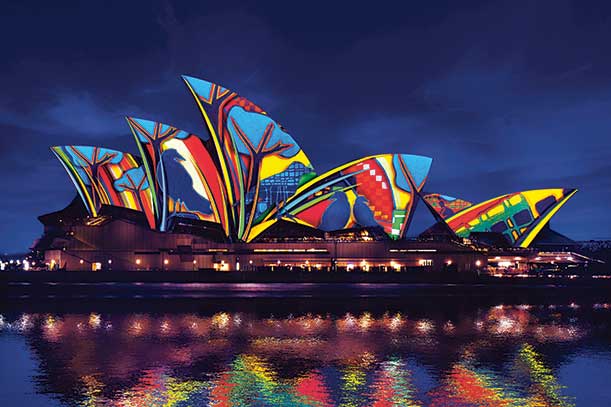
Vivid Sydney

Featured image taken from http://www.sydney.com/destinations/sydney/sydney-city/vivid-sydney

This June, I had the opportunity to visit the Vivid festival in Sydney, Australia – a 23-day annual outdoor exhibition that saturates the city center with colors, sounds and an explosion of the arts. The festival features artworks from artists, designers, engineers and makers across the world that turns the harbor rim of Sydney, including iconic public places such as the Opera House, Darling Harbor and Royal Botanic Garden, into an open gallery of the creative arts. A glimpse to the festival can be found here at http://www.vividsydney.com/.

Walking in the middle of tree-hung fairy lights among the buzzing crowd and passing a pulsating animation that was being projected onto the Customs House, I could not help but contemplate how much beauty in this world that was created with good engineering, fine ideas and the appreciation for the arts.

A favorite piece of mine in the midst of light and music is a small public furniture located by the Sydney’s Walsh Bay. The sculpture described a two-seat bench with soft, flowing curves, electronically lit with a smooth gradient of bioluminescence, the range of colors that can be found in creatures at the depth of the sea. However, as an enthusiastic visitor walked by and took the seat to look at the captivating harbor view, the surface of the sculpture where the body touched turned into a cool, bleaching white light. Designed and created by two UNSW student and alumni, Nila Rezaei and Nathan Adler, ‘Exterminia’, the name of the piece, depicts the effects of climate change on the coral reefs and the marine living system in general. Being an engineering student, I love this clever concept of introducing environmental awareness into architecture. The piece provoked thoughts. It gave the artwork meaning.

There would be other people who remembered other pieces of artwork because they connected to their personal experience, and spoke to them the way Exterminia did to me. But it is the connection and what it means to you that matters. Sometimes even the greatest artwork of the world would not matter to us as much as a happy birthday painting from your best friend, or hand-sewn dress that your mom made.

This brings back the thoughts I have had recently about people. That the substantiality of things in life lies in the message it conveys. And that we, I like to believe each of us is a piece of arts from the universe itself, are all trying to convey who we are and our uniqueness to the right kind of people, and if you concentrate on searching for that in the ones you met, you can see that people are simply substantial in their own ways.