+KHAOS+ EP.22: BACK ON EARTH, HUMANITY’S GREATEST NIGHTMARE
+KHAOS+ EP.22: BACK ON EARTH, HUMANITY’S GREATEST NIGHTMARE
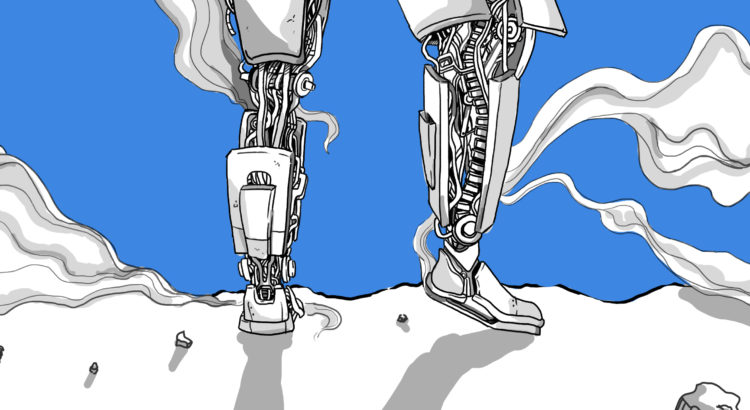
Milo, Kira, and Ed barely made it back to earth, only to find every SALV standing getting taken over by malicious parasitic robots that were released through the disintegrated parts of Ellea that had just hit earth. Humanity’s greatest weapon and hope turning into humanity’s greatest fear, Ed is left with a fatal mission to protect Milo and Kira.
+Author’s Comment+
Hope this one looks like nightmare fuel.
Feel free to follow my Instagram art account: @kats.art.folder
Happy Sunday everybody! I hope that you are all doing well! Today will be one of my last few posts for this year. I thought that I would share a deeper side of me in this one. I hope that you all enjoy it!
One thing that I have learned by growing up in a strict traditional household practicing a different culture is that people who are not like you want to hold you back, make you more like them. Both of my parents were born and raised in India, coming to the United States for their education and building a great life for my brother and me. I grew up practicing Hinduism, taking part in incredible traditional Indian festivals, and when compared to my friends, I was generally sheltered and not allowed to partake in as much. Initially, it used to bother me when I felt that I was being held back by my culture and religion, feeling as if I was not allowed to do everything I wanted, not allowed to be like the other kids around me. This caused me to resent my culture and religion and run away from it for many years…
However, what I have come to understand as I have grown and matured is that my culture and the core values that my parents have imparted me with are what have made me who I truly am. Growing up in a primarily Caucasian society, I would be constantly berated and belittled for being different. I became used to hearing,
“What are you eating?”
“What are you wearing?”
“Why aren’t you allowed to do this?”
Now, I understand that I was not held back by my family nor my culture, or religion. Rather, I was held back by the belief that I had to be like everybody else around me. I was held back by the belief that being different was wrong. I was held back thinking that my culture, something that I am now so proud of, was holding me back from doing the same things my friends were doing. I have come to learn time and time again how important it is to pull against anybody or anything that holds you back, even when that person is yourself. My own thoughts, perpetuated by the actions and words of others around me, held me back from embracing a beautiful culture that has made me who I am today. I have learned how important it is to stay true to yourself and your roots.
In this piece, done in colored pencil and gold leafing, I demonstrate being held back literally. I show a depiction of myself reaching out to the viewer, dressed in a traditional sari, attempting to pull against the two hands on either side of me trying to hold me back. By wearing the sari I am embracing my culture, adding a layer of traditional Indian heritage with the gold leafing and garb. The hands represent the various forces that are holding me back from embracing myself. This piece was so cathartic to create both in its message as well as through the technique of foreshortening.
I have been meaning to write this post for some time but was wary of sharing and did not completely know how to put my thoughts into words. I hope that everything I talked about made some type of sense and that you all enjoyed reading some of my realizations and epiphanies. Thank you all so much for taking the time out of your day to read my words. As always, if anything that I discussed in this post stood out or if any questions arise please feel free to comment and share your thoughts! Looking forward to next Sunday.
We are rapidly approaching the end of the semester which means I only have a couple of posts left. This week I’m posting a day late because my organization, MUSIC Matters, held our biggest event of the year. If you attended SpringFest day festival or the night concert featuring Hippo Campus – I just want to say thank you. We all appreciate it so much and hope that you enjoyed it.
Moving on, this week we are talking about Mentality Magazine! I had the opportunity to speak to Liz Hoornstra, the current editor-in-chief of the publication. She explained that the magazine aims to do two main things: 1. Create a sense of community for its members and 2. Destigmatize mental health through writing. As someone who has been focusing on taking control of my mental health for the past year, I was really excited to learn more about how the magazine has done this and how others can support their mission!
Mentality Magazine typically publishes digital issues, with a printed copy done once a semester. This semester marks an exciting milestone for the organization: 10 printed publications (and 5 years of being an org on campus!). Some of the topics they’ve been focusing on most recently deals with the impact that the pandemic and racial injustice towards the BIPOC and AAPI communities have had on peoples’ mental health. This follows in their larger commitment to diversifying the magazine’s staff and writing focuses, including highlighting marginalized voices in mental health discussions. I was excited to hear that they’re taking on these topics so directly, as they have affected us all in different ways over the past year and are, in many ways, directly tied to some of the most widespread mental struggles on campus.
Mentality Magazine has also recently partnered with steps wellness, “the mental wellness platform for college students”. The platform helps connect students to licensed therapists, provides safe, private spaces for them to have therapy sessions in person or through video call, and allows them to share and read about their peers’ experiences with mental health. This is something that I found incredibly important. Especially in college living situations with many roommates and with most therapy sessions being virtual right now, it can be hard to find a space where you can talk about your struggles without worrying if others will overhear or barge in. This partnership shows that Mentality Magazine is really committed to helping students at every level of their mental wellness journey.
Liz also explained to me that COVID has sparked some important conversations regarding mental health equity and accessibility, things that people were sometimes skittish to talk about before.
“We welcome any and all members to Mentality, but we also are very open that mental health is not a topic that you can be apolitical about and we have to recognize that, holding a space in the mental health community here at Michigan means that there are certain times when we cannot stay silent. I hope that going forward, that is something that we are prioritizing.”
If you’re interested in getting involved in Mentality Magazine, you are welcome to join at any point! They look for writers all through the year, so you don’t have to join at the beginning of the year or semester. You can visit mentalitymagazine.org and fill out the contact form and a member of their exec team will get back to you about the next steps. If you don’t have enough time to be a writer, or that’s not your personal skill set, you can still do other things to help support the magazine and its important mission on campus! Reading and sharing articles is so important – de-stigmatization can’t happen without conversation.
That’s all from me this week! Thank you so much for reading and I will be back next week with my last post of the semester featuring a capella group 58 Greene!
So you’re at the door to a concert, anticipating a night of beautiful music full of romanticism and grandeur. Someone stops you at the door. They give you a booklet. What is this?? Reading material for the concert? Will the concert be so tedious that the audience is handed a short story to occupy themselves with? At the top it reads “a listener’s guide to Schumann’s Davidsbündlertänze”. Hm, a program note, how precocious!
Program notes help contextualize music and are helpful to even the most educated of audiences. For unfrequent concert goers, these program notes ground unfamiliar music to real life, the conception of the piece and what the composer might have wanted to get across. In most cases, program notes are welcome. Only in exceptional cases are program notes unwelcome, cumbersome and hindering the many different interpretations of the music. However, Schumann demands Program Notes!
Here’s Why:
Background
Schumann is a German romantic composer, pianist, and influential music critic who lived from 1810-1856. He wrote a prolific amount of piano music, chamber music, songs, and symphonies. Despite his notoriety as a composer today, during his lifetime, he was mostly known as a music critic. He brought many prominent composers to fame including Chopin and Brahms. That being said, his writings were very important to him and the public. He was very well versed in literature and often would incorporate them into his works. Schumann was a romantic at heart and would include descriptive titles like, “Entirely redundantly Eusebius added the following, but his eyes spoke with rapture” which is the title of the last movement in Davidsbündlertänze. Without program notes, the audience is left in the dark about the context of his various titles.
Titles
I think the Schumann’s most inventive and descriptive titles come from his piano music. Since both him and his wife are pianists, this genre was probably the most accessible genre for him to write. It is also one of the most intimate instrumentations to write for as he generally wrote them for his wife to perform (he could not perform due to a hand injury). Generally, his titles for his movements reflect the tempo or speed at which he wants it to be played at. However, there are two key instances where he deviants from this in Davidsbündlertänze, the last movements of each book
no. 9 Here Florestan stopped and his lips trembled
no. 18 Entirely redundantly Eusebius added the following, but his eyes spoke with rapture
two sides of Schumann
An average program note on Davidsbündlertänze would explain who Florestan and Eusebius are. A good program note would explain why they are placed at the end of each book. A great program note would explain how Schumann’s writings pertain to the piece and bring meaning to this romantic masterpiece.
Other depictive titles would include movements in Kinderszenen such as “child falling asleep” or “the poet speaks”. These types of titles only need a translation and any other explanation would be extraneous.
However, titles in Carnaval are names and an explanation of the event and who these people are would be necessary to give the context of the piece.
(one of my favorite movements from Carnaval)
Literature
Sometimes we need to include program notes to notify the audience of what is written before the piece. In both the Fantasy in C, op. 17, and Davidsbündertänze, there is an epigraph.
In the Fantasy, he prefaced the work with a quote from Schlegel:
Durch alle Töne tönet
Im bunten Erdentraum
Ein leiser Ton gezogen
Für den, der heimlich lauschet.
“Resounding through all the notes
In the earth’s colorful dream
There sounds a faint long-drawn note
For the one who listens in secret.”
Davidsbündlertänze is prefaced with this “old saying”
Alter Spruch In all und jeder Zeit Verknüpft sich Lust und Leid: Bleibt fromm in Lust und seid Dem Leid mit Mut bereit
Old saying In each and every age joy and sorrow are mingled: Remain pious in joy, and be ready for sorrow with courage.
Both are quite poetic and foreshadow much of the music to come. But are these meant to be read to the audience? Are they to be privy of the communication through the score from composer to the performer? Without a program note or a direct reading of the epigraph, the audience would be left in the dark, none the wiser. Is the inclusion of these simply to help the performer find a clearer aural image of the piece? I am of the firm belief that these poems while not necessary for the audience, can add a lot to their reception and conception of the piece. It adds meaning and draws out even more romanticism from the music. It can guide the listener in search for that “faint long-drawn note for the one who listens in secret”. That being said, I would advise to include a translation in the program notes rather than read it aloud before the piece. Any reading of the poems would fade from an audiences mind by the end of the piece.
Musical allusions
As I mentioned before, Schumann was an avid music critic. He consumed music voraciously. Schumann would plant little Easter eggs in his music, quotes of melodies from other pieces, either quoting himself from the same piece, a past piece, or entirely new music.
In Davidsbündlertänze, he uses quotes the entire no. 2 Innig (inward) in no. 17 Wie aus der Ferne (as from the distance). Any audience member paying attention will recognize the tune right away and it’s such a magical moment anyway that mentioning it in the program notes would spoil it.
In Carnaval, he quotes his earlier piece Papillions op. 2 in no. 6 Florestan. I think it’s worthy to note because this quote gives more context to Carnaval as a piece. The inclusion and recognition of the quote would place the audience in a masquerade ball.
My last example of a musical allusion is the most poignant. In Davidsbündlertänze, Schumann uses the theme from Clara’s Mazurka to start the entire 30 min piece. He pays homage to her and signals that Clara is the starting point and inspiration of the piece. Schumann writes in another Clara homage in his Fantasy op. 17. Written for the Beethoven Monument, Schumann pays tribute by quoting from Beethoven’s song cycle An die ferne Geliebte (to the distant Beloved) at the very end of the first movement. He quotes the melody in Beethoven’s last song “Nimm sie hin denn, diese Lieder, die ich dir, Geliebte, sang.” (Take these songs/which I to you/Beloved/sing), unifying his love ode to his Beloved, Clara Schumann.
~
So, now you’ve found your seat and settled in for the concert about to happen, waiting for some beautiful Schumann melodies to wash over you. Read through those program notes and slip into the mind and shoes of Robert Schumann. Listen to the rhapsodies of love and desire with astute ears, a well-informed mind, and an open heart.
In case you aren’t tired of seeing my amateur paintings yet, here is one I created today. I’m not sure of the title yet, but I’ve been thinking of calling it “Assimilated.”
I hope you are able to take a moment for yourself as the semester winds down. If you’re looking for something to do, I highly recommend turning towards art – such as painting – for stress relief. As evident by my work, you don’t need to have experience or artistic ability to enjoy it!




 Moving on, this week we are talking about Mentality Magazine! I had the opportunity to speak to Liz Hoornstra, the current editor-in-chief of the publication. She explained that the magazine aims to do two main things: 1. Create a sense of community for its members and 2. Destigmatize mental health through writing. As someone who has been focusing on taking control of my mental health for the past year, I was really excited to learn more about how the magazine has done this and how others can support their mission!