Springing Forward: My Spring Bucket List

Happy first day of Spring! March 20 marks the Spring Equinox and if the warmth of the sun rays today showed us anything, it was that the calendar and the earth have finally connected via speed dial and coordinated their outfits.

Image via wallcoo.net

Spring is, of course, a time associated with fresh starts, rebirth, blossoms, and joy. But this so often is spring “in theory,” “in the ideal greeting card world,” “in warm-weather latitudes.” When the rains come, all too often with exams and papers in accompaniment, it is easy to get a little down. In order to motivate myself (GRADUATION IS ALMOST HERE!), I’ve made a list of tasks and skills I want to accomplish or at least take a stab at to remind me that spring has sprung and that there’s no better time to discover, learn, and live.

(Feel free to steal some of these bullet points for your own Spring 2016 bucket list! Or add to my list in the comments below!)

  • Visit the UMich Botanical Gardens
  • Sneak into an East Quad music practice room and learn how to play this on the piano.
  • Write a few of my favorite quotes on paper with a purple calligraphy pen, and have them framed.
  • Attend a Swing Ann Arbor event.
  • Participate in National Poetry Month (30 days of April, 30 poems!)
  • Contribute something to the chalk wall at Mash 
  • Explore Detroit (if you have any recommendations, let me know!)
  • Buy flowers at the Saturday morning Farmers Market 
  • Start sending more snail-mail letters to friends.
  • Ummm…find a job for next year!!!
  • Enjoy every day as it comes and make the most of it.

What will you do this spring?


On the Bookshelf Pt. 2

Here is part 2 of the list of books that everyone should read. These were curated with the help of friends, so some of these, I haven’t read, but do intend to.

  1. I Know Why the Caged Bird Sings by Maya Angelou
    • This deeply personal novel follows the struggles of abandonment and sexual assault. It conveys the extreme struggles that a person can overcome, even when forced to deal with them at a young age. This novel also sheds light on societal issues, such as racism, that we should be actively learning more about. It is a strongly affecting novel that leaves the reader a different person after completing it. This slot also stands for other Maya Angelou works, such as her poetry or Letter to My Daughter.
  2. Fahrenheit 451 by Ray Bradbury
    • This novel constructs a narrative in which the protagonist stand on the wrong side until convinced his convictions are wrong, something that we all can learn from. Taking pages from both Nineteen Eighty-Four and Brave New World, we are introduced to a dystopia were comforts rules all, but a tyrranical government enforces the comfort. From this, we can learn what it means to change and how censorship can influence us all.
  3. God of Small Things by Arhundati Roy
    • In this piece, we follow the lives and relationships of a single family as they struggle to grow into new people. This is the only novel by Arhundati Roy, but its universal themes catapulted her into literary history. Throughout the novel, we are wretched back and forth from present to past as we learn that family is the strongest influencer we have and how the past does truly affect who we are as people.
  4. One Hundred of Solitude
    • This novel is based in a genre that is potentially alienating to most american audiences, magical realism. It follows the rise and fall of a single town. It has a great protrayal of love and how it can be corrupted. It also uses the cyclical nature of history to show us how mistakes can be repeated and how they can affect us. In addition, we can all learn from its use of literary devices and its amazing word play.
  5. The Giver Lois Lowry
    • Seeing a theme with this list, this is yet another coming-of-age story. Also this is another one within the dystopia genre. We follow the protagonist as he comes to slowly learn that his society is not what is was always presented to him as. From this novel, we can learn that it can be beneficial to question our society and the rules that are set in place. We can grow and change and leave behind the places in the world that hold us back.

My North Campus Respite

The world has become a scary place. Now, I do not know if the world recently underwent a major transformation that turned it from the safe bubble of general contentment that I knew as a child or if things have actually gotten worse, but I have never been so scared of listening to the news. I love politics, not the political nonsense and gridlock that has become synonymous with American democracy, but the intrigue of elections and the psychology of why people believe what they do. I enjoy being informed, reminding myself that the world is bigger than Ann Arbor, Michigan and that the United States is only a small part of collective whole. Yet, every time I turn on the news I am bombarded by story after story with a very clear message: terrorists, global warming, school shooters, Democrats, and Republicans are all coming to get you and there is nothing you or anyone else can do about it.

Being a worrier, I find myself thinking about everything that could go wrong all too often. I consider where I sit in the computer labs on campus and always know where my exits are, I am tricked by packaging that says “Natural” and “Organic” and I have found myself looking over my shoulder as I walk through a deserted parking lot after a long night in the lab at the slighted rustle of branches. Through all of the media hype, fear mongering and the concern that lingers in the back of my mind, there is one place where I have always felt that the trajectory of the world is not a downward spiral, and even if it is, that we can fix it.

There is something about the music school on North Campus which insulates it from the rest of the world. Perhaps it is that it is on North Campus – an entire bus ride away from classes graded on a curve – or that it is small enough that every music student at least vaguely recognizes another, or maybe it is the music itself. The idea that while music is performed in every language imaginable, at it’s core music is universal and greater than it’s sum of parts. The notion that a performance can provide a respite from a world on the brink of disaster, and the knowledge that performance has served that same purpose for the past 1,000 years.

There are days when the media gets to me, days when the stress of an upcoming exam is overpowered by the unpredictability of a world that I cannot control. Those are the days when I feel blessed to have found a home on North Campus because there is something about the pond sort of shaped like a piano, and a building that is supposed to look like piano keys that blocks out the uncertainty, gently reminding me that as long as we have music we can survive another 1,000 years on the brink of disaster.

Passions vs. The Real World

It’s that time of the semester.

If you are currently in college, you know what I mean. Today in class one of my professors spoke openly with us, telling us that professors hated this time of year. After months of snow and winter and general gloominess, the effects are starting to show in students. They raise their hands less often, they feel more lethargic, and he described it as just a general atmosphere that all professors dread.

As for me, I can definitely feel it. It’s not only the lack of warmth and sunshine (that we seem to finally be getting here in Michigan), but just the everything-ness of this time of the semester. It’s not just having to do schoolwork, it’s having to do schoolwork, and find time for meetings, and friends, and jobs, and summer plans, and family, and – for some of us – graduation. It’s a list that goes on and on.

Last night I read through a short story I wrote this semester for the Hopwood Awards. I didn’t write a blog post about this, but it’s the first time I’ve been brave enough to submit anything I’ve written. I decided screw it, I’m a senior, it’s now or never, and wrote a 20+ page short story in the span of about three days, which, if you are a writer, know how incredibly short that is. I even got up at 9 a.m. to finish it up before the deadline, shocking my roommates who typically don’t see me up and awake before 11, sometimes even noon.

But I was thinking about how much joy that gave me, even in the midst of the crazy semester around me. I banged out a 20+ paper because it was something I’m passionate about. Writing, for me, has always been something I’m passionate about. And at the moment, I’m working on a research paper for a class..and yet I’m not. I can’t work on it, because I have so many other thousands of millions of things to do.

Inspiration and creativity are some of the most elusive characteristics of writing. A lot of advice I’ve been given in college surrounding my writing is to keep doing it, even when inspiration doesn’t hit.

But I never seem to have trouble with inspiration – it’s always the time. I get so frustrated that I have other things I could be doing besides working on a short story or writing Part 2 of the blog post about albums (I promise, it’s coming). And then this frustration gets worse whenever I realize that I have to do things I don’t want to in order to do the things I love, like write and read and watch TV (and think critically about watching TV).

But sometimes, life doesn’t work that way. I don’t like it, but it’s the truth.

This message is brought to you by a stressed college student who knows she shouldn’t be stressed but is anyways.*
*never stop writing, even when you’re stressed

Going Green for St. Patrick’s Day

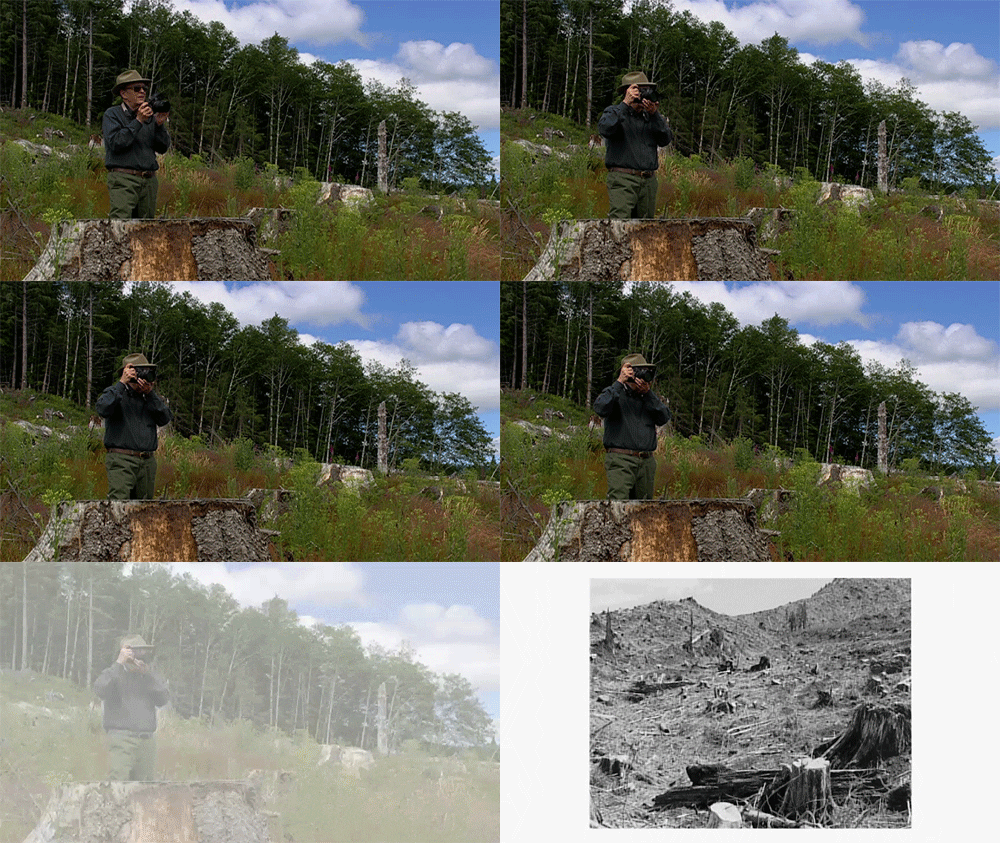
A photographer in a green cut down forest takes a photo and the screen cuts to the black and white photo of a desolated and cut down forest.

It’s St. Patrick’s Day! The day when people frolic and drink Guinness in happy green attire. The day when it’s somehow okay for people to pinch you for not wearing green (consent!) and it’s acceptable to wear every single one of your giant four leaf clover good luck charms. Oh, and it’s the day to celebrate St. Patrick if you’re Irish and/or Catholic.

In honor of this joyous occasion, I thought it would be particularly apropos to talk about going green. Don’t worry, this isn’t about to get political. I’m talking about green art, or environmentally friendly art! You might ask yourself, what is green or environmental art? Well, it all boils down to one thing. Environmental art has to somehow better the relationship and connection people have with our planet. It’s not that hard to do either!

Some people choose to make environmental art that teaches a lesson about how to treat the natural world. Think of Dr. Seuss’s The Lorax or Disney and Pixar’s Wall-E. Like it or not, these two have strong lessons about saving the planet inside beautifully written and illustrated/animated books and movies. The Lorax, Wall-E, and other educational modes of art have helped many people understand the environment in new, fun, and beautiful ways. And, Wall-E has even helped to persuade a few people to use their old boots as flower pots instead of throwing them away! Hint: That’s upcycling. We’ll get to that.

Other people create art that directly helps the environment in some way. This may sound difficult, but it can be done with a lot of success, too. One artist, Jason deCaires Taylor, is a great example of someone whose art benefits the environment. He created those underwater sculptures you may have seen to help coral reef habitats thrive, an especially important task during this time when natural coral reefs are disappearing around the world. His work has even inspired other artists to look at how their art can benefit the environment, creating more environmental artists all the time.

One of the easiest ways for an artist to go green is to reuse materials so they don’t end up in landfills. When an artist repurposes old materials for new pieces, that’s called upcycling. Remember that boot planter inspired by Wall-E? Well, that’s not all you can do with your old and unwanted materials. Need ideas? An old tennis racket becomes a great embroidery board. Bottle caps turn into decorative and waterproof tabletops. Old scrap metal transforms into fantastic sculptures. Toilet paper rolls are painted and turned into bracelets. There are endlessly possibilities for these old items, and each one can help protect the environment in a small, yet substantial, way.

But that’s not all green art is. Some artists paint pictures or take photographs showing the environment in artistically beautiful ways to help people understand the importance of it. Others create dances or sing songs. More use specifically environmentally friendly materials like paints and glues. There are actually hundreds of ways people have been making green art. And the best part? It’s never too late to start making your own.

Happy St. Patrick’s Day everyone! Stay safe and stay green!

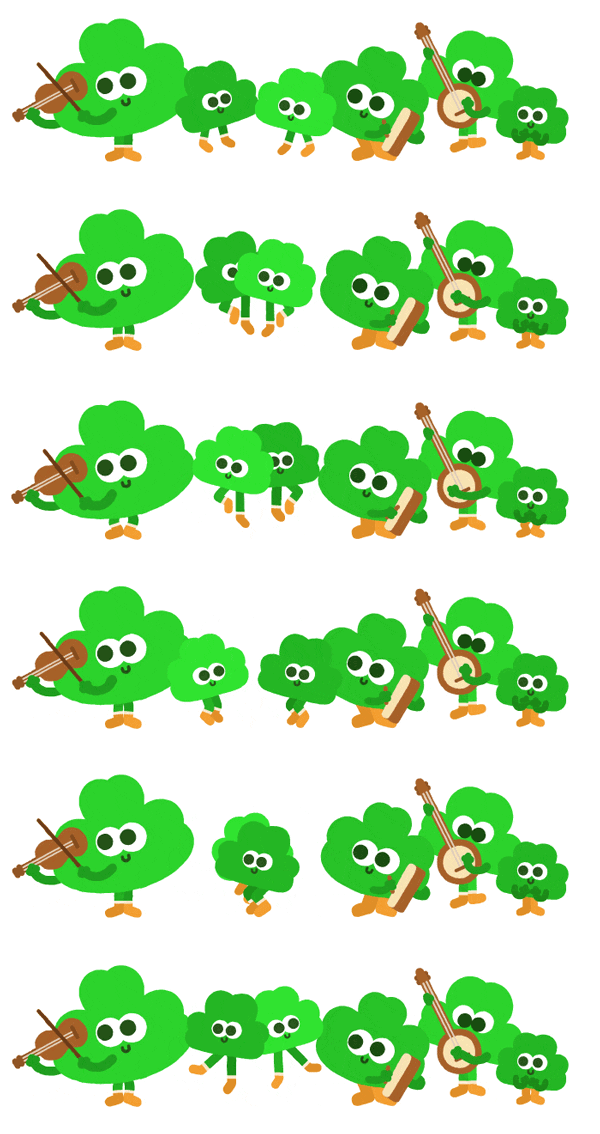
Six cartoon shamrocks dance around and play music.

Popgun Volume 1 and the Comic Book Anthology

Anthologies are a bit of an odd animal for me, especially comic book anthologies because the difference in visual style from story to story is glaring. In anthologies with just short stories for example, until you read each work, aesthetically, it feels as if it all blends together.

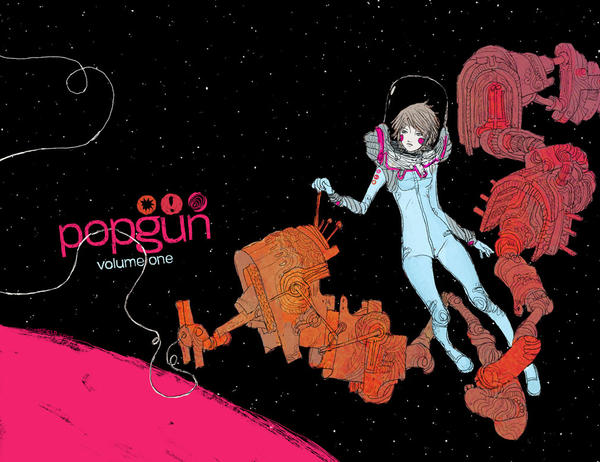
Although I’ve already spoken about Island, I recently discovered an older work of anthology with Popgun. Now the reason I struggle with this particular work despite absolutely adoring the first issue of Island, is the sheer length of it. The anthology is packed with short and long comics for a total of 450 pages.

When an anthology reaches a length of this magnitude…do you work around a central theme? I don’t think that works, simply because it can become dull over the great length, especially with the sporadic aesthetic and prose an anthology can offer. The Island was, for the most part, short, featuring no more than 4-5 stories. However, here, there are well over 40.

But the loss of a theme can leave a reader directionless, but perhaps that is the point of an anthology like Popgun – to bombard you with work from a large pool of artists and writers – most of whom were not famous yet.

As a reader, it is easy to forget about the opportunities available to the writers who are featured in works such as this. By having so many pages of content, the platform grows larger for aspiring comic book creators and it is a chance for them to be featured in a book edited by famed comic book creators and published under Image. Popgun is a mix tape of up-and-coming creators and should be considered as a bag of random goodies rather than a cohesive work. In other words, it’s not only a platform for new creators to get published, but it’s also a means of readers discovering new creators.

The Island magazine has the right idea, but maintain a smaller dosage of stories in order to maintain some sort of cohesion. However, although it may be a bit overwhelming, the need for expansive works like Popgun may need to return.