Sometimes I sit alone and wonder whether there is a better or worse character in the history of television than George Costanza, who if you don’t know is one of the four ensemble characters on Seinfeld. Many times I have cried from laughter watching this dysfunctional, irrational man getting himself in and out of tight spots (both literally and figuratively), but just as many times I have cringed at the thought that this walking farce is based on a real person. Let’s just consider some of the things that Georgie (as his mom so affectionately calls him) has gotten away with relatively unscathed:
He creates a fake charity called the Human Fund so that he doesn’t have to get his coworkers Christmas presents by making a donation on their behalf. He then accepts a hefty donation to his fake charity by his boss and tries to keep it for himself.
He leaves his car in the New York Yankee’s parking garage for a week and his boss George Steinbrenner assumes he’s DEAD, so he fakes a bunch of injuries to cover for the fact that he just never goes to work.
His fiancé dies from licking too many toxic envelopes while sending out wedding invitations, and he doesn’t mourn her so much as he mourns the giant fortune he finds out they would have inherited together.
He tries to get Elaine to set him up with Marisa Tomei (yes, that Marisa Tomei) even though he is engaged at the time (which he is aware of, thank you very much.)
He has a contractor alter his desk so he can sleep under it instead of doing work. When George Steinbrenner comes looking for him and sits in his office for over 3 hours, he has Jerry call in a bomb threat to get him out of the office, only to have Steinbrenner and his grandkids hide under his desk and find him.
He goes on a date with a waitress from Monk’s and while walking through the park talks about how, when you break it down, manure isn’t so bad. It’s just a newer, with a ma in front of it!
He starts dating a woman in prison because she won’t be able to “pop in” on him unexpectedly, and then tries to break up with her when she’s up for parole (she doesn’t get out on parole but then does the ultimate pop-in when she breaks out of prison and shows up at his apartment.)
This is just a taste of the absolute chaos that is the life of George Costanza. His life is like the opposite of the whole “I can’t make this up” in that it’s complete nonsense – there’s no way his life isn’t made up. And yet somewhere, at this very moment, Larry David is walking around causing some raucous. The genius who created Seinfeld based George off of himself, a fact that simultaneously leaves me disturbed and feeling better about my own life.
As I so often do, I will leave you with a little bit of George Costanza. Here’s a best of:
Cover art for the magazine. Drawn by Brandon Graham.
Brandon Graham has once again led me to another interesting find. This time, it is in the form of his multi-artist project called Island – a comic-magazine that hosts 3-4 stories that cover a similar theme, all written by different writers/artists. Prior to this, I never knew comic-magazines existed but to my surprise there were many illustrated magazines that had existed or are still running – one of which is called Heavy Metal (which incidentally has a new editor – Grant Morrison – a beloved and incredibly talented comic book writer).
My first foray into this format was undeniably pleasant for the magazine was constructed with great artistic and thematic eloquence. In total, there were five artists whose work was featured in the first issue. The first artist is Marian Churchland, a Vancouverite (and so beautifully captured by the her portrait – a white skinned goblin protecting its shiny stone), who drew the title pages, or rather, painted, with broad and bold brushstrokes of oil paint. However, she did not write any of the stories.
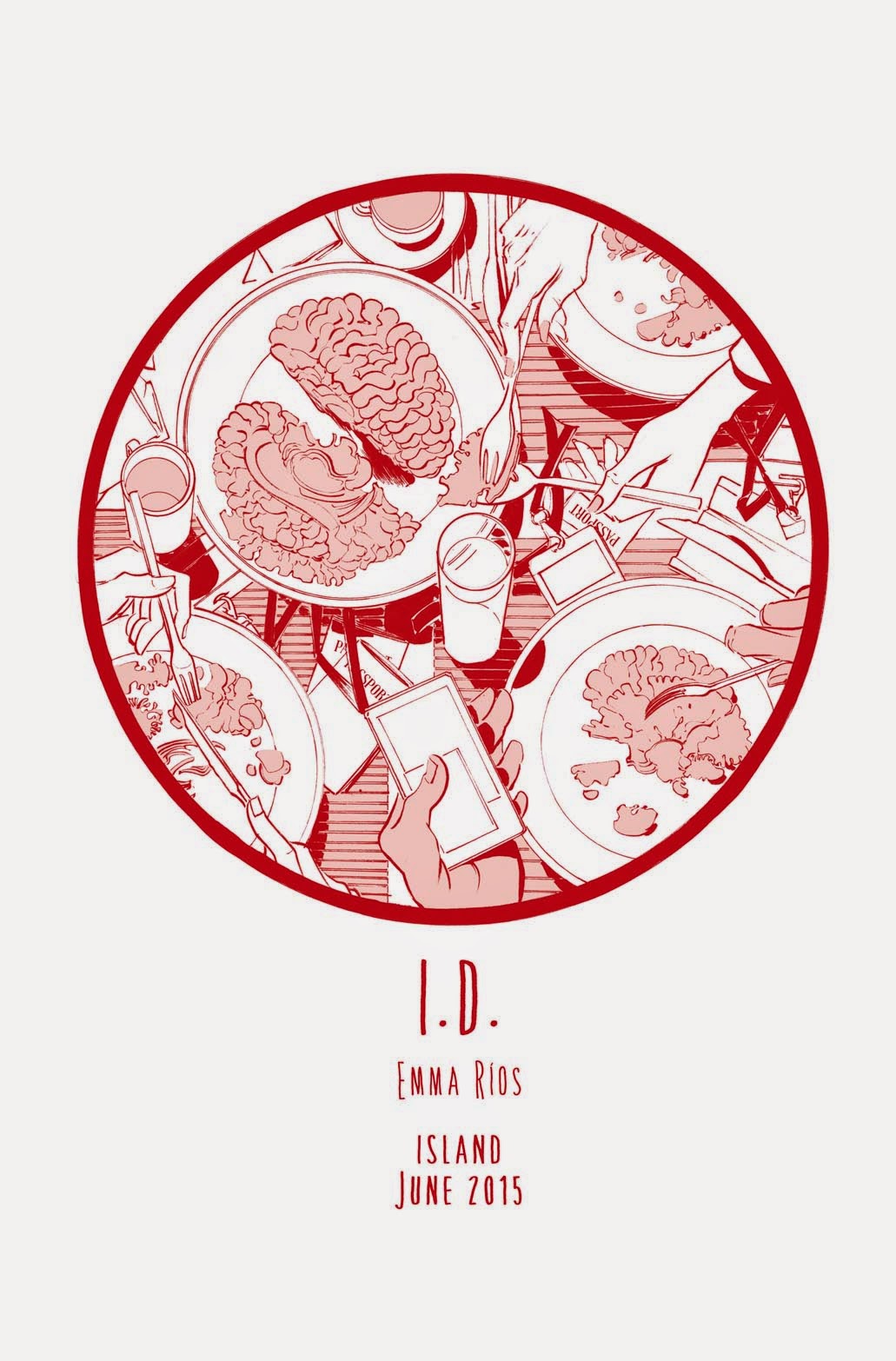
The title page for I.D.
Then there is Emma Rios who wrote and drew the first story called I.D., which features three individuals who are unhappy about their bodies and wish to partake in a body transfer. The whole comic is done in red ink and although the basic story is tried and a little stale, the beautifully rendered background and swift lines keep the otherwise subdued tale, very energetic.
Afterwards there is an essay called Railbirds by Kelly Sue Deconnick, who, if you read comics, you might have heard of. She created, with Valentine De Landro, Bitch Planet (another title published by Image Comics). The essay is first and foremost, a tribute to the late Maggie Estep, with the undercurrent of whether or not Deconnick feels like she is a writer or not and how her interactions with Estep shaped her. The essay is fairly meta at times, and is quite conversational, but it is still interesting to see how someone worked through the question of: am I what I am?
Nikoli walks around the city…searching.
Now we come to the comic by Brandon Graham called Multiple Warheads 2 (a continuation of Multiple Warheads which he did far prior to this project). Reading and viewing Graham’s work is always a treat and quite possibly the only time I allow myself to laugh at stupid puns (in the title spread, he has a sentence that says, “A pound of flesh but they won’t get a Graham.”). The story is about a boyfriend who is lounging about, in “vacation” mode, in a floating city while his girlfriend goes around doing smuggling work. Oh, also, did I forget to mention? The girlfriend smuggled a wolf penis and sewed it onto her boyfriend, making him half wolf. That is how biology works right? But in the midst of all this, the question of identity comes in again, as the boyfriend tries to find himself, as he considers how his girlfriend is doing so much work while he does nothing.
Graham’s work is, as is expected, visually dense. There is just so much to soak in. The backgrounds are littered with tiny details of tiny figures doing tiny things. Graffiti soaks the walls of shops that are cluttered with junk that are both of and not of this world. There are seemingly arbitrary numbers written on tree trunks and the backs of animal heads. But his density doesn’t create frustration; it creates wonder because of the breath of its creativeness. A whale café. How could you not want such a thing? He also has an interesting reaction panel, where there are two different outcomes based on what the female character, named Sexica, orders at the café. It is a visual inventiveness; one that is so aware of the possibilities of the exploration of space and narrative in a comic format, that is nothing short of astounding. Even his choice of color is beautiful. He uses muted tones that complement each other perfectly. And the smooth and clean lines and lack of tonal shading, gives it a Tintin vibe.
The mummy gets attacked by cats…with knives.
The final story is a skateboarding story by Ludroe called Dagger Proof Mummy (I can’t make this up – this title is amazing). It is a story about a mummy who gets attacked by cats with daggers and also about a girl who misses a skater named Dirk, a boy who can skate on walls and ceilings, who believes that once you stop “rehearsing for failure” you can break down all barriers and achieve greatness. Why wouldn’t the girl be convinced? He can skate on the ceiling! I won’t tell you how Dirk disappeared, in case you want to check out the magazine yourself.
By the end, the magazine does end in a grace note. Which is nice, but slightly cheesy. In the limited confines of a magazine, that is an accumulation of different artists’ work it is hard to know how to end it. But, if we consider the content outside of the individual stories, we can take into account the bookends that Graham created in this magazine.
In the very beginning, before the table of contents, the reader is treated to a very short comic featuring Brandon Graham’s actual head, spitting out the self-portrait of Graham, a yellow slug-like creature. It also features a godlike voice, commanding Graham to wake up, and not waste the creative freedoms he has been bestowed. Graham then considers creating a magazine, this magazine that features work from his fellow artist friends. Then at the end Graham ends with a quote from Federico Fellini.
“People ask me, ‘Why do you recreate Venice in a studio instead of using the real one.’ I’m always a bit surprised by such questions. I have to recreate it, because I have to put myself in it.”
He then goes on to muse about style, and space, and external versus internal influences on a story.
The ending bookend not only closes on a note that lets you forget about the cheesiness that happened earlier. But it also gets you thinking, not purely about identity, but the way in which an artist interacts with their medium. We have almost moved on, past the internalized struggle, and now towards finding yourself in something other than you.
I don’t know if this is an appropriate thing to mention given that the writer wrote in different fully formed personas, but it is still relevant, and nonetheless true. So, Fernando Pessoa once talked about the power of meditation, how “…the contemplative person, without ever leaving his village, will nevertheless have the whole universe at his disposal,” that, “One can sleep cosmically against a rock.” But eventually, when all our thoughts are but formulations of meditation, we yearn for life, a form of meditation that is absolved of intellect. Instead, drenched in the tactile richness of nature and life. We cannot live in ourselves forever.
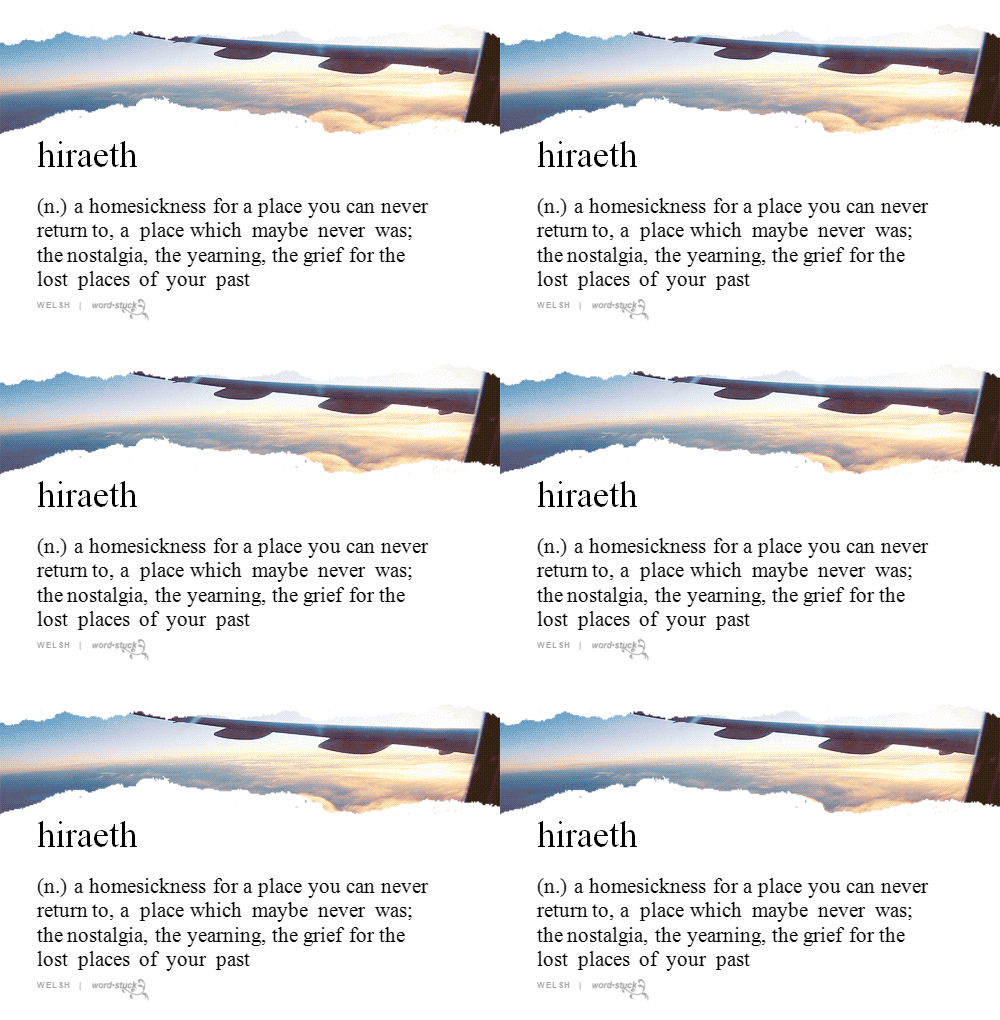
At this very moment, your heart may be fluttering with anticipation, your stomach might be knotted with nerves, you might have a sudden urge to kiss the person to your right, perhaps you are antsy with iktsuarpok.
Descartes claimed that there are only six basic, universal emotions, which he called the “primitive passions”: wonder, love, hatred, desire, joy, and sadness. While I agree that all human beings, no matter their language or culture background, certainly experience these six emotions, should we constrain ourselves to vague generalities, when there is an infinite number of sensory opportunities for us to experience this world? Should foreign languages stop us from exploring the inner workings of our brain?
Words are very telling about cultures; they help define what’s important to a culture’s people. In the same way that the Inuits have over 50 words to describe snow in all its varieties, cultures put into words the emotions and feelings that are the most relevant to their society. Words are efficient, yet words also are practical and purposeful vessels of emotion. We may feel “cozy and warm from being inside with friends on a cold day,” but because we don’t have a word that sums up that particular feeling, we would be more likely to let the feeling go unsaid. The Dutch on the other hand, whose vocabulary includes the word “gezelligheid,” can express in just four syllables their warm-hearted comfort.
Words are fascinating. Especially foreign words. Even when you aren’t sure how to pronounce them, their specific meanings that define a feeling you’ve had before somehow brings the world closer together. We become one culture of feeling beings. We bond over our likenesses rather than the differences between us.
True, you might not ever use one of these words while hanging with your friends or in a school paper. In fact, it might be wholly pretentious if you just said, “As Mr. Rochester stepped out of the shadows, Jane Eyre was overcome with a bout of basorexia and nearly succumbed to it.” But, there is something very comforting knowing that the word exists. That someone on the other side of the globe has expressed a feeling for you. A secret between you and the word.
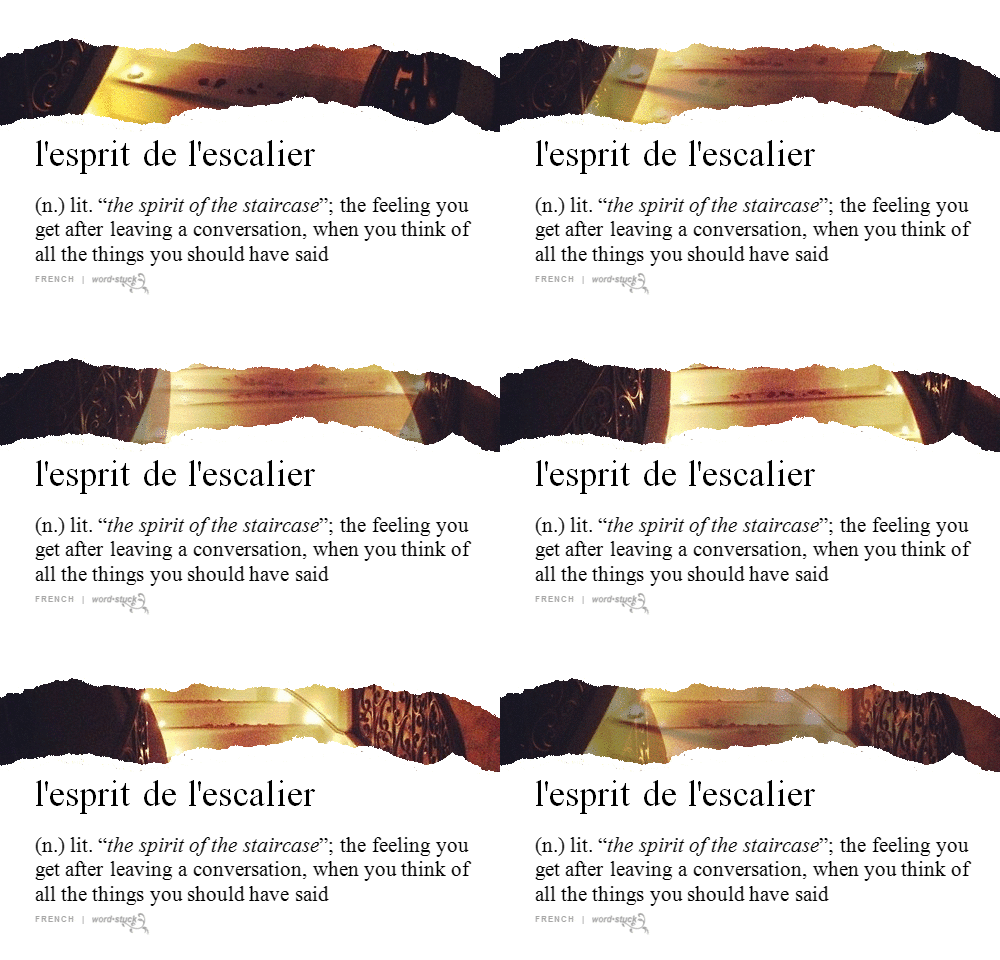
It’s no coincidence that words and emotional expressions are the two most effective ways that humans communicate with each other. Of course, then, we find people striving to connect the two together. Books such as Tiffany Watts Smith’s “The Book of Human Emotions,” Ella Frances Sanders’ “Lost in Translation,” and Tumblr site “Word-stuck” are increasing the powerful beauty, history and art of this compounding. We are inventing a language of feeling, a language that is ever growing, a language not bound by country borders or regional differences, but a language born out of humans just being human.
Being a stranger is a weird, almost uncomfortable concept for me. I cannot pinpoint a specific time in my life when I felt this way. That is not to say that I have never felt out of place. I have felt bizarre many times: Drama Club auditions, various social gatherings, competitions, and so on. The reason there is no pinpoint time to focus on is because I have always been a stranger. I have not always been uneasy, but I have always been on the outside. My entire conscious life has been me with dealing with the fact that I am not part of the consensus. Some of it is from unfortunate circumstances, while most of it is my own doing. The best place to start with my constant and continuous stranger-dome is where it most likely began.
I was not unique to begin with, my birth was ordinary and easy and I was born normal and healthy. My unfortunate “uniqueness” started when I began to try to communicate with others. I was far from normal in that aspect. For some unexplained reason, whenever I tried to talk, it came out a gargled mess. I was speaking a foreign language while still speaking my native tongue. The only person who could understand me was my sister, and she had to become a translator for me. I was effectively mute without my sister. I don’t know what kind of lasting psychological impacts this has had on me, all I know is that this was my first encounter with a life-long problem of trying to connect with people.
Of course, since very few people could understand me as a child, I was placed in a speech pathology course from first to fifth grade. I rather like the course. My teacher was nice and fun and I had two other people in the class to become friends with. Unfortunately, that would change too. I would once again become an outsider. In third grade, one of the other students no longer had to take the class, and in fourth grade, neither did the other. I was alone in that class. I did not feel unique and special, I felt strange and like a failure. Eventually, though, I learned to take solace in it and cherish it as an important time when I wouldn’t have to feel ashamed about my speech. Life continued to changed, though. I had to move on to sixth grade where I could no longer take the speech classes. I had to continue being a failure at the basic human skill of speaking, and I still feel to this day that I am not an ordinary English speaker, I have an accent, even within my own family, and I still often have trouble with my pronunciation.
Sixth grade was an important year, not only for my loss of speech pathology, but also for my acceptance. This deceptive writing is not meant to say that I finally felt like less of a stranger. No, I still felt uneasy every day. The uneasiness just originated from a new source. In sixth grade I learned to accept the fact that I was gay. The ramifications of this, I can still feel today. I had always known I was gay in some capacity, but sixth grade is the year I finally accepted that I wasn’t bicurious or bisexual, but gay. This was not a beautiful moment where I truly became myself, like some movies have one believe. This was shaking nervousness that terrified me. I was not like everyone else, I was further alienated from the people that I wanted nothing more than be close to. To borrow a title from author Robert A. Heinlein, I was a stranger in a strange land. I could no longer lie to myself and be what everyone thought I was.
Even though I was able to accept the fact that I was no longer like everyone else, I could not admit it to others. I was stuck in a perpetual limbo where I was an aberrant, but not one that was readily visible. I was lost in my own mind and terrorized by the thought of what people might do if they found out. This terror was short lived, though, as I quickly realized that most of the people I cared about would still care for me, whether I was gay or not. But even though the terror of repercussion subsided, I was still terrified of telling anyone, and I still am. I still have my life firmly rooted in this preconstructed closet and only a few people have glimpsed inside. And while the previous sentence may cause others to believe that I was able to overcome this terror, they were misinformed. Only one of these glimpses were truly of my choice. Most of them were of some indecipherable obligation I felt to tell those people. I am still terrified of escaping this shallow place I’ve been hiding in and the only reason I even chose to discuss it is because of this concerning obligation I feel.
And the separation doesn’t end there, nor is it my greatest separation. In high school, I started to have, what I think, are very concerning thoughts about myself. At this time of my life, I started to realize that I didn’t feel like everyone else. I wasn’t having these hills and valleys of emotions that others seemed to have. They were truly happy or genuinely sad. I’m not sure if I’ve really felt these emotions in their fullest forms. I have laughed and I have cried, but I never seemed to be happy or sad. I was simply content. I didn’t have any hills or valleys, I only had a plain. Nice for grazing, but not very life affirming. This became the most absolutely horrifying of my aberrancies. How can I truly be a person if I don’t have these emotions? Am I simply struck with an empty depression that I’m not aware of, or am I truly without these ranges of emotion?
Perhaps the most pathetic thing about it is that I now crave some sort of emotional reaction. I feel empty and the only thing I truly want is to feel something other than the emptiness. I want to be in love, I want to be happy, I even want to be depressed, because at least it is something other than the utter flatness. I feel like I’m not actually living, that I am something different from everyone else and it’s not something I enjoy. Even as I was writing this, I wished I was in such an emotionally vulnerable state that I could cry, but I am unable. This is not my emotional vulnerability, this just an expression to me.
I have always been a stranger and I probably will always be a stranger. The most telling aspect of this is that when I moved into the dorm, I felt no different than when I did at home. I believe the reason behind that is because I have lived as a stranger my entire life. Being in a strange place is nothing new to me. This disheartening truth is a constant to me. I am a stranger no matter where I go, no matter who I am with, and no matter what I am doing.
This year, the University of Michigan Department of Theatre and Drama turned 100. Additionally, it marks Arthur Miller’s 100th birthday and 125 years of acting classes at the University available to be take for college credit. As a result, the theater department has put on numerous special events to mark this very special anniversary including producing Arthur Miller’s All My Sons in the theater on North Campus named after the playwright.
Many people know Arthur Miller from high school English class where they (most likely) begrudgingly read Death of a Salesman. Death of Salesman was and is more than a Pulitzer Prize winning drama, the work gets to the core of what it means to be an American and to have the chance to fight for and earn the American Dream. Though commonly listed as one of the most influential American plays of the 20th century, Death of a Saleman was not what established Arthur Miller as one of the preeminent playwrights of the 20th century – rather it was All My Sons written in 1947 that produced such a reputation.
To those unfamiliar with Arthur Miller’s life, the celebration of Arthur Miller and the University of Michigan’s Theatre Department may seem to be a case of convenient timing – however – Arthur Miller’s connection to the University of Michigan is much more. After graduating from high school in Brooklyn, Miller worked numerous menial jobs to afford tuition at the University of Michigan. It was here where Arthur Miller studied Journalism and wrote for the Michigan Daily, and where he wrote his first play No Villain which after winning the Avery Hopwood Award prompted him to consider a career as a playwright rather than a journalist. After his graduation from the University in 1938, Arthur Miller maintain strong ties to the University establishing two awards named after the playwright and lending his name to the theater built on North Campus in 2007 – the only theater in the world that bears his name.
As we mark 100 years of Michigan Theatre and of Arthur Miller, it is important to remember that 100 years from now we might well be celebrating the next great mind who graduated from this institution. For it is the opportunities which this University provides that helps it’s students develop into their full potential, potential that one day may change the way people see the world just as Arthur Miller has.
So last night I watched an episode of the ABC sitcom The Middle where everyone in the family seemed to forget something at the end of the school year. Axl, the oldest, forgot to do his community service; Sue, the middle child, didn’t receive perfect attendance because everyone in the school forgot her; and Brick forgot to write in a daily journal for the entire school year. In order to move to the fourth grade, he had to write down everything that happened during the entire year, and his mom, bless her heart, was going to write down every single page so that he could move on.
The entire time, though, I felt myself sympathizing with the mom, Frankie, the most (as I often do). She stayed busy the entire three days until the end of school, helping her kids do what they had forgotten, and yet the entire time she kept asking her husband questions – “Where’s my phone?” she asked at one point, talking to him from her silver cell phone in her hand. “I must have left it in Brick’s classroom, hold on I have to turn back.”
This doesn’t feel uncommon to me. Not to brag, but I have a pretty good memory – I owe it to my theatre and piano years, where I had to memorize lines and music seemingly every week. But there’s always that one time, that one day, where I lose my head and forget everything.
It seems to me, though, that this is a trait that might be somewhat common in artists/creative people. Or rather, perhaps it’s a stereotype. We’ve got so much going on in our heads, from stories we wanna write to drawings that have to get on the page. Our grand vision is way more important than that lunch date, right?
Which is all to say, of course, that little did I know when I was watching that ironic episode last night, that I myself forgot to write my column, when it was supposed to be posted last night. I’m only what – 11 hours shy of being on time?
But I have to say – if that episode of The Middle taught me anything at least, it taught me that everything works out in the end, am I right?
Ah me. Let’s hope next week in the midst of these crazy midterms, I won’t forget again. No promises though.