Letters by Lydia: Faux Calligraphy

Welcome back to another post! Today is all about faux calligraphy, so let’s start by explaining what that even is.

Faux calligraphy got its name by, as you might have guessed, being a sort of “fake” form of calligraphy.  Where traditional calligraphy uses a brush pen to get those thin upstrokes and thin downstrokes, faux calligraphy allows you to get the same technique with a regular old pen (or, really, any sort of pencil, marker, etc that creates a standard line).

In this example, the top version is regular calligraphy with a brush pen, while the bottom version is faux calligraphy using a marker with a bullet tip.

So how does this work? It’s actually pretty simple, which is why a lot of people, especially beginners, prefer it over traditional calligraphy.  A lot of beginners also use it as a gateway into traditional calligraphy, because it uses the same principles without requiring the technique involved in using a brush pen.

To start, you can just write whatever word/letter/phrase you have in mind.  This can be in cursive, or in print, whatever you prefer!  The next step is the key: you need to identify all the downstrokes. In the example below, I showed where the downstrokes are on the cursive letter “a”, but if you want a more comprehensive guide, I have a few other blog posts about handlettering basics that should help you out!  Once you identify where all the downstrokes are, you simply make those lines thicker, whether by drawing an outline and filling it in like I did, or by just adding a few extra lines around it.

Find the downstrokes, outline them, and fill them in 🙂
Here’s a little alphabet guide to help if you’re struggling with the downstrokes, too

Once you’ve got the basics down, this another style where there are a lot of fun variations to play around with. I included some of my favorites below, to show that you can do this with cursive or print, vary the thickness of the downstrokes, bring in color, etc. With the “lazy” and “hard” styles, the lazy one is just what you’ve been doing already (it isn’t lazy, it’s just easier than the hard version). The “hard” version is where you kind of map the downstrokes out in your mind ahead of time so that the lines don’t intersect and downstrokes remain solid white. This takes some practice to get the spacing right, which is why I called it the hard version, but it’s definitely not impossible and can be really fun to practice!

I hope you enjoy trying out a new style, or at least learning about it, and for all the umich students out there, have a great spring break!

OTM #26: Caffeinated

Walking is one of my favorite things. I just got over having COVID this past week, and I think an extremely long walk was exactly what my body needed after the long rest period. I wasn’t that eager to walk in the first place, but sometimes coffee just has an insane effect on me – I think it’s funny how things in our bodies can change so quickly just because of different substances. I was shaking even after the walk, my body tired and asking me to lay down yet simultaneously twitching and shaking with vibrant energy. Despite that dissonant discomfort, it felt good in a way. It is grounding to feel my body at work, to gain awareness of my internal systems reacting to what I’ve fed them. After a week of illness, it felt like I was being Frankensteined back to life. It felt good to be out in nature, moving my limbs back and forth, back and forth. This week, it feels particularly good to be human. I hope you’re all hanging in there with midterms and looking forward to break!

Desolate

What can you say when there’s nothing to do

What can you do when there’s nothing to see

What can you see when there’s nowhere to go

Where can you go when there’s nowhere to stay

Where can you stay when there’s nowhere to live

Where can you live when there’s nothing to eat 

What can you eat when there’s no one to speak 

What can you speak when there’s no one to hear


The Indian Artist, Revamped: Let’s Talk About Brushes

Good afternoon all! I hope you are all doing well! I have decided to continue in along of the lines of my last post and discuss painting materials. This week I will talk about some of my favorite brush types and the effects that can be achieved from them. This post was inspired from my best friend who had a hard time understanding the difference between a mop and a filbert!

First, it is important to delineate the difference between synthetic and natural brushes. Natural bristles are made from some sort of animal hair, such as hog or badger. Synthetic bristles are often made from nylon, polyester, or a combination of both. Natural-bristle brushes are best for applying oil-based alkyd paints, and synthetic-bristle brushes are recommended for water-based latex paints.

Second, it is VERY important to take care of and properly clean your brushes (especially after using oil-based paint). I have to take my own advice here as I am definitely a culprit of leaving my dirty oil painting brushes lying around for a shameful amount of time. You’ll need odorless mineral spirits (OMS), a rag, tissues, or paper towels. Wipe the brush of any paint, then wash in OMS or Terpenoid, and then dry it with a tissue or rag. I like using a simple soap at the end of my painting session to make sure they are completely clean.

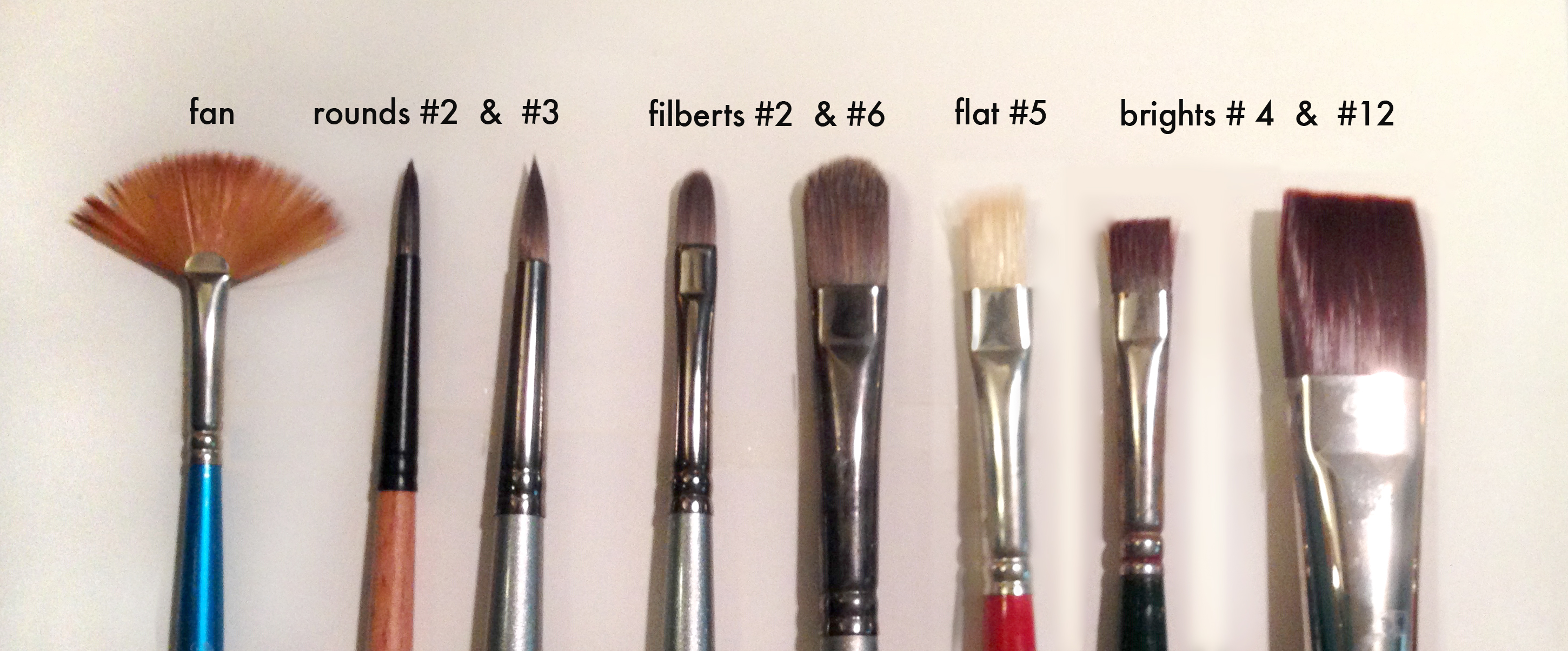
Brushes come in a variety of styles. Eventually, you’ll determine your own favorite brushes to use! I love using large mops for blending and small filberts for laying down color. Here are some basic brush descriptions, though the length of the bristles often varies from brand to brand:
Round: round with a pointed tip; this brush is great for delicate work and details
Flat: flat with squared ends; these are great for covering large areas of a piece quickly
Bright: These are similar to a flat brush, but the hairs on brights are shorter. This allows a bit more control than the longer flat brush. Because it has short bristles, which bend less, it can move oil paint against the grip of the canvas, and fill large areas fast.
Filbert: Also sometimes called an oval, a filbert is flat with rounded ends and great for mixing paints
Fan: flat and shaped like a fan — You can cut some of the bristles out of your fan brush in a ragged pattern to make a very rough scraggly mark; fans are great for painting grass, hair, fur, removing brushstrokes
Mop: Exactly what you would expect, a full bristled brush that is great for blending

Types of Oil Paint Brushes


I hope that you all are enjoying this more theory and materials-based blog posts. I absolutely love collecting and trying out various shapes of brushes to see the effects that I can create. If any questions or thoughts arise, please comment or reach out to me via my socials!


Until next week,

Riya


Instagram: @riya_aggarwal.art

Portfolio:  https://theindianartist.weebly.com/