NO UGG BOOTS! NO LONG ISLAND!

Gabriel Kahane is one of those musicians that I’ve been following for a while. I think I first found his existence through his song cycle, Craigslistleider. As just as ridiculous as it sounds, Craigslistleider is a cycle of songs for voice and piano that takes its text and inspiration from strange strange craigslist ads. The assless chaps for sale. The (possibly very ill) gentleman who can’t stop putting ice cubes down peoples shirts. You’ve got it all. Perhaps my favorite song is about a man begging for the name of a relish he found two years ago (he doesn’t know the name of the relish because, as the name of the song tells, “Some Dipshit Through [sic] My Bottle” of it. I think the “sic” is what kills me there). But enough talking. Listen to the man himself!

The whole song cycle is quite a gem- a great example of a composer taking an absurd text and making something really valuable out of it. I have a bit of a problem taking contemporary poetry and setting it to music, because it seems like the music isn’t really adding anything to the text. If anything, the music is forcing the music of spoken language into a constrained box of singing. But all of this is to say is that I think Gabe Kahane gets it very right here. He takes a moderately amusing text and turns it into a hilarious and very successful song cycle.

But Gabe Kahane is not one to be put in a box himself. In addition to his work in *ahem* contemporary classical music, he’s also a pop musician, and a damn good one at that.

But this is trying to put a label on something that he does, and I really don’t like that. When Kahane comes up in the media, he seems to be always billed as that guy who is stretching the boundaries of genre and bridges a gap between pop/rock music and classical music. I don’t find a lot of redeeming qualities in that argument, save the unlikely scenario that you are ever held at gunpoint and demanded to describe Gabriel Kahane’s work in a phrase or less.

That line of thinking seems reductive, it seems to put classical music as this thing that is diametrically opposed to popular music (and that just isn’t true), and it seems to put his music in a box of mixing genres (if you shake the box enough, all the classical dressing will get around to everything for the optimal music eating experience).

I think the really engaging thing about Kahane’s work is that it exists simply as very intelligent music. It is emotionally and intellectually satisfying, and that’s really all I need. The lyrics are some of the most resonant that I’ve encountered in a long time. It’s lyricism that is smart (“Modern’s a stillbirth/that was born before it died/in 1939/or was it ’45?”) and tragic (“Our hotel room was too small/For our luggage and our arguments/So we left them in the hall/And went to bed. Went Straight to bed.”), but above all, true. And that truth is what resonates the most with me, not the sense that he is referencing classical music, or that he uses traditionally “classical” instruments, or that he uses pop (or classical) rhythms in his classical (or pop) music. To misquote Gertrude Stein, An art is an art is an art is an art. Check out his music (two albums and a musical!) here.

And you should go see this man perform, it will be well worth it. UMS is bringing him here this Thursday and Friday at the Arthur Miller Oddslot Theatre. Grab tickets! Yours truly will be there Thursday night in the back live-tweeting the experience, so if you wanna jump on that, my twitter will be anxiously awaiting you. See you there!

A Balancing Act

Live at the Metropolitan Museum of Art is “Stag by Sharkey’s,” (1909) perhaps George Bellows’ (1882-1925) most famous painting.  Filled with action, movement, and perfect lighting, the painting depicts a boxing scene that is as graceful and beautiful as it is raw, real, and violent.

Bellows died at the young age of 43 as a painter part of the Aschan School. The artistic school was known for its rejection of French impressionism and glorification of the American West in favor of portraying the real disarray of new American cities. Bellows in particular depicted the “grittiness, violence, and masculinity” of New York City.  However, throughout the remainder of his career, Bellows experimented with other painting subjects, varying from standard portrait types exhibiting piercing and frightening eyes, to landscape and an extreme use of light contrast, perhaps to portray his perspective on the disparity between light and darkness within the new city.  In personal opinion, his earliest works of the budding city are his most invigorating and impactful on the viewer.

The scene of “Stag by Sharkey’s” depicts a turn of the century illegal fight club in New York. At the time, prize fighting was illegal, so men turned to underground alternatives for prize fighting.

Upon live view, Bellow’s painting is a hundred times more powerful than its digital replica. The command of Bellow’s rough and thick brush strokes reach out to the viewer and pulls him into 1909. The painting places the viewer in the third row of the fight, amidst the crowd, the noise, and the sweat. While both men are fighting each other, their grace in movement resembles a choreographed dance. The man on the left’s leg is extended, almost at point, and

scoruri live fotbal rezultate live fotbal rezultate live la fotbal

continues through the arch of his back. The man on the right reflects a mirrored curve to his back, as they meet in collision in the center.  These lines are also present in the muscle detail of each man; strong and graceful pieces that work together to generate a force much larger than the individual.

Standing in front of this painting elicits real emotion. It is the perfect balance between light and darkness, roughness and grace, detail and ambiguity.    It tells the story of a dirty and real New York, filled with excitement and uncertainty. While the city faces accusations of gentrification and a loss of its once gritty backbone, Bellows reminds us of the raw backbone of the city, and how it is perfectly balanced and beautiful in all of its glory.

A Little Nostalgia

With a new year beginning, feelings of nostalgia are bound to arise in place of past events, people, and art. As the years go by we are graced with new and upcoming artists and artwork that brings about change within how we view certain aspects of life and ourselves. With the start of a new year, it becomes a question of what will be created or discovered this year, that will completely trump anything we’ve ever seen before? What will challenge our views or enlighten our minds? Yet, there will always be a deep appreciation for what art has done to get us where we are today.

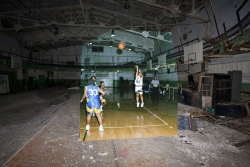
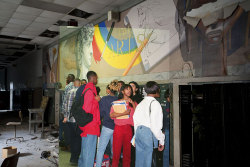
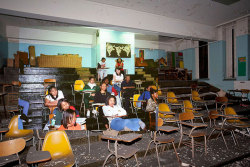
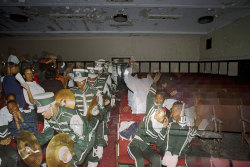
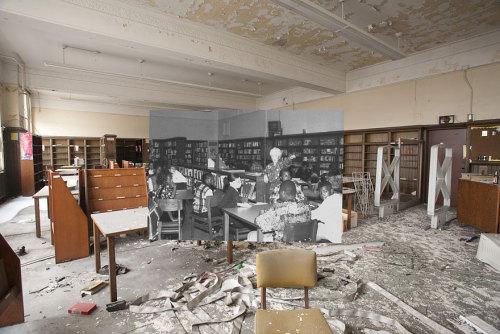
Take these photo sets for example:

School Break (Detroit)

Photo Credit: BoredPanda.com

A New York Minute

batmanpride.tumblr.comMacauley Culkin in Home Alone 2: Lost in New YorkTom Hanks and Meg Ryan in You've Got MailPatrick Swayze and Whoopi Goldberg in Ghost

Photo Credit: PandaWhale.com

I loved these photographs because they elicit feelings of nostalgia for the past and greater times, especially when it comes the time for new beginnings. What I also loved was the artistic quality of them and coupling two eras of moments that are completely different from each other.

In art there should always be reverence for artistic history, and what got us to where we are today, but let’s also keep our minds open to whatever creativity can bring us in the future.

Bronwyn Lundberg and The Lesbian Supper

Another artist this week!

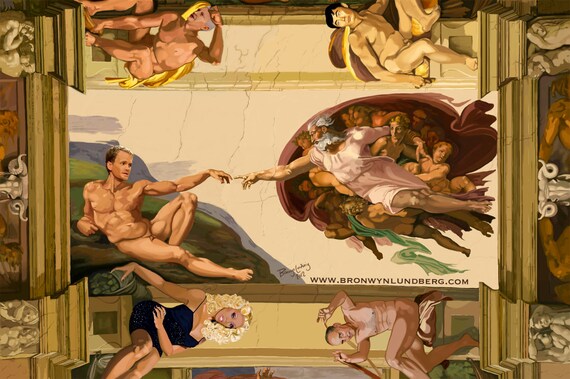
This time, artist Bronwyn Lundberg who recently grabbed headlines for the following piece of art she composed. Yes, ladies and gentlemen. It is indeed The Last Supper and the lovely Ellen DeGeneres in the  infamous Bjork swan dress is indeed the Jesus of the table.

The Lesbian Last Supper by Bronwyn Lundberg

Lundberg, a lesbian artist, upon having a discussion with a friend about how to decorate her bed, came up with the idea of redoing The Last Supper with a lesbian theme. Yeah, I don’t get how she got that idea either…

Needless to say, this piece has ruffled some feathers. Lundberg’s response:

I personally don’t think this is sacrilegious in the least but of course, there are those who would see Lundberg dead for defiling a classic religious piece. Hey, humorless nitwits will always be humorless nitwits, eh? Another Lundberg piece: The Creation of Neil.

The Creation of Neil by Bronwyn Lundberg
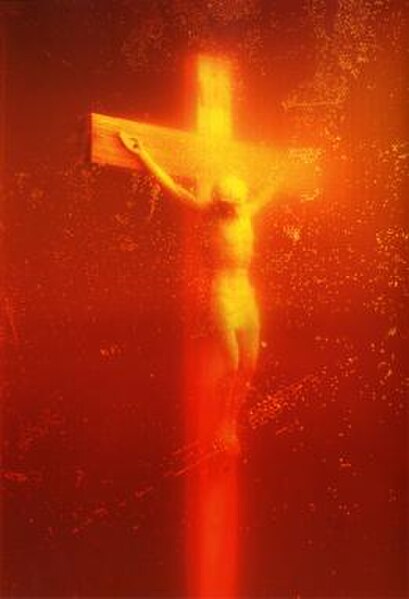
Piss Christ by Andres Serrano

And what’s an article about potentially blasphemous art without Piss Christ, the Andres Serrano photograph of a crucifix submerged in his urine? Here’s a copy for good luck.

When I came across this piece a few years ago (thanks to Wikipedia, I’m sure), I didn’t know how to respond. I’m not Christian yet there was still the shock. A crucifix…? In… pee…?! At the same time, I didn’t really see anything offensive about this picture (read: not Christian). To me, it was clearly Serrano making a statement on what the organized church had become and its values compared to Christ’s values, etc, etc. It was a statement of fact to me. Like a number or a scientific truth I learn in class. It did not strike me as the statement of a (very controversial) opinion, most likely because I shared that opinion, thus making it no longer an opinion but a concrete truth in my eyes.

Is it the same thing again? Am I being cray cray when I think Lundberg’s isn’t offensive in the least? It’s fun. And cute. Ellen as Jesus? Ha ha. It captured my attention for, like, an entire five minutes. I wrote a blog post about it.

Religion + politics + art = volatile beauty

In case you wanna check out Lundberg: here’s the Huffington Post interview with her about the Ellen painting. And here’s the link to her  website.

Peace.

Piss.

Ha ha. Okay. Bye.


Ann Arbor-ing at its Finest

I was in Clarkston. I was in St. George. I was in Las Vegas (airport…).

None of them are quite like Ann Arbor. I live in this weird not-city city where hippies dance outside, maybe-professors play weird instruments on the diag, hipsters angstily smoke through campus, and I model-walk down State St. all while my circle scarf blows in someone else’s face.

But I thrive here. In this magical haven/hell.

I got back from break, unloaded all of my belongings, and then blared Bastille mash-ups while I lit incense, steeped some herbal tea (the one instance my life isn’t caffeinated), and read Hardt’s book on Deleuze. Some people have the gall to tell me that I live a delusional life that once I leave Ann Arbor I will never be able to function in society.

And to them I raise my wedding-ring finger, which in my book is as dirty an insult as it gets.

This city builds people who will run corporations—sure—who will cure cancer—woo-hoo—and who will build really tall buildings—gasp. This city also creates those that will be on Broadway, write the next Howl, and describe this post-postmodern/whateverthehellyouwanttocallit society we live in. It creates people who make culture and those that destroy culture. And thankfully, all so humbly, I hope to leave here creating and critiquing “culture.”

Or ontological variations thereof.

It’s also way more than this. Ann Arbor is an emotional feeling. You can’t deny that pulling off of M-23 and heading your way to Main Street doesn’t bring a certain joy to your heart (a certain burning to your bosom—which is often 3am pizza). It’s the feeling walking across the diag in a herd of people and trying to run one floor down Dennison and almost being late to class. It’s the feeling where I have a community of friends I can turn to and a community of strangers I will just maybe meet.

But let’s not get utopian too fast.

Conceptualizing much on a deep level on any type of plane is still difficult. I still scream to myself on the streets and still see violent acts of racism, sexism, homophobia, classism, ableism, ageism. I feel uncomfortable walking home alone whilst wearing beadazzled short shorts and for good reason—people throw insults like/with objects from cars. And I’m privileged in all ways except for identifying as gay. How would it feel to not have all of this privilege?

Ann Arbor allows for conversation. In some spaces a safe dialogue is all I want and usually get. In classrooms I can actively debate those that I unapologetically oppose. In hookah bars and coffee shops and discotheques I can converse. Above all, Ann Arbor is a place that I can talk to people and usually be heard (even if it is only myself that will ever listen).

My thoughts are “free” here.

But it’s not just about me. There are so many poetry readings to go to where people’s words, if but for an instant, are free to be heard. We have art galleries (UMMA to unknown) that have Monet and have porn folded into paper sculptures—images are free to be seen. We have boom boxes and spoken word and symphony orchestras and jazz combos and acapella where notes are free to be felt.

In the most cliché of ways: Ann Arbor is a place where the cage is semi-loosened. The bars are bent just enough so I can stretch my limbs. And it feels so nice to be home.

Years


It’s difficult to lay a finger on how Bartholomäus Traubeck’s deceivingly simple “Years” manages to be so curiously evocative. The piece, quite essentially, consists of a modified record player that reads slices of wood, translating year ring data into music. Grain and ring density and color and width are converted into piano tones— every slice of wood will, then, produce unique music. There are years and years of history ingrained in any given cross-section, decades, perhaps even centuries. Tree rings reveal an entire chronology of climatic phenomena, of course. But “Years” acknowledges that data and continues outwards; it is a passage of years, a flow of time, the gathering of individual events that become trivialized within the sheer scale of the entirety.

What is interesting about Traubeck’s piece is the relationship between the concrete and the abstract, the input and the output. Reading yearly rings is on the whole fairly objective, and once the translation has been coded, the process is straightforward, transparent. Yet how the sure bts soccer tips.com artist chooses to make the translation is entirely within his control. What qualities in the cross-section will become what qualities in the music? How far, which way? The relationship is arbitrary, up to the artist’s discretion. As a critic succinctly phrases, “the design object is at once material— an interactive sculpture— and immaterial, interpreting an inanimate ‘fossil’ into arguably the most abstract art form,” music.

The finished product is deep, sparse, heavy. There is a certain dignity about it, something in its air that is greater in scale than a record player and a bit of tree. Our ears pick up the sounds, sometimes nearly careful, sometimes discordant when it hits a knot in the wood, and join them into something conceptual, something not physical. We’re reading history, reading time, constructing a tentatively cohesive narrative— only not with our eyes, but through our ears.