Are Great Authors Necessarily Sad?

Today is my birthday!

It’s also Fyodor Dostoyevsky’s (spelling?) birthday, apparently.

I found out that I share a birthday with the Crime and Punishment guy when I ran across this STARTLING image tagged as “Dostoyevsky’s birthday” on my Tumblr feed.

Personally, I’ve never read a Dostoy boy book.

I do have Crime and Punishment sitting on my book shelf, however. It looks nice there.


But the above image / quotation got me thinking: Are people with “large hearts” and “big intelligence” always sad?

That seems needlessly pessimistic on face value but seems maybe somewhat true when you think about how many good ‘sad’ books there are versus how many good ‘happy’ books there are.

But I don’t know. The more I reread the quotation, the more I think it’s just reductive and wrong.

Like, okay, people with big brains inevitably experience pain and suffering, but doesn’t literally everyone inevitably experience pain and suffering? And why must the ‘really great men’ (who are they? I’d like to ask Fyodor) have great sadness on [E]arth? Because they’re sooooo smart, they can’t find a way to be happy?

best football odds and expert soccer predictions best football odds from oddslot today football predictions from the experts

It seems to me that part of being smart is ‘being able to be happy / not being inevitably greatly sad.’

I am annoyed when ‘great men’ seem to ‘get off’ on being despairing.

Despairing is not sweet.

Whence this tie between intellectual merit and pain?


Oh Hey I Live There…

One of the many benefits of being a wolverine is the luxury of wandering into The UGLI to grab some movies that I probably don’t need to be wasting time watching, but I do anyway. Recently I ended up grabbing 30 Minutes Or Less, a movie set in my hometown of Grand Rapids, MI. It came out awhile ago, and I was aware that it was filmed in my hometown, I just never got around to watching it. After watching the movie, which was hilarious might I add and I highly recommend to anyone who likes Aziz Ansari, car chases, and craziness, I completely saw my hometown in a different light.

I left Grand Rapids with vigor and hope for the bigger and the better, but after seeing it with explosions I began to see the beauty of the place I left behind, and I’m still not completely sure if it’s because of the explosions or… Anyway, Grand Rapids became this Hollywood set in my eyes. The cinematic look of its downtown, usually scattered with people and bad drivers, became this place with artistic backdrops and beautifully ancient brick buildings, liveliness, and vibrancy.

I don’t know if it’s what they call homesickness, whatever that is, but I like to think that it’s my mind’s recreation of a place that I began to lose excitement for. A local bar became a strip club, the Family Dollar that I’ve graced countless times became a stakeout scene, a gas station next to my old house became a scene where a decision to rob a bank was made, which all added this feeling of excitement for sure, but also this intriguing construction and dimension that I’ve never held Grand Rapids to have.

Sometimes we see the Hollywood lights or the hustle and bustle of New York City as these creative and thriving locations, but we don’t see the beauty and the aspects of interest within the places we live. It took me eighteen years to see Grand Rapids in a new light, but I can confidently say that I’m from the west side…of Michigan that is.

And if you would like to see the beautiful city of GR from your own humble abode, along with some hilarious moments, check out the trailer for 30 Minutes Or Less!

The Rookie from Compton

Hip-Hop, true to the 21st century entrepreneurial spirit, is constantly searching for the next great artist to contribute to its repertoire. At the moment, all eyes are on a young rapper from Compton, CA by the name of Kendrick Lamar. So much so that Hip-Hop pundits are considering if his recent debut album good kid, m.A.A.d city has placed him presently at the number 1 spot in the game. Kendrick’s first two mixtapes established him as an extremely talented, creative artist focused on more substantial topics than rapping about money and fame. This album expands on that, weaving a dark story of his very personal struggles with adolescence and his hometown. Kendrick’s album shows his J Cole level flow, access to Kanye-quality beats, Odd Future style juvenescence and an intimate transparency only matched by Cudi. good kid, m.A.A.d city, despite being fairly similar in sound, is an extremely comprehensive album from a likeable new rapper.

When producer extraordinaire 9th Wonder came to lecture here two months ago, he was asked to comment on the common assumption that Hip-Hop is dying. He agreed that it is certainly changing, but ensured the audience that Hip-Hop is not dying, nor will never die, so long as there are always new talented artists to keep it alive. He mentioned specifically how Kendrick Lamar is basically shouldering that responsibility by himself at the moment. Kendrick not only matches his creative talents with a worthwhile story, he also has an incredible attitude. On “Backseat Freestyle,” Kendrick articulates his concerns as a 16 year old and then contrasts them with the rest of the record’s lyrics. The hook to “Backseat Freestyle” reads, “All my life I want money and power/Respect my mind or die from lead shower.” Clearly, Kendrick has developed on many different levels in the past nine years. This particular song summarizes his 16 year old mindset- one focused on women and money. He had little practical ambition and was only concerned with material gains.

The subject matter of the rest of the album, however, delves powerfully into Kendrick’s intense struggles with his city, Compton. The title encapsulates his conflicted feelings of isolation; he strays away from the gang violence that all but consumes the city, stopped smoking after a bad experience with laced marijuana and feels as though he would be hated by the majority of his fellow Compton residents. Thus, he is the good kid in this mad city. The acronym m.A.A.d stands for “Me an Angel on Angel Dust,” referring to the laced joint. Almost all of Kendrick’s songs relate to the constant presence of violence, gangs, drugs, alcohol and peer pressure. This is why Kendrick stands out from the Hip-Hop freshmen (Asap Rocky, Meek Mill, etc): his words are undeniably real. Listening to his songs, you cannot help but be impressed by his level of transparency and openness. Kendrick has a message, and its one of a deep struggle. He has spent his life trying to come to terms with the city that raised him, while simultaneously coping with the realization that he does not fit in to the standard role of a Compton teen. The track “good kid” discusses how, despite his inability to enter the gang culture, he is still labeled as a gangbanger and criminal. “Poetic Justice” professes his skills in writing poetry while also acknowledging the commitment necessary to a stable relationship, opposed to just a sexual one he dreamed of at age 16. Each track reveals a new element of Kendrick’s life with which he has been coming to terms in a beautiful and creative way.

The beats on the album do not vary in any largely noticeable ways, but Kendrick does perform some very unique alterations to his voice. There are practically 5 different versions of Kendrick’s voice on the album, which not only validates his prowess as an MC but also enhances the mood of dark insanity prevalent throughout the record. This is supplemented by a strong set of featuring artists, including Dr. Dre (naturally, a fellow Compton rapper), Drake, Mary J Blige, Pharell and Schoolboy Q. Unfortunately, Lady Gaga’s unbelievable chorus to “Bitch, Don’t Kill MY Vibe” was released after the album dropped over a shortened version of the song. Her amazing voice brings the quality of the song to a new dimension, really augmenting the quietly resentful and proud tone of the song. Overall, good kid, m.A.A.d city is a deep, cohesive and strong album that may shock and provoke on the first listen, but will prove to be inspiring and sentimental on the ensuing plays. I highly recommend checking it out.

Favorite songs: Swimming Pools (Drank), m.A.A.d city, Now or Never and Bitch, Don’t Kill My Vibe.


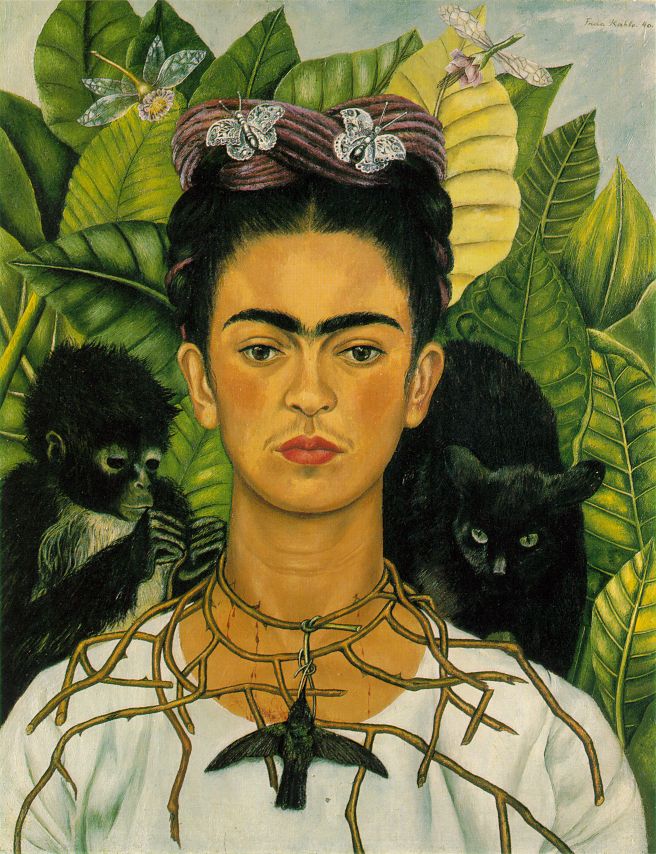
Frida Kahlo, Depression, and Art

Frida Kahlo: one of the loveliest women to have ever existed.

As a woman with severe depression and anxiety and other mental fuck-ery who paints her nightmares, I’ve been inspired by Frida in a way that “normal” people can’t empathize with. Don’t get me wrong, I’m nowhere near as talented, intelligent, or wholly beautiful as Frida is but when I look at her life, I feel hope, rather than pity at the travesty her human experience was.

Created in 1940, it is one of my favorite paintings ever.
Self-Portrait with Thorn Necklace, Hummingbird, and Unibrow, created in 1940

On Halloween, I acted on a recent whim to dress like her and made a thorn necklace and dressed as Frida from her Self-Portrait with Thorn Necklace, Hummingbird, and Unibrow. It’s not only one of my favorite paintings but one of my favorite paintings ever. When I look at this painting, I see myself. I see my blood where the thorns pierce my neck and I see the beauty around me and the sadness in me. An indescribable sensation of relief washes over me as I realize that someone so famous, loved, and even revered has felt the what I have felt and perhaps that is why art itself is so appealing: there is a spiritual and intellectual connection between the audience and the artist and we feel compelled the same way the artist was when they created their work.

I’m reading a book right now called A First Rate Madness: Uncovering Links Between Leadership and Mental Illness. Reading it is like looking at a work by Frida. The description of historical leaders and innovators who have turned their experiences into something creative, beautiful, and brilliant is inspirational to no end; once convinced that my condition was hopeless and my life was futureless, I now dare to think that perhaps not all is lost. And I feel hope. Which is all we ever need, right?

I don’t want to turn this blog post into a corny mush fest, inviting everyone to turn negative experiences into something positive and then give examples of people who have done this in the past. I’ve heard enough of those condescending, douche-bag lectures for several lifetimes. I just want to thank the likes of Frida Kahlo and Van Gogh for showing me that beauty was possible in places of utter ugliness and despair. I want to thank them for not just instilling emotion in me but for understanding me. I want to thank Frida for being so fucking smart and independent and  awesome and providing me with an actual role model: someone who was completely different and okay with that.

ObamArt

Living life is art. This theme should be apparent from my ramblings about staring at walls, going to concerts, and having epiphanies. But some moments in life aren’t just moments, they’re events. When people ask me, as I sit crazily out of my mind as an old retired professor, what you were doing on November 6th, 2012 I will answer: holding my breath, and then I’ll proceed to pass out and die.

Let me preface this with the fact that I’m not one for American politics. Everything about it is problematic, semi-unchangeable, and over-hyped. I say this as I read critique on Foucault, drink heinous amounts of coffee, and listen to indie music my red skinny jeans thrive in—take my word as you may. Strictly speaking, I don’t actively support most of what Obama or Romney had to say but in a loose way I wholeheartedly supported Obama. I support the symbol he is for Americans. I support that he sees other humans as people with “rights,” people who deserve to be “equal.” I support him in that he actively supports people who don’t have millions of dollars or even jobs.

Moments before his reëlection (umlaut because I can) I looked at the top fifty pictures of the Obamas. My friend and I almost burst out into tears caused by their sheer cuteness and adorableness. When my President plays peek-a-boo with a child, my heart stops. I played a mental reel of all he did, all he promised, all he didn’t do, all the things he said he wouldn’t do, all the things that happened in these four years. And when the magnificent Rachel Maddow told us the great news, I realized this was an event I could celebrate.

Grabbing my belongings and hopping on a bus (yes, visiting the friend on north campus) I tried picking a song that could fit this moment (I pick 212 by Azealia Banks for all of my moments, so this time was no different…), and I tried thinking beautiful thoughts to help commemorate it (feeling comfortable in not having to flee to Canada or protest everyday in the bitter cold)—all in all, I wanted to do cliché things. And thus I headed to the Diag.

And then I left the Diag.

And then I headed back to the Diag after finding friends.

This event, this moment of post-reëlection on the Diag was an event, it was art. I felt like I was a piece of metal, a stroke of a brush, a lone light bulb, and upside down urinal.

Let me explain.

No other space on campus has that many smiles. No other space on campus has that much racial “diversity”. No other space on campus has that many people simultaneously and spontaneously dancing. No other space on campus has that much, I have to say it, “hope”. No other space on campus has the feeling of that much accomplishment.  No other space on campus has ever heard the words “Obama” or “four more years” so much. No other space on campus was this space on campus.

When people ask what I did on November 6th, 2012 I won’t respond with: I went to class, I caught up with a friend, I waited in line for an hour, I drank coffee. I will say that I voted for Barack Obama who was then reëlected that same evening and that I had never felt as comfortable as I did in the four years that preceded it. That feeling I had, that was art.

Organic Geometry

Fractals are generally considered highly mathematical, geometrically based structures, computer-generated and precisely constructed. But they are present everywhere, everywhere. These infinitely recurring patterns, in which structures are constructed of smaller versions of themselves, which are in turn constructed of yet smaller versions, are organic. They manifest themselves everywhere, be the scale microscopic or larger than perceivable to the eye.

How? The arrangement of veins on a leaf, for instance, is translatable to the arrangement of the branches’ spacing, which in turn might be translatable to the tree’s growth patterns or range distribution. There is a method in the shapes of waterways, their curvatures, erosion patterns. There is a pattern in the ridges of mountains, in the way lightning forks, in the formation of crystals, of the shapes and proportions of life-forms, for limbs and facial features and the famously cited nautilus shell spiral. The Fibonacci number and golden ratio are not purely isolated, theoretical concepts that exist only as abstracts. They just happen to be the most efficient way for organic forms to grow and propagate, for inorganic ones to form. It’s physics.

Slime molds are another oft-cited example; planted on a map of existing cities, for instance, it will develop optimal paths for nutrient transport—paths that very nearly exactly model actual major roads and highways. Patterns are not restricted to static structures, for in movements (eddies in a rivulet or air current) and behaviors (flocks, swarms) there is also something to be mapped.

Here, Catherine Ulitsky creates geometric networks out of flocks of starlings.

In another instance, photographer Thomas Jackson’s Emergent Behavior series is “inspired by self-organizing, ‘emergent’ systems in nature such as termite best wining today mounds, swarming locusts, schooling fish and flocking birds,” organic systems consisting of individuals but behaving as cohesive entities. This, posits a commentator, “[creates] an uneasy interplay between the natural and the manufactured and the real and the imaginary.”

The forms and shapes and patterns we observe everywhere are not as arbitrary as we are inclined to think. They organize themselves into strikingly orderly arrangements, creating forms that manmade designs might care to imitate.