REVIEW: Benjamin Britten’s War Requiem

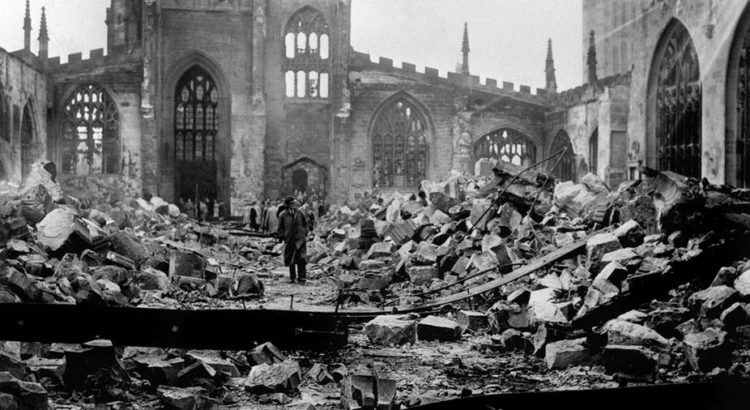
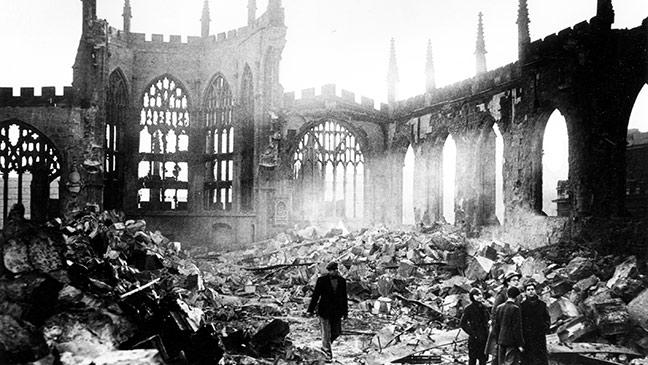
Benjamin Britten’s War Requiem was commissioned for the re-consecration of Britain’s Coventry Cathedral, a beautiful church tragically destroyed in a World War II bombing. Britten himself was a staunch pacifist who had registered as a conscientious objector during the war, and the unique combination of these two elements gave birth to a piece that cuts through the gloss of glorified war stories into the more complex, tragic truth of the raw destruction of war. The text of the 80-minute choral piece is assembled from the Latin Mass for the Dead and the poems of Wilfred Owen, a World War I soldier who was killed just a week before the armistice at the young age of 25. Owen’s poetry is plainly anti-war, and the first of his lines in the piece is the chilling “What passing bells for these who die as cattle?”.


The requiem was presented as the collaboration between the Ann Arbor Symphony Orchestra, the UMS Choral Union, the Ann Arbor Youth Chorale, as well as three vocal soloists. The addition of the children’s chorale as specified by the original work adds a uniquely haunting aspect to the piece, a reminder that war ultimately results in a great deal of innocence lost, and the sacrifice of young lives with full futures ahead. Britten alternates between dissonant chanting mixed with layers of percussion and smooth, lyrical passages as the piece glides from movement to movement. Yet throughout the entire piece, the atmosphere is solemn, almost haunting. Britten refuses to let the audience forget why the piece was conceived, as a response to a tragedy brought about by the senselessness of war. It is impossible to hear the words of Owen echo through the auditorium in the rich tenor of soloist Anthony Dean Griffey without feeling an acute sense of what we have lost to the cruelty of war. Owen himself was a poet who garnered an abundance of post-humous acclaim despite his short career and the few poems he wrote; his career was brought to an abrupt end by a premature death on the battlefield.


Owen is merely one of many young talents, or simply young people, or people in general, whose lives were stolen from them by the merciless combat between sides. War Requiemserves as a haunting reminder that war is not a necessary evil, nor is it one we can afford to distance ourselves from. In the United States, it is perilously easy to turn a blind eye to those suffering from wartime brutality in other countries and in the modern age it is perilously easy to designate war as a “necessary evil”, a tragic yet inevitable byproduct of civilization. Yet as Britten wants us to remember, in a society as advanced as ours, the fact that we have accepted senseless violence over superficial causes as the price of civilization ought to haunt us, and we ought to remember that we have more power over our fates than we like to admit.

REVIEW: If Beale Street Could Talk

If Beale Street Could Talk is a paradox. It is a beautiful movie about ugly realities. It is light enough to take flight and simultaneously weighed down. It should be an ordinary love story of two young people, but it also can’t be because those two people are black. And it is a movie of extraordinary substance, but only sometimes. So, I loved it, but only sometimes.

One of the most significant paradoxes, is how the film can feel incredibly focused and far too broad with its characterization. This is especially true for Tish (KiKi Layne) and Fonny (Stephan Lane), the couple around which the film (and occasionally the camera) revolves. Tish is newly pregnant. Fonny is newly imprisoned. It is a story that feels sadly inevitable. So even as Tish holds out hope for her beloved’s return, we watch with a sense of doom. They are beautiful outlines, walking down the street, hand in hand. Brightly blue and yellow clothing against the concrete sidewalk, you want to follow their silhouettes forever. But that’s all they are. Outlines. They never feel shaded in because so many things, their personalities, their histories, feel like afterthoughts in the narrative. Instead, they are constantly overshadowed by racist, societal forces that refuse to see them as people. And ironically, neither can we.

Though, Barry Jenkins certainly tries. His humanist style is apparent in every shot. When his camera focuses, really focuses, on Tish’s and Fonny’s faces, the lack of explanatory detail is utterly insignificant. Their eyes seem to contain a depth that is voiceless, a meaning that is inexplicable. When the score starts thrumming and the camera sweeps across a brick New York street, the feeling grows until it encompasses everything. Those overwhelming moments don’t by themselves, make the film incredible, but it certainly impresses upon you the importance of every moment. Time slows down, each passing moment agonized over, a memory in movement. For Tish and Fonny, after all, time is of the essence. Separation by prison glass makes every second precious. Seconds before Fonny is led away to a place where even Tish’s love cannot reach. Seconds before their time together is a distant memory.

The film’s greatest accomplishment, though, is forming characters around the Tish and Fonny so their relationship never becomes claustrophobic. In that way, the movie emphasizes familial love as much as romantic much to its advantage. Unlike Tish, her parents have long seen the world as it is. So, their happiness at the imminent birth is both incredibly joyous and a cautious projection. Regina King as Tish’s mom stands unwaveringly in her role, her eyes swimming with hidden vulnerabilities. And as Tish’s father, Coleman Douglas is a pillar of strength, going so far as to sell stolen merchandise to support the increasingly heavy fees for the lawyer. Every moment that the world crumbles, there is a willing hand, reaching out to take on another burden.

A love story above all, If Beale Street Could Talk wanders in a world of color without ever hesitating to explore the dark corners. It is, after all, in the hidden spaces where love blossoms best. In a cramped apartment room where Tish and Fonny finally connect. In a family home, where the celebration for a new member begins with a toast. In these places, there can be no police interference or shady justice systems. In these places, love triumphs.

PREVIEW: Benjamin Britten’s War Requiem

This Saturday, February 16 at 8 pm, the Ann Arbor Symphony Orchestra, UMS Choral Union, and Ann Arbor Youth Chorale will join forces to perform Benjamin Britten’s monumental composition, his War Requiem. The featured soloists will include Tatiana Pavlovskaya, soprano, Anthony Dean Griffey, tenor, and Stephen Powell, baritone.

The work was commissioned for the 1962 re-consecration of Britain’s Coventry Cathedral, which was destroyed in 1940 by a Nazi bomb raid. Composed of six movements, the War Requiem “mixes the Latin words of the Mass for the Dead with poetry of Wilfred Owen, who was killed in action just one week before World War I ended.”

The performance will take place at Hill Auditorium, and it will run for approximately 80 minutes, with no intermission. Tickets may be purchased at ums.org/performance/brittens-war-requiem/ or at the Michigan League Ticket Office.

REVIEW: Complex Rhythms

This past weekend, the School of Music, Theatre and Dance’s Department of Dance staged a fantastic performance entitled Complex Rhythms at the Power Center for the Performing Arts. Featuring four separate works, each had its own unique character and feel.

The performance opened with 7 x 12 and a Little Bit of Cha-Cha, a work by Robin Wilson with a jazzy and joyful, toe-tapping feel. Featuring live music by members of the Grammy-nominated ensemble Straight Ahead, I was immediately taken by the musicians’ position onstage, rather than off to the side. Before the dancers entered the stage, the musicians treated the audience to a jazz feature, solidifying the fact that they were an integral part of the work. Throughout the dancers’ rhythmic choreography, it remained evident that music was intended to play a very central role in 7 x 12 and a Little Bit of Cha-Cha. Additionally, the costume design, with bright colors and swinging skirts, complemented both the choreography and the music.

Next was the premier of Studio A, will you die with me? by Jennifer Harge, “a fire ritual that works to disrupt the anti-black, heteronormative, and capitalist structures that live within the fabric of Western dance studios and dance curriculums.” Featuring a backdrop of rows and rows of lit (electric) candles, ashen-colored costumes, glittering masks, and a long blue piece of fabric spread across the front of the stage, it was a performance that was at once unsettling and challenging, confusing and thought-provoking. Additionally, the soundtrack of the choreography was norm-defying and fascinating – it was an aural hodge podge that was not exclusively music, and for a length of time it was a recording of what seemed to me to be a woman humming singing while washing dishes.

My personal favorite of the evening was Prelude, Fugue, and Riffs, a new work by Bill DeYoung set to a recording of Leonard Bernstein’s “Prelude, Fugue, and Riffs” by the University of Michigan Symphony Band. With a backdrop of lights that resembled a collage of starry night sky and brick wall, the entire performance had a swinging, urban vibe that hearkened back to another era, while simultaneously remaining modern.

Last was probably the most monumental of the evening’s works, Shelter by Jawole Willa Jo Zollar. First staged in 1988 “to address the suffering and isolation of homelessness,” the version performed by the Department of Dance was adapted after Hurricane Katrina “to address the lives of the people that the hurricane left homeless.” It was a powerful performance, featuring spoken word (by Associate Professor Robin Wilson, original company member of Urban Bush Women, who first staged Shelter in 1988) and percussion as accompaniment to the emotive choreography. “I ain’t fled nothing. My country fled me,” Professor Wilson emphatically repeated.

Complex Rhythms explored a wide variety of human emotion and struggle, and it was a boundary-challenging, thought-provoking performance. Congratulations on an excellent performance to all those involved!

PREVIEW: The Ark’s 32nd Annual Storytelling Festival

As a beautiful Ark tradition, The Ark’s Storytelling Festival brings together some of the greatest storytellers for an evening of humor and wit with a touch of heartfelt emotions. This year, the 23rd Annual Storytelling Festival features Laura Simms, Edgar Oliver, and Ivory D. Williams.  Come out to the newly renovated Ark on February 23 at 7:30 PM for some engaging and entertaining stories. Tickets are $25 and can be purchased at MUTO in the League Underground.

REVIEW: 2019 Oscar Nominated Shorts: Animation

The 2019 Oscar Nominated Shorts in the Animation category explore similar themes of family and time, evoking certain emotions over and over again.

Many of the shorts, including Bao and Weekends, were autobiographical. Bao, Disney Pixar’s short released with Incredibles 2 and applauded for its cultural representation, tells the story of a lonely Chinese mother and one of her dumplings when it comes to life as a little dumpling boy. This narrative with animations characteristic of Pixar plays with the idea of parental possessiveness and the need for familial love and attention, taking a harrowing turn at the end that leaves one to wonder the costs of overprotection. Also featuring an Asian-American family is One Small Step, the cleanly-drawn animation about big dreams and realistic achievements. Through the passage of time, Luna must grapple with her dreams of being an astronaut and the obstacles in her way, supported by her single father the entire time. The crisp 3D animation was certainly appealing, turning this “dream-chasing-believe-in-yourself” storyline into something fresh and emotional.

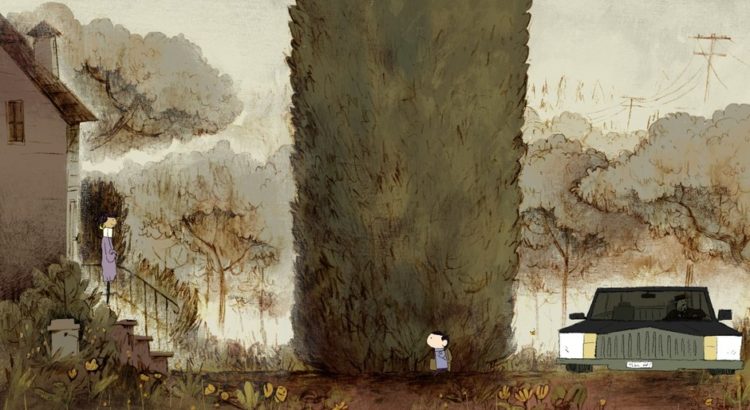
Another short that deals with family is Weekends, a hand-drawn melancholic tale of childhood after a recent divorce. The absence of dialogue brings all the focus onto the universal mood of this film, as a child bounces between homes and lives and relationships evolve as a result, offering a compelling story of a fractured family with purely the art of animation. Late Afternoon looks at the painful issue of memory loss, as Emily, an elderly woman, goes through old memories in order to make sense of the present. Through the use of color, Emily was able to weave through all the different memories, and the flow through time between the present, the subconscious, and the memories. The emotions associated with memory loss was heightened with the use of water throughout the film, washing over her as she searches for clarity.

The last nominee shown, Animal Behaviour, features anthropomorphized animals in a group therapy session. As the most comedic short in the featured films, it is filled with crude animal jokes based on their natural traits until an ape gets going and sets off the dog therapist. The lineup also included two additional selected shorts, Wishing Box and Tweet Tweet. Wishing Box introduced us to a greedy pirate and his hungry monkey companion who come across a box that will give you anything you wish for, while Tweet Tweet gives us the courage to balance on a tightrope as a girl befriends a sparrow who guides her throughout her life.

All the short films used a variety of animation styles, opening my eyes to how diverse animated films can be. From the scratchy and homey feel of the hand-animated Weekends to the colorful, flowy vibe of Late Afternoon to the crisp 2D-on-3D animation of One Small Step, the animation nominees were all both visually appealing and emotionally resonant.