REVIEW: Ice Carving Festival

There are far too few true delights in this world, especially when living in Michigan in the middle of winter. Most things are dead, either outwardly or inwardly. Going gloveless to text a friend back could invite frostbite in minutes, and the threat of entire sunless weeks is omnipresent.

Luckily, we’ve identified one of the handful of things that the cold preserves, rather than kills: ice! Beautiful, wooded County Farm Park was the perfect backdrop for a wintry festival, with a playground for kids, a pavillion for the artists, and a rec building for arts and crafts. The ice carving teams from Washtenaw Community College, Macomb Community College, and the University of Michigan supplied the Ann Arbor area with a Saturday full of joy with their astounding skills. The sun even stayed out for the day, reflecting off the sculptures, glittering off smooth curves and edges.

There seemed to be an animal theme: a giraffe, rabbit, and salamander emerged from three blocks of ice, while U of M also constructed a vintage-style camera.


The audience was mostly families with small children, and the outdoor environment thankfully allowed for a great many adorable dogs to walk amongst the crowd. My girlfriend and I were probably the only childless adults to make pipecleaner snowflakes in the craft room, but we received no criticism, even when mine turned out looking like a deformed spiderweb.

Children below the age of ten did appear to be the festival’s sole target audience, which felt like a bit of a mistake. In future years, they could decide to open it up to older children and childless adults, perhaps with a musical guest or a few local food trucks. There could be a reception that goes later into the evening after the carvings are completed, adding in an element of colorful lights, during which the artists can explain their pieces and process. There is only so much an event with no admission fee can add in, but there is a variety of routes planners could take to expand the festival that involve little cost.

But the place they are at now is wonderful already; they had secured a sponsor (an living community with new apartment buildings opening nearby), which allowed them to serve hot chocolate and popcorn, as well as to supply several crafts.

I am always thankful for free stuff. The sponsor gave out hot chocolate mugs to keep, which is a beautiful thing for any college kid (I, for instance, am the proud owner of exactly two $1 plastic plates from Target). Despite the cold, the day was made infinitely more joyful with a little sweetness, and some cool art.
 

REVIEW: The Painted Face Artistry, Design and Voice in Chinese Opera

This performance was by Li Yang, a member of the National Peking Opera Troupe. Peking Opera is also known as Beijing Opera and is a regional style of traditional Chinese opera. It is said that one good second of Peking Opera requires 10 years of training. This was true of Li Yang who left his home at seven years old to train in an opera school. Since then his whole life has been dedicated to practicing and performing Beijing Opera.

Before the performance began, we heard a history and background of Chinese opera, with an emphasis on Beijing Opera, which was given by Professor David Rolston. It’s a very interesting subject and I encourage you to do some research before watching a Chinese Opera. At least to learn about the main characters that will be performing and a summary of the plot. The face painting is important in Chinese opera because it can be very difficult to understand what is being said, even for native Chinese speakers. So the face paint tells a lot about the character. The color of the face paint is very important: red indicates loyalty, black indicates integrity, purple and pink indicate honesty, white indicates conceit and trickery, yellow indicates an aggressive nature, etc.

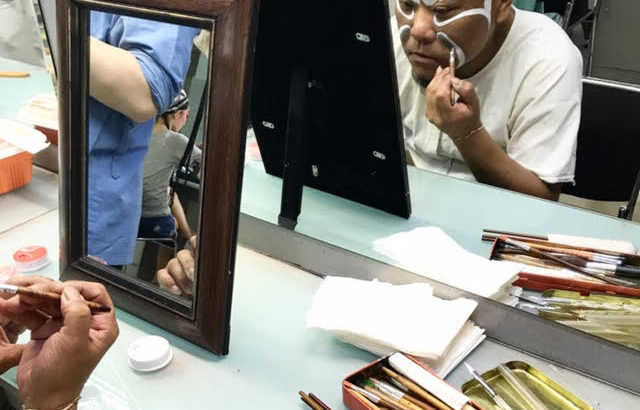
Li Yang performed two different songs for us, each song from a different character and therefore with different face paint.  The first character was Cao Cao which is an evil character from the Romance of the Three Kingdoms, and the second character was Li Kui, from Water Margin,  which is one of the four great classical Chinese novels. He performed each song twice, the first time without any face paint and the second time with the full face paint. Li Yang paints his face himself. Actors in the U.S. don’t do their own makeup, but in Chinese Opera they do because this allows actors to create their own distinguishing features to their face paint.

I actually enjoyed watching Li Yang perform the songs without any face paint more because I could see the expressions on his face more clearly. I thought his facial expressions were comical, especially when he would fully open his eyes and dart around his eyeballs. I really enjoyed watching his movements while he sang which reminded me of Tai-chi.

The songs he performed for us usually have an orchestra accompaniment. Li Yang would mimic the sounds of the orchestra with his voice while he performed. It was very interesting to hear, the best way to describe it is with “tutt tutt tut, putt putt put” sounds.

Afterwards, they had a raffle. I wanted to win the grand prize of getting my face painted by Li Yang, but instead, I got a bottle opener in the shape of a painted face. Which was still nice.

I attached three images below, the first two images are of Cao Cao, the second image is Li Kui.


REVIEW: On the Basis of Sex

The film On the Basis of Sex, a celebration of the life of Supreme Court Justice Ruth Bader Ginsburg, is inspiring, educational and thoroughly enjoyable.

The movie opens with a crowd of what appears to be all men – first year law students – parading in to be addressed by the school’s dean, all to the fitting tune “10,000 Men of Harvard.” Then, in the sea of feet clad in men’s dress shoes, the camera focuses on a high-heeled pair marching in their midst – the feet of Ruth Bader Ginsburg (Felicity Jones), one of only nine women in her Harvard Law School class.

In the dean’s address to the students, he speaks of the students using only male pronouns, and it becomes clear that he does not believe that a woman has any place at Harvard Law School. Then, if there was any doubt in viewers’ minds about this fact, at a supposed welcome dinner for the nine women, the dean asks them to “report who [they] are, and why [they] are occupying a place that could have gone to a man.” To suppressed snickers from the other female students, Ruth Bader Ginsburg reports that her “husband is in the second-year class,” and she is at Harvard “to learn more about his work, so [she] can be a more patient and understanding wife.”

In contrast to this, it becomes apparent throughout the movie that Justice Ginsburg’s marriage to her husband Martin Ginsburg, portrayed by Armie Hammer, was profoundly modern for the time period. He was a tax lawyer, and unconditionally supportive of Ruth Bader Ginsburg’s professional aspirations. In fact, he was the one who found her the court case that would become the climax of the movie.

The court case, which involved Charles Moritz, a man caring for his mother who was denied a caregiver’s tax deduction because he was not female, would ultimately be taken to the Tenth Circuit Court of Appeals. In my opinion, though still enjoyable, the actual courtroom scenes were probably among the movie’s weakest, because the way they were portrayed seemed rather cliché. Ruth Bader Ginsburg stumbled severely during the oral argument, and then appeared to save the case in her rebuttal. In fact, Justice Ginsburg herself recalls that “[she] didn’t stumble at the outset.” However, enthusiasts of United States government and politics will certainly appreciate the numerous references to landmark Supreme Court cases sprinkled throughout the movie (I know I did).

Overall, it’s hard to condense a life into 120 minutes, and in my opinion, On the Basis of Sex did an excellent job. I am personally surprised that the movie only has a 72% rating on Rotten Tomatoes. While it may be true that the film offers a glorified, simplified version of Justice Ginsburg’s earlier years, we are, after all, looking back on history through a lens colored by the knowledge that the film’s heroine would become a leading litigator for gender equality, and then a member of the nation’s highest Court. The movie is not a comprehensive biography, nor do I think it was intended to be one. If the movie leaves the audience more curious than when they came, then in many ways, I think that is a victory.

I, for one, could not stop smiling for at least half the movie (“Is that an answer, Mrs. Ginsburg, or a filibuster?”), and watching On the Basis of Sex has only increased my curiosity and desire to learn more about Supreme Court Justice Ruth Bader Ginsburg.

The film is currently showing at the Michigan Theater.

PREVIEW: Ice Carving Festival

Each brutally cold winter, millions of people across the state of Michigan ask themselves the same question: “Why do I live here?”

But then we remind ourselves of the existence of ice carving festivals, and the frostbite miraculously retreats from our extremities.

Yes, that’s right, this Saturday, February 9th is Washtenaw County’s annual ice carving festival! Come on down to County Farm Park from 12-4 PM and watch students from regional colleges compete for ice carving fame. Admission is free, if you needed more motivation to watch amazing art created before your very eyes.

Additionally, there will be refreshments and crafts for kids (though if we’re being honest, I will also be participating), so bring along the whole family!

Related image

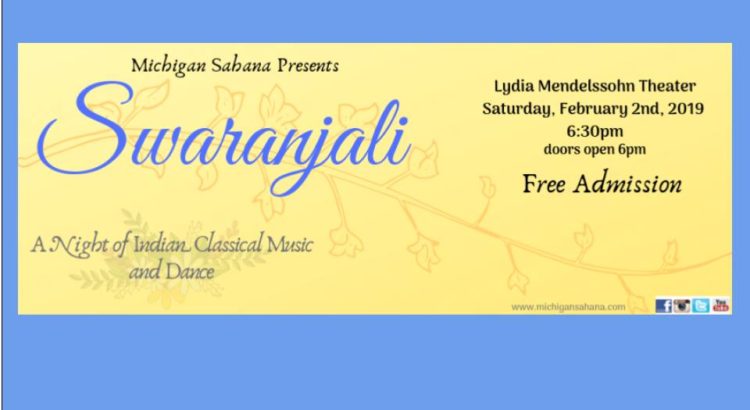
REVIEW: Swaranjali

This year, Swaranjali was a little more limited in scope than it has been in the past – I believe there were fewer performances than I’ve seen in previous years. However, the performances were, as always, of excellent caliber. Every time I attend a Sahana concert, I find something different to consider as I watch the performance. This time, there were two things that struck me.

First, one of the performances was a Kathak piece, Kathak being one of India’s classical dances. About 15 years ago, I used to take lessons in Bharatanatyam, another Indian classical dance. I’ve seen multiple performances of both styles of dance and others before, yet it was only last night that I consciously registered that there is a difference in the way Bharatanatyam and Kathak dancers hold their hands. The way you hold yourself – what I know from partner dancing as ‘frame’ – is incredibly telling about the feel of a dance. I’m amazed it took me this long to see the distinction, but after having realized this, it was interesting to think that to experienced performers, the difference, of course, must be a night-and-day contrast.  And yet Sahana often does performances that blend different styles of music and/or dance, and the way they navigate that blend has never been jarring. I think their performances are stronger for it, and in fact, that was the theme of another dance piece at Swaranjali. This one was first danced in Bharatanatyam, then in Odissi (a third classical dance), and then in a combination of the two. It was incredibly intriguing to see two dancers, each experienced in one style, try the other’s style and manage to put their own spin on it. The performance worked very well, showing that interdisciplinary work often produces the most innovative results.

The second thing that struck me as a result of Swaranjali was the very different air around performances of classical music. In India, classical music seems to flow much more freely between improvisational and structured music. It also seems to have a much more collaborative air (although, not having attended very many jazz concerts, I can’t make an authoritative comparison to jazz). When listening to Indian classical music it always seems like a team effort even if there’s only one person playing at the moment – I think it might come from a general sense on my end that the musicians are all very attuned to each other, and that the music they’re improvising is still stylistically cohesive with the piece they’re playing, both of which I find don’t always happen in other improvisations.

And, of course, there’s a certain joie de vivre about an Indian performance that I’ve never experienced elsewhere. Sahana’s performances always evoke for me that sense of tight-knit belonging, humor, and pride that I feel when I am surrounded by my cultural heritage.