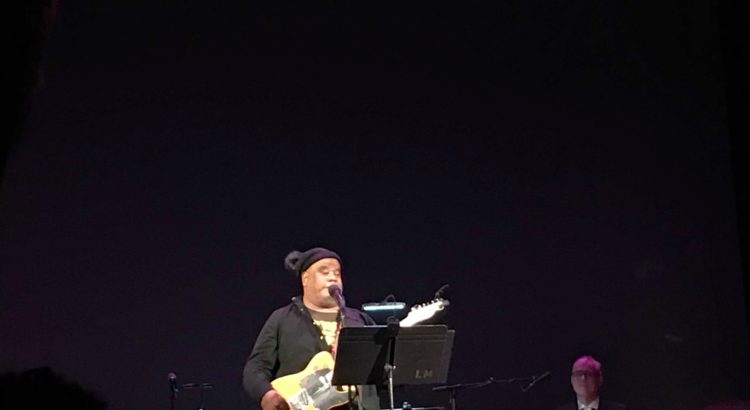
Stew’s poignant prose accompanied by Heidi’s soulful melodies create songs that encourage and make you think all at the same time. It’s not until after many listens do you fully grasp all the references within the lyrics. Notes of a Native Song is an album meant to train its listeners to analyze every situation. Songs within the album are a clarion call for activism. Stew and The Negro Problem’s performance was an illustration of how songs can shine light on social injustice and inspire a generation to take action.
Stew, feeling under the weather, started by lowering our expectations, stating that the current performance could not nearly be as good as the previous night. However, halfway through the opening song, we knew that his disclaimer was not true. Stew and The Negro Problem kicked off the performance just as their studio album does with a song titled Baldwin Country. Baldwin Country gave the audience background information about James Baldwin. Stew used the song as an appetizer to sate the audience’s initial inquiries as to what the album is about and what kind of music they were about to hear for the ensuing hour.
Stew and The Negro Problem artfully lulled the audience during Istanbul. The song acted like a palate cleanser for the ears. Istanbul was followed by the thought-provoking lyrics of Amen Corner and Proof. “Jesus ain’t no match for jazz and these police.” “When the restlessness of Jesus meets the patience of Job.” “Power is so powerful it can’t afford to pay people to speak truth to it.” “Power looking ugly, Power looking mean, but never painting power so that Power’s ever seen.” These two songs have driving melodies and powerful lyrics.
Florida, Stew jested was the only political song on the album. A song in which the band plays a laid-back Californian beat while Stew compares Florida to other states in the Union. Stew suggests that no state is better than another; each state has pros and cons. But quickly follows up with “It doesn’t matter if the weather is great if I gotta wear a bulletproof vest.” The amusing comparisons and harsh criticism of Florida, made Florida my favorite song in the performance.
I was introduced to Stew last year when SMTD performed Passing Strange. The first act is a feast full of political statements and nuggets of truth not often heard aloud. It opened my eyes to musicals that have a motive other than to entertain.
Without force feeding the audience, Stew and The Negro Problem served up a well-balanced performance—one that left me full all the while leaving me to beg for more. The insightful songs and sounds of Stew and The Negro Problem inspired me, and I am thankful they returned to the University of Michigan to once again share their mighty message of a movement.
If you haven’t had the time to see Frozen 2, now’s your chance! With Thanksgiving just barely over, it’s the perfect time to grab some friends and family and enjoy the next adventure of the frozen cast as they plunge into a magical forest on a quest to find the source of a mysterious voice that has been calling Elsa towards the northern reaches of the land. Filled with magic, reindeer, and frozen fun, it’s the perfect movie to celebrate the coming winter.
I’m sure you’ve all seen the trailer by now, but just in case you haven’t, check it out below and purchase tickets at a theater near you.
Nadim Azzam and his crew put on quite a performance at the Ark’s Artist Spotlight last night. Compared to my other experiences at the Ark, I found that this genre of music fell into a more distant category from the general body of work that has been presented before. Althea Grace’s bluesy indie opening set very much felt at home amidst the audience and atmosphere that represents the most beloved elements of the Ark.
What I greatly enjoy about Nadim Azzam is a unique charisma that can be consistently felt throughout his set in the rhymes and rhythms of his music. The personality of his sound comes from the self-evaluated rebelliousness of his teen years, as Azzam says, “Most of my songs are written to myself, a lot of them are about expressing struggle and pain while still trying to be hopeful. They can be about feeling lost while trying to find a way, wanting to become a better person and living up to potential.”
A personal highlight included the presence of a tight-sounding jazzy saxophone in the mix of acoustic qualities and 1950s’-sounding ballad-like presentation. I credit Nadim Azzam for the ambition that is required for such a bold merging of hip-hop, acoustic, and jazz, but I often found the seamed mashing of genres together rather disjointed. While the melodies and striking timbre of the group produced heartfelt sounds, I was generally less than impressed in the level of sophistication present in the group’s sung lyrics. However, the flow that Nadim put forth in his rap lyrics was impressive and seemingly well-rehearsed.
While Althea Grace played the part of a successful opener for Nadim Azzam, I am hoping that she finds herself returning to the Ark as a headliner one day. Her music is light and subtle with an element of mystery that she weaves into a captivating musical narrative.
From humble beginnings, Nadim Azzam began his musical journey upon the discovery of his love for music and vocalization on a wilderness exploration trip. His smooth tone sincerely gels with the music that he aspires to make widespread, as we are seeing his rise to greater appreciation in the ears of listeners, local or otherwise. From playing at the Ann Arbor Summer Festival in 2019 to the upcoming release of his full-length album in 2020, Nadim Azzam does not show any sign of slowing down.
Until death do us part. That’s what most couples promise each other during their wedding vows. It is a statement, both uplifting and bleak. It expresses the hope of a forever while acknowledging that life has no absolute guarantees. Separation is always a possible outcome. But knowing that doesn’t minimize the pain, startlement, and humiliation when you have to say good-bye to the promise of “Always”. Marriage Story is about one of those good-byes. Except for Nicole (Scarlett Johansson) and Charlie (Adam Driver), it can’t be a farewell forever. For, they have a young son to take care of, a family that must be preserved even through divorce. With a star-laden cast and an award-winning director in Noah Baumbach, Marriage Story has all the potential of an incisive and emotional film, perfect to watch during this Thanksgiving break. This film is being shown at the State Theater. Tickets can be bought online or at the box office ($8.50 with a student ID).
Theatre in the round? Kind of. But, like, more than that.
The University Musical Society brought this production of A Midsummer Night’s Dream to the Michigan Theatre as a National Theatre Live streaming on Sunday, November 24.
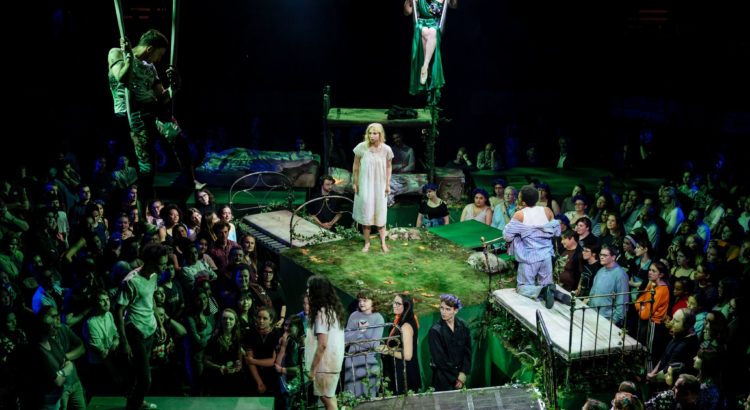
Director Nicholas Hytner’s take on the classic is comical, enchanting, and the most entertaining Shakespeare I have seen performed. During an intermission interview Hytner stated he began work on the play with some very strong ideas. First was the use of silks and aerial performance, as well as modeling the world of Athens after that of Gilead in The Handmaid’s Tale to reinforce the contrast between the repressive culture of the city and the freedom of the forest. The most effective directorial decision made by Hytner was to switch many of Titania and Oberon’s lines, changing the usual plot so that Titania is the one to trick Oberon, instead of the other way around.
In addition to his role as director of this production Hytner is also the co-founder of Bridge Theatre, a new 900-seat performance venue in London designed with a high degree of adaptability. As director he takes great advantage of this unique space to create the magical world of the forest. Production designer Bunny Christie uses this canvas masterfully as platforms are raised, lowered, and shifted through a standing audience to create an immersive and magical world. Beds that signify actual sleeping quarters in Athens return festooned with moss, vines, and leaves to represent the trees and landscape of the forest. The fairies’ domain is made of flying aerial silks which the actors use to great effect, spinning, twisting, and posing to illustrate their prowess in magic and spellcasting.
Photo by Manuel Harlan.
The lighting design of Bruno Poet and sound design of Paul Arditti both work with the scenic design to create a wonderful sense of atmosphere. While the lighting in Athens is stark and monochromatic, it shifts to deep greens and ethereal purples once the story shifts to the forest. Poet also does a great job of creating focus on specific areas. While holding Titania in a spotlight, a burst of light reveals Puck, having sprung up on the opposite platform. Arditti’s well-chosen sound combines with these lighting effects to create an almost tangible magic in the air, reinforcing the omnipresent nature of the mischievous fae. His atmospheric soundscape is near perfect. The best sound atmosphere is one that goes unnoticed. It is felt but never inserts itself into the scene. The low synth chords of Athens and the lilting strings of the forest do just that. They imbue the audience with a feeling that not only fits the words of the playwright but also justify the other design elements.
Photo by Manuel Harlan.
Christina Cunningham’s designs also reinforce the director’s visions. The stark and simplistic grey dresses of the Helena and Hermia in the city, combined with their white head coverings produce a broadly dystopian impression. The plain black suits of Theseus, Egeus, Demetrius, and Lysander are a uniform of masculine power. It is in these elements that Hytner’s inspiration from TheHandmaid’s Tale is most evident. The Rude Mechanicals are costumed in jumpsuits, highly reminiscent of the party uniform of Orwell’s Nineteen Eighty-Four. However, the most striking Athenian costume is Gwendoline Christie’s first as Hippolyta. Her black gown is beautiful in its simplicity and powerful in its monastic silhouette. She is striking, posed as a stark statue in a glass cage, placed there by Theseus. The costumes of the forest characters present a more fun, whimsical image. Puck flits in and out of scenes in patchwork jeans, graphic tank, and colorful armbands. The other fairies have faces painted with glitter and look more like acrobats or fashion models than beings of nature. Oberon, cast by Hytner as a frivolous playboy, is perfectly gorgeous for most of the play in long flowing gold silk robe, often shirtless underneath.
The one pitfall in the costume design is Christie’s green gown as Titania. This dress is emerald green, silky, more than floor-length, and one-shouldered. The asymmetrical floral detail on the bust contributes to a hyper-feminine and soft picture. This picture directly contrasts the headstrong, vengeful Queen that arises with Hytner’s line arrangements. What would make sense in a traditional rendering of Midsummer just doesn’t work here.
The sheer amount of talent, wit, comedy, and spectacle in this show had me thinking back to it constantly. It made me glad to have seen it and glad to be studying theatre. If there’s one major objection I have, it’s that there’s almost too many ideas in this production. The audience participation and reaction is a riot to watch, the aerial work is amazing, the acting top-notch, and the designs gorgeous. But I at times felt lost in the concept of it. While likening Athens to the theocracy of Gilead creates a striking stage picture, the extremely heavy real-world consequences of that dystopia doesn’t seem to fit in the comedic, self-aware romp of the rest of the production. The aerial acrobatics are well-integrated until Gwendoline Christie spends her time as Titania just sitting on a silk, buckled in, drawing attention to the fact that she is not an aerial artist. The comedy is refreshing until the Rude Mechanicals’ performance near the end is so drawn out that people are checking their watches.
But don’t get me wrong- this is a fantastic production. I haven’t read Midsummer for years and my memory of the plot was fuzzy, so this was a refreshing dip back into the story. And there’s so much more I could write about. Before this my favorite Shakespeare play was Twelfth Night, but Puck may have just bewitched me into changing my mind.
Not everyone gets a chance to look back. Most of the time, life moves too quickly or too erratically. To properly track its irregular movements, to be able to tie the story of a life into a neat bundle, is usually an impossible task. But film demands the impossible. In Pain and Glory, Salvador Mallo, a once-fiery film director, has not attempted the impossible in some time. Tired out by the many professional and personal mistakes, weighed down by pain, he is at a standstill. Recounting the life of this brilliant and flawed man is another brilliant and flawed man, director Pedro Almodóvar. Almodóvar is responsible for such artistic masterpieces as The Skin I Live In. This newest endeavor, Pain and Glory, is once again a hit among critics. However, it is also a far more personal story than Almodóvar has ever written. If you want to experience the impossible and truly take a look at a life in full, Pain and Glory is currently showing at the State Theatre. Tickets can be bought online or at the box office ($8.50 with a student ID).