
REVIEW: Water by the Spoonful

SMTD’s production of Water by the Spoonful does not deal with light subjects. The play follows a family coping with death, a chatroom for recovering drug addicts, and the way these two groups intersect. Another key point is how Elliot, the son of the deceased Ginny, copes with PTSD resulting from his time spent in Iraq. Though the play finds itself confronting all these difficult situations, it leaves audiences with hope and a heightened sense of one’s priorities.


This was my first time at the Arthur Miller Theater. I found its layout really interesting, especially in the context of Water by the Spoonful. The theater is square with the stage at the center. Only a few rows of seats radiate from each of the three exposed sides, both on the ground level and balcony. The performance feels so immediate and three-dimensional when viewed in this way; I could see the smallest changes in an actor’s face, feel the movement of a fight scene, and watch the water fall as it is poured on the stage by the spoonful. When a sizable portion of the dialogue takes place in a chatroom, four different locations need to be created. By angling certain rooms towards different sections of the audience, the staging created this dual sense of dislocation and togetherness in a really interesting and effective way. The section of the stage farther back by the wings was also used in conjunction with an elevated balcony and the central space to explore some of the collage-like overlapping sections of the work. As characters inhabit all three spaces with various lines and music weaving in and out of the scene, the different spatial contexts allowed a type of visual overlapping to coincide with the aural and theatrical pastiches going on.


The use of space was intriguing in this work, but what is space if not filled with characters and lines and interaction? The performances in Water by the Spoonful gave life to a plethora of diverse and complex characters. Notable performances include Alyxandra Ciale Charfauros and Vincent Ford as Orangutan and Chutes&Ladders, respectively, as the two bring a realness to their characters that becomes amplified in their back-and-forth conversations. Kyle Prue’s performance as Fountainhead, a man with an addiction who can’t quite face his reality, was also one that I found highly immersive.


Ultimately, I found Water by the Spoonful to be a great performance. The material was used in really thoughtful ways in terms of both direction and performance, and I look forward to trekking to North Campus again to see more work in the Arthur Miller theater.
REVIEW: Teaċ Daṁsa Loch na hEala (Swan Lake)

This weekend I saw the most interesting interpretation of Swan Lake I could have imagined. It was put on by a traveling group of performers, why have been touring with this show since 2016, and have won several awards, both for their production and choreography. The music is described as “Nordic and Irish traditional music with minimalist and experimental influences”. So, I expected maybe a little bit of deviation from the normal storyline of Swan Lake. However, when I walked into the theater, there was a man on stage, wearing a cloth diaper, attached to a cinder block by a rope around his neck, bleating like a goat. Immediately I knew this was not going to be anything like what I had expected, and I was certainly correct. Although there was a lot of symbolism and parts of the performance I did not understand, I definitely enjoyed it more than I thought I would.

The story is narrated by an older man, who acted as both characters in the show, as well as sound effects for different elements of scenes. This man was incredibly talented, playing two people with completely unique voices in one conversation, voicing a radio that was changing channels, and being the sounds of a police vehicle, to name a few of the noises he imitated. His talent almost made you forget you had seen him practically naked and making animal noises at the beginning of the performance. Throughout the show, he tells the story of a younger man and his struggles of depression while living on a moor in Ireland.

The story was sometimes beautiful, and sometimes quite unnerving, which certainly made for a lasting impression. One of these scenes was a birthday party which was held for the depressed young man, and the people who showed up clearly were meant to be disturbed or off-putting in some way. They danced around in a halting jumble of bodies and noises while the young man’s caretaker, his grandmother, cackled into a microphone. She was also holding a cake, which several of the party attendees attacked and grabbed chunks of with their hands, shoving it into their mouths with reckless abandonment. By the end of the scene, they had all preyed upon or overwhelmed each other, and the dance ended with them all motionless, lying on the stage. The emotion of the scene was interestingly unreachable; as an audience member, I was unsure of whether I was supposed to feel pity for this party of strange beings, or whether they were enjoying themselves, and had given into carnal desires by the end. I couldn’t tell if it was actually the party that seemed to be unenjoyable, or it was the young man’s depressed interpretation of the scene. It was entirely disconcerting to be unsure of how to react to what was happening in front of me, and these conflicting emotions stayed with me until the end of the show, where I was still wondering what to make of this haunting scene.

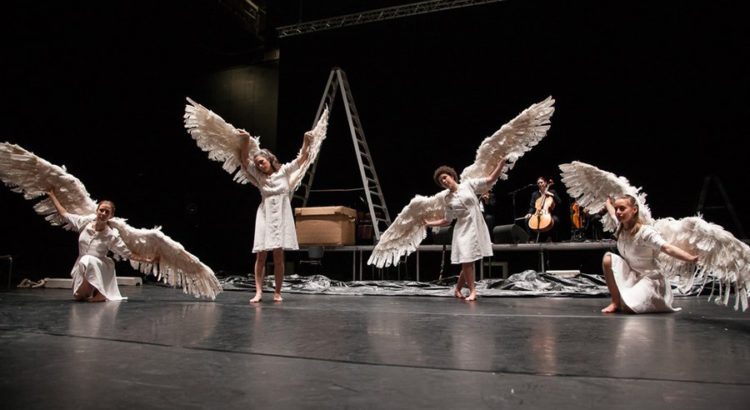
In contrast to some of the more interesting sequences, there were some beautiful dances that mesmerized me. When the young man goes to commit suicide, he is stopped by a young woman in white with angel wings, and they are joined by others in the same outfit. They danced together, in a mix of lyrical and fluid styles. The way the women in white whirled around the young man, almost touching him but not quite, was a display of the immense work they had put into the dance as it was impossible to look away from their ducking and weaving around each other, so close but not quite touching. The ending of the show was definitely the most impressive part, as the different dancers helped to spread small white feathers all over the stage. There must have been pounds of feathers drifting all over, as they threw them up into the air, swirled them around themselves, and even brushed them into the audience. It was amazing how much it looked like it was snowing, and it was even cooler how the dancers’ individual movements were all it took to push the feathers into the sky.

Although the dancing was the focus of the show, the music was by far my favorite part. A small group at the back of the stage played mostly string instruments, sang, and certainly set the mood of each dance. The music was haunting, and soothing, and graceful, all with an undertone of Irish melody. It certainly was a key ingredient in making this show spectacular.

At the end, I wasn’t sure what exactly I had just experienced, but I knew I enjoyed it. I spent the rest of the evening thinking about the show, and what different dances or parts might have meant. I think that is the mark of a good performance- one that makes you think about it long after exiting the theater.

PREVIEW: Flying DOWN to RIO with P.O.R.K.

Sundays are all too often reserved for the results of a week of steady procrastination. Or perhaps various responsibilities have tugged you every which way and through the mud despite constant work. The end of the week turns from an intended relaxation day to a horror-filled scramble to finish everything at once. We must fight this international tragedy, by starting to save time for ourselves to self-educate in the matters of the heart and spirit.

And so I invite you to join me at the Zal Gaz Grotto Club (2070 W Stadium Blvd) at 4pm on Sunday, November 17 for an evening of old-time jazz and film. We’ll be “Flying DOWN to RIO with P.O.R.K.,” in which Phil Ogilvie’s Rhythm Kings (P.O.R.K.) will be playing all the songs from the hit 1933 musical adventure comedy Flying Down to Rio after its screening. The cover is $10.

They say 1930s dress is encouraged, though not required, but I will be deeply hurt if I’m the only one in full costume, so I had better see some other participants in there.


REVIEW: Water by the Spoonful

SMTD’s production of Water by the Spoonful soared beyond all expectations; it went beyond a simple examination of addiction, familial dysfunction, and the human burdens accompanying both, and instead quivered in an unwavering state of compassion, warming my heart in counterbalance. Quiara Alegría Hudes’ Pulitzer Prize-winning play proved to be as patiently restorative as the the metaphor in which its name is based upon – the title refers to a method of hydrating sick children, in which the caretaker must sustain the child with spoonful-sized dosages of water, spaced five minutes apart. If improperly executed, the results can be devastating; Hudes’ work carries an undercurrent of this metaphor throughout. The characters in the plot, be they recovering addicts, mourners, or both, must likewise learn to sustain their individual burdens within life’s fragile constraints, while recognizing the healing properties of interpersonal support and forgiveness.

I perceived the play to be pretty nonlinear; it was only after Yazmin’s monologue about the necessity of ‘dissonance’ that the scenes and characters gradually unveiled themselves to be far more interconnected than their initial, disparate origins. Indeed, the concept of dissonance through Yazmin’s terms clarified my understanding of the play; on the surface, the eccentric crack-addicts interacting within the support chatroom, Ginny’s death, and her two very different mourning relatives seemed dissonant, like chess pieces moving in no relation to one another. Yet it was about halfway through that I conceived of more than just a community death connecting each character’s stories. Rather, the addicts and the Ortiz family are practically interwoven, not only in narrative but also resolved in the sense of universal yearning, grief, and overall, a collective search for harmony.

“Dissonance is still a gateway to resolution.” – Quiara Alegría Hudes, Water by the Spoonful

Beyond the heartwarming characters and SMTD’s moving portrayals of them, I particularly enjoyed the production’s sound and set designs and the little details included in such that effectively highlighted the pure human emotionality running through the piece. Though Hudes writes Water by the Spoonful with dissonance and John Coltrane’s uninhibited jazz music in mind, the sound designers working on this production incorporated these musical concepts especially well in the play’s most emotionally charged moments – like Odessa’s overdose and the abrupt endings of multiple chatroom arguments. In addition, the set designers managed to transform the space from scene-to-scene into vastly different simulated environments, through multiple wheeled components, which I thought was consistently convincing and effective. After all, how does one spatially represent the cyberspace and how people would interact within a “chatroom”?

SMTD’s Water by the Spoonful will be on show at the Arthur Miller Theatre until November 17; I highly recommend going if you have the chance!

PREVIEW: Vivaldi’s Four Seasons / Max Richter’s Vivaldi Recomposed

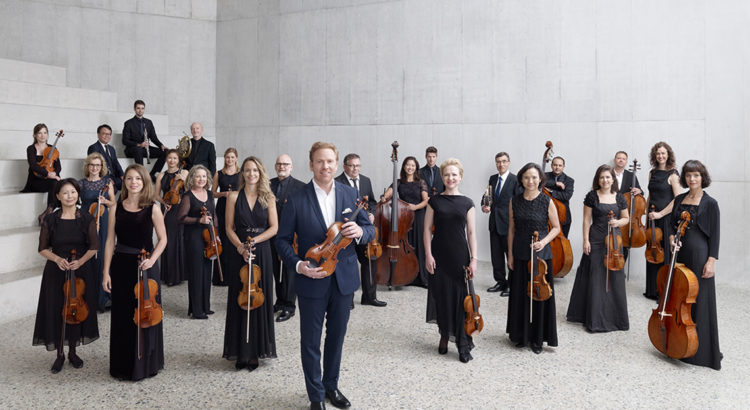
On Saturday, November 16, join the Zurich Chamber Orchestra for a performance of  Max Richter’s Vivaldi Recomposed, as well as the piece that inspired his composition, Antonio Vivaldi’s famous set of violin concerti The Four Seasons. Both of the pieces are iconic in their own right: The Four Seasons is the best known of Vivaldi’s works, and Max Richter’s Vivaldi Recomposed topped classical music charts in 22 countries when it was released in 2012.

The concert will take place at 8 pm at Hill Auditorium (note that the performance was originally scheduled to be at Rackham Auditorium, but was moved “due to extraordinary demand”). Tickets may be purchased online or at the Michigan League Ticket Office.

REVIEW: La Bohème

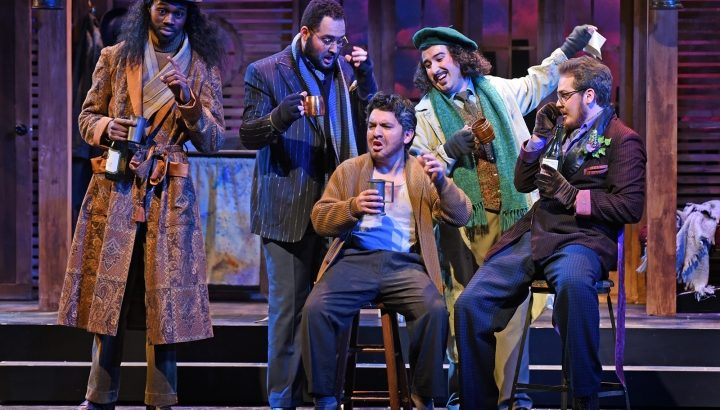
The School of Music, Theatre & Dance’s production of the opera La Bohème was certainly a treat. Featuring the University Opera Theatre and the University Symphony Orchestra, it was a chance to go to the opera without leaving campus!

Though La Bohème was first performed in 1896 (the music is by composer Giacomo Puccini, and the libretto, or words, is by Giuseppe Giacosa and Luigi Illica), this performance was set in the post-war era. This allowed for more modern costuming and set design, and in my opinion, it also made the entire storyline seem more relatable, as the characters were not in the distant past. The addition of English captions over the stage was also a welcome addition, since the entire opera is in Italian (which, unfortunately, I am not fluent in).

If you know the musical Rent, the plot of La Bohème will be familiar, as the musical is a modern adaptation of the opera. However, though the storyline contains themes of youth, romance, poverty, and realities of the “Bohemian” existence, the plot seemed rather underdeveloped to me. In particular, the ending seemed abrupt, and I would have liked more closure (though perhaps this serves to further the opera’s themes).

That said, the simplicity of the plot allows the opera’s music to shine through. The University Symphony Orchestra performed the score spectacularly, and the leads and the chorus were also wonderful. I enjoyed the fact that the design of the Power Center allows the orchestra to be largely visible, rather than hidden under the stage. Sometimes, however, this was to my detriment, as I was watching the orchestra and listening to the music rather than watching the on-stage action and reading the captions!

In the area of set design, the opera production was also stunning. There was a short intermission between each of the opera’s four acts to allow time for elaborate set changes, and they were certainly worth the wait. I can only imagine the time and effort that goes into designing and constructing the sets. My personal favorite was the set for Act II, which took place in Paris’s Latin Quarter on Christmas Eve. Featuring a nearly full-scale two-story building façade, streetlamps, and Christmas wreaths and garlands, it was a work of art. On a separate note, this scene also featured members of the University of Michigan Marching Band, as well as the Ann Arbor Youth Chorale! I also enjoyed the set for Act III, which featured falling snow and a moving train.

The School of Music, Theatre & Dance’s production of La Bohème was an excellent opportunity to see a high-quality performance right here in Ann Arbor, and I am glad that I had the chance to attend!