
REVIEW: London Philharmonic

Photos are provided by Peter Smith Photography

On October 18th, the London Philharmonic returned to Hill Auditorium after 13 years. The concert was especially thrilling for me, as it was my first time experiencing the London Philharmonic live. The repertoire, performed in order, included Britten’s Sinfonia de Requiem, Shostakovich’s Violin Concerto No. 1 in a minor, Tania León’s Raíces (Origins), and Sibelius’s Symphony No. 5 in E-flat Major.

I found it unusual that they chose to open with a requiem, given the somber, darker tones typically associated with such works. Yet Britten’s piece turned out to be grand in its own right, and I was surprised by how much I enjoyed listening to it. The quality of the music drew me in immediately, largely due to Edward Gardner’s conducting—I found my eyes fixed on him from the very beginning.

I consider the conductor to be the heart of an ensemble: the musicians move and breathe to the beat of the baton, and the phrasing of each lyrical line relies on the tiniest of gestures. A captivating conductor is vital to the quality of an orchestra’s performance, and Gardner’s skills truly shone, especially when every instrument joined in a musical passage. The contrasting dynamics filled the auditorium with a depth of sound that made me feel one with the Sinfonia de Requiem, despite being in the audience. 

Although I had never heard Shostakovich’s first violin concerto before, the eerie dissonant intervals and unsettling lack of vibrato in the opening unmistakably evoked his distinctive melancholic style. Once the second movement began, the intensity of the piece immediately shifted my attention to violin soloist Patricia Kopatchinskaja. The clean harmonics and intonation of her double stops were breathtaking. Furthermore, she preserved Shostakovich’s voice by weaving between the lack of vibrato characteristic of the first movement and the vibrato that expressed her own musicality.

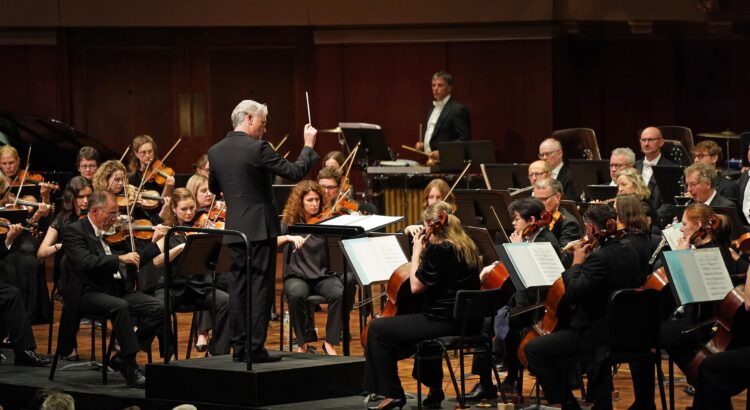
London Philharmonic Orchestra performing with Edward Gardner and Patricia Kopatchinskaja in Hill Auditorium, October 18, 2024.

Like the preceding pieces, the introduction of Raíces was quieter and calm. What made it stand out from the rest of the program was the lively beat that picked up in the latter half; in this section, the woodwinds and brass melodies particularly shone, establishing themselves as the main characters of the piece.

Sibelius’s fifth symphony continued the trend of opening with a peaceful first movement, which made me hopeful for a triumphant ending to conclude the night. Instead of achieving an impactful ending by increasing the tempo, the last movement made its mark through the layering of instruments. The full volume of the brass rang beautifully through the hall, yet I could still hear the violins complimenting them with a gorgeous melody rich in luscious notes. The concluding measures were also unexpected; rather than maintaining that full sound, they transitioned into a series of single note chords played by the whole orchestra.

However, I must confess that for me the highlight of the concert was actually the encore: Variation IX, Adagio “Nimrod,” from Edward Elgar’s Enigma Variations. It was another calm piece, but rather than a somber sound, it featured sweet tones and a yearning melody that lingered with me long after the performance. It provided a perfect change of pace accompanied by a bittersweet emotion that proved to be more memorable than a loud and exciting ending.
REVIEW: Twelfth Night

Photos are provided by Peter Smith Photography

From October 10 to 13, the School of Music, Theatre, & Dance presented a musical adaptation of William Shakespeare’s Twelfth Night. The witty script combined with the students’ incredible singing and dancing made it such an enjoyable experience that I ended up watching it twice. 

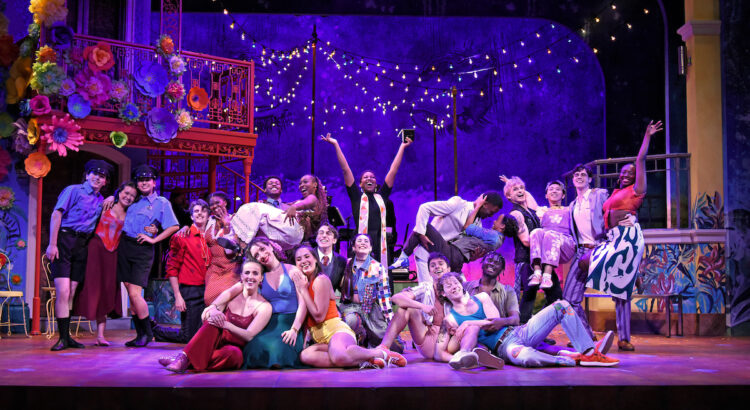
The performance took place in the Lydia Mendelssohn Theatre, which although a little small, is actually my favorite venue for musicals. The charming, comfortable velvet seats and the excellent acoustics ensure that every line and lyric is crystal clear. The actors also make creative use of the entire space by entering and exiting through aisles and side doors instead of always walking backstage, and this added interaction with the audience made the show feel all the more immersive. The set design for Illyria, a mythical city surrounded by water, was stunning: the intricate details of the staircase, balcony, and guardrails added realism, while the bright colors and decorations created a whimsical atmosphere.

The first musical number that stood out to me was “If You Were My Beloved,” performed by Viola, Olivia, and Orsino. Viola’s youthful, endearing voice accidentally captures Olivia’s heart, embodying the innocence and purity of the kind of love Olivia has been longing for. Olivia’s bright and powerful voice conveys the excitement of newfound love, radiating optimism and hope for her future romantic pursuits. Lastly, Orsino’s deep, charismatic voice reflects the depth of his persistent and long-held admiration for Olivia. Despite their conflicting interests while singing these lyrics, the trio harmonizes beautifully, hinting at the tangled and humorous love triangle filled with misunderstandings and unexpected twists.

Another memorable number was “Is This Not Love?” Feste’s soulful tone beautifully captured the yearning and frustration that come with being in love. This exasperation was further amplified through the choreography where Viola and Orsino would reach out for each other without ever fully connecting, underscoring the emotional distance between them. A particularly powerful moment featured Orsino spinning Viola in the air; despite their physical closeness, their emotions remained unspoken.

Funnily enough, it was “Count Malvolio” that left the deepest impression on me. I loved the playful costumes of the backup dancers that mirrored Malvolio’s outfit, and their addition allowed for a grand choreography filled with silly gestures that perfectly captured Malvolio’s ambitious dream of becoming a count. With its humorous lyrics and catchy chorus, I found myself singing it for days afterward.

Overall, each musical number was a joy to experience, and I left the theater excited to listen to them again. However, I found myself disappointed with the recordings I found online, since they lacked the vibrancy and emotional depth that made the live performances so special.

Watching the show from two different perspectives—the main floor the first time and the balcony the second—provided me with more ways to experience the performance. From the balcony, I could appreciate the full scope of the choreography, from the various formations to the synchronization. On the main floor, however, the experience felt more cinematic; the singing was more immersive and the actors’ facial expressions brought the romantic tension and developments to life. Honestly, if given the opportunity, I would happily go back to watch the musical a third time and re-experience the beauty of Illyria once more with SMTD.


REVIEW: Spy x Family Code: White

Spy x Family is one of my favorite anime, so I was super excited when I heard there’s a movie, especially since the end of the last season felt incomplete. Spy x Family is a comedy anime that follows the daily life of the Forger family. As the agency’s most talented spy, Loid Forger is tasked with Operation Strix: a high-risk mission that requires him to form a fake family to maintain world peace. He marries Yor Forger, unknowing that she’s a top-tier assassin, and adopts Anya Forger, a telepath.

In the new movie, Spy x Family Code: White, Loid is told by his superior that mission Operation Strix is to be transferred to a new agent, meaning that the Forger family is no longer needed. To stay in charge of Operation Strix, Loid must prove that he and his fake family are the most fitting for the role. The movie isn’t written by the author of Spy x Family, Tatsuya Endo; I didn’t know this beforehand, but it became obvious halfway through. While Loid and Yor didn’t seem any different, Anya’s shift in personality is what gave it away. I think the out-of-characterness was a tool to be more humorous but at some times it was too much. To be completely honest, it lacked the same charm the anime has in terms of storytelling and plot. The creators did a good job setting it up in the beginning, but in the homestretch, it became rushed and had some unexpected (not necessarily in a good way) twists.

It’s possible to watch the movie without having seen the anime, but it would help. I’d recommend watching the anime over watching the movie, which feels more like a fun addition rather than an essential story. I still had a lot of fun watching it though

REVIEW: A Little Night Music

A Little Night Music, based off of the movie Smiles of a Summer Night, was an exciting and jaw-dropping musical full of plot twists and shocking revelations that uses humor, song, and dance to portray infidelity as a romantic comedy. Set in 1900 Sweden, the story revolves around a messy love web between a lawyer, Fredrik Egerman; Fredrik’s wife, Anne; a famous traveling actress, Desirée Armfeldt; Desirée’s lover, Count Carl-Magnus Malcom; and the Count’s wife, Charlotte.

The drama between the characters shows the darker side of romance in a sarcastically endearing way. The men are ungrateful towards their partners but down bad for Desirée, which is what generates the jealousy that pushes the plot forward in unexpected ways. The entire time I was on the edge of my seat, uncertain where the story was taking me. The ending was bizarre yet satisfying: happy yet bittersweet. Afterwards, I had a lot of fun talking to my friend about all of the twists and turns in A Little Night Music, which for me is what set it apart from the other musicals I’ve watched. It was a story completely different from what I expected when reading the description of the plot online.

The students really brought this show to life; their voices perfectly replicated the classic European noble accent. The wardrobe was gorgeous, particularly Desirée’s deep red dress and Charlotte’s dark blue dress, a contrast that hints at their differences and heavy animosity. I was also very impressed by the live playing of the cello and piano on stage, as it was my first time seeing instruments played on stage by the actors and not by the musicians in the pit orchestra. Especially the student who portrayed Fredrik’s son, Henrik, who played the cello with a very good tone and vibrato. 

My favorite song would be “Send in the Clowns,” sung by Desirée as she discovers that love doesn’t always go as predicted. The lyrics were relatable and the emotion in her voice mirrors lots of the experiences people face in romance today. This is the last musical I’ll see this semester and was a fun one to review. If you’re looking for something to betray your expectations, then A Little Night Music is for you!

REVIEW: Tales from the Realm of Pops

This semester’s Michigan Pops Orchestra concert, Tales from the Realm of Pops, has been my favorite concert of the past six I’ve attended. The theme this semester was fairytale and fantasy, and the repertoire was full of my personal favorites that are both famous in the classical world and familiar with most audiences: from Prokofiev’s Romeo and Juliet to The Legend of Zelda to Sleeping Beauty, the orchestra certainly took us on a magic carpet ride.

The first piece to capture my heart was Tchaikovsky’s notoriously hard Violin Concerto in D Major, Op. 35, performed by this year’s High School Concerto Competition winner Minji Kim, a Junior studying at Skyline High School. The past three High School Concerto Competition winners have all been violinists, but she’s left the biggest impression on me so far. The first movement of Tchaikovsky’s violin concerto, the Allegretto, features intense lyrical runs up and down the violin, which Minji nailed each time. What impressed me the most were her double stops. Double stops mean two notes are being played at the same; this requires the bow to be completely evenly balanced on the strings while the fingers are to be a precise distance apart. It’s very easy to be out of tune when playing double stops, especially while shifting, but Minji made it sound incredibly easy with her crystal-clear tone and perfect intonation. This was my first time listening to this concerto live, and it couldn’t have been any better.

Right after came one of the unarguably best orchestral works to ever exist: Scheherazade, Op. 35 by Nikolai Rimsky-Korsakov. Pops played the third movement, The Young Prince and the Young PrincessJust like the title suggests, it’s an incredibly romantic movement that passes the melody between the strings and winds, as if they were lovers conversing. The lyrical line evokes so many feelings, such as yearning and passion before turning into playful flirting when the tempo picks up. I highly recommend listening to all of Scheherazade. It’s truly a piece that shows music can weave a colorful story and brings out the violin’s full potential during the many concertmaster solos, which Katie Zhao did an amazing job of.

I’m so glad I got to attend this concert despite being busy with finals and the coming end of the semester. It whisked me away from my stress and worries and was the best refuge I could get. I’m now all the more excited to come back to another Michigan Pops concert next year, and I wonder if they’ll be able to top this semester’s amazing collection.

REVIEW: Dr. Seuss’ The Grinch

I loved Dr. Seuss’s books growing up but never watched the movies, so to celebrate the end of the semester and the coming of Christmas, I watched The Grinch at the Michigan Theater on Sunday, December 10th. I haven’t watched any of the previous adaptations, but they seem pretty different. The first version, How the Grinch Stole Christmas!, came out in 1966 as a cartoon that’s 30 minutes long. The second version, also titled How the Grinch Stole Christmas, came out in 2000 as a live-action that’s 1 hour and 55 minutes long. The most recent one is what played at the theater: the 2018 animation that’s 1 hour and 30 minutes long, which is simply titled The Grinch.

This version is essentially the Grinch’s origin story and the audience gets to learn who the Grinch is as a person rather than a thief. The best part is we get to see his relationship with his dog Max, who is youthful and energetic in the film but old and weary in the book. Another character they redesigned was Cindy-Lou Who, the little girl who catches the Grinch in the middle of his act. In the book, she was less than two and only on a page or so; in the movie, she’s much older and one of the main characters.

The animation was fun and very fitting for a children’s Christmas movie. The palette was bright and the characters were cute, even the Grinch. I enjoyed hearing the narrator’s lines and rhymes because they added more of the book elements too. His voice surprised me though because he sounded relatively young when I was expecting an old man reminiscent of Santa, which I wish they went with instead. Because I knew the plot beforehand, it felt like a very long movie and some parts were dragging on, but I enjoyed it overall and would rewatch it again once it’s closer to Christmas.