REVIEW: Monos

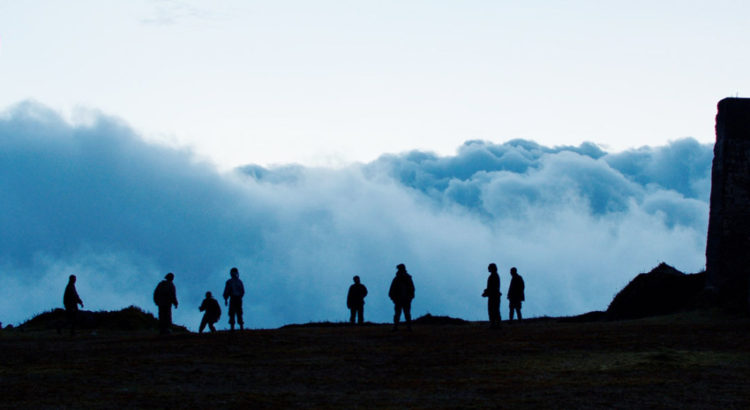
Monos begins high above the rest of the world. So high, that one can watch the fluffy tops of clouds as they meander across the sky. So high, that trouble seems a distant, unthinkable thing. But trouble finds its way everywhere eventually. It will hunt you down with relentless feet and unbounded strength. For the eight teenaged soldiers stationed atop a Columbian mountain, trouble comes in the form of a dairy cow. Or maybe that is an oversimplification. Maybe trouble was always there, awaiting an opportunity to rear its bloody head. Because these are isolated teenagers, orphans really, conscripted into a war they don’t fully understand. The tragedy is that for this group, peace was never truly an option.
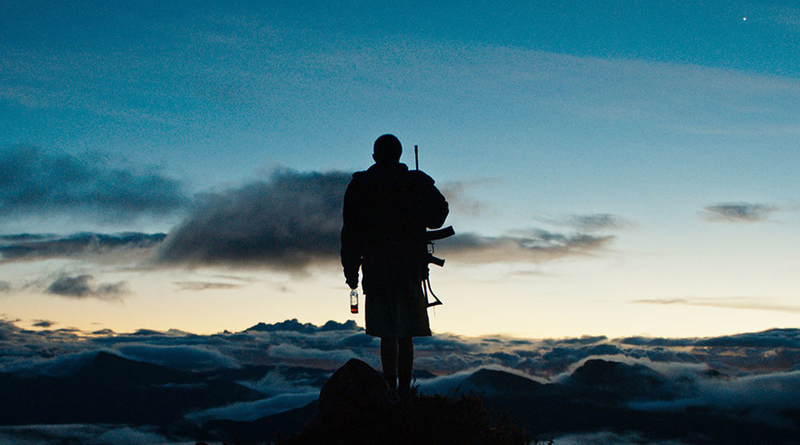
 

Image result for monos film rambo"

Choice is always lacking in Monos. There is no escape from this beautiful, isolated place. They are trapped together and so, together they form a makeshift family with makeshift names. Throughout the film, the teenagers only use pseudonyms. Their false names are like flimsy costumes, war-like personas that they assume as they pretend to be soldiers. Still, for all their bravado, they are young. There is so much potential in their youth and so much danger. Youth is corruptible and all that potential can quickly turn sour. The question becomes if any of that budding hope can survive in such an unforgiving environment. The adults, those who should be caretakers to the children, hand them guns instead. And so, when there is no one to turn to and nowhere to go, what can they do except obey orders and shoot to kill? In the rampage of war, they are the most helpless pawns of all. In their attempts to gain a semblance of power for themselves, the teenagers can only imitate the system that they know, one of violence and oppression. Even imagining a world without endless conflict seems impossible.

The film, though, is not devoid of hope or beauty. There is no lack of beautiful landscapes, even when they become marred by blood. The stony majesty of the mountain is framed in beautiful wide shots by cinematographer, Jasper Wolf. The camera soars above all, to the heavens, rendering every person small and insignificant. Against the vast expanses of sky, the teenagers are only black shadows. They are rendered indistinct, without detail as they stare into a universe that seems infinite. The tragedy, though, is in the limitations. During their brutal training sessions, the frame becomes claustrophobically tight on their faces. We see all the strain, all the terror of failing or showing any weakness. For, no weakness will be tolerated. They are trapped again. The way Monos alternates between different kinds of shots is unsettling. It throws audiences into an uncomfortable situation where nothing is quite safe. Even during the moments of exhilaration, when there exists the possibility of a haven within the confines of war, there always looms a sense of dread. This is reinforced by an intermittent score that kicks in without warning and ends in a searing screech. Otherwise, the film is almost entirely silent, broken only by snatches of dialogue.
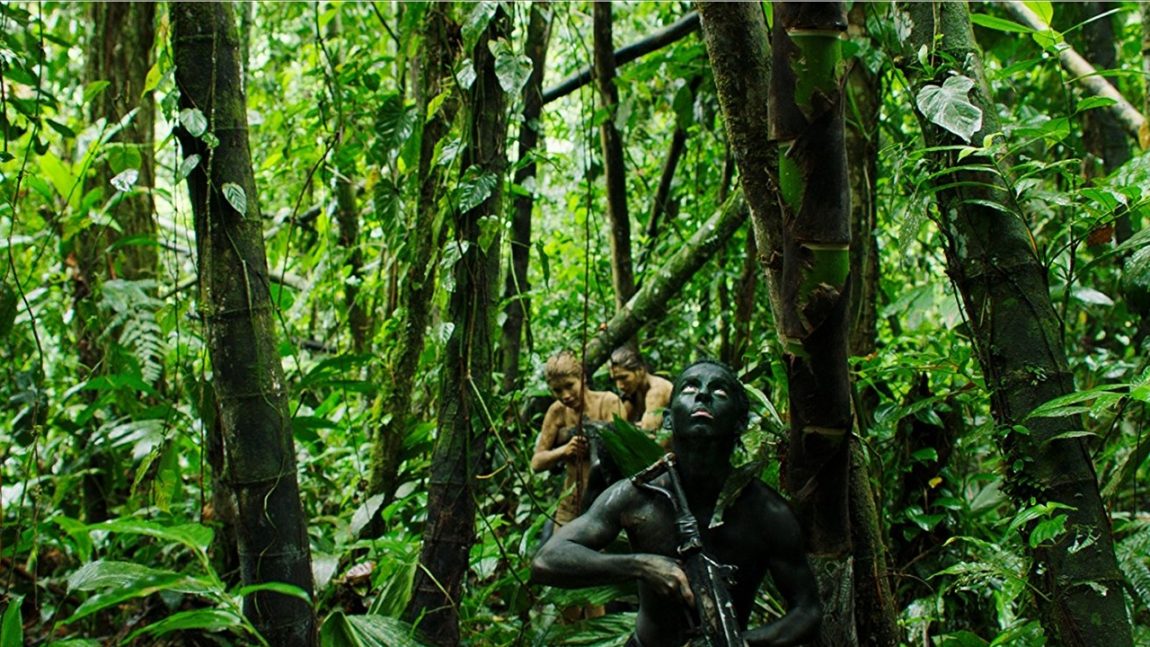
Image result for monos film"

That dialogue is delivered with equal amounts of veracity and vulnerability by the young actors. Especially prominent is Sofia Buenaventura as Rambo. Rambo is the gentlest of the group and therefore, tasked with the most inner conflict. She has still not quite given up the idea of a different life, one that she can see with eyes that express every feeling. But even the harshest of the teenagers do not begin as stony killers. They are capable of happiness, capable of openness. Gradually, though, as they close their hearts, as they embrace violence, the actors become harsher too. Their expressions sharpen and bodies move more wildly, desperation in every tendon. But no matter how hard they strive, they can’t escape. Their actions are meaningless in a grander scheme.

Monos is an unrelenting ride. It alternates between loud and quiet, between small and large. However, for all its varying extremes, there is one overwhelming direction. Down. The film plummets from the beautiful mountaintop into the depths of the jungle. We fall with it, knowing that there is nothing to waiting to catch us at the bottom.

REVIEW: Mark Webster Reading Series

As my first impression of the Mark Webster Reading Series, I must say I was thoroughly impressed. From the venue, to the atmosphere, to the amazing authors, I enjoyed myself from start to finish.

The Helmut Stern Auditorium in the University of Michigan Museum or Art (UMMA) is a perfect place to host these readings. The auditorium is beautiful. Not so large that I felt disconnected from the reader, but not so small that I was uncomfortable. Like Goldilocks, I found myself in a venue that was just right. Being from a technical theater background, I couldn’t help but notice that the entire event went smoothly; no lighting or sound errors, no technical difficulties. Seemingly a small feat, but I know how easy it is for things to go wrong, and from what I could tell, they had their shit together.

Entering this event was like entering a separate universe. Within the auditorium, everyone was so friendly and eager to listen to the night’s readers. The hosts were funny and relatable when introducing the event and transitioning between authors. Notable was the peer introductions. Each writer was introduced by one of their peers; a friend and fellow writer. These peers wrote their own introductions, and did very well to prepare me for what was to come. They were very genuine, not only tackling the things each author writes or where they each grew up, but also the composition of their own character, and the most important question: why do they write what they do.

Annesha Sengupta was the fictional writer of the night. Her style of writing the same characters into every story under different circumstances is very clever and unique. The story she chose to share was very moving; a story about a father, told three different times, with three different outcomes. The story did very well to test the bounds of fatherhood, of family. Particularly notable to me was the last of the three stories, in which the father goes to a Waffle House, and proceeds to be haunted by ghosts of his parents, making him reflect on his past with his daughter and wife. I was certainly impressed with the diction and voice imposed by Annesha. Something was certainly to be gained from listening to her read as opposed to reading it myself.

Bryan Byrdlong, the poet for the night, shared a number of poems with the audience. Almost all of them had one thing in common: zombies. When Bryan’s peer mentioned zombies in her introduction, I had to admit I was a little on guard. Fortunately, I was not disappointed by Bryan’s tellings of zombies. These were not stereotypical zombies you see on TV. They were more meaningful. Hidden beneath each one was a message. It was less about being a zombie or running from them, and more about feeling like a zombie. Woven into his poems were questions of race and identity, of right and wrong. My favorite was the first one he read. It was a simple concept, really. He watched a video of a cop shooting a black man, but in reverse. This way, it appeared that the man rose from the dead, and the cop ran away in fear. Something about the simplicity of the story compared to the complexity of the message within certainly made this poem stand out as my favorite. However, the rest of his works were each exceptional in their own right.

Overall a truly amazing experience; hopefully the first of many. Huge thank you to Helen Zell, who gives the amazing opportunity for these writers to share their work, UMMA, for providing a perfect location, and Annesha Sengupta and Bryan Byrdlong, for sharing their amazing work!

REVIEW: Eurydice

“This is what it is to love an artist: The moon is always rising above your house. The houses of your neighbors look dull and lacking in moonlight. But he is always going away from you. Inside his head there is always something more beautiful.” – Sarah Ruhl, Eurydice


Eurydice read like bundle of freely associating thoughts and tasted, on occasion, cloyingly maudlin. Nevertheless, I appreciated the relative lightheartedness of this rendition that held it distinct from the tragic tone of the original tale of Orpheus and Eurydice, and its refreshing perspective shift to that of a female protagonist. Sarah Ruhl’s Eurydice not only rewrites but also seems to directly challenge the classic Greek myth; instead of being centered around the husband Orpheus’ (Kieran Westphal) epic journey to retrieve his wife Eurydice (Maggie Kuntz) from the depths of the Underworld, Ruhl centers the play around Eurydice’s personal experiences and the ultimate verdict she must make: returning to the living world with Orpheus or remaining in the Underworld with her father. In spotlighting her verdict, Ruhl allows Eurydice’s character the empowerment and dimensionality that the classic Greek myth denies her, whilst introducing themes beyond the frailties of human trust and spirit, such as the complexities and ephemeralities of memory, communication, language, and love.

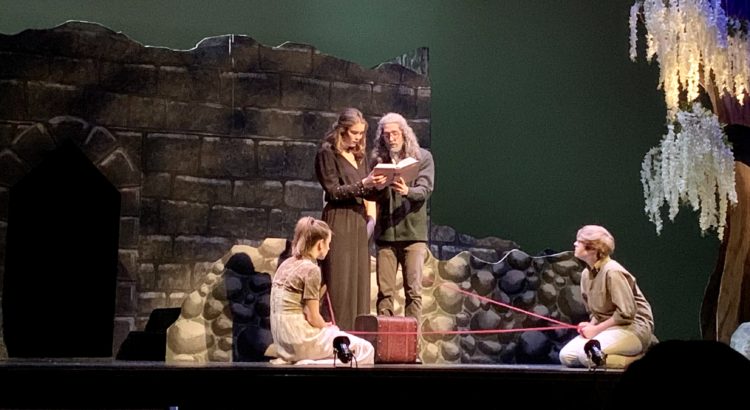
Though the Rude Mechanicals‘ cast, direction, production, and design did an overall wonderfully impressive job in effectively conveying the refreshing eccentricities of Sarah Ruhl’s play, I couldn’t help but search for more within Ruhl’s dialogue and writing, which collaterally impaired the rhythm of the production. For some unperceived reason and for the entire duration of the production, I found myself either cringing at saccharine one-liners, snickering with the audience, or passively waiting for the closing of a scene. Though it’s plain to see that Ruhl intentionally chooses to structure Eurydice in a more painterly storytelling manner marked by freely associating motifs and ideas, I saw a disconnect between the intention of emotional release from the audience and certain syrupy moments in the production that occupied a disproportionate amount of stage time. It was during superfluously long scenes such as the Father unravelling the string ‘room’ he constructs for Eurydice that I felt the most passive in my viewing, and therefore disconnected from the emotions of defeat and hopelessness that the scene is meant to elicit.

Despite the slight awkwardness in timing and emotional translations, I enjoyed the red string motif present throughout the production. Intuitively, I interpret red string as a symbol of connection and of relationships impacted by fate – I thought that this motif translated especially well in the context of Ruhl’s Eurydice, in which the miscommunication and overall character differences between Eurydice and Orpheus are highlighted. This miscommunication and hesitance on Eurydice’s part is what ultimately causes Eurydice to call out and violate the rules Orpheus’ must follow in order to revive her. This scene appeared the most impassioned and dynamic to me; both Kuntz and Westphal beautifully portrayed the hesitancies and doubts both characters’ spirits were in turmoil with in the most artistic fashion. After expressively pushing and pulling with the string in a shifting, dance-like sequence, Eurydice eventually calls out to Orpheus, who turns back as the pent up tension from the mutual string-pulling comes to an abrupt climax and subsequently two simultaneous outbursts from each character. The cast’s various interactions with the red-string were notably artful and succeeded in showcasing the tension running through Eurydice and Orpheus’ strained marriage as well as the imperishable relationship between Eurydice and her Father.

REVIEW: Jojo Rabbit

This weekend marks the opening of Jojo Rabbit, a movie about a young German boy named Jojo, who learns that Jews are not as bad as he has been taught, through a blend of irreverent humor and surprising seriousness. However, I think that despite the advertising, I did not feel this movie was as focused on being an “anti hate satire” as it so claimed. Instead, I saw it more as a commentary on the opinions people may have about others who are unlike them, and how easily stereotypes can be broken. Young Jojo completely assumes the Jewish girl he finds hiding in his attic is the epitome of the devil, however he learns that when you get to know someone, they are not always the people that others claim them to be. While there were definitely an abundance of comedic moments, I was surprised by how many times I felt emotionally moved, either to sadness or contemplation. In between the humor, there were scenes that were very real and addressed the intensity of the time period, reminding viewers they they were, in fact, watching a movie about the mass genocide of human beings.

As a Jew, I found some of the scenes containing actual events to be a little underwhelming, in terms of how serious or intense they should be. While I do understand that it was a comedy, these events are not to be skimmed over. The beginning of the movie really threw me off in this respect, as it showed people enjoying heiling and having a good time at political rallies. The teenage girl who lived in the attic did not seem nearly as unhappy as you’d believe someone living in a small space for probably over a year might be, and some of the aspects of the war scene were not as traumatic as you’d imagine they would be for a young boy.

The character of Hitler, played by Taika Waititi, the director, was an integral part of both the comedy and profundity of the movie. He brought an interesting twist to the idea of an imaginary friend as he was at times scarily realistic, but at others, seemed just like a 10 year old boy. Waititi played such an interesting role, as both a dictator and a kid’s imaginary friend. At first, he was just funny commentary on Jojo’s life, but continued to lose his influence over Jojo and got more and more terrifying as Jojo began to befriend the girl in the attic. I really enjoyed Jojo as a character as well, and the arc that he experienced was very uplifting as he learned that Jews are not mind-controllers with horns. It made me hopeful for our future, that if we can get to know each other, maybe those who are different than us will not seem so scary after all. As a female, and a Jew, I related very strongly to the girl who was being hidden in Jojo’s house. She represented the reality of the situation and the fear of having such a dangerous and uncertain future very well. Her stories of her previous life being ripped away were intensely tragic.

Overall, I do not think the movie was as good as the critics are raving, but it was definitely an experience I enjoyed. Its perceptivity of how different people can learn to understand each other as well as its humor made it a movie worth going to see.

PREVIEW: Eurydice

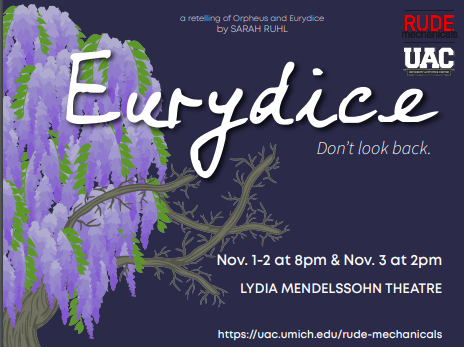
On November 2nd at 8 pm, and November 3rd at 2 pm in the Lydia Mendelssohn Theatre, the Rude Mechanicals will be presenting the tale of Eurydice through Sarah Ruhl’s contemporary lens. The show is a rendition of the classic Greek myth of Orpheus and Eurydice – two star-crossed lovers who become tragically entrapped in a tale of trust, passion, and grief over the trials and tribulations of love. Orpheus, a skilled musician, finds himself on a journey to bring Eurydice, his wife, back from the underworld after her accidental departure from the living. What follows next is a series of trials that test both Orpheus’ faith and spirit and the frailties of the human condition that determine our behavior in the practice of love.

This event is both available for purchase and on the new Passport to the Arts voucher.

Tickets ($7 for students; $10 general)

REVIEW: Artist Spotlight: Ordinary Elephant

Ordinary Elephant is a folk duo comprising of married couple Pete and Crystal Damore who, for the past five years, have been traveling together in their RV with their three dogs around the United States. The crowd for this music set was small, but as far as The Ark is concerned, this condition always lends itself towards the Ark’s most charming atmosphere: a simple stage setting with a cluster of audience members crowding the stage, setting up an intimate space for music, storytelling, and community building.


The music of Ordinary Elephant is subtle, earnest, and would accompany one nicely on a late-autumn afternoon. Crystal provides strong and vulnerable leading vocals alongside her acoustic guitar, and Pete contributes a strong harmony and proficient technique on his octave mandolin and banjo. I found my favorite moments of the evening captured in the interludes of songs during Pete’s instrumental solos. The chemistry of the two on stage proved to be rather striking: quite present was a gentle acceptance and mutual appreciation for the other that I hope to emulate in my own relationships.

Ordinary Elephant’s storytelling encapsulates a deep and grounded honor for family. Often before each new piece Crystal would breathily whisper into the microphone—as though telling us secrets—about the inspiration for their next song. The great majority of their work seemed to come from stories of her life in Lafayette, Louisiana: her activities of leisure, memories of her grandmother, and warm devotion to her father. Another great delight to share in were the readings of Crystal’s imagist-like poetry with precise words and  thoughtful delivery that seized me. I found myself struck with wonder as we, the audience, were invited into a reflection on the value of the simple and the good.

Crystal most certainly proves to be a competent leader for this duo, but I would have loved more space to get to know her husband through the music. Raised in Austin, Texas, Pete has a charming style and seems to be a gentle, good-hearted man. His harmonies complemented his wife’s so well, and often  helped make the presented lyrics more clear. There were times the words were muddled from a less-than-articulate delivery, yet this commonplace practice is not unusual in the folk genre. What could, I believe, move this group forward is the building of distinguishing dynamics; while their musical style and content reflects deep sentimentality and timeless values, there were moments I had hoped they would expand their reach and deliver some more punch and pulse to their set.

I hope that Ordinary Elephant passes through these parts again some day: every time I sit through a group’s set at The Ark I feel like I’m saying goodbye to an old friend when it’s time to go.

Ordinary Elephant is on Spotify and just released their third album, “Honest,” on May 3rd, 2019. I’ve included their link below, and I encourage you to invest in the music of this delightful duo.