REVIEW: Sankai Juku, Meguri: Teeming Sea, Tranquil Land

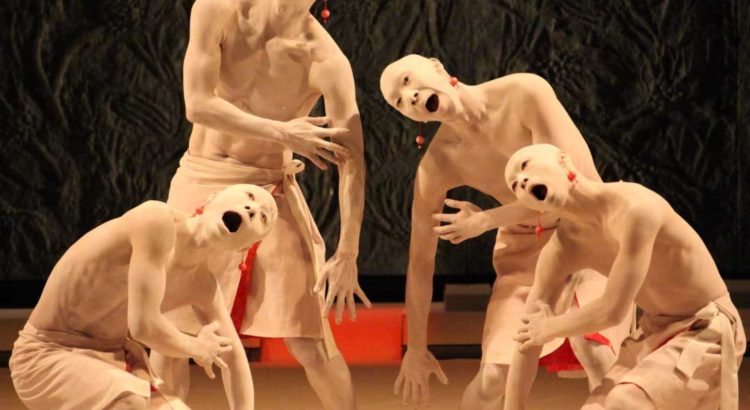
After experiencing the Japanese dance form of butoh through Sankai Juku’s meditative performance, I felt both emotionally disturbed yet liberated. The continuous 90-minute ‘dance’ performance, composed of seven distinct acts, is supposedly choreographed to emanate the circularity within processes and systems such as the earth’s transformation and its movement through the four seasons. The eight performers are powdered a stark white from head to toe, donning bald heads, asymmetrical earrings, and mostly white, sarong-like costumes on their lower halves. They move in correspondence to emotionally dynamic music and express a “dialogue with gravity” through both graceful and grotesque movements marked by spinning, jumping, and eerie bodily gesturing. It is personally difficult for me to describe Sankai Juku through a traditional ‘dance’ perspective; I fail to see it confined to any form of dance theatre that I have experienced before. Sankai Juku as a whole feels more akin to a poetically disturbing expression of the human experience, while their interpretation of meguri translates as a storytelling experience that is facilitated by the mostly monochrome stage lighting that changed with each act.

I thought Ushio Amagatsu’s portrayal of the grotesque within the context of meguri communicated to the audience particularly well; Act V, titled Forest of Fossils, left me especially disturbed with my thoughts asunder. It was during this section that I finally reached some sort of understanding of the performers’ wide, gaping, mouths and permanently perturbed eyes – to me, they communicated agony in discovery and marked the climax of the program. During Act V, only three performers are present on a stage set aglow with greenish light; the music is both tensely trembling and pulsating with the sounds of rocks grinding, which calls to mind the natural shifting of the earth’s tectonic plates. Paralleling the earth’s provocations are the performers, who appear the most agitated that they have been, with one performer gesturing the most frantically and in the most ‘agony’ – at one point, that performer drags his limbs across the powdery ground in a tight spiral to form two symmetrical circles, then subsequently emotes in pure tension and agony around the formation of those two circles. The remaining two performers respond in an unsettling symmetry, and their generally upwards arm movements seem to be grasping at some unattainable substance or idea. The desperation and agony contained within this grotesque imagery, combined with the increasingly jarring music, left me feeling deeply unsettled and in rumination of Amagutsu’s artistic intent behind that section.

As much as I enjoyed the dichotomy between the grotesqueness of Amagutsu’s work and the beauty in the circularity and meguri it conveyed, I think the most uniquely beautiful aspect of Sankai Juku is how the performance manages to maintain universality in evoking the most visceral of emotions from its audience. My disturbed reaction to and interpretation of agony from Act V, Forest of Fossils, differs from the next audience member, yet the emotional impact of this does not seem to suffer in the face of Sankai Juku’s widely interpretable themes derived from the human experience.


REVIEW: Sankai Juku’s Meguri: Teeming Sea, Tranquil Land

Sankai Juku’s Meguri: Teeming Sea, Tranquil Land is a unique show to say the least. If you’ve never heard of the Japanese dance form of butoh, this is a good introduction. 

Butoh began in post-WWII Japan as a response to both traditional and Westernized forms of dance that were popular at the time. The dancers typically perform in all white body makeup and the style is characterized by controlled, slow gestures as well as grotesque and somewhat disturbing movements. 

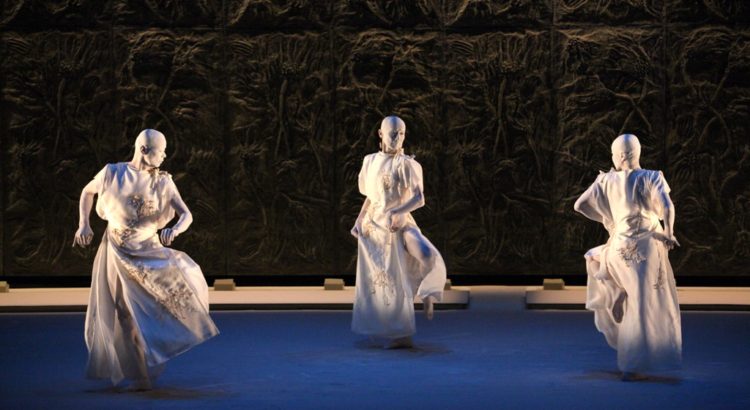
All of this and more is present in Sankai Juku’s performance. Directed by Ushio Amagatsu, Meguri consists of seven sections, delineated by color scheme and number of dancers. As the name of the show implies, imagery of the sea plays against imagery of the land with the use of blue, aqua, and warm amber lighting by technician Genta Iwamura.

The dancers, painted white from head to toe and wearing bald caps, are clad in light, off-white simple garments, with the color of the linings usually changing to match the lighting of a certain section. This simple realization of costume by Masayo Iizuka does well at avoiding being overly theatrical while still fitting into the world of Meguri. 

Although Amagatsu does not present any concrete narrative within Meguri, these motifs create the overall impression (at least for me) of the primordial Earth and life’s emergence from the sea onto dry land. The beautiful backdrop of sea lily fossils, credited to Roshi, contribute to this sense of history. 

As I said, Amagatsu’s choreography does not tell a story, but rather sets a mood. The music and sound design by Takashi Kako, YAS-KAZ, and Yoichiro Yoshikawa is my favorite element of the show. With a healthy mix of orchestral strings and winds as well as some layers of synth, the music provides a cinematic sense to the choreography. Without it the performance would seem much less interesting and important. 

Overall I’m glad the University Musical Society brought this world-class performance to our campus. While not for everyone, Meguri: Teeming Sea, Tranquil Land transports and transfixes the viewer, and there’s something to be said for watching something that is so magically disturbing. 

REVIEW: DisEducated

A musical that captures the anxieties of being a college student, while also making you laugh. Blank Space Workshop’s presentation of Diseducated took place this past Friday and was a privilege to watch. Blank Space Workshop is in their second year here at Michigan and provides a space for developing shows to be workshopped, re-worked, and staged in a short period of time. 

The plot centered around a college English Literature 101 class, in the struggling english department of a struggling university. The english class is taught by the Professor Whitley, a distinguished scholar, holder of two doctorate degrees, and a world-renowned singer/songwriter. Well, sort of. Whitley has never read any of the books he’s teaching, and his titles are decently illegitimate, which becomes evident almost immediately to our main character Beatrice. Beatrice is a fan of classic literature and finds concern in Whitley’s unorthodox teaching methods. To highlight, the class is taught a song about grapes, instead of reading Steinbeck’s The Grapes of Wrath. The class has been drinking tequila, to really understand the classic “Tequila Mockingbird.” Whitley prefers to fake it until he makes it, asserting that a lot of people today aren’t as well-read or as well-rounded as they make themselves out to be. Our protagonist is forced out of her comfort zone, and finds herself taking charge of her deteriorating academic situation. 

 The Cast of DisEducated

The performance was staged in a large classroom in the Walgreen Drama Center, the perfect ambiance for the musical. The audience sat in our orange desks with chairs attached, reminding us of the feeling of sitting in a class that just isn’t right for you- just like Beatrice. The show’s music touched on issues such as Tinder (and Grindr) culture, beefing up your resume, and most interestingly the frustrating differences between GenZ students and the adults tasked with teaching them. Every lyric was relatable, and tastefully forced us to laugh at ourselves. 

The show raised questions about how we see education. Are you reading Steinbeck, or are you pretending that you have for your colleagues? Does it really matter if you have? Is it shameful to enjoy GenZ delights such as multitasking and swiping right? Most importantly, the show was enjoyable. The writing is peppered with clever nods at what it’s like to be our age, like opening the show with a Nick Colleti vine reference. Everyone in the room was having fun, whether they were laughing at GenZ or Baby Boomer critiques. 

A huge congrats to the show’s writers Sammy Sussman and Allie Taylor.

PREVIEW: Sankai Juku


Look out for a review on Sankai Juku’s Meguri: Teeming Sea, Tranquil Land this weekend! I’m super excited to see some contemporary Japanese butoh in this dance show brought to the Power Center by UMS. If you’re looking for a unique night of dance and theatre, this might be the show for you. Sankai Juku will be performing two shows, Friday Oct. 25 and Saturday Oct. 26 at 8 PM!

PREVIEW: Take Your Pick: Collecting Found Photographs

The University of Michigan Museum of Art (UMMA) invites visitors to “come help build [their] collection of “ordinary” American 20th-century photographs.” The exhibition Take Your Pick: Collecting Found Photographs, which will be on display through January 12, 2020, features over 1,000 amateur photographs from the 20th century. The photographs are on loan from the private collection of Peter J. Cohen, who has amassed more than 60,000 photographs from flea markets across the United States and Europe. Visitors may vote on their favorites, and the photographs with the most votes will be added to UMMA’s permanent collection.

In addition to being visitor-interactive, this exhibition asks some interesting questions regarding the definitions of art: “What belongs in a permanent collection, and why? Who and what should be represented, and how should we decide?” As is noted on the exhibition webpage, this collection of original photographs is of special significance in today’s digital age, when most photos only ever exist as files on an electronic device.

Be a part of the dialogue and check out Take Your Pick: Collecting Found Photographs at the University of Michigan Museum of Art!

PREVIEW: Cappella Pratensis – Missa Maria zart

If you would like to try something new in terms of music listening, join Cappella Pratensis, a Dutch-based early music ensemble, this Friday, October 25 at St. Andrew’s Episcopal Church. The performance will begin at 8 pm, with a pre-concert lecture starting at 7:15.

Missa Maria zart (Mass for Gentle Mary) is a 15th-century polyphonic, or multi-part, work composed by Jacob Obrecht. At the time it was written, the piece pushed boundaries – at 69 minutes, it is the longest known Mass ever composed. Centuries later, the piece is still beautiful to modern ears, albeit very different in sound from the “mainstream” music of today. That said, it is pieces like these that were the origins of the music we listen to today.

Tickets, which are $15 with student ID, may be purchased online at https://academyofearlymusic.org/portfolio/cappella-pratensis/ or at the door on the night of the performance.