
REVIEW: Chamber Music Society of Lincoln Center

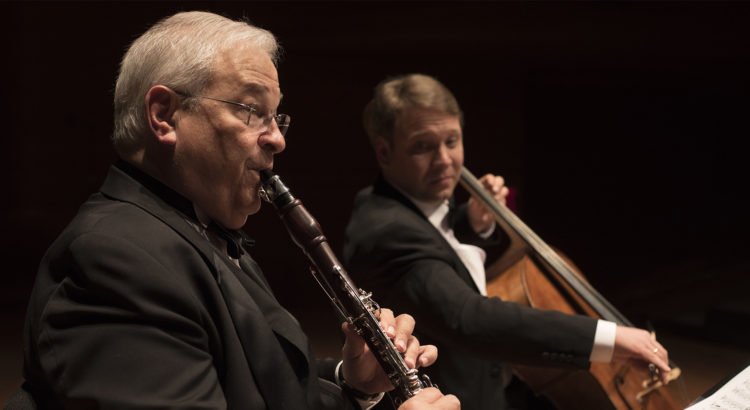
Once again, the Chamber Music Society of Lincoln Center did not disappoint. It is a joy to witness performances where those onstage are truly enjoying themselves, and this was one. The thirteen performers, in different combinations of instrumentation for each of the four pieces on the program, managed to effortlessly convey the character and emotions of the music, allowing the audience to get lost from reality outside the walls of Rackham Auditorium.

The first piece on the program was Henry T. Burleigh’s Southland Sketches for Violin and Piano, with Mr. Chad Hoopes on violin and Ms. Gloria Chien on piano. The piece was at times whimsical, serious, or soulful, and I was captivated by Mr. Hoopes’s ability to (seemingly effortlessly) draw a matching range of sound colors from his violin. His sound and his playing were flexible in a way that allowed the audience to experience the full range of the piece, and for this reason it was one of my favorites on the program.

Next up was Antonín Dvořák’s Quintet in E-flat Major for Two Violins, Two Violas, and Cello, Op. 9, followed by Leonard Bernstein’s Sonata for Clarinet and Piano. Both were flawlessly executed, and the Bernstein Sonata was fascinating in that is was his first published piece.

That said, for me, the real culmination of the evening was the final piece: Appalachian Spring Suite for Ensemble by Aaron Copland. Often hailed as one of the most quintessential works by an American composer, Copland in fact won the 1945 Pulitzer Prize for his efforts. While Appalachian Spring was originally premiered in 1944 as a ballet commissioned for Martha Graham scored for thirteen instruments, Copland wrote an orchestral suite version the following year, removing about eight minutes of the original music. The version performed by the Chamber Music Society of Lincoln Center was completed by Copland in 1958, and it is an arrangement of the 1945 orchestral suite, but with the original instrumentation. For me, it was particularly interesting to hear this version after the Ann Arbor Symphony’s recent performance of the orchestral version, because I somehow expected that orchestration in my head. Instead, each entrance was a new surprise. I especially enjoyed the chords in piano during the opening of the first movement, and how it fit with the scoring of the chamber version. Although it is not Copland’s original version, this 1958 version gives a sense of how the music must have sounded when the ballet premiered at the Library of Congress. For me, it is impossible to hear Appalachian Spring (in any version) without conjuring images of frosted landscapes, sunrises over the mountains, and running streams. It is a true musical escape, just like the Chamber Music Society of Lincoln Center’s Friday evening performance of it.
REVIEW: Out There: A Performance by art duo Princess

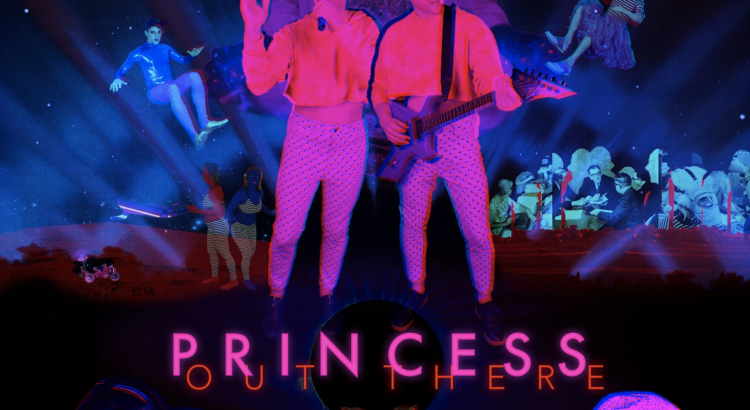
There is a distinct difference between natural weirdness and the sort that is manufactured. Entitling an album “Out There” is far too self-realizing a move to truly belong to the former distinction. Things can be disastrous in cases like these, and unfortunately Princess’ performance veered quite drastically into the side of inorganic. This is not to say that there was no value in their work; quite the opposite, the intentional obscurity of meaning, though cringeworthy, was useful in forcing me to figure my own ideas about what I was seeing and hearing.

A concept album seems perhaps the wrong medium for what these two are doing. There is simply a lot going on, and their work suffers as a result.  They have a good sense of rhythm and tune (especially the flow of the rapping sections), but whatever their flat choreography was supposed to be doing was not being accomplished. The lyrics were often impossible to glean much meaning from. Most notably, the “party-party-party” song, most of whose words were about as inspired as you might imagine. I could speculate on what the song’s purpose is, perhaps some link to the procedural, routine nature of party culture, and the poisons that hide within its mindlessly indulgent atmosphere–the sexual harassment and assault, the brainwashing of men to be hunters who deserve prey, of women to bat their eyelashes and be a thing to desire. But to expect an audience to leap this far to make any conclusion of meaning is a bit much.

A bit too dark to see, but they are currently on the ground in anatomical position.

The space travel motif’s linkage to the album’s purpose was unclear. And though it was often visually striking, I found it relied too heavily on a single type of color scheme (red/blue combination and the vibrant, neon flat coloring of random objects). Also, the repetitive, jerky movements of the characters and objects in the video got old about halfway through the act. However, it still must be noted that the complex layering technique of visual artist Jennifer Meridian was impressive, if at times monotonous. Her work might perhaps be more suited for shorter videos and advertisements that demand the sense of excitement her design provides so well.

Mostly what I find fault with in the performance was its over-the-top brashness. I find it distracts from an audience’s ability to gather meaning from what they are experiencing. It’s more closely related to modern art than an exploration of misogyny in society. In all its spectacular glory I feel they are unable to develop their ideas into anything beyond the surface level. This is a shame, because the two clearly have an enormous creative capacity. I feel that, if they used their potential differently, they could have great success in creating thoughtful, deep, provocative art. While I and others in the audience can certainly derive our own meaning from the performance, the chasm over which we must stretch to get there is too wide. Perhaps this is the result of too many strongly creative people collaborating on a single project–in the process it became too much of a conglomeration than a precise piece of art.

If you’d like to check out the album for yourself, it’s currently available for preorder at their website bandofprincess.com. There you can witness one of their songs under the “videos” tab, and find other information about the band, including tour dates and background on the duo’s origins.


PREVIEW: Isango Ensemble: The Magic Flute

In its UMS debut, the Isango Ensemble, a South African theatre company, will be presenting three performances of a re-imagined look at Wolfgang Amadeus Mozart’s captivating score, transcribed for an orchestra of marimbas. This production provides a familiar and classical background alongside a vibrantly-contrasted foreground of a South African township setting.

This show will be playing October 16th, 17th, and 19th at the Power Center. I’ve been anticipating this performance for as long as I have known about it, for alongside being captivated by the works of Mozart, the Isango Ensemble’s work has been highly praised for its inventiveness and captivating performance! Be sure not to miss the Isango Ensemble this week!

Isango Ensemble: The Magic Flute

REVIEW: Gala Mukomolova Poetry Reading and Book Signing

In the first reading of the Helen Zell Visiting Writers series, I sat excited and enthralled to witness the arrival of poet Gala Mukomolova. It was lovely being back in the UMMA Auditorium for the 2019 inception of the series, with the warm light suspended by translucent threads, giving it the quality of floating Hogwarts candles; the dimness of the room lulling me into a kind of aesthetic trance; poetry washing onto the shores of my mind. And so entered Mukomolova’s work into one of my beloved programs at Michigan. 

In her reading, Mukomalova read from her debut poetry collection Without Protection. Mukomolova has many identities she explores in her work. She is Russian, Jewish, refugee, New Yorker, lesbian. These intersecting identities ground her work into her own universe, and she enters this space she has invented with the agency, authority, and recognition of her own power. I am currently unraveling what it means to write about your identity in your work– how much of it seems like “material” you’re performing, and how much is actually authentic. I haven’t read Mukomolova’s work in full and am only acquainted with the work she read to us, but it seems to me that she enters her poetry as her own creation. When she writes in Russian, or explains deeply personal situations, she seems to explain the narrative not for us, but for herself; the work, in some ways, seems to be the many aspects of her identity in conversation with the other parts in one place. To me, this seems wildly liberating, not the puppeteeting that might structure other inauthentic works. 

Mukomalova’s poetry collection explores the story of the old Russian fable about the young girl named Vasilyssa trying to escape from the witch Baba Yaga. Her power, bravery, and divine feminine energy guide her to enter Baba Yaga’s home Without Protection. The collection includes a multiplicity of narratives colasing into one, delicately woven together, the old and new and personal and universal all in conversation. One sentence will be about the story of Baba Yaga, the next an anecdote from Mukomalova’s life, another an advertisement on Craigslist. It’s a brilliant tapestry of multiplicity and power that Mukomolova crafts in her poetry. 

There is, moreover, a definite belief in the power of women, and more specifically, in the sexuality of women. Mukomalova writes:


I want everything. I want to be fucked like the wife who waited

for her soldier’s return, fucked: the island, the sand, the nymph, 

the lust that strands him. Fucked: the witch’s sword against his dick before she 

opens. Ill deep throat, I’m sayin’

it’s April, 72 degrees, I’m in love and wearing platforms. This song is just like 

my first years in America, the jump off. What I mean is reckless, performing 

a kind of hope.


Mukomalova’s poetry is unabashed about desire, about the complex highs and lows of wanting and not having, or wanting and having and being a woman. There is an erotic energy weaved into her poetry that gives it power and shamelessness, an unapologetic ode to her womanhood and sexuality. 

Overall, I enjoyed the reading very much. Rereading some of her poetry here to write this blogpost reminded me how thrilling it is to read it, and I have to admit that I enjoyed reading it more than I did hearing it. In any case, I think this makes it easier for you, dear reader of this blog post, to go out and read Gala Mukomalova’s stunning and multi-layered debut poetry collection Without Protection

Sources: https://coffeehousepress.org/products/without-protection, poetry except from https://pen.org/four-poems-by-gala-mukomolova/

PREVIEW: NT Live: The Lehman Trilogy

Catch a one-night only broadcast of National Theater Live’s Lehman Brothers Trilogy this Sunday, October 13th at 7 pm at the Michigan Theater! Detailing 164 years of American capitalism amounting to the 2008 market crash using only three actors, Italian playwright Stefano Massini’s work is sure to not only be a thought-provoking performance, but an impressive one at that.

Take a break from studying this weekend, find tickets online at https://www.michtheater.org/show/nt-live-the-lehman-trilogy/ , and come out to see some great theatre!

PREVIEW: Chamber Music Society of Lincoln Center

On Friday, October 11, members of the Chamber Music Society of Lincoln Center (CMS) will be performing at Rackham Auditorium! The program focuses on the “intrepid American spirit,” featuring works by Harry T. Burleigh, Aaron Copland, Leonard Berstein, and Antonín Dvořák (although he was Czech, he taught in New York).

If the Chamber Music Society’s appearance with UMS earlier this year was any indication, audiences can expect a technically pristine and spirited performance. The concert will take place at 8 pm, with a pre-concert talk presented by University of Michigan professor Dr. Mark Clague at 7 pm in the Rackham assembly hall. Tickets may be purchased at the Michigan League Ticket Office, or online at https://ums.org/performance/chamber-music-society-of-lincoln-center-2019/