

REVIEW: Change Our World (Slam Poetry)

Spoken word is a powerful medium for literature. It brings together elements of traditional poetry, the lyrical form and flow of rap music, and the stage presence and movement of dance. The audience is more closely involved in the experience than a reader of Dickinson might be; it is a conversation with the author, a chance to see the emotion on their face when they speak and to react more richly to the writing.

Members of University of Michigan’s Slam Poetry team opened the night with a selection of poems I still feel lodged in the back of my mind, even days later. I will not reveal how many tears I cried, but the number was embarrassingly high.

A self-proclaimed “emotional b*tch,” Bronx native Roya Marsh is sheer inspiration in human form. She has ascended from minor competitions and open mics to performing at Carnegie Hall in front of an audience of thousands. She commands the stage whether in mid-poem or casual conversation with members of the peanut gallery; it is impossible to peel your eyes off of her as she moves through words you know are intentionally selected one by one. Her 15-poem set (all memorized and organized in her head, or what she calls her “rolodex of poems”) felt somewhere between a Sammus concert, a comedy act, and a palm reading session. The crowd was modest, but that made it all the more personal. At one point, she asked just about everyone if they’d been to New York and what their major was.

The poems went hard and fast, their words expressive and moving. I felt a literal, bodily sensation when I was being pushed through such a range of emotions in a short period of time; a sense of that fullness which can only be achieved through a run-on stream of hurt and joy and experience. It was easy to fall into the atmosphere of the place, the fancy theater and the lights of the stage and Roya standing, shining in front of the audience. I was rapt, unable to focus on anything else as I took in what it meant to be in a room of strangers all feeling differently about the same words. The night and the poetry were completely encompassing, ambient. The turmoil within the intersection of race, gender, sexuality, and class had never been so clearly laid out, and in such an undiluted way. Other expressions of such experiences have the tendency to fall flat, whether in traditional poetry, theater, or novel form. Hearing the author speak as loudly, as harshly, as fast or slowly as they choose to is more strongly moving than anything that could be written on a page.

If you are interested in keeping up with what she’s up to, Roya is on Twitter at @ChampagnePoet (right up there in the search results for Drake). She is currently working on an album of spoken word poetry, coming out next year, so keep your eyes peeled for those updates!
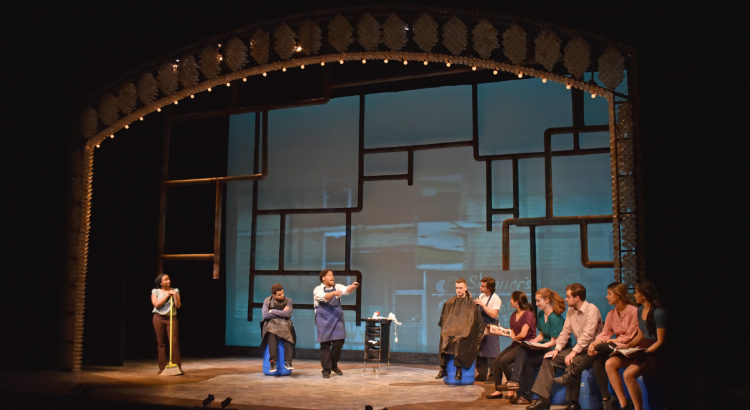

REVIEW: Der Kaiser von Atlantis

Considering the circumstances under which Der Kaiser von Atlantis was written — (it was written in the Theresienstadt concentration camp with the musicians available, and was rehearsed but not allowed to be performed because the Nazis thought the title character seemed a bit too much like Hitler) — it seems reasonable to consider it something akin to an unfinished work. The piece starts out with a really interesting idea which it doesn’t really have the space to explore. The libretto is crudely formed, and reads more like the work of a poet than a dramatist. Each individual moment works splendidly as an exploration of its own theme, but the parts fail to gel into a particularly coherent whole. The title character of Kaiser Overall gets a strong starting point, and a strong ending point, but not the development that brings him from point A to point B.

The opera begins with a prologue, which takes the form of a conversation between Death and the clown Harlekin. The characters converse on their melancholy state. A drum-major announces that Kaiser Overall has declared a universal fight to the death. Everyone will take up arms and kill each other. Death feels quite frustrated by this; he feels overworked, and thinks Overall is being disrespectful of him. So Death goes on strike, and in the ensuing bloodbath, no one can die. In the second scene, Overall gets updates on how the murdering is going, and is distressed to find out that no one is dying. In an effort not to be seen as weak, he tries to turn the situation into a positive, by saying that his soldiers have been given a formula which makes them immune to death.

In Scene III, we meet a soldier and a maiden who are unable to kill each other, so they fall in love instead, casting death aside. And in Scene IV, everyone’s pretty upset about this no-one-being-able-to-die thing — not least the people who are stuck with mortal wounds that should have killed them hours ago. Death shows up, and tells Overall that he will get back to work, but Overall must give up his life first. Overall agrees, and promptly dies, followed by everybody else. A quartet sings a hymn to death, and the opera ends.

I’m not really going to dig into a full dramatic analysis of the opera. It’s a very surreal opera, a very philosophical opera, and not a very complete opera. I don’t think it’s really my place to tell you what you’re supposed to get out of it. Peter Kien’s libretto is vague, doesn’t really apply itself as any specific allegory, and very open to interpretation. Ullman’s score employs a good deal of pastiche and reference, and evokes a variety of composers of the era, including Shostakovich, Szymanowski, and even Kurt Weill. On a moment-to-moment basis the opera is most effective.

Der Kaiser von Overall was presented tonight at the McIntosh Theater in the Earl V. Moore School of Music, directed by Matthew Ozawa, and performed by students in the School of Music, Theater, and Dance. It will be presented again tomorrow, April 7th, at 8pm. Admission is free, and the opera runs approximately one hour. Supertitles in English are projected above the stage.

The singers all gave wonderful performances. Louis Ong as Kaiser Overall and Zachary Crowle as Death imbued their characters with immense gravitas, which Lucas Alvarado and Kayleigh Jardine, as the Soldier and the Maiden contrasted with a lovely tenderness. Daniel McGrew, Jenny Cresswell, and Logan Dell’Acqua had the most abstracted roles, as Harlekin, the Drummer, and the Loudspeaker respectively, and though their characters were not very defined, their performances were definitive. The fourteen-piece ensemble, lead by Timothy Cheek, gave out a sound almost twice its size — though I regret to say an electric keyboard is still no substitute for a real harpsichord.

The production is directed by Matthew Ozawa, and though the theater itself is not very conducive to a tightly-focused dramatic treatment of the work, a lot is done with lighting (also by Ozawa) to carry the piece. There was a lot of apparent symbolism which at places I felt bogged the production down, and there were moments where the sheer size of the stage proved distracting, but I cannot count this against the opera. Der Kaiser von Atlantis is of sufficient interest for its history alone, and any production therefore worth an eye or two.

PREVIEW: FLINT

A new play is being put on by the school of music, theater, and dance called FLINT. The play was written by Professor Jose Casas and was the result of a collaboration with Umich students and volunteers from Flint. The play is meant to resemble a documentary and tell the complex story of Flint residents’ experiences with the water crisis. Casas wrote the play based on over 80 interviews with Flint residents, some of which he searched out and others he stumbled upon by happenstance. The project began over a year ago and has involved students interested in what is referred to as social justice theater.
A classmate of mine is one of the actors and shared with me the anxiety he and his colleagues felt about their debut. He shared a worry that comes hand in hand with social justice theater, are we serving the community or exploiting it? For my classmate, this fear culminates on April 16th when the troupe will be performing in the play’s namesake.
I must admit, hearing about this anxiety gave me hope. A group fueled by such good intentions and so concerned with the impact of their work will surely do the story of Flint justice. If you want to see FLINT make your way over the Arthur Miller theater between now and April 14th to see what’s in store.

Image courtesy of university productions.

REVIEW: Change Our World – Poetry Slam

What I have learned about slam poetry at U of M is that slam poetry is one of those things everyone goes “ah that is so cool” too, but don’t care to participate in or view. The people that like slam poetry, love it, because it consumes their emotions and creativity. Slammers can’t get enough slamming. They perform and watch others perform. If you don’t slam you don’t care to watch others perform. It isn’t like improv comedy, where everyone goes to see the shows whether they perform improv or not. This is an important lesson to learn because Rackham yesterday was mis-booked. Rackham is a big beautiful auditorium, but it feels daunting when only 20 people show up for the slam leaving the auditorium empty. At least Kai made a great decision forcing everyone to come to the first few rows to make the vast space feel smaller.

The show started with readings from the UM slam poem team, who will compete at CUPSI in a few weeks. I’ve seen and reviewed these poems before at previous slams , but of course, I was entertained watching them a second time.  Sorry for any misspelled names and incorrect quotes in this review. Dylan has an awesome voice for reading slam poetry; my favorite lines of hers was “the girls you care enough about to loan to what-if-it were her scenarios.” Lizzie used moon imagery very well in her poem, from marks on a body to something to reach for. My favorite line was ” Manifest love in silence, loving him means I cannot speak.”

Kai’s poems were absolutely phenomenal, I feel like she is ready to get some viral recordings on button poetry. Her first poem creatively used ghosts to symbolize depression, what is wrong with hypocrisy and culture in America, and how these issues have affected herself and her family. I liked Kai’s use of sheet white faces, rituals, exorcism and I liked how I could never tell who Kai was addressing this poem to, whether it was to herself, America, or her parents? I liked the quote “Depression in America is laziness in Asia, and not a disease but a ghost to her father.” Her second poem was also great, I liked the imagery of mechanical humans and her repeated use of three questions.

This was all introduction for the main poet of the night, Roya Marsh, who has the dream job, she travels around reading slam poetry. She is a professional poet featured on frontier poetry and button poetry and has won all these other impressive awards I forgot but you can probably look up. To introduce her, a local poem legend, Ty, read a poem about mint tea that was short but beautiful. My favorite line was ” Mothers will chase, fight, hunt, honey, home to settle and be comfortable.”

Roya’s poems were all extremely passionate. She showed how important it is to memorize your poems because then poems can come from the heart instead of a sheet of paper. She also cusses a lot in her poems she even had a whole poem about certain curse words. Cussing in slam poetry is like a right of passage, only great poets can use cuss and not have everyone in audience flinch.  Roya said if you’re going to put a curse word in your poem, it should be the strongest word in the poem, otherwise, don’t use it.

Roya read so many poems. that I can’t comment on all of them, but I will say what stood out to me and if you like what you hear, check out her book or check her out online. Most of Roya’s poem were about being gay, a woman, and being black.  My favorite poem was about how uninvited she feels in American churches and how that has empowered her sexuality and body. She had a poem about the mass shooting at a gay bar in Orlando where she recited every single victim’s name. She had a hilarious line about Donald Trump that had me laughing for 5 minutes, but is too profane for me to write about. Her imagery throughout her performance was so strong, my favorite usage was about her pulse. She had a whole verse about acheivements of famous historical black women that rhymed. My three favorite lines of the night: “silence is a cloak draped over a body of lies” , ” pessimism is trying to kill myself, optimism is trying to live in spite of that” ,  “Black joy knows prosperity in the face of white supremacy.”

REVIEW: That Brown Show

I was very excited to see That Brown Show, and so, it seems, was everybody else in the audience, because they were much more boisterous than usual. In most other settings, this would have been somewhat irritating (in some parts, the audience cheered so loudly that I could barely hear the music), but after attending so many Indian student performances, I’ve accepted that this exuberance is simply part of the show.

I think all the ensembles did a very nice job, but I know I’ve seen much better from some. Sahana Music could have been a little more balanced – the vocalists didn’t perform much, while there were several percussion solos – but I loved the harmonium solo. Taal is capable of far more than what the piece they performed let on. The storyline of their dance, Robin Hood, could have been more connected to their choreography. The choreography itself seemed more fit for a nightclub until they started incorporating movements inspired by Indian classical dance, which they performed much more gracefully. It is possible that this was a deliberate juxtaposition between the more graceful Merry Men and the decadent King Richard, but if so, a more obvious difference would have helped. The Michigan Bhangra team had, as always, a very energetic performance, and their movements were crisp and unified, even those of the handkerchiefs they were flicking around. I wish they hadn’t had a video playing in the background, because after I noticed it all it did was distract me. Michigan Manzil had a really cohesive performance, and I was amazed at the unison they displayed despite the throng of people onstage. Their storyline for the dance – 21 Jump Street – worked really well with their performance, and their style and energy remained consistent throughout even when they were blending moves from different genres of dance. Sahana Dance was my favorite: they did a beautiful job of blending the three styles of dance that were represented onstage. Often, they take turns highlighting each dance style, but this time they managed to dance at the same time, and it worked really well. And they had some really unique music choices (that transitioned well) and some beautiful geometric formations. Michigan Izzat, as per usual, had a really tight performance with their hallmark crisp movements and a very well implemented storyline. Someday, though, I’d like to see them do more lyrical movements. I think it would add a lot of range to their repertoire, and I know they’re skilled enough to perform them. Lastly, Wolveraas had some really lovely musicality and very consistent energy, and they didn’t let that slip even despite a couple minor mishaps. This year, TBS was a competition – why I don’t know, and I hope it isn’t actually going to happen annually – and Izzat won the audience’s vote.

Strangely, Hill Auditorium as a venue didn’t seem to help anyone. Somehow the sound seemed muffled, not as bright as usual, and that leeched energy from everybody’s performances. This was not helpful, because these performances require a lot of energy, and I realized then that not all of that can come from the performers. But that couldn’t really be helped. My last note, though, is something that can be fixed: I really wish they would get their tech together. There were some hiccups with videos, sound editing, and sound balance that seem to happen at every show, and I know those are things that are so easily fixed with some minor attention to detail.

PREVIEW: Der Kaiser von Atlantis

This weekend, the School of Music, Theater, and Dance will present two performances of Viktor Ullman’s Der Kaiser von Atlantis. Composed circa 1943 while Ullmann and librettist Peter Kien were both in the concentration camp at Theresienstadt, the darkly surreal opera concerns a bloodthirsty Emperor who orders a nation-wide fight to the death. Death himself, annoyed at being overworked, frustrated at the lack of respect he gets nowadays, and angered that the Emperor seems to feel himself fit to do Death’s job, goes on strike, resulting in no one being quite able to die in the ensuing bloodbath.

The opera will be directed by Matthew Ozawa, with music direction by Timothy Cheek. The cast comprises seven SMTD voice students and a chamber ensemble.

Performances are April 6th and 7th, at 8pm at the McIntosh Theater in the Earl V. Moore School of Music building. Admission is free.