REVIEW: Love Lies Bleeding

To say that no trailer could have adequately prepared me for the intense gore, smut, and hilarity of Love Lies Bleeding is a major understatement.

This past weekend, I attended a screening of Love Lies Bleeding, the recently released film by Rose Glass starring Kristen Stewart and Katy O’Brian, at the Michigan Theatre in downtown Ann Arbor. The movie follows gym manager Lou (Kristen Stewart) as she embarks on a whirlwind romance with bodybuilder Jackie (Katy O’Brian), finding themselves at the center of a series of homicides.

I decided to see this movie on a whim after my original plan to watch Drive Away Dolls was foiled by its unavailability near campus. Apart from a cursory glance at the trailer, I went in blind, a decision I’m grateful for after experiencing this bizarre yet enthralling flick. The majority of the audience seemed to share my sentiment, as we collectively gasped, screamed, and burst into laughter in response to the sheer shock factor. It may sound dramatic, but it’s the truth. As a fervent movie enthusiast, this viewing experience fulfilled my need to engage with the screen, surrounded by a predominantly queer and female-presenting audience, fostering a sense of camaraderie.

The remainder of this review contains minor spoilers, so I recommend stopping here if you wish to see the movie without further knowledge of its contents, which I highly recommend.

Love Lies Bleeding was a tight 104 minutes, maintaining a brisk pace without allowing the plot to meander. Following a year of films that took their time (looking at you, Oppenheimer and Killers of the Flower Moon), I welcomed the prospect of a movie I could watch without needing multiple bathroom breaks. All jokes aside, the pacing worked beautifully, keeping me deeply engaged while still delivering surprises.

Some artistic choices didn’t quite satisfy me, particularly the part where Jackie grows to fifty feet tall, followed by Lou joining her in frolicking through the clouds after escaping from Lou’s shady criminal father. While I understood the symbolic purpose behind this growth, I found it a bit too on-the-nose, detracting from the grounded, realistic elements of the story. Similarly, while I comprehend the intention behind Jackie’s muscles bulging and growing due to her increasing self-confidence and steroid usage, it significantly altered the movie’s tone, adding a science-fiction element that made the overall story feel disjointed.

I must admit that the ‘point’ of Love Lies Bleeding, as assumed in every movie, may have eluded me… but I couldn’t care less. This was the most enjoyable and magnetic theater experience I’ve had since the release of Bottoms, another favorite among the queer female community. The increasing release of movies featuring queer women across genres and exploring the intersection of these identities excites me immensely. This somewhat absurd yet enjoyable thriller excites me about the potential of queer cinema in the 21st century – the lines between mainstream and queer media are blurring significantly. 

Featured image available courtesy of Google Images. Love Lies Bleeding is now playing in theatres. 
REVIEW: “Tales Told in Brick and Stone”

Taking Time with “Tales Told in Brick and Stone”

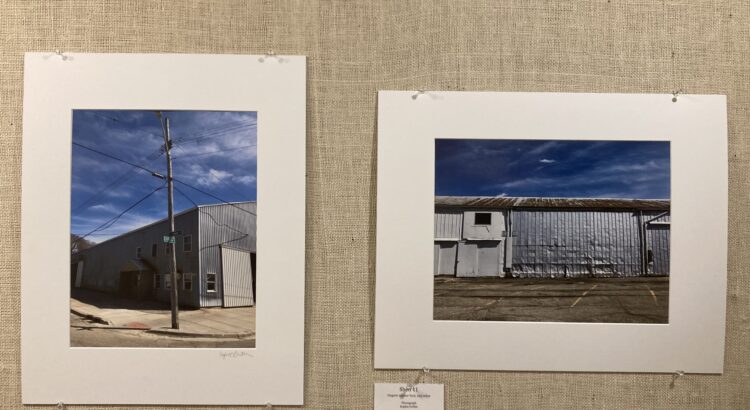
This week I took a walk to The Argus Museum to check out “Tales Told in Brick and Stone” a photography exhibition centered on the emotional resonance of abandoned buildings. The show is a group exhibit featuring the work of Sophie Grillet, Susan Lawless, and Sasha Mykhailova. Themes of shadow, neglect, and decay bring our attention to what we abandon, and express reverence for the echoes of the past found in the structures of our present.

Sophie Grillet is an English artist turned Ann Arbor local.  Her collection “Shadows of the Past” reflects on impermanence. Often her compositions pair buildings with the shadows of figures, contrasting the fleeting nature of people with the intention of buildings to last.

“Orvieto Italy” and “Shadow on Glass”

Susan Lawless’ work is a photography essay titled “Asylum”. It features photos of the abandoned  Northern Michigan Asylum for the Insane. “Asylum” reflects on what it means to be on the outskirts of society. There is a haunting quality to a location like an abandoned insane asylum, and Lawless’s collection brings a respect to the place. We are asked to spend time with something that so often we turn our eyes and minds from, and in doing so we spend time with the memories of the people who once lived and worked there.

“Warning”

Sasha Mykhailova is a Ukranian photographer. Her collection is a series of photographs taken of the aftermath of the Chernobyl nuclear disaster. The photographs are of rooms abandoned and in states of disrepair, gymnasiums with floors warped beyond being a floor, dormitories with rusted out bed frames, papers yellowed and scattered across floors. The presence of disaster and decay warns us to turn away, go back, find another way to go. Mykhailova holds our hand and says, “It’s okay, look”.

“Chernobyl” 6-9

The stories that buildings tell are subdued and often quietly complex. To listen to them requires us to slow down and spend time with emotions that aren’t usually comfortable. We are eager to be distracted from the past, the marginalized, the fleeting, and the abandoned. Maybe in part because it puts our present moment into the context of history. After spending time with “Tales Told in Brick and Stone”, I felt like I had gained a reverence for the past, and an awareness of how the structures around me will continue on long after me. I looked around The Argus Museum with a new perspective, appreciating a space dedicated to remembering.

The Argus Museum is on the second floor of the Argus building on William Street, a few blocks away from the Ann Arbor District Library. It is a museum about the Argus Camera Company, which was founded in Ann Arbor in 1931. In addition to the current arts exhibition, the museum is full of old cameras and artifacts about camera making, documenting the history and development of the Argus camera company. The museum hosts photography exhibits and conferences throughout the year in their gallery space.

“Tales Told in Brick and Stone” will be available for viewing at The Argus Museum until April 5th.

REVIEW: Color Cabaret

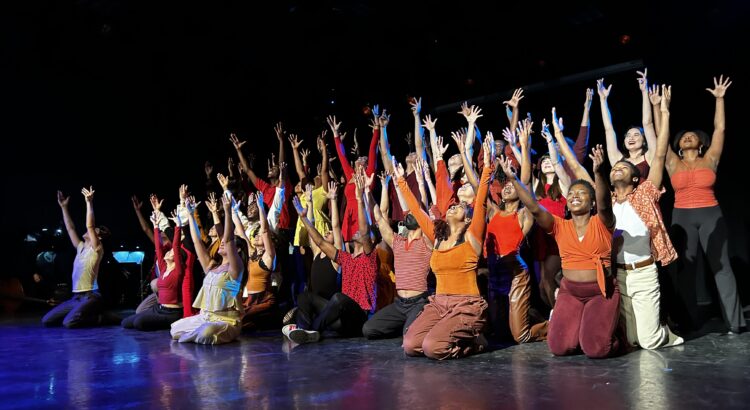
Biennially, the students of the SMTD Department of Musical Theater put together a cabaret to uplift the diversity within their department. Color Cabaret features BIPOC performers from all four years of the department performing many Broadway Classics and music from the Musical Theater canon. The group hosted two shows on February 22nd at 7p and 11p; around 60 minutes and II Acts. The Towsley Studio in the Walgreen Drama Center was packed to the brim with some of the most eager family members, students, and colleagues I have seen at a student production.


The directors of this performance were Oluchi Nwaokorie and Haoyi Wen, along with music director Caleb Middleton and choreographers Abigail Aziz, Keyon Pickett, and Logan Saad. The show consisted of a collection of Musical Theater numbers, fully choreographed dances, lighting, and orchestrated with a five-piece band. The performers hosted infectious energy that bled through the room—vibrant dance numbers, satisfying harmonies, and one-of-a-kind arrangements.


Many of their numbers used Broadway tunes with rewritten lyrics by the performers describing the experience of People of Color and the stereotypes placed upon them. Arrangements, lyrics, and poems were re-written by many of the members of the Cabaret, including Alyssa Sunew, Ryo Kamibayashi, Brendan Johnson, Drew Perez Harris, Aaron Syi, Angeleia Ordoñez, Anna Zavelson, Aidan Jones. (Along with two additional arrangments by Stephanie Reuning-Scherer and Catherine Walker/Henry Crater).

Every single aspect of this performance was led and created by Students of Color. Directing, marketing, arrangements, lyric re-writes, choreography, lights, band and music direction (etc.). Each number was truly unique—from Part of You World performed in different languages, to a witty Book of Mormon rewrite and medleys from Once On This Island, Falsettos, High School Musical & Rogers & Hammerstein’s music, I was on the edge of my seat after each performance. This group truly created a beautiful piece of theater on a rather bleak February night.

Color Cabaret is an enormously special part of SMTD and a thrilling way to amplify BIPOC voices in the Musical Theater Department. Be sure to catch Color Cabaret in 2026 (if you’re still here!). Next, The Department of Musical Theater will perform A Little Night Music  April 18-21, 2024. Tickets are available here.

REVIEW: Michigan’s Got Talent

Wolverine’s Prove “Michigan’s Got Talent”

On Tuesday February 20, I used my Passport to the Arts to attend Michigan’s Got Talent, a talent show for the University of Michigan student body. The event was hosted by MUSIC Matters, a student organization that organizes music events on campus. Performed for the Lydia Mendelson Theatre’s packed audience and a panel of three judges, the night was act after act of inspiring creative force.

The event was MCed by two members of student improv troupe ComCo and judged by former president of MUSIC Matters Anna Lair, as well as the University of Michigan’s Vice President for Student Life Martino Harmon, and Mark Clague, an SMTD musicology professor whose scholarly interests center on the role of music in community building.

Student Band “Mahogany”

The range and variety of talent in the Michigan student body was on full display, from the upbeat k-pop covers by Korean American band Seoul Juice to the rhythmic flair of the Michigan Ballroom Dance Team. Individual talents and student organizations alike shined their light on stage. The audience was moved by vocal performances by Jeheil Butt, who also performed with DJs Acapella, and singer-singwriter Jacqueline Dianis whose buttery smooth rendition of Tennessee Whiskey was powerful and sincere. Student jam band Toast gave a zippy and energetic performance, and nine man band Mahogany connected to the audience with upbeat grooves.

Apparently on a whim, the ComCo MCs asked if anyone in the audience had a talent they’d like to share, and a brave audience member climbed onto the stage to perform an impromptu tap dance. After that, several other audience members volunteered their talents at the piano during set changes. There was a magic in the air of rooting for someone to make the change from audience member to performer at a second’s notice.

Outrage Dance’s Final Pose

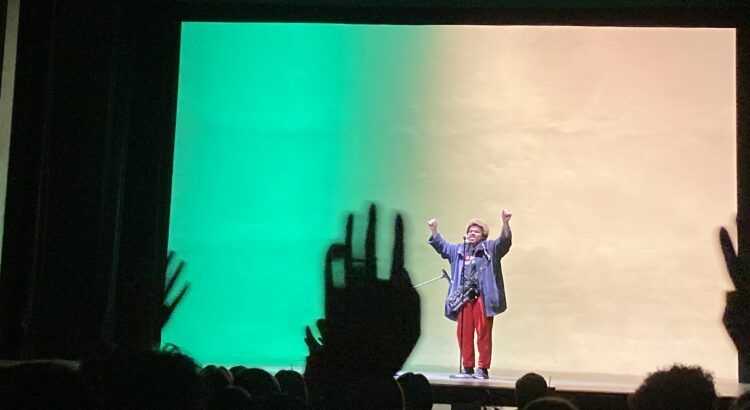
Outrage Dance gave an energetic and technically impressive performance that knocked the audience’s socks off, winning the Crowd Favorite Award. Trenton Michael (featured image) and his saxophone performed an upbeat, spunky, and honest original song that had the audience clapping along, winning him Most Original Performance.

My favorite act was probably Tola Kilian and Miguel Retto, who represented the Michigan Ballroom Dance Team with a performance of Pink Panther. The suave and sassy dance was truly a pleasure to watch, and reminded me of my days studying abroad and dancing the Tango in Argentina.

Tola Kilian and Miguel Retto of The Michigan Ballroom Dance Team

I left Michigan’s Got Talent moved by the talent of my peers, and glowing from the chance to catch and reflect the shine of my classmate’s creative expression. The opportunity to see students in the audience sit up from their velvet seats and show that they too had something to share, imparted a whispered awareness of the energetic creativity that hums in the people around you. Michigan’s Got Talent was a celebration of music, and of life. I think performers and audience members alike walked out of the theater feeling inspired, and a little more talented.

Music Matters hosts other events to promote the arts and music on campus. You can check out their instagram to learn about upcoming events like Spring Fest in April.

REVIEW: The Grown-Ups

Directing student Leah Block (BFA 24′) presents her senior thesis: The Grown Ups  by Simon Henriques and Skylar Fox. This effortlessly quirky piece revolves around a group of young counselors from a summer camp who are earnestly cultivating the next generation of camp-goers. The counselors all love camp! And all their camp traditions! Except for the racist ones…like the previous Indigenous name of their predominantly white cohort or the exclusionary structure of camp games (lending preference to older kids and men). But besides that, it’s all fine…..right?

New counselor Cassie joins for her first summer at the newly renamed “Indigo Woods” and meets the easygoing Lukas, high-strung (but well-intentioned) Becca, overly excited Maeve, and the odd and hardworking Aidan. The group indoctrinates Cassie, welcoming her and really  wanting her to have a good experience at camp. Each evening the group comes together at the campfire, recalling scary stories of their previous camp years, debating the best tactics to support the campers all while a national online argument is breaking out, shifting the political sphere of the world. Summer camp can feel isolating for some, (especially as their world is crumbling underneath them) and these young adults are now the “Grown Ups” in the face of crisis.

This cast was thoroughly cohesive and enormously charming. Each character was undeniably unique yet eerily resembling someone you’ve met before (probably from summer camp). Becca (Sarah Hartmus) and Aidan (Hugh Finnigan) were house favorites, with electric chemistry and sidesplitting comedic moments. I enjoyed both their attention to comedic timing and thoughtful physical acting. While I was drawn to Becca and Aidan’s characters specifically, I felt deeply connected to each counselor as an audience member. The way Henriques & Fox crafted their intimate dialogues made it feel as though I instantly knew each of these characters. The seamless flow of the actors’ choices among one another further enhanced the sense of familiarity. This ensemble was tight, with a deep-cutting emotional payoff in the end.

When I walked in, I was apprehensive of an in-the-round setting—a notoriously difficult set-up to direct for. But Ms. Block had perfected it and some. Her direction was personable and genuine, I felt like I was involved in all of the camp discourse, and ultimately a part of the demise. The in-the-round choice was brilliant for the storytelling aspects of this show, leaving another theater full of young adults to look inward at our place in a world facing escalating disasters.  Her vision was clear and cohesive, as so many poignant themes made their way out of the writing onto the stage, cultivating a really powerful performance.

Camp Counselor Leah taught us many things throughout our time at Indigo Woods: “Just because it’s the way we have always done it does not mean that it is the best way”, “comfort is the death of progress”, and “We can’t let resentment of not getting the world we want to stop us from leaving it better than we found it (Directors Note)”. She brought us all inside an idyllic summer camp and from there we were abruptly shot back into reality—perhaps that was the point of camp all along.


[Photo above depicts Sam Smiley as Lukas.] Photo thanks to SMTD’s Theater & Drama Dept.

REVIEW: Arbor Falls

Kicking off the 2024 season for the SMTD Theater & Drama department is Caridad Svich’s Arbor Falls. It is a more recent piece, premiering in 2022 at Illinois State University. Directed by Tiffany Trent, this reflective and quiet play invites the audience to reflect on themes of community, fear, and change. According to newplayexhange.org, this is the fourth time the play has been fully produced onstage.

Arbor Falls is one part of Svich’s seven-play cycle entitled American Psalm. The plot revolves around the members of the dwindling members of a church within a small unnamed town. The preacher of the church allows a passing traveler to stay in their church, and the town unforgivingly reacts with gossip and rejection. The traveler exposes the spiritual and moral values that lie within their society’s foundation, as a juxtaposition to their seemingly neutral spirituality. The town members pressure the preacher to send the traveler away, as the traveler does not immediately fit into the community. Each character is unnamed and un-gendered, named “Preacher”, “Traveler” or “Churchgoer”, so the presentation of characters in this show is quite flexible. The freedom of dialogue and character presentation within the script was apparent, and I can appreciate how each production of Arbor Falls would have its own nuances based on the performers and community.

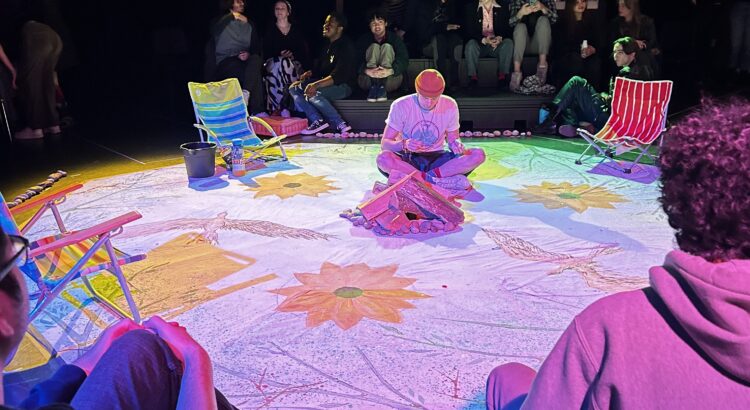
Set of Arbor Falls, Lydia Mendelssohn Theater

The set of the play didn’t entirely establish the environment of the town of Arbor Falls. I understood the simplicity of the townspeople’s viewpoints, their closeness to each other, and the dedication and importance of faith in their community, but I didn’t know exactly where we were (physically, or in time) from the assorted colors and textures. One enchanting aspect of the set was the courteous lighting shining through the top window. It functioned, to me, as the ounce of faith and hope left in the town. Which, is dwindling dimmer and dimmer, until a grand event near the end swoops the piece away.

The dramaturg team describes the play as “..an exploration of love, life, and the mess of all things human.” In my own reflection, this is an accurate description of the overall play, with the humble and morally conflicted Preacher, as well as the judgemental and pious Churchgoers. But moments after the curtain call, I found myself parsing through my memory of what actually had happened the last two hours. Svich’s poeticisms often fell short in terms of plot—their stillness and reflection were often lost to the audience. The story depicts itself at a lull through Act I, until an abrupt scene near the end, where the Traveler turns into a ghost(?) or eagle (?) flying away, absorbing the top of the window fixture. This abrupt moment made me question everything that happened before. This moment felt abstract for the groundedness that was created in the hour and a half before. The scene is still simmering in my mind—possibly the only moment that stuck.

Although, Svich’s blatant messaging regarding how communities treat outsiders was clear. She often explores stories of wanderers and the disenfranchised in her plays, connecting to her roots as a child of an immigrant. This relevant messaging shined through the rather monotonous performance.

The Department of Theater & Drama will present Anton Chekov’s The Cherry Orchard in the Arthur Miller Theater later this spring. Shows will run April 4-14. Tickets are available here.


Photo thanks to University of Michigan SMTD.