REVIEW: Chamber Jazz Ensemble

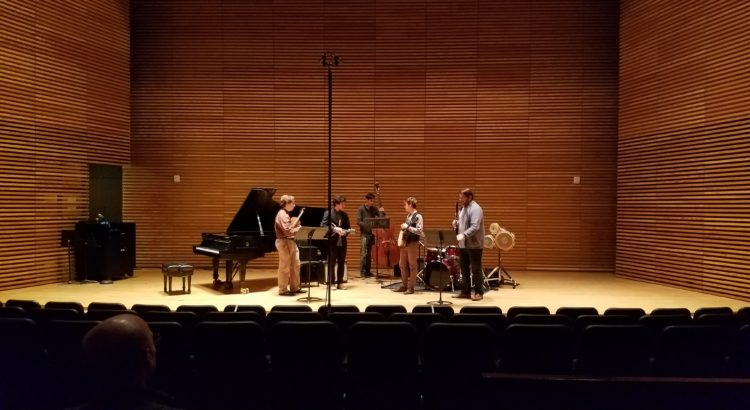
This was my first time going deep into the belly of the school of music theatre and dance for the chamber jazz ensemble performance. I said that I wanted to experience some new jazz and that is definitely what I experienced Monday night. The first ensemble (featured in the picture above) was definitely the furthest stretch from what I consider jazz. It seemed a lot more like a bluegrass group based on instrumentation as there was a violin, mandolin, and banjo in addition to the upright bass, drum set, and clarinet. They called themselves Knit & Wool which only added to their Mumford and Sons vibes. Their first piece was confusing. It featured a lot of clapping and latin vibes making it sound more like flamenco than jazz to my ears. There seemed to be so many pieces trying to fit together and I just couldn’t decide if it was successful in my mind. However, their second piece was amazing. The mandolin player composed the second piece which made it even more exciting and made me wonder if this strange ensemble had been formed as an experiment to test out his composition. The piece was beautiful, very melodic and meandering, successfully pulling together overlapping melodies without sounding chaotic. It felt like summer and adventure to me and I couldn’t help but smile throughout the show.
The second ensemble was very 50s jazz with a big band vibe, featuring sax, trombone, trumpet, guitar, bass, drums, and vocals. I’m generally not super into jazz with vocals, I tend to listen for the instrumental aspect of the music. However, I think the vocalist was my favorite part of this ensemble. She looked the part and her voice was beautifully interesting and jazzy. The two pieces they played were arranged by the performers themselves with the first being arranged by the trombone player and the second by the saxophone player. The trombone and trumpet players were both women and I love it when women play stereotypically masculine instruments. However, I was originally surprised when the trombone didn’t play a solo in the piece which she arranged. It became clearer to me after listening to the second piece when she played an extra long solo. The second piece was Cherokee by Kamasi Washington which I hadn’t heard before but I know Washington which made me feel like quite the jazz fan.
The last ensemble was not as printed on the program but we were all the better for it. They walked on the stage and instantly oozed “cool”. The pianist had an afro, long sideburns, and wore round sunglasses indoors making him look straight out of the 70s. They introduced themselves as the bassist (I couldn’t quite hear his name) and the minorities aka the bassist and the majorities aka, aka, aka… they had many different aliases. This ensemble featured piano, drums, bass, guitar, alto and tenor sax, and trumpet. The first piece that they played was so modern jazz. It was chaotic and dissonant and reminded me that I really do need to expand my jazz horizons. They threw me for a loop in the middle though when it suddenly changed to sounding like a classic jazz combo. I leaned over and asked my boyfriend if they had transitioned into a second piece without pausing because it felt so different. The piece eventually looped back around to its chaos before ending. The second piece really brought it home featuring the great trumpet player and guitarist. You could feel real synergy on the stage and knew that they enjoyed their instruments and playing together.
REVIEW: Tillirnanngittuq

Why is the UMMA so difficult to navigate?? If you aren’t looking at one of the main exhibits it is just a maze of half levels and random staircases. However, if you manage to find your way through and follow the signs for the Buddhism exhibit, you will find the Power family’s Inuit art collection. It is a fairly small collection, filling on room comfortably. Everything is one of two media, prints or sculptures. The first piece I saw entering the exhibit was a sculpture of two intertwined narwals with their bodes carved out of a beautiful, blueish granite and their horns out of ivory. This was probably the largest of the sculptures and certainly held a place of honor. I really like multi media sculptures; Degas’ dancer sculptures have always been favorites of mine as he uses ribbon and tulle to create a more realistic, and textural representation of his subjects. The Inuit sculptures utilized a similar technique by using ivory and horn to represent tusks, teeth, and horns on their sculptures. This added something extra to the art and made it feel connected with the real life animals that they represented.
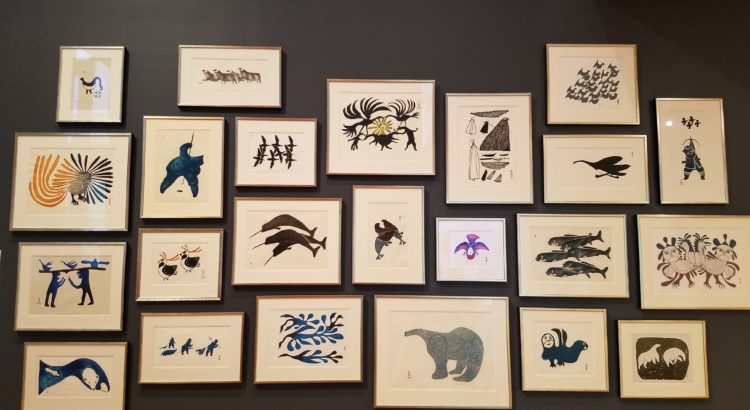
The other art form featured in the exhibit was prints. The gallery wall featured some twenty, framed prints of various hues and subject matter arranged on one wall together. Next to the gallery wall was a stone print block for one of the prints on the wall. I generally think of prints being carved on wooden blocks or maybe a plastic like vinyl but many of these prints were carved into stone or ivory. The prints on the wall mainly featured animals and fed into the general hue of the room as many were printed in black or shades of blue while the sculptures were mainly carved out of stone on the black and blue color spectrums. The prints were interesting individually but also as a collection altogether. Many of the prints featuring birds were at the top while polar bears were at the bottom. To my mind, they were roughly arranged so as to put predators at the bottom and prey at the top. Two prints in particular were placed alongside each other creating a story. One print featured a flock of birds while the print next to it featured a smaller flock of similar birds and a hunter with a bow pointed at the birds above them. This interplay between the prints really displayed the beauty of good curation as those prints did not seem to be made by the same artist or necessarily intended as a pair but added something to the gallery when featured as such.

PREVIEW: The Six Senses of Buddhism

This exhibit is currently in UMMA and will be there until June 30, way past the end of the school year.

What is meant by the sixth sense is the mind, which for those unfamiliar with Buddhism is closely represented as enlightenment. The mind of the Buddha is what Buddhists train so hard to obtain, through sutra’s, meditation, and basically every other practice.

If you want a more involved experience with this exhibit than simply strolling through and looking at the art, UMMA is hosting many events like conversations, demonstrations, and tours in this exhibit. Go to UMMA’s website to check it out.

I know Sat May 11th, 1:30-2:30pm there is a demonstration of a tea ceremony in the exhibit and right afterwards at 3pm-4pm there is a group conversation which will shed some light on the artwork.

PREVIEW: Change Our World (Slam Poetry)

Poetry has long been a medium that puts words to the indescribable. It can be used to explore the feelings that exist amorphously, from the most complete pains to immense elation. It draws together seemingly unrelated pieces of life and brings light to ideas that we may otherwise glaze over in our striving for a normal life. Further still, slam poetry combines this style of writing with a moving, lyrical flow that resonates with a wider audience, adding in a most earnest emotion to the already poignant stanzas.

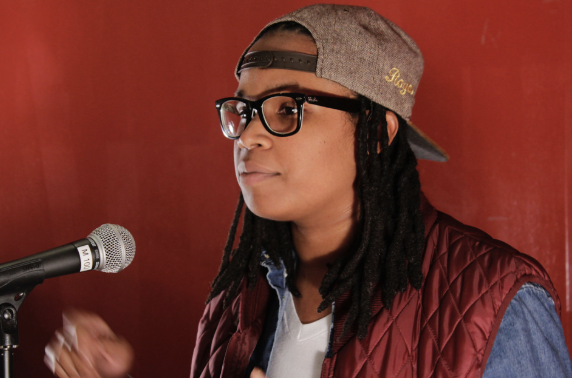
The U of M Slam Poetry Competition group and Roya Marsh are coming together to perform their work Wednesday, April 3rd at Rackham Auditorium. Come snatch a seat at 7 pm and prepare yourself to gain new perspectives on social justice issues that plague our existence. Admission is free for students and faculty, and staff!

Image result for poet

REVIEW: Alcina

This was my first time seeing a full opera performance, and unlike the guy next to me who kept dozing on and off, I loved it. I was captivated from the very beginning which had a very eerie feel, flashing lights, people still like statues, and the orchestra playing fervent music.

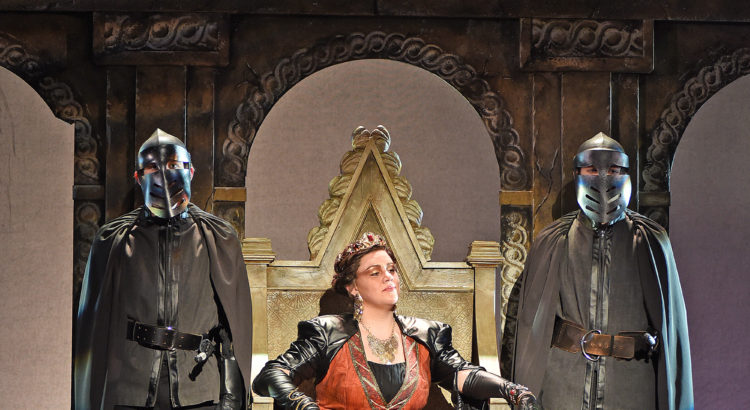
The scenery and outfits were awesome. I got the impression that the island was beautiful, but with an artificial non-natural sense of beauty. The colors felt fluorescent, rocks and landscapes were too symmetrical, and animals had a ghostly-dead look to their face. This was fitting, because the island is supposed to have a false sense of beauty cast by Alcina. The costumes of the characters were very bold. When they first meet Alcina, her court is filled with interesting costumes; people in masquerade masks, Trojan knights, and what looked like a holy Legolas dressed in all white. My favorite scenery design was the purple flowers that would overhang from above because of the different uses they created with these flowers. Depending on the lighting, it would be a beautiful array of purple flowers above, or simply tree overhangs representing the forest, and if the lighting was very dark it would represent a spikey cave or rock formation above.

My favorite character was Ruggerio because of how amazingly feminine his voice sounded, and how well he acted the part of a naive but entitled and faux-macho character. The whole time Ruggerio had this smug sly face that had an air of cockiness to it. In reality, he was kind of a fool, who was so easily tricked by Oronte, and after breaking out of Alcina’s spell still couldn’t recognize Bradamante.  It was fitting he always looked foolish with long blond hair and pure white or gold clothes. When he would beat his chest or put his hand on Bradamante’s shoulder, I would laugh from how ridiculous the actor acted. I am curious about the exact meaning of Ruggerio having such a high pitched voice.

Oronte had a classically beautiful voice. It was soothing and clear, which was interesting because Oronte is a bad character for most of the play. Immediately I could tell Oronte was a bad character, he had a scar above his eye and was dressed in all black, so it felt unfitting that his voice sounded heroic and good-natured. In the end, Oronte goes against Alcina and becomes good, so in this way, his voice was foreshadowing. He is also a true lover, he always deeply loves Morgana no matter how she hurts him, and Oronte’s voice sounded like a true lovers voice. Every actor had an amazing operatic voice, but what also stood out to me was how gracefully Morgana was able to waver her voice and how great Melisso’s bass/baritone voice was.

Thankfully we had English subtitles case above the stage. For a three hour opera, there is actually very little dialogue, because the same word or sentence will be repeated continuously for three minutes. I was confused because it didn’t sound like the exact same sentence was being sung over and over again. Also, when words are being sung in operatic fashion, it takes a lot longer than it would to speak the same words.

I am not an expert on Handel, but I know that his music is known for sounding royal and regal. In this opera, the wavering voice was the main vocal instrument. Especially when a character was in love, every word they sang would have a vibrato, which often gave a richer tone. Again Morgana did a phenomenal job with this. The main instrument was the harpsichord, which is like an organy sounding piano. The harpsichord would play the whole time, often being the lone instrument while actors sang. The orchestra would support the harpsichord or play when there wasn’t any singing going on.

PREVIEW: Julius Caeser

This year I have been transformed into a Shakespeare fan and this will be my first time seeing Julius Caeser. This showing is a 1960’s twist of Julius Caesar, which usually takes place in ancient Rome. It is during the time when Kennady was assassinated, for those familiar with the Julius Caeser you should be able to see the connection. There will also be a live jazz trio for the show.

This show was directed by Arthur Nauzyciel of the Théâtre National de Bretagne in conjunction with the American Repertory Theater. Which basically means it’s going to be a very high-quality show.

See it Friday, April 5 or Saturday, April 6. Both shows at 7:30 pm the Power Center.