PREVIEW: The Lute: Cai BoJie (Chinese Opera)

FREE performance of traditional Chinese Kun Opera. I attached a link with more description and the RSVP to claim free tickets. The show is Saturday, April 13, 2019, 7-9:30pm, at the Michigan Theater. The Suzhou Kunqu Opera Theater of Jiangsu Province, China is coming all the way to Ann Arbor for this performance.

I cannot stress how special this event is. This is probably your only chance to see a traditional Chinese opera show if you don’t actually go to China. Even if you go to China, it is hard and expensive to see a show of this quality. This is the Confucius Institutes last event before they leave U of M, which is why it is so spectacular.

http://www.confucius.umich.edu/event-details/the_lute/ (Link for free tickets)

PREVIEW: Chamber Jazz Ensembles

Be sure to make it out for tonight’s performance of the school’s chamber jazz ensembles. The performance is at 8pm in the Stamps Auditorium of the Walgreen Drama Center. The event is totally free as one of the School of Music, Theatre, and Dance’s over 900 annual shows. The college offers many different opportunities students and faculty from both within SMTD and without to participate in chamber ensembles of various size, genre, and difficulty level.
I’m excited to go to this performance as an amateur jazz lover always looking to expand my knowledge and taste in jazz. I’m hoping for there to be a big band style ensemble as I’m hoping to branch out a bit from my typical taste in jazz which is mostly smaller ensembles from around the 1950s. Most of my experience with modern jazz has been Kenny G or the horrible “watercolors” smooth, elevator jazz station my parents love, so my impression of jazz after the 1960s is generally abysmal. I know that there has to be good modern jazz out there though so hopefully this performance will be a step in the right direction and introduce me to some new sounds and composers.

REVIEW: Wang Qingsong/Detroit/Beijing

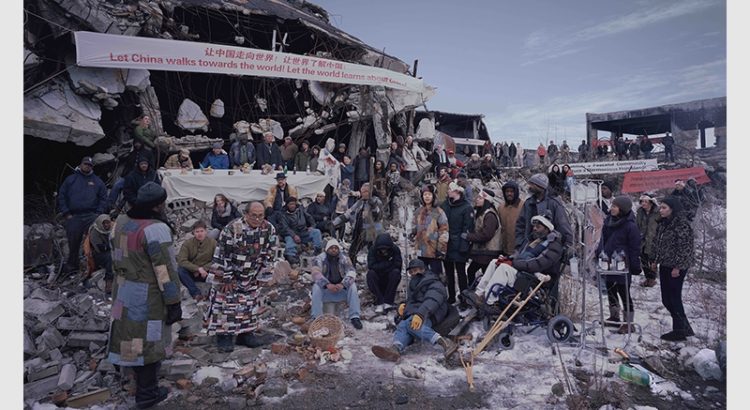
The corner, glass exhibit of the UMMA always holds something new and exciting. Watching it change from season to season is a small way that tired students passing by can experience a little bit of art. When the giant moon balloon was deflated and taken away bright, Chinese writing began appearing on the glass. Like many of my classmates, I was curious what lay inside and took time to venture inside. The Wang Qingsong/Detroit/Beijing exhibit is a recreation of a 1959 drawing by Wang Shikuo. This drawing told the narrative of peasants uprising against their landlord and claiming their rights to the land. Qingsong’s photography project recreates this narrative in Highland Park, a small city in the heart of Detroit. The project was originally meant to be recognized in Beijing but after visiting Michigan the artist was inspired. The exhibit itself features the final photograph and components of the journey to creating it. The Chinese phrases on the glass walls are taken from banners featured in the photograph while the two garments in the center of the room are also featured in the photograph. One garment is a coat in a traditional Chinese style but the fabric is made from a patchwork of American and Chinese clothing tags. The other garment is the bloodstained shirt featured at the center of the photograph. The project is meant to create unity between the communities of Detroit and Beijing in a conversation about capitalism and activism. The photograph is set in an abandoned Highland Park factory and features over 70 volunteers including locals. My favorite aspect of the exhibit was the coat made of tags. It was a great detail that really accentuated the power of consumerism on society.

REVIEW: Sounds from the East to the West

Two of my recent musical passions are classical music and Chinese pop music. Recently I have been listening to Johannes Brahms second symphony and the Chinese band Sodagreen. This concert wasn’t a blend of classical music and Chinese pop music, but it is a western take on Chinese music.

Grace came out to play the first song in a beautiful red dress. What was most interesting about this first piece is that Grace played with only one hand. I am not sure if this is how the piece is supposed to be played, if she was showing off, or was doing a technical exercise, but I can only imagine it is easier to play any song with two hands. My favorite song by Grace was the second song she played Jasmine Flower Fantasia because of how different her right and left hand played in this piece. Her right hand played a peaceful quiet background which sounded like raindrops while her left hand more forcefully played the actual melody. Her left hand reminded me of someone busily basking away, if that makes any sense.

Grace’s style in this concert was very focused around emphasizing loud notes. It was like she would just buildup until she hit a few key important notes and then would start again. For the piano the loudness of the note played is extremely important. Whether the note is banged by a hand crashing down or carefully pressed by a finger makes it a completely different note. This is what I think distinguishes the piano most from other instruments like the guitar.

Oliver Jia was a piano master. He style was fast and quiet. I am not sure what the technical term is, but he would hit a few notes very fast so it sounded like musical notes in a flurry. When doing this if he messed up one note or missed the tempo, it would be a very apparent mistake, so thankfully he played this perfectly. A lot of his songs had a showtooney feel to them, which I assume was the western influence. My favorite song Oliver played was The Bright March in Liu Tianhua Impromptus. It really sounded like a march.

The second half of the performance they played together. Even though I had my wisdom teeth pulled the day before, I felt extremely comfortable sitting there and listening to the beautiful music. Classical music brings up emotions in me that I can’t communicate with words. It was a remarkable performance and I was very happy to see a standing ovation at the end.

REVIEW: Roulette

This show is like watching a cool dialogue between a couple that easily could be you and your significant other.  There are only two characters in the whole play, a girl and a guy in a relationship. The whole play is in one scene, their apartment, and there is very limited use of props. In fact, the actors themselves did all the scene setting themselves. I enjoyed this because it made two aspects of the play super important, the dialogue and the relationship between the two characters. These were all the substance the play had, so if the dialogue wasn’t clever and well-written, and the relationship between the guy and girl was poorly acted, the play would have been miserable to watch, which it wasn’t. Sometimes cool props and extras running around just make for a pleasant distraction from the intense moments of the play. This play felt intense and that was because the actors did a phenomenal job.

I enjoyed that the male part was loaded with poetic and deep lines. He also had an amazing voice that sounded so genuine when he spoke. After many of his romantic lines I would anticipate the couple to kiss, only to see an intense look and then another question asked. Finally, the kiss did happen after he said the most important lines for the first time “I love you” ironically after a story about puking.  My favorite dialogue during the play was when they were talking about how ” oh uh ya” is more like a no than a yes. This part was funny and made me realize concretely “oh uh ya is not yes”, “yes is yes”. The actor did an awesome job of acting when he was talking about his previous assault as a child. All of a sudden he felt very vulnerable and insecure from the way he held his leg and gave quick one word replies.

I enjoyed relating to this play as I am sure anyone who has ever gone through a relationship or breakup has. The line that really stuck with me was when the guy asked “Do I hurt you more often than I make you happy?” because this is a question I always contemplate when I am dating someone. The female role also reminded me of how I feel my significant others talked. I could tell that the play was co-written by a girl and a guy because the feminine and masculine roles were defined really well. Throughout the play the girl and guy had different ways of presenting information and used different nuanced language that really felt authentic.

The couple was portrayed to be a few years out of college working adults, but the vibe I got was definitely an immature college relationship vibe. The way they joked around with each other and how they would talk at times made me think I was watching a college relationship. However, the actors both being college students definitely biased my opinion.  For the final vodka shot that was taken, the acting was good, but I was confused about why it was drunk. I felt that it was less clear and had less build up than the previous five shots. Unless this was intentional, I think there needed to be more dramatic substance leading to the final shot and more suspense about whether it will be drunk or not. It kind of felt out of the blue and sudden, which took away a lot of potential suspense.

It was interesting how insignificant the play made the fact that the couple shared different religious values. The boyfriend even said he doesn’t believe she will go to heaven because she isn’t Christian. I was expecting this to escalate, but not only did they not take a shot over religion, they didn’t even seem to have any friction over the topic, it just led to some playful joking around. I guess in modern times shared religious values is becoming less and less significant in relationships, and the writers realize that.

The play was very good and well-written, especially for college students. The dialogue was clever, relatable, and realistic. However, a dialogue is really what the play was, there wasn’t much plot or character development or creativity in this sense. In the end, I enjoyed watching it, but it isn’t a play I would want to watch a second time.

REVIEW: Alcina

The principal challenge of directing Baroque opera for a modern audience is, I think, the prevelance of the Da Capo aria. Da Capo arias are, in short, arias that take an ABA form. A main A section, followed by a contrasting B section, followed by a repeat of the A section, which some people feel should be ornamented with improvisations by the singer, and others feel should be sung exactly as notated. In a modern music theater mindset, we expect songs to get us from point A to point B, and the fact that so many arias in Baroque operas very specifically end with a return to the beginning seems counterintuitive to making them dramatically compelling. Of course, Handel in the 18th century wasn’t writing for a modern music theater mindset, and audiences in the 1700s approached operas very differently from how we approach them today. Meaning that sitting through contemporary productions of Baroque operas can be a real slog a lot of the time.

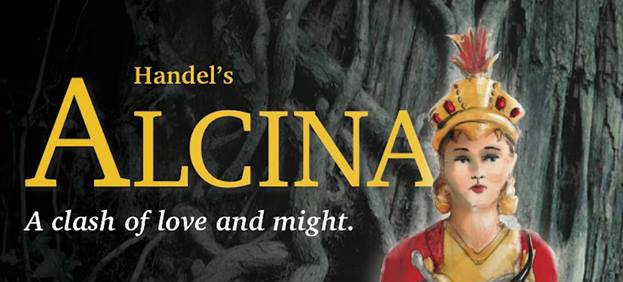
Alcina is one of George Frideric Handel’s more popular operas today, and when I heard that the University opera department was going to take a crack at it, my interest was immediately piqued, hopeful that the production would be able to thread the needle that is making Baroque opera compelling to a modern audience without compromising the elements that make it unique.

But first, a summary.

Alcina starts with Bradamante arriving at the island of the sorceress Alcina. She is disguised as her brother, Ricciardo, and has come to rescue her betrothed, Ruggiero, who has fallen under Alcina’s spell. Alcina is in the habit of seducing men who wash up on her island, and when she tires of them, transforming them into local wildlife a la Circe. Bradamante is accompanied the tutor, Melisso. The first person they meet on the island is Alcina’s sister, Morgana, who becomes infatuated with “Ricciardo,” which provokes the jealousy of Morgana’s suitor Oronte. Bradamante and Melisso succeed in finding Ruggiero, but he is so thoroughly under Alcina’s spell that he rebukes them. Meanwhile, a young boy called Oberto is on the island, searching for his missing father, whom Alcina has already transformed. In the rest of the plot, Bradamante and Melisso try to rescue Ruggiero from Alcina, while Morgana and Oronte work out their jealousy, and off on the side Oberto tries to get Alcina to show him his father.

And now, a review.

Right off the bat, this production was gorgeous. Gorgeous sets, gorgeous costumes, gorgeous lighting, even a pretty nifty-looking pre-show curtain. The look was very lush, but very stately, and reminded me of really old-school Jean-Pierre Ponnelle-style productions. It is a good look, a classic look, and one that works really well for this style of opera. I don’t think I can overstate how stunning the look of this production was, and the visual aspect was maybe of all aspects the most appealing.

The musical quality too was top-notch, as one would expect from the School of Music, Theater, and Dance. A phenomenal cast of singers (admittedly, I have only seen one of the two casts), and a wonderful orchestra lead by Stephanie Rhodes Russell. I did note that the orchestra was rather larger than Baroque opera typically calls for. Baroque opera often thrives with lighter voices which can sometimes get drowned out by a too-large orchestra, and it seemed that was sometimes the case here, but on the whole, the musical aspect of the production was excellent.

Unabridged, Alcina can run upwards of four hours. I estimate about an hour of material was cut from this production in an effort to get it down to a manageable length. Usually a three-act opera performed with two intermissions, this production had a single intermission inserted near the end of Act II, with the second half of the performance picking up with the last scene of Act II and going into Act III. It was a lopsided arrangement, with the first half of the evening being nearly twice as long as the second, which did make the first half somewhat fatiguing, especially as it had not only the length of two acts, but the dramatic content of two acts, which needs some time to be digested.

I had expected that the bulk of the abridgement would be in the form of cutting sections of Da Capo arias, and also trimming recitative, which turned out not to be the case. Oberto lost the largest chunk of his material (which had the side effect of making Alcina less villainous, as Oberto’s main function in the plot is to provide a victim for Alcina to antagonize so that the audience knows she’s evil), but I was surprised that as many Da Capo arias were kept entirely intact as there were.

The big problem with Da Capo arias (especially those as long as Handel writes) is how can you stage them such that by the end we feel something has actually happened? Does the aria progress the plot? Reveal something about character? Act as a signpost for an important turning point in the story? And what is the character’s reason for returning to the top of the aria? The very form makes this difficult, and I’m not going to try and be a purist and say all of Handel’s Da Capo arias are always one-hundred percent justified. Handel lived three-hundred years ago and these operas were written for a very different theatrical environment. I really think that, when presenting a baroque opera for a modern audience, there is no shame in trimming down a Da Capo aria if you can’t find a way to make it dramatically compelling.

So, yeah, a lot of the longer arias in this production were pretty stagnant, I might even go so far as to say boring. There was a lot of unmotivated standing and singing, or unmotivated wandering and singing. Sometimes it seemed that characters forgot to whom they were adressing an aria, or why they were even singing it in the first place.

Bradamante’s “jealousy” aria in the first act was one that stood out to me, because that’s one that I think very easily can be incredibly compelling, and reveal something about Bradamante’s character, but here it just wasn’t and didn’t. But most of the arias that I found stagnant were ones that I recognize are difficult to pull off theatrically, so mostly I just wished they had been trimmed down.

On the other hand, there were also arias that really really worked! Oronte and Morgana were the two most engaging characters, probably in no small part because their subplot is arguably more interesting than the main plot with Alcina and Ruggiero. Oronte is a character that I have never really liked, but in this production he was maybe the biggest highlight, and, in a novelty to me, managed to be really funny and shockingly entertaining without compromising the overall serious tone of the opera.

The interpretation of Morgana in this production was also new and interesting to me. I’ve seen her played very innocently, almost childishly sometimes, and, most notably, I have seen her played (and have typically interpreted her myself) as being as much a victim of Alcina as anyone else in the opera. (Which is why I’ve always felt that Morgana getting vanquished along with Alcina at the end is really unwarranted and unfair.) In this production, she was definitely still a more likeable and more fun-loving counterpart to Alcina, but she was also very clearly conscious of her own actions and had agency — she even carried around a sword in the first act, and used it! So this production loaded her with a bit more responsibility for her own actions, which at the same time lessened the villainous aspect of Alcina much in the same way reducing Oberto’s part did, since Alcina didn’t really seem to be excersizing any control over Morgana here.

All this considered, I still found Morgana the most likeable character in the opera, and I still feel her being vanquished at the end is undeserved. And I think it’s great that, between Morgana and Oronte, this production really managed to maintain two complex and morally ambiguous characters who were both still really likeable and fun to watch on stage, again without compromising the overall tone of the opera.

I don’t mean to diminish the other players. Bradamante, Ruggiero, Melisso, Oberto, and, of course, Alcina, as important pieces of this opera, and, considering the difficulties of Baroque opera previously mentioned, were about as well executed here as I’ve ever seen them. It was with Morgana and Oronte, though, that this production really went above and beyond, and I wish that Handel and Riccardo Broschi (the librettist), had given them the ending they deserve. I have said in the past that this opera does not deserve Morgana, and that Morgana deserves a better opera. This production confirms that for me, and adds Oronte to the list as well.