
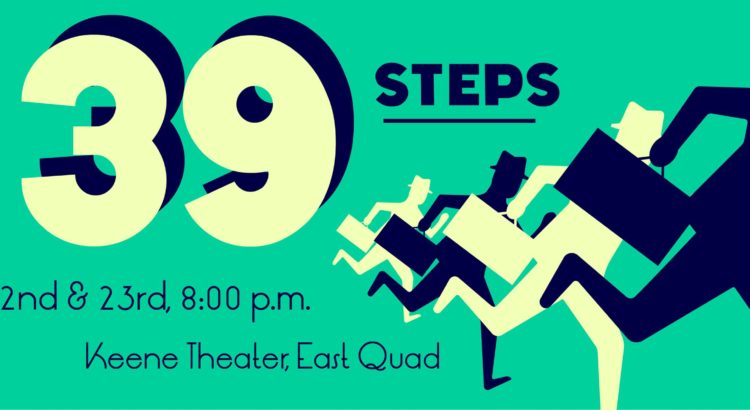
REVIEW: The 39 Steps

When an evening at the theater goes horribly awry, Richard Hannay finds himself on the run from the law, and before long in the depths of an international conspiracy which he must uncover in order to clear his own name. Needless to say, hilarity ensues.

***

Some things in life are deceptively simple. For example, figuring out whether or not “deceptively simple” is the appropriate term to apply to the thing you are about to describe, because “deceptively” is a terrible adverb that you should never use as long as you’re trying to communicate clearly and unambiguously. (“Clearly” and “unambiguously,” on the other hand, are both model adverbs.)

Another thing that is deceptively simple — that is — appears to be simpler than it actually is, is Patrick Barlow’s The 39 Steps. This not to be confused with Alfred Hitchcock’s The 39 Steps, or, god forbid, John Buchan’s The 39 Steps. Patrick Barlow’s The 39 Steps is a reworking of Simon Corble and Nobby Dimon’s The 39 Steps, itself an adaptation of Hitchcock’s, in turn based on Buchan’s. I cannot speak to Corble and Dimon’s interpretation, but Barlow’s interpretation of their interpretation is a Monty Python-esque reimagining of Hitchcock’s spy thriller, which calls for four skilled actors, and not much else. Sets are kept minimal by necessity, as the play changes location on a dime, and and costumes are sometimes limited to an array of jackets and hats, as they need to be changed even faster. It is a play which practically seems designed for small-scale community theater, due to its lighthearted nature and apparently low technical demands. But this is by no means easy, and retelling an entire adventure novel with just four people can leave one short of breath.

The RC Players, whose production of The 39 Steps opens March 22nd at the Keene Theater in East Quad, have assembled the requisite cast of four funny people. Sushrut Athavale leads the cast as the pencil-moustached Richard Hannay, cool and quippy, though not himself immune to comic outbursts, Hannay is the perennial leading man, and, to this end, Athavale is the only actor who plays just one role through the entire performance. In a farce, it is easy to forget about the straight man, who acts to ground the antics of the more absurd characters, but the role is one essential to the genre, and requires a comic talent of its own which Athavale certainly possesses. He is opposite Maria LoCicero, who first appears as inciting-incident-on-feet Annabella Schmidt. Once Schmidt’s plot utility is exhausted, LoCicero portrays two other characters, the Scottish Margaret, who, like Ms. Schmidt, is something of a one-scene wonder, and Pamela Edwards, the persona in which the actress spends most of her time on stage. Still, all three characters fall under scrutiny, and LoCicero does a marvelous job portraying each as distinct and uniquely entertaining.

Athavale and LoCicero are joined by JD Benison and Nicholas Megahan as the two aptly-named Clowns, who portray between them literally every other character in the play. They change their voices and costumes seemingly every sixty seconds, sometimes more, sometimes even handing characters off from one to the other in a daisy chain of hat and jacket switching. They certainly have the flashiest parts of the play, and the quick-paced broad comedy that characterizes many scenes rests squarely on their shoulders.

There is one element inherent to farce which I cannot review for myself, and that is how live comedy feeds on the audience. The broader the comedy, the more it feeds. To that end, the cast in a farce must always be on alert, careful to time their jokes to the tempo of the audience they have any given night. Thus a farce will always be continuing to find its shape, and the actors must be up to the task. Without seeing every performance in this run, I cannot say whether they are or not, but my strong suspicion is that they absolutely are.

The 39 Steps has a metatheatrical element to its comedy as well, which was splendidly executed throughout. Director Sam Allen has done some wonderful space work, which was perhaps most notable in a scene set on a moving train. I do not wish to go too far into it lest I give anything away, but let it be said that both the interior and exterior of the train were perfectly embodied and practically visible in what was, in fact, empty space, which had an exhilaratingly comic effect. In some ways, the less-furnished scenes were more impressive than the scenes that had a full contingent of chairs, tables, windows and doors, because the less that is literally portrayed, the more the cast and creative team have to come up with inventive and humorous ways to convey the same information to the audience. Suffice it to say that the bits of comedy which leaned on the fourth wall were, I thought, the most humorous moments. One moment which was very funny, but which I wish had been leaned into even more, was a moment near the end of the play where even the actors playing the characters seem to get in on the comedy, the actors themselves becoming characters, bringing us to almost Brechtian levels of verfremdungseffekt.

Speaking of meta-comedy, if I can make one nerdy nitpick, it is that the references to other Hitchcock films which litter the play (for instance, one character refers to the “Rear Window” of a house) were, with the exception of one, entirely played down, unemphasized, and, if I recall correctly, in one instance cut altogether. Now, I will be the first to say that the exclusion of reference humor is hardly something that should hamper one’s enjoyment of the play. I have myself criticized plays for relying too much on reference humor, which is exceedingly audience-dependent and often awkward to pull off. At the same time, given the abundance of jokes of all sort in The 39 Steps, (if you don’t get one joke, there’ll be four more in thirty seconds one of which you will) I don’t think the relatively small amount of reference humor works against it, and I don’t think it hurts to lean into it in this instance. On the other hand, this is a very minor nitpick, and will also only be noticed by the extreme Hitchcock geeks in the audience who also happen to have seen or read this play before. Which, for this production (though I haven’t done the demographic surveys) is probably a relatively small percentage.

In short, if you enjoy the movies of Alfred Hitchcock, and/or the comedy of Monty Python, and/or just want to enjoy a fun evening at the theater that doesn’t take itself too seriously, The 39 Steps is a brilliantly-written farce, very well executed by the RC Players. (In fact, it is all those things even if you don’t like Hitchcock/Python/fun evenings at the theater. But I don’t see why you wouldn’t.)
Preview: David Wilcox & Beth Nielsen Chapman

This show is at The Ark (316 S. Main Street), which is one of the best music venues in Ann Arbor. It is a small, intimate location that still attracts big names. Also, the Ark is non-profit, which is always respectable. This show is March 28th (Next Thursday) at 8pm.   Tickets are $20.

I’m super excited for this show because it combines pop and country music. These artists don’t have a history of performing with each other, which will make an interesting dynamic on stage.

Beth Nielsen Chapman is an accomplished musician in the Songwriters hall of fame with seven number hits. David Wilcox has been producing albums and writing music for movies since the 1980’s. Whereas Beth Nielsen Chapman is a country and pop artist, David Wilcox focuses on folk music.

Here is a song by each artist to check out:

REVIEW: Value the Voice

The UMMA auditorium was a beautiful venue for Value the Voice. Each storyteller had a different color spotlight which seemed almost hand-picked for the stories they shared. The theme for this event was “The Shoulders of Giants” and each storyteller had a very different kind of giant in their life. The stories were both heartbreaking and uplifting as I had expected going into this event. The fact that this event was put on by the Department of African and Afro-American Studies and the Comprehensive Studies Program meant that the crowd was on the smaller side but very tight-knit with many of the crowd members knowing each other. It was obvious which storytellers were community figures based on the vigor with which the crowd screamed and cheered when they were announced.
The first story was bathed in bright pink and centered around a freshman’s experience with her mother’s body dysmorphic disorder. She told us about a life with two mothers, one that was absent in some ways but present in many others. Her mother’s disorder often prevented her from attending school events or even leaving the house in general and sometimes led to conversations spoken through doors due to her anxiety with being seen. However, she was always present in her daughter’s life in one way or another whether it was through the lunches she packed for her everyday or being the first person to hug her after graduating from high school.
Another story that resonated with me was the second to last story about a senior’s experience losing many of her giants. She described growing up in Detroit, working Saturday’s at her family’s Eastern Market flower stand, and the friends and family that she made in this community. She told of the teacher that bought a bouquet every weekend and paid for her and her brother to go to a dinner with Trayvon Martin’s parents and a local businessman with a roll of cash that always tipped her and her brother separately so they didn’t have to split it with the shop. The storyteller later shared that she had lost all of these giants she talked of so fondly. The most heartbreaking part of her story was about a dear friend that she described as her soulmate (in a non-romantic way) and his suicide only a year or so prior. As her voice faltered with the emotion of the loss she shared the crowd snapped in support carrying her through to the end. Despite all this loss, she told us of the airplane earrings she wore to remember her friend who had wanted to be a pilot and the fact that she would be graduating this Spring.
Value the Voice is the perfect name for this event as that is what it promotes, putting value in the stories and wisdom of our community members and allowing us to create supportive spaces where we can share with and learn from others.

PREVIEW: Exhibition of Art by Michigan Prisoners

The Prison Creative Arts Project is putting on its 24th Exhibition of Art by Michigan Prisoners as of March 20th going until April 3rd on North Campus in the Duderstadt Center Gallery. The Prison Creative Arts Project (PCAP) is a University of Michigan collective composed of students, faculty and staff, and community members that are passionate about connecting the Umich community and those affected by the justice system in artistic collaboration. Their members included both youth and adults that are currently in detention facilities and have past experience in the carceral system. Students and faculty members participating in PCAP visit correctional facilities across the state of Michigan every year to collaborate with prisoners on their art, promote art communities in correctional facilities, and select pieces to display in the annual exhibition. PCAP is centered on the fundamental value that anyone can create art and using the connections art can build to create bonds and foster learning between its participants. This art exhibit is one of the biggest of its kind in the country and is continuing to expand. This year PCAP will be offering audio commentary in conjunction with the exhibit which visitors can access with their phones. Further, PCAP has partnered with the local restaurant, Detroit Filling Station, where they had their launch party. Beyond the dates of the exhibit in Duderstadt’s gallery, pieces from this collection will be on rotating display in Detroit Filling Station to further engage the community in their project. I’m excited to see this exhibit and experience the ways experience in the carceral system affects artistic work.

Image courtesy of the PCAP website.

PREVIEW: The 39 Steps

A raucous reimagining of Hitchcock’s thriller (which requires no prior knowledge of Hitchcock to enjoy), The 39 Steps comes to Ann Arbor courtesy of the RC Players, who will perform this comically thrilling (and thrillingly comic) play March 22nd and 23rd at the Keene Theater in East Quad. Suggested ticket price is $5.

PREVIEW: Value the Voice

Value the Voice is a moth-style story-telling event series on campus that has been going on since Fall of 2017. The event is co-sponsored by the Department of African and Afro-American Studies and the Comprehensive Studies Program and draws on the long and significant history of story telling stemming from West African culture. Each event features a different focus and students, faculty, alumni, and community members are welcome to come share their stories. This week Value the Voice is focusing on the theme of The Shoulders of Giants. The event will take place in the University of Michigan’s Museum of Art basement auditorium at 7pm and is open to all. I’m curious to see how the nature of the sponsoring programs will influence the nature of the stories shared and the audience at the event, also how its location in the UMMA might influence the ambiance of the event. I’m excited for this event as I have been interested in attending Moth events in the past but never been to one. I once attended a podcast recording which featured individuals in the STEM community sharing their experiences with the intersection of the STEM field and their personal lives. After attending this event I’m excited to see how Value the Voice and see how the stories of people in my community will resonate with me and teach me about those associated with my school