REVIEW: Yangqin Sonorities and Styles

Shoutout to the Confucius Institute for hosting another awesome traditional Chinese music performance.

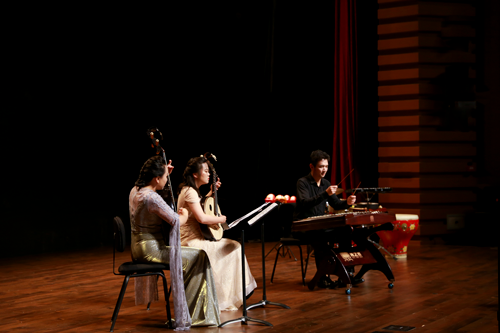
Through 11 beautiful classical Chinese songs I got to hear many beautiful Chinese instruments: the yangqin, zheng, erhu, ruan, pipa, and of course percussion (Look these instruments up they’re all super cool). I was able to hear the instruments play songs on their own, and altogether as an orchestra.

The focus of the night was the yangqin, which is an instrument unlike anything western culture. In western music, most of our classical string instruments just seem to be bigger versions of each other: violin, viola, cello, bass. Chinese music has so many varieties of string instruments and the yangqin is one of the most unique combining a string instrument with percussion. The yangqin’s control over tempo while having the sound of a beautiful string instrument is so special.

I enjoyed that the whole night focused around the yangqin because I was really able to pay attention to the special techniques of the yangqin and listen to how other instruments support the yangqin. The yangqin player Xie Jun is an award winning yangqin player, and I was able to see many masterful techniques I had never seen before. The yangqin is played with a drumstick striking the strings. For the first time ever I saw Xie Jun pluck strings with his fingers, brush the drumstick across the strings to silence them, and use the butt-end of the stick to strum the strings.

Xie Jun really was a master. He didn’t use sheet music for any of the songs and even closed his eyes most of the time that he was playing.  This means he didn’t just memorize the pieces but has practiced them so much he has enough muscle memory to not have to look at the instrument while playing.

This was my first time hearing a zheng live. The zheng is one of the coolest instruments I have ever seen. It is similar to a harp, but it a pressure based. The strings are hoisted by a bridge about halfway of the string and while one hand plucks the strings, on the other side of the bridge the other hand bends the string into the note desired.

My favorite song was the 10th song played Spring at the Heavenly Mountain, because of how the erhu complemented the yangqin. I felt a story being told that involved religion and flying insects. The erhu in Autumn Lyrics had a scratchier and whispery sound, which was also very beautiful. It reminded me of a wailing ghost.

The most disappointing aspect of the show was the audience.  There were around 30 people there, which considering we were in Mendelssohn theater meant we filled about 5% of the theater. It felt embarrassing to have such a small audience for a group of master musicians.  I’d like to say that this was because of the snow and cold weather, but I never students at cultural events void of free food or their friends performing. Half the cultural shows I attend I feel as if I am the lone student there, representing U of M. I know Michigan students like drinking, over studying, and wasting time on their cell phones and it’s disappointing that so much culture is going to die in this next century. I’m so fortunate that the University of Michigan and Ann Arbor still likes to host cultural events for the few of us that appreciate it. The few of us that were at this show enjoyed it so much we were able to get a double encore out of the orchestra.

PREVIEW: Hopwood Awards Ceremony with Natasha Tretheway

The esteemed poet Natasha Tretheway will be reading at the Hopwood Awards Ceremony tomorrow Jan 30 from 6-8:30 PM in the Rackham Auditorium. Her work has won many accolades from the Pulitzer Prize to longlistings for the National Book Award. Tretheway seamlessly merges traditional and non-conventional styles in her poetry and powerfully comments on history as a contemporary poet. The even will also announce and celebrate its student writers who won the 2019 Hopwood Awards. I look forward to a delightful evening of literature with the creative writing community on campus. This event is free.

REVIEW: Chamber Music Society of Lincoln Center

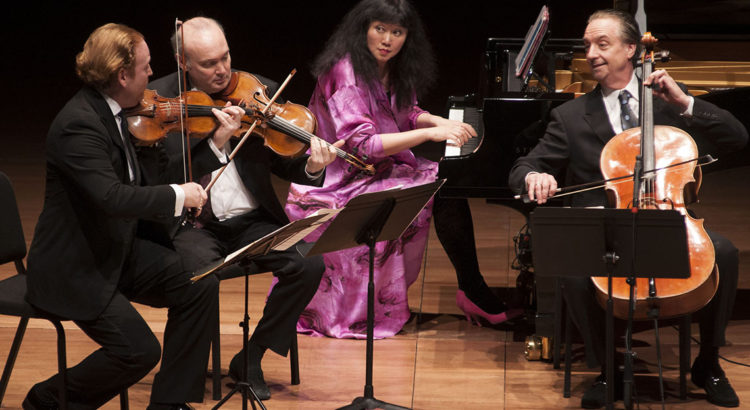
Technically flawless is the only way to describe Friday evening’s performance at Rackham Auditorium by pianist Wu Han, violinist Daniel Hope, violist Paul Neubauer, and cellist David Finckel of the Chamber Music Society of Lincoln Center. Each of the performers are highly accomplished musicians in their own right – just to give you an idea, Mr. Neubauer was appointed principal violist of the New York Philharmonic at age 21, and Mr. Finckel was the cellist of the Emerson String Quartet for 34 seasons. As a group, their music-making demanded the audience’s attention from the very first note, refusing to relinquish it until the concert’s conclusion.

The program consisted of piano quartets, which, counterintuitively, consist of a piano, violin, viola, and cello.

The first piece, Quartet in a minor for Piano, Violin, Viola, and Cello, Op. 1 by Josef Suk, was written by the composer when he was a seventeen-year-old student of Antonín Dvořák. With a dramatic first movement, ethereal and dreamlike second movement that fades into nothingness, and a third movement that is jarring, the piece concluded to rapturous applause.

The second piece, Johannes Brahms’s Quartet No. 3 in c minor for Piano, Violin, Viola, and Cello, Op. 60, was one filled with an underlying tension that never quite left the music, even during the sections that could be described as more tranquil. It was during this piece that I specifically noted Ms. Han’s skill on the piano – her fingers seemed to dance across the keys with extraordinary lightness.

The final programmed piece was Quartet in E-flat Major for Piano, Violin, Viola, and Cello, Op. 87 by Antonín Dvořák. However, the audience, thoroughly captured by the evening’s performance, called for and was granted an encore of Dvořák’s Bagatelles, Op. 47, V. Poco allegro. The piece was announced from the stage. It was noted, to the audience’s amused laughter, that Dvořák composed it when his publisher insisted that he work on something more popular than what he had been working on (he had been working on his Slavonic Dances, which are famous even today).

After the concert, the performers came out into the lobby of Rackham Auditorium to sign albums and interact with audience members. It is always fascinating to hear artists discuss their work, which is not usually an opportunity after classical performances!

Overall, the Chamber Music Society of Lincoln Center presented an evening of music of impeccable quality that was greatly enjoyed by the audience!

REVIEW: Folk Festival Night 2

An amazing 5 hour show deserves a review that is long and hefty, but I understand those that only want to read about certain artists so I will number the paragraphs.

1 RFD Boys

2 AHI

3 Pokey LaFarge

4 Joan Osborne’s Dylanology featuring Jackie Greene

5 I’m With Her

6 Rufus Wainwright

7. Peter Mulvey

1. The first band to take the stage was the RFD Boys. The RFD Boys play bluegrass, which is the folk music you think of when imaging hillbillies playing banjos in Kentucky. The group has been playing together for 50 years and still has three of the original members. One of the new members and also the lead guitarist for the band is the son of one of the original lead singer. The son was outstanding. His voice had a thick country accent when he sang that fits bluegrass perfectly. He sang better than his father. The group sounded best when they were singing together, usually in the humming and refrains of the songs. The fiddle player (I usually say violinist, but after seeing a folk festival I realize there is a huge difference between a violinist and fiddle player) was also a great bass singer that wove all the voices together.  He was a perfect accompaniment for the rest of the group. My favorite song they played was Turkey in the Straw. In this song I was able to hear all the different instruments they were playing (violin, guitar, and banjo) play over the same riff.

2. The next group to take the stage was AHI. AHI isn’t anything like a bluegrass band. They describe their style as a mix of Marley, Michael Jackson, Tupac, but I thought they sounded like a christian rock band. His lyrics were Gospel and made me think of God, the Crescendo’s were slow and uplifting, and the drum beats reminded me of contemporary christian rock groups like Hillsong. I loved the lead singer’s voice, it was rough and rocky like Rod Stewart. The guitarist played solo’s on acoustic and electric guitars. Electric guitar solos are always king, but something special about the acoustic solo is the “clang” sound you can get from a strong pluck. I think folk music really loves “clanging”. My favorite song they performed was a Sam Cook cover A Change is Gonna Come. They had a great slide guitar for this song.

3. Pokey Lafarge was like a 1940’s performer came through a time machine to perform for us. His clothes, hair, guitar, music style, way of talking, jokes, all of it was from a previous century. He’s a character like his name implies. Pokey had a showman’s personality and great stories, he should part-time as an MC. My favorite song he played was Arkansas, in this song he sounded like Bob Dylan from the album Nashville Skyline. For his last song, Pokey did something I really appreciated. He went of his mic and unplugged his guitar. Sound engineering is really amazing, but folk music doesn’t need so much reinforcement, it was nice to dial it back a little and hear the guitar naturally. This also showed how powerful Hill auditoriums acoustics are. One man with a guitar, and I could still hear crystal clearly up in the mezzanine of an auditorium that seats 3,500 people. Pokey had a line that really stuck with me “Even bums get lucky sometimes”. I think this will be the new motto of my life.

4. The show hit a new level of wonderful when Joan Osborne’s Dylanology featuring Jackie Greene came on. These are special artists that took upon the task of only playing covers of Bob Dylan songs. Joan Osborne has a voice with a lot of emotion, perfect for slow songs and folk music. Jackie Greene was the only real guitarist of the night combining folk and rock & roll into powerful riffs, chords, and solos. I would say I’m a Bob Dylan fan, but most of the songs they played I could not recognize. Songs that I did recognize they altered so much that I could only recognize them from the lyrics. They radically changed Bob Dylan’s song and turned his folk sound into a dramatic jazz feel, or bluesy funk feel, or grand concert feel. The sound was different depending on whether the pianist was on the electric piano or grand piano. Some great songs they played were Highway 61 Revisited, Gotta Serve Somebody, and Knockin’ on Heaven’s Door.

5. I’m With Her is an up and coming group comprised of three young women. Contrary to what I first believed, they came up with the name before Hillary Clinton. This group was on after intermission and brought the night back to a more traditional folk sound. For their age they sounded very experienced. I enjoyed their formation, all three huddled around one mic with the lead singer always in the middle of the trio, and the fact they all played multiple instruments. All three singers had their own attributes. Sarah Jarosz had the most authentic country twang to her voice, Aoife O’Donovan had the most melodic voice great for hitting softer notes, and Sara Watkins had the most powerful voice that provided the best base to harmonize around. However, this group was my least favorite performance of the night. I thought the fiddle playing was pretty weak, it sounded amateurish with a lot of missed notes. The rest of the instrumentals was nothing special. My favorite song of theirs, and also the debut of the song, was Call My Name. 

6. Rufus is the singer of Hallelujah in Shrek, making him forever a legend. Rufus has the voice of an angel, it is simply his voice that makes him so special. The level of clarity and resonance in his voice is something I have never heard before. It’s a gift from God and Rufus used this gift well. His voice has a boyish sound to it and he hits every high note with a natural strength that he can hold in a note for over 30 seconds. I was excited when he walked out on stage because of how crazily he was dressed. It reminded me of a homeless person, but it is how I would expect someone who is a genius and crazy (in his case crazy genius and crazy) would dress. He is a great piano player whose fingers fly around the keyboard, but his voice doesn’t need anything accompanying it to sound magnificent. Rufus obviously knows this because he performed an entire song just singing with his voice. His style is something I would never associate with folk, it is like a eerie beautiful style I expect from the Phantom of the Opera. I appreciated that Rufus didn’t like pauses between his songs and as soon as he finished a song would go on to the next; he didn’t even wait for the applause. I think that he was in a bit of a rush because it was his husband’s birthday and he probably wanted to Skype him. My favorite song he played was Early Morning Madness. 

For the encore Rufus brought out all the magicians to join him in singing Hallelujah. Rufus sang the first and last chorus, in-between choruses were sung by other artists, and the refrain was sung by everyone. I thought this was mean of Rufus. No one can compare to him when singing this song, and even Jackie Greene and Joan Osborne sounded like amateur’s in their choruses. This song brought my friend, who I made at the show, cry, and he was older man.

7. The last musician was actually the MC for the show. Peter Mulvey didn’t just talk like most MC’s, he sang songs. This is the best kind of MC. Peter has an extremely soothing voice and is sneakily very good at guitar. I thought of Peter like ginger with sushi. I eat ginger between every piece of different fish to clean my palette for the next piece of fish. My favorite song he played was a stream of consciousness song called Pigeons.

I attached some photos below (sorry they aren’t too clear).


REVIEW: Paved with Good Intentions

“The road to hell is paved with good intentions.” And from what it looks like, the foreseeable future that’s changing along with the climate is that hell. Artist David Opdyke’s exhibition changes the way you see the world and the bigger picture, both literally and figuratively.

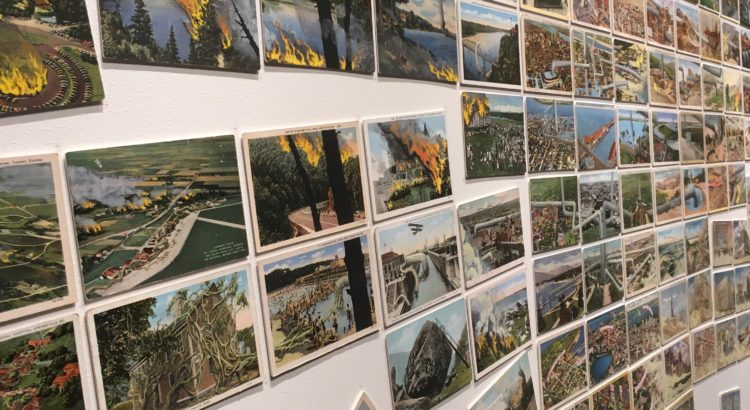
His politically-charged art attempts to stir something in you, something nostalgic yet foreign. By creating a feeling of longing for the past and reaching for the future, he grounds you in the present. There is a sense of chaotic unity in the gridded mural landscape. It alleviates the gravity of climate change through its absurd humor while leading us through an anxious journey that some people wouldn’t be able to go through by themselves. The postcards create a personal relationship with the viewer, using scenes and landscapes we may recognize and defacing the postcards with his drawings in a fashion similar to how we deface the actual landscape.

“Paved with Good Intentions” utilizes different levels of intimacy. The installation works both from a distance and up close, and the intricacy of the details pulls you in, requiring you to step closer and look at every single postcard before stepping back out to see the whole picture. This work requires more time than you think it would take to look at everything, precisely because of how much there is to see. Every postcard is interconnected, from the tornado to the fire to the flying frogs, putting a global layer to something so local. The accompanying animation of his postcards uses a slapstick humor inspired from Monty Python’s “Flying Circus.” It uses a different media to convey the same message in a more animistic way.

The world is too big to quantify and the enormity of the climate change crisis is too large to fully encapsulate, but David Opdyke tackles it through something as simple and recognizable and approachable as postcards. Set aside some time to stop by the Institute for the Humanities to experience this humorously serious exhibition through February 26.

REVIEW: (F)ART at the UMMA

I am a huge stand-up comedian fan and this is not the first show I have seen by the U of M Stand-Up comedy club, but it was the most well attended. I was surprised at how large the turnout was, until I realized that most people were there for something completely different. The show was incorrectly advertised as an improv comedy art tour (which sounds so cool and I hope UMMA does it), and most people were there for that. Nonetheless, when they announced it was going to be a regular stand up show instead, no one got up and left, and when I looked around during the show everyone was still smiling and happy. So I am glad that this “scam” worked out for everyone in the end.

It was a very interesting venue to host a stand-up comedy show (the modern arts wing of UMMA). Surrounded by fancy art which I call high artistic culture, while listening to crude college student stand-up comedy, which I would call low artistic culture, the lowest of the low. Still, I commemorate whoever decided to host the show here because the atmosphere was so much more light-hearted and open than the usual location of The Michigan League.

I appreciated the MC of the show ( I think she is the president of the club) because of her energy. Her jokes before every comedian came on stage weren’t very funny, but her big personality still got the audience in a mood ready to laugh with the comedian coming on stage. She ended the show as the last performer, and her jokes were just like how she MC’d. They weren’t very witty or funny, but her energy, charisma, and animated gestures made it very entertaining to watch. Her performance was basically the thoughts and life of a crazy artist and the synthesis of her performance made me really connect with her story/jokes. I guess it is just a different style of humor than I am used to when seeing stand up comedy shows, one that brings a smile on my face more so than laughter. Her performance stuck with me the most after the show and that says a lot.

The other comics had many different styles some were dryer, some more nervous, some more animated, some self-deprecating, some more narrative, (none that were punny which was surprising), but no one else stood out as much as the MC did.  My favorite jokes of the night was a serial killer joke where I couldn’t really tell how serious the comedian or real life the joke was (Great job on getting me to think you’re a killer David), and a joke about Grindr that had good suspense because of a buildup using the distance of a “nude photo”.

One joke I thought had a lot of potential, but really missed the punch was a long narrative joke about being at a massage parlor. The joke went into detail about the oil and masseuse being too close to his private parts, but there were no sounds or animations which I think were necessary for this joke. A couple of “slurps” “splats” and “EWHs” could have gone a long way.