PREVIEW: SMTD@UMMA Performance: Press A-Flat to Play

If you are interested in video game music, then this event might be for you! On Sunday, January 27th at 8pm, join SMTD and UMMA in the University of Michigan Museum of Art museum apse (the main hall where you first enter) for what promises to be an intriguing and challenging performance.

“In response to the Virtual Worlds considered in the exhibition Art in the Age of the Internet, SMTD professor and video game music specialist Matthew Thompson explores the dichotomy of real/unreal in a live performance of new analog transcriptions of favorite video game soundtracks, joined by undergraduate and graduate piano students from his studio. ”

Admission is free, so don’t miss it!


PREVIEW: Chamber Music Society of Lincoln Center

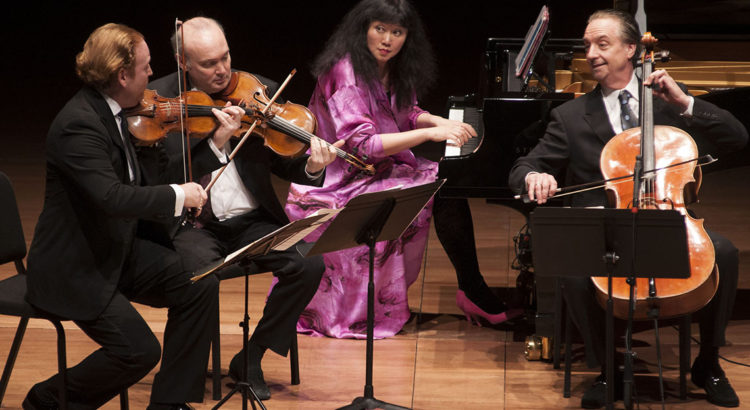
Calling all chamber music enthusiasts! This coming Friday, January 25 at 8 pm, the Chamber Music Society of Lincoln Center will be performing at Rackham Auditorium. The program includes piano quartets by Brahms and Dvořák, as well as by composer and violinist Josef Suk.

Hailing from New York City, the Chamber Music Society of Lincoln Center is known for its excellence, and I am very excited to see them perform! The evening’s ensemble will consist of Daniel Hope, Paul Neubauer, and Chamber Music Society of Lincoln Center artistic directors Wu Han and David Finckel.

Tickets may be purchased online at the University Musical Society’s website, or at the Michigan League ticket office. As is always the case for UMS events, student tickets are just $12 or $20!

REVIEW: Alpine Yodeling in Chinese

Shoutout to the Confucius Institute for hosting this awesome lecture/performance.

I’m a huge fan of Chinese music. I listen to traditional pipa, modern groups like SodaGreen, and all time greats like Leslie Cheung. However, I have never heard of yodeling in China because yodeling doesn’t have a presence or history in China. The speaker, Lu Tong, only started promoting yodeling to China in 2010, and yodeling had its first feature performance as a song in the recent hit movie Hello Mr.Billionaire. I think yodeling will become more popular as Chinese movie music, because if you aren’t familiar with Chinese comedy, it is very ridiculous, care-free, and boisterous–perfect for yodeling.

Something I never realized about yodeling is that it is a music technique not a music style. For instance yodeling is in the same category as operatic singing not jazz. Yodeling began in the alps as a way of communication and was an imitation of the sound of wolves. So in yodeling different repetitions, tones and words had different meanings. For example if something is yodeled three times, something urgent is being communicated. Jimmy Fallon and Brad Pitt did a skit where they communicated to each other across New York City yodeling. The skit is humorous but not so far fetched.

Different regions have different yodeling styles. Every country has their own unique style, but most styles can be categorized in two particular styles, Alpine and Country yodeling. Alpine yodeling uses more chest voice and can be described as more operatic. It has a lower tone, stronger resonance and longer notes. Country yodeling is more light hearted, free-flowing, and softer. Many say that Country yodeling sounds like a donkey.

What Lu Tong was demonstrating today was his journey of trying to create a unique yodel that was domestic to China. He wants to create a Chinese way to yodel. First he imitated how Northern Chinese farmers call their pigs. The sound these farmers make is a “lue” sound. When he performed a song using this sound I noticed he yodeled extremely fast and with a relatively stable pitch compared to most yodeling. He also performed a yodel that used the sound Chinese farmers use to call their chickens, which as you can probably guess sounds very similar to a chickens cluck. Yodeling originated from imitating animal sounds, so using a chickens clucking is an accurate way to yodel. However you can also base yodeling off non-animal sounds. Lu said yodeling reminds him of the sound of Chinese ambulances.

Something else very interesting about yodeling in China, is that the classic yodel sounds, like  “you-wu-di” and “you-de-lai” are words in Chinese. When he performs he often likes to incorporate a story with the yodeling, or give some context of a discussion happening when he is yodeling.

I wish there was more yodeling and less lecturing. It was nice hearing him yodel as examples throughout his talk, but we only got the chance to hear one full song.

One thing that was nice about this being a lecture-performance, is that I was able to ask a question afterwards. I asked if he has ever thought about combining buddhist chanting with yodeling. He actually said he has done it and performed part of a buddhist sutra in a yodel style. However, he said this wouldn’t be popular in most places as it is seen as disrespectful to the sutra.

PREVIEW: Spirited Away

I’m thrilled to be attending my first Studio Ghibli movie on the big screen! Spirited Away will be screened on Wednesday, Jan 23 at 7 p.m. in the Michigan Theatre. It is part of a larger film series, Icons of Anime, curated by the Center for Japanese Studies. Directed by the acclaimed Japanese director Hayao Miyazaki, the movie follows ten-year-old Chihiro as her family stumbles upon a supernatural theme park. The movie has gorgeous, magical animations and is a captivating fantasy.

PREVIEW: Transformation, Aesthetics, & Beauty: Translating Chinese Poetry

Did you know that Literati has “Local Learning” workshops? I did not. Last week they had a drawing workshop on the human form. This week they have one on Nonviolent-Compassionate-Communication skill building.

Next week, on the 28th, they have one on translating Chinese Poetry. I am curious how the instructors plan to demonstrate the art of translation, as well as teach non-Mandarin speakers to translate a complex poem. I take Chinese, so I understand the succinct nature of Chinese characters and how each of them are saturated with history and meaning…

There will be two instructors at the event: Sarah Messer and Kidder Smith. Sarah Messer is the author of four books. She teaches Creative Writing at UM. Plus, (fun fact) she is a cheesemaker at White Lotus Farms; so you can expect to enjoy some cheese tasting at the translation event. Kidder Smith, on the other hand, taught Chinese history at Bowdoin College in Maine, where he also chaired the Asian Studies Program. He is currently leading translations on many Chinese texts, such as Sun Tzu—the Art of War, and Having Once Paused: Poems of Zen Master Ikkyu.

At the event, Messer and Smith will introduce Zen Master Ikkyu, an unconventional 14th century enlightened Zen Master who wrote poems in Classical Chinese, upended gender roles, and transformed the aesthetics of medieval Japan. They will also discuss how writing poetry and translating involves transformation, aesthetics, mindfulness, and beauty.

Event date: Monday, 1/28/19, 7pm

Location: Literati, 124 E. Washington St. Ann Arbor, MI 48104

Register Ahead of Time: https://www.literatibookstore.com/event/local-learning-transformation-aesthetics-and-beauty

Cost: $25

REVIEW: Mary Poppins Returns

Image result for mary poppins returns

Mary Poppins Returns hit theatres in December 2018, and was received with mixed reviews– some loved the new spectacular addition to the classic Mary Poppins film starring Julie Andrews; others found it exhausting and drab in terms of plot, characters, and music. I find my own opinion lodged somewhere between the two; I didn’t love the movie, but I will defend its integrity and originality. The movie takes place a generation after where the first movie left off. Michael and Jane Banks, the children who Mary Poppins comes to nanny, are all grown up now. Jane is an activist fighting for union workers’ rights, and Michael is an artist and teller with three children who recently lost their mother– and it seems like that they’re all about to lose something else– their house. Amidst this financial turmoil, Mary Poppins materializes to help the Banks children– all of them– go on a magical adventure to revitalize their sense of wonder and joy.

Emily Blunt’s rendition of Mary Poppins is, well, blunt. This new Mary Poppins, reeled in through a kite with not a single hair out of place despite emerging from the eye of a raging storm, with perfectly poised little kitty heels bent at an artful angle, with her curt responses and matter-of-fact commandeering of the Banks children– she’s not as cheery and la-di-da as Julie Andrews’ Mary Poppins. This new one’s feisty. She’s got attitude. She means business. This new Mary Poppins rolls her eyes and bustles around and smiles less but manages to do more. Her magic is controlled and precise, bestowing the children with their own sense of agency rather than spoiling them with her treats. Emily Blunt’s interpretation of Mary Poppins is slightly spicier than it is sweet– and I love it for that. I’ll defend this movie against musical theatre purists that argue that Emily Blunt is not as good as Julie Andrews. They’ve both made the role their own in fun and inventive ways.  

That being said, however, in all honesty, my reaction to this movie was quite ordinary. I didn’t love it; I didn’t hate it. The plot of the Banks children trying to keep their house wasn’t the most engaging, even if Colin Firth was the one playing the evil banker. I didn’t find myself humming the tunes to the new songs as I walked out of the theatre. They just weren’t as catchy or extraordinary as they’d been hyped up to be. And, most importantly, the movie didn’t light up that spark of wonder and joy that Disney movies usually do; the nostalgic, gooey, fuzzy feeling spreading through my stomach– that life can be seen through a rose-colored lens– this movie just didn’t strike that emotional cord for me.

It did have its ups, though. In a song called A Cover Is Not The Book (possibly my favorite part of the whole movie– it’s really fun and whimsical), Jack and Mary Poppins perform with animated characters under the dazzling lights of a circus tent, and in the classic Hamilton style, we get some of Lin Manuel-Miranda’s crisp rhymes and fast-paced rap-style rhythms. There’s a song where the Banks children’s bathtub transports them to an oceanic adventure, swimming with whales and dolphins under an infinite blue sky and tufty white clouds. There’s the subtle romance between Jack and Jane, and though it’s painfully underdeveloped, it’s cute to watch. But still– I can’t really say that any of this adds up to a hugely substantial and magical movie experience. It’s a fun movie, and obviously part of a larger American musical cultural phenomenon, but in isolation, it seems enjoyably ordinary to me.

(Poster from Google Images)