
REVIEW: PIVOT

At SMTD, every senior is encouraged to craft a thesis project, serving as a culmination of their artistic endeavors throughout their university studies. Rileigh Goldsmith (BFA Dance 24’) chose to create a unique experience to observe dance. Goldsmith presented an immersive sensory journey through the layers of creative consciousness through the lens of virtual reality. This was certainly one of the most unique presentations of dance I have ever seen.

The setup was at the Duderstadt Center, in a room nestled in the hallway leading to Pierpont Commons. It was set up like a black box with an unassuming maze. Each “room” contained a VR headset that the viewer would put on to briefly exist in the little world of Goldsmith’s creation.

The experience commenced in three parts. The first: “Question”, offered a thought about how often we notice our often concealed inner tranquility. It presented beautiful 360-degree landscapes with a gentle voice reciting a poem by Goldsmith herself. Act II was entitled “Untether”. Her program note mentioned: “PIVOT is a movement narrative which explores human resilience amidst comforting constraints, choice paralysis and fear of the unknown.”  This act featured Goldsmith’s reposeful frolics in a bright and grassy field while performing choreography of her own. It was ethereal and cherubic, exemplifying freedom and bliss. Act III was called “Pivot”. This act featured a collection of dancers fading between a 1930s-themed number and a stark contemporary piece.  She left the note: “In some realities, you were meant tethered, apathetic, and stagnant. In others, you are unbound, confident, and empowered.” 

A corresponding hanging door matched each act, labeled I, II, and III. Subtle decor lined the outskirts of each room, calling back to motifs of each act—tea candles, dainty white ribbons, and blue lamps.  The design was visually impressive and satisfying. It submerged the viewer into the creative realm of Goldsmith’s consciousness.


Goldsmith challenges the viewer to find freedom within their creative mind. She epitomizes power, maturity, and poignance in her choreography and design. The exhibit is open Tues – Fri, 12 to 6 pm, and Sundays, 12 to 6 pm. (from Jan. 10 through Jan. 21.) 


Order of Acts:

I. QUESTION

II. UNTETHER

III. PIVOT
REVIEW: Clown Show

Each year a class through the SMTD Department of Theater teaches clown, a form of theatrical physical comedy. This course is taught by Professor Malcolm Tulip and comprises of many senior theater majors. Their final performance of the semester was performed in the Arthur Miller Theater on December 11th in a room of rambunctious peers and overlooked members of the community. My expectations for a clown show were previously unclear, but I have found a newfound respect for the art form from this fanciful, erratic performance.

Our modern perception of clowns is strongly associated with “circus clowns”, but the jesters have taken many forms throughout history. Clowns can be dated as far back as 2400 BC in Egypt. The art form has modified itself over centuries and existed uniquely in many cultures such as Early Roman and Greek jesters, Chinese jesters (most notably in the Han dynasty), Europe in the early 1800s (with the famous Joseph Grimaldi), and the 19th Century North American circus clowns. More about clowns is linked below.

At the top of the clown show, each clown introduced themselves with a small routine. Then,` they paired up to offer small vignettes starring their established characters. The vignettes included themes like, “Grocery Store”, “Treasure Hunt”, or “How We First Met”. Each routine was situationally unique, yet maintained the clown’s persona introduced at the beginning. They performed while pantomiming most “props and set pieces”, sometimes speaking to each other, sometimes silent.

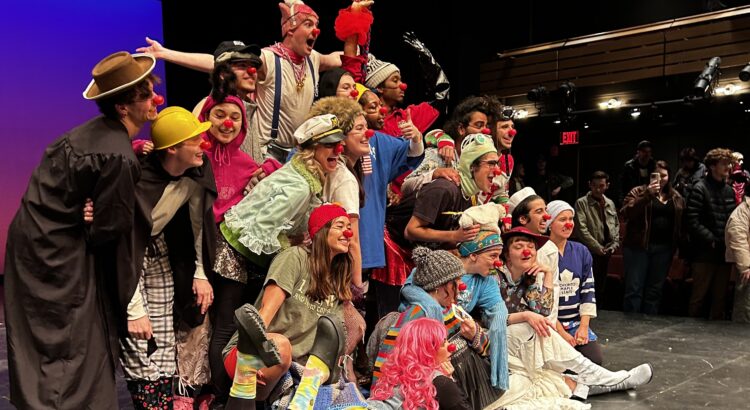
These actors were effortlessly hysterical, and the audience remained responsive. They were fearless and remained intensely committed to their choices. Each student cultivated a genuine extension of themselves through a whimsical and highly physicalized filter. The clowns wore costumes reflective of their character with, of course, the beaming red nose. No two were alike in the slightest, each offering selective mannerisms. The troupe created a fanciful and utterly unique theatrical space within Arthur Miller, destigmatizing the often misunderstood art of clowns. 


More on Clowns Here: 

Clown and Theater 

Clowns: History and Mythology


Image taken during the 12/11/23 Clown Show.

REVIEW: Dr. Seuss’ The Grinch

I loved Dr. Seuss’s books growing up but never watched the movies, so to celebrate the end of the semester and the coming of Christmas, I watched The Grinch at the Michigan Theater on Sunday, December 10th. I haven’t watched any of the previous adaptations, but they seem pretty different. The first version, How the Grinch Stole Christmas!, came out in 1966 as a cartoon that’s 30 minutes long. The second version, also titled How the Grinch Stole Christmas, came out in 2000 as a live-action that’s 1 hour and 55 minutes long. The most recent one is what played at the theater: the 2018 animation that’s 1 hour and 30 minutes long, which is simply titled The Grinch.

This version is essentially the Grinch’s origin story and the audience gets to learn who the Grinch is as a person rather than a thief. The best part is we get to see his relationship with his dog Max, who is youthful and energetic in the film but old and weary in the book. Another character they redesigned was Cindy-Lou Who, the little girl who catches the Grinch in the middle of his act. In the book, she was less than two and only on a page or so; in the movie, she’s much older and one of the main characters.

The animation was fun and very fitting for a children’s Christmas movie. The palette was bright and the characters were cute, even the Grinch. I enjoyed hearing the narrator’s lines and rhymes because they added more of the book elements too. His voice surprised me though because he sounded relatively young when I was expecting an old man reminiscent of Santa, which I wish they went with instead. Because I knew the plot beforehand, it felt like a very long movie and some parts were dragging on, but I enjoyed it overall and would rewatch it again once it’s closer to Christmas.

REVIEW: She Loves Me

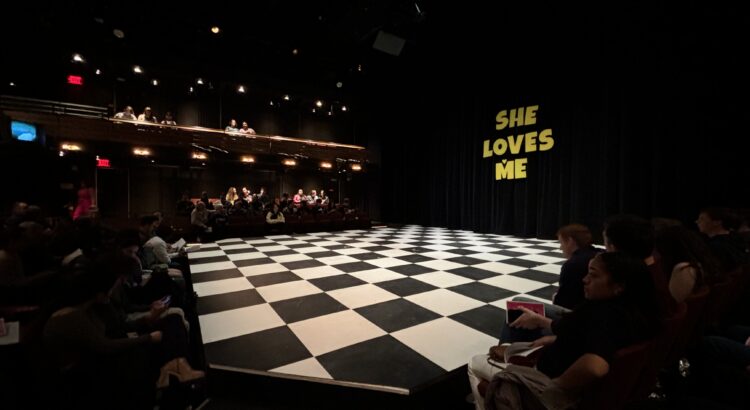
This past weekend, I watched the musical She Loves Me (1963), a romantic comedy with a classic enemies-to-lovers trope set in 1934 Budapest, Hungary. The male lead is Georg Nowack, the hardworking manager of Maraczek’s Parfumerie. He’s always at odds with the female lead, Amalia Balash, an employee who’s not the best at her job and believes Georg always has it out for her. There’s a unique array of workers at the parfumerie. There’s the playboy Steven Kodály, the innocent delivery boy Arpad Lazslo, the sexy lady Ilona Ritter, and the cheerful father Ladislav Sipos.

It’s a frustratingly slow-burn romance; most of the first act is unraveling the main character’s mysterious love interests, their “dear friends,” and getting to know the other employees. In the second half, though, the romantic development quickly speeds up and She Loves Me plays, my favorite musical number. I enjoyed watching the usually serious Georg dancing around the stage and singing his heart out, giddy with love.

The show was completely run by the Golden Theatre Company (GTC), a student organization that strives to spread the joy of musical theatre and create opportunities for all students to be part of the production and performance process. When reading the program notes, I was fascinated that quite a few members were freshman or not musical theatre students; one was even a Mathematics and Computer Science major! Furthermore, everything was done well. The stage props for the parfumerie were adorable and intricate, the outfits were gorgeous and elegant, fitting for the era, and the microphones and music were clear.

As suggested by their name, the GTC only performs musicals from the Golden Age of musical theatre (roughly mid-1940s to late 1950s) or musicals sung in the classical style. I look forward to their next semester’s performance because I’m sure they’ll choose a wonderful musical to perform with the highest quality.

REVIEW: The Boy and the Heron

Studio Ghibli has released multiple iconic works such as Princess Momonoke and Kiki’s Delivery Service, and they just dropped their newest film, The Boy and the Heron. Like TotoroThe Boy and the Heron is a semi-autobiographical fantasy story written by Hayao Miyazaki, one of the co-founders of Studio Ghibli. The main character’s name is Mahito, whose mother died in a fire. After a couple of years and still mourning her passing, he and his father move from Tokyo to the countryside. There, he meets a suspicious heron, and as suggested by the title, the plot thickens.

In my opinion, quite a few of Studio Ghibli’s works are rather abstract and The Boy and the Heron is no exception. However, I do think this movie was easier to understand and had more reasons for all the fantasy involved than some other films like Howl’s Moving Castle and Spirited Away (both are still my favorite Studio Ghibli movies though). When I watched the films as a child, I was fascinated by the world-building and unexpectedness of it all, but once I grew older and re-watched the films, I wanted more background information and explanation. I think this movie includes both elements well and thus reaches a large demographic. Furthermore, there are themes of life, death, family, and friendship that anyone can learn from. 

I was surprised that Studio Ghibli released a new movie. Honestly, I thought the last animation they ever made was Ponyo in 2008, but they’ve been releasing works until 2014 with When Marnie Was There, which I’ve never seen or heard about. I would watch this film multiple times, and it’s showing at the State Theatre until December 14th with screenings in both Japanese and English. I watched the Japanese Dub with English subtitles version, and I noticed that the Japanese title is very different from the English one. In Japanese, the title is 君たちはどう生きるか (Kimitachi wa Dō Ikiru ka) and translates to ‘how do you live?’. I wish they hadn’t changed it, because I feel like the Japanese title has more meaning and inquisition to it. But now you guys know, so when you watch the film, keep in mind that the story is about more than just a boy and a heron.

REVIEW: Reading and Q&A with Ross Gay

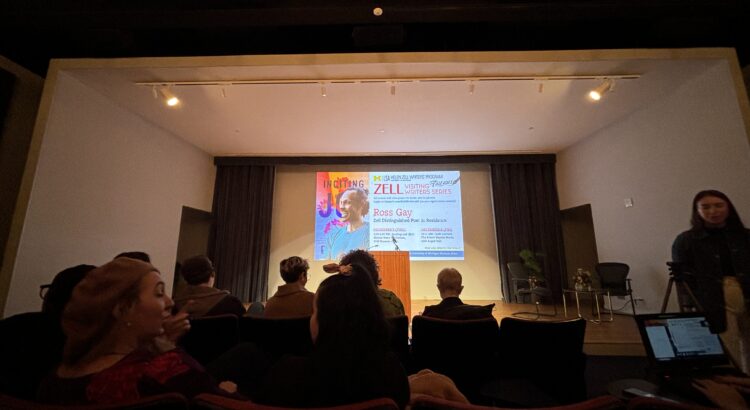
On Thursday, December 9th, the poet Ross Gay gave a reading and held a Q&A session at the UMMA Stern Auditorium. I haven’t been to any poem readings before so I was surprised to find that the venue was so packed there weren’t enough seats. I’m a visual learner, so I often find myself zoning out when I’m required to listen for long periods. However, my professor told me that she fell in love with Ross Gay’s writing after she went to his reading, whereas when she read his poems they didn’t have as much of an impact. I quickly found out what she meant. When Ross Gay was reading his poems, it felt like he was giving a speech or acting out lines of a play. In other words, it felt like he was reading prose rather than poetry.

Since it’s impossible to speak line breaks, I was trying to notice how he may emphasize certain phrases more than others. I’m not sure if I’m looking too hard into things, but I did notice that at some times he’d pause a bit longer or change the inflection and volume of his voice. However, everything flowed so smoothly and sounded so natural it’s hard to point out specific spots to closely analyze unlike when reading poetry. The performative aspect was what drew my attention because he wasn’t simply reading words. He interacted a lot with the crowd through eye contact and hand gestures. It was interesting to see how his passion transfers off of the page and how he expresses himself, and it was an experience that made me realize how off I may be when interpreting an author’s work.

There were a few moments where the audience laughed which surprised me, but that could’ve been because the poem he read was about basketball, which I know nothing about. I think overall I’m always picking apart texts to find a ‘deeper’ message when it could just be something unknowingly lighthearted until read aloud. It made me realize that as a reader I often project my own emotions and experiences when interpreting other people’s work, perhaps blinding myself to the obvious. I only wish I had his poems written down in front of me to look at while I listened to further explore that concept.