
REVIEW: UMMA Pop Up: Adam Kahana/Kenji Lee Duo

Most of us students know UMMA for the relaxing coffee lounge facing the diag or the large art display room facing the Union. More perceptive students realize that UMMA houses some amazing art pieces and galleries. Still, even more perceptive students know that UMMA hosts a variety of talks and events, all of them listed online, and you should go check it out!! Now to the actual review–

When I arrived at 1pm I was disappointed at first to see no one in the audience listening to Adam and Kenji performing a duet of music except a lone student photographer. However, it also meant I got the best seat in the house sitting on the bench next to them. I then realized that there were no actual seats laid out for the musical performance, the bench I was sitting on is in the museum permanently. It was then that I realized that listeners were intended to stroll around the art exhibits while listening to the music. The acoustics were fantastic and the music could clearly be heard from any of the art rooms on the first or second floor. I enjoyed having two perspectives to listen to the music. One perspective where I was very engaged sitting next to the music watching Adam’s fingers fly around the fretboard of his guitar, and the other more passive perspective hearing the music in the back of my head as I focused on artwork.

I don’t know the names of any of the songs Adam and Kenji performed, but I know that it was all jazz music. It was an unusual instrument pairing, a tenor saxophone and a guitar, but this allowed for a unique sound. I expected that the guitar would play the rhythm and support the saxophone who would solo over the guitar, but to my happy surprise, they took turns being the lead and background. I personally enjoyed Adam’s rhythm playing, I think low toned notes sounded really good on his guitar.

UMMA does Pop-Ups every weekend, usually around 1pm on Saturday and Sunday, and as long as a football game isn’t going on you should really check it out. If you do, you might see me there because I certainly plan on checking out some more Pop-Ups

PREVIEW: Pat Metheny

On Wednesday night, Hill Auditorium will play host to the legendary jazz guitarist, Pat Metheny.  Pat is truly a pioneer of modern jazz guitar.  He has a distinct improvisatory style that is admired by many and has helped him earn 20 Grammys.  While his compositions are mostly jazz, he has the musical skill to delve into other genres and create great music for them.  In fact, last year, he wrote a concerto for two percussionists that the Philadelphia Orchestra premiered with their Principal of Percussion, Christopher Deviney, and world renowned marimba soloist She-e Wu.  In addition to his collaborations with musicians of other musical genres, he has worked with some of the biggest names in jazz including Ornette Coleman, Gary Burton, and Herbie Hancock.  In addition to his 20 Grammys, Metheny has a host of other accolades to his credit including induction into the Downbeat Hall of Fame and becoming the youngest person to earn the title of NEA jazz master.  This performance promises to be one of the best musical performances put on by UMS this year.  The show starts at 7:30 with no intermission.  There are still tickets available!

REVIEW: The Philadelphia Orchestra

Last night, the University of Michigan’s historic Hill Auditorium served as host to one of the greatest orchestral ensembles in the world: the Philadelphia Orchestra.  As one of the most recorded American orchestras of all time, the Philadelphia Orchestra is generally considered to be part of the “Big 5” American orchestras along with Chicago, New York, Cleveland, and Boston.  After their performance in Hill last night, it was easy to see what all of the hype was about.  They opened the concert with a piece by Nico Muhly, a newer composer who incorporates a lot of minimalist concepts into his music.  He combined beautiful moments that could have been part of a Tchaikovsky symphony with a lot of instances of almost atmospheric sounding music where it seemed like nobody really knew what was going on except the orchestra.  The piece features a lot of percussion, and the Philadelphia Orchestra’s section is one of the best.  There were many tricky xylophone and vibraphone licks accompanied by huge booming moments from the timpani and bass drum.  All in all, they did a great job with what seemed to be a complex and challenging piece.  After the Muhly, the orchestra performed Tchaikovsky’s Violin Concerto with world renowned violinist, Lisa Batiashvili, as the soloist.  Her playing was electric.  Honestly, in terms of interpretation, he rendition wasn’t my favorite version of the concerto, but nobody can deny how great her sound was, especially when combined with the lush background provided by the orchestra.  The audience loved it so much that Ms. Batiashvili received a more raucous applause after the first movement than most orchestras do after a whole concert, prompting Yannick Nezet-Seguin, the music director, to turn to the audience and say “There is still a second and third movement”.  After ending the piece in an energetic fashion, Ms. Batiashvili and the orchestra were met with an even more enthusiastic applause than the one before and an almost immediate standing ovation.  As an encore, Yannick and Ms. Batiashvili performed a song for voice and piano by Tchaikovsky that Mr. Nezet-Seguin adapted for piano and violin.  As expected, it was performed beautifully and the audience erupted once more to take the concert to intermission.  The first half encore also served as a reminder that Mr. Nezet-Seguin will be coming back to Hill to perform as a pianist with a renowned soprano, a concert sure to be well attended by those who viewed this one.  In the second half, the orchestra performed Rachmaninoff’s Symphonic Dances, a somewhat newer 20th century masterwork that epitomizes the type of music this orchestra is traditionally known for recording.  It was phenomenal.  The loud sections were enormous and incredibly exciting.  Seemingly every member of the orchestra had a solo at some point and they were all executed to perfection.  The principal trombonist, especially, impressed me.  His tone and overall sound were exactly what I wanted to hear from his instrument.  Hill Auditorium is a huge hall that hides the articulation from low instruments, but the timpani and low brass sounded absolutely incredible and everything I heard them play was clear as day.  The strings really shined as they played through the sweet soft sections interspersed throughout the piece.  Overall, this was easily the best rendition of Rachmaninoff’s Symphonic Dances I have ever heard.  Just when the audience thought the night could not get any better, the Philadelphia Orchestra decided to wow the Ann Arbor crowd with their encore selection.  They played “The Victors”.  It probably sounded incredible, but I don’t think anybody really knows because the whole audience was clapping and singing along, overjoyed that they decided to play our fight song.  To top it off, the percussion section broke out Michigan hats and scarves while the tuba player, a Michigan alumnus, clapped and fist pumped along with the audience.  The whole encore was quite a spectacle and served as the perfect end to one of the best performances I’ve seen at Hill.

REVIEW: Staging Unrest: Performance in times of crisis

Politically provocative theatre has always been integral to the narrative of art and society, from the statements made about race and power as early as in Shakespeare’s Othello to the ones about immigration, representation, and leadership in Lin Manuel Miranda’s Hamilton. There seems to be something important about the staging and design of these plays that gives power to their political messages and articulates such notions to the masses– in Hamilton, one major feature of this was the cross-racial casting. For centuries, Othello was staged with portraying Othello in blackface. There is clearly something we must fundamentally understand about theatre to stage these pieces with thoughtfulness and grace. SMTD discussed these ideas in their talk, “Staging Unrest: Performance in times of crisis”, in conjunction with their upcoming production, Night and Day.

The panel for the event consisted of two directors, two designers, and the American and Polish cast for the play (there are Polish students and professors at the University of Michigan participating in this production). Night and Day is written by Charles Mee, who posts all his plays online and allows people to write over it, take parts out, and change it however they please (here is it, if you’re curious: http://www.charlesmee.org/plays.shtml). This play is about image and movement and interpretation– it gives a great deal of freedom to the actors, directors, and designers to make it how they please. One actor claimed that this piece allowed for the flexibility and maybe even sympathy of different viewpoints, whereas other political theatre already has a message preconceived in the mind of the director or actors. Night and Day is experimental, daring, dissociative– and it puts pressure on the concept of political unrest rather than providing answers to resolve it.

A great deal of beautifully articulated points about theatre were posed at the panel, and each person on the stage had something insightful to contribute. Malcolm Tulip, SMTD’s beloved directing and acting professor, said, “Theatre is a series of scenes or images that we put in succession to each other, and the friction between them is what causes the depth and thought.” I thought this was a profound way to view political theatre especially– there is something happening between the images and scenes, whether on or off-stage, that causes the pressure to make meaning. There’s something important to be said if one scene is about Trump declaring that he’ll build a wall between the United States and Mexico, and if the scene right after it depicts a suburban Mexican family in California celebrating their daughter’s quinceanera. There’s tension, friction, pressure, whatever building between the two. It doesn’t even have to be overtly said. Night and Day zeroes in on this technique.

I also found interesting what Dominika Knapik, the Polish choreographer for Night and Day, said: when asked what theatre was like in Poland, she admitted that one of the popular sentiments surrounding Poland’s theatrical and artistic scene was that people’s tax dollars shouldn’t go towards making art that isn’t politically correct. “Wouldn’t this make theatre unpopular in Poland, then?” the mediator asks. Knapik says no– it only makes theatre more relevant if the government is actively trying to fight it. Art is a force to be reckoned with in politically decisive times. It fans the flames to revolution or degradation.

I thought the panel was responsive and extremely insightful, but I feel as though the event was too heavily geared toward the play Night and Day. I expected it to be more about staging political theatre from a theoretical perspective (it was marketed as such), and was a bit disappointed with the narrow focus on the upcoming Night and Day production. Still, the event was well-organized and stimulating. Above all– I would recommend everyone go see SMTD’s upcoming production Night and Day by Charles Mee and performed by students at the University of Michigan and Polish students from the University of Krakow.

REVIEW: The Wanted 18: Contemporary Cinema from the Islamic World

Image result for the wanted 18

Claymation from the perspective of cows, real interviews of Palestinians and Israelis, a personal narrative interwoven as the spine of the movie, and a compelling true story of a town of Palestinian people who secretly milked eighteen cows as a way to resist Israeli occupation– this movie is artistically ambitious, politically evocative, and utterly heartrending.

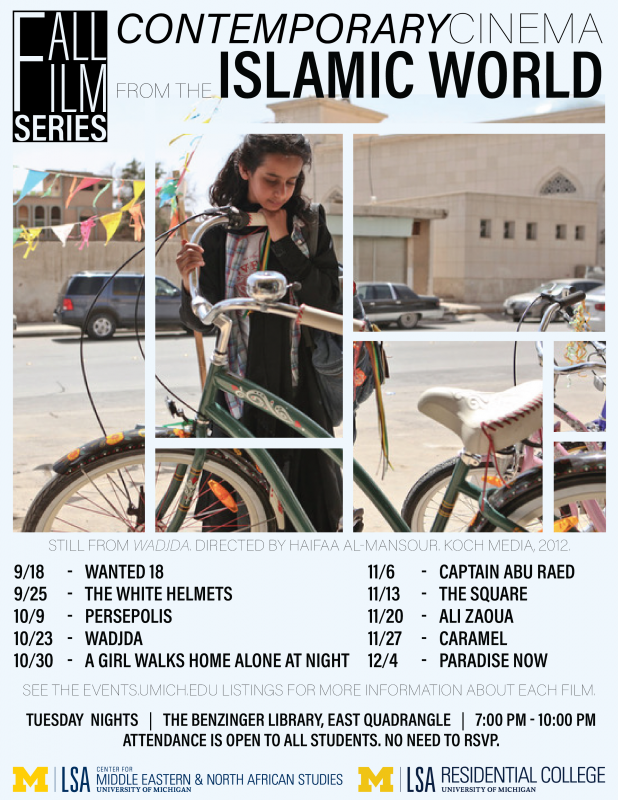
The Residential College, with support from the Center for Middle Eastern and North African Studies, is hosting a series of movies on contemporary cinema from the Islamic world, and The Wanted 18 is kicking off the series. The film screenings take place in East Quad’s Benzinger library at 7 p.m. After the film screening, audience members had a short dialogue on the movie lead by the series’ curator and host, Sascha Crasnow. I appreciated the organization of the events, the dialogue that followed it, and the film was easily one of the best documentaries I’ve seen.  

This documentary takes place in Beit Sahour in the 1980s, a small town east of Bethlehem with a majority-Christian Palestinian population. The people of Beit Sahour used the cows as a way to boycott Israeli goods and remain self-sufficient. The eighteen cows went from ordinary livestock to infamous celebrities that were “threats to the national security of the state of Israel”. How? How did these cows, as one interviewee put it, become “political activists” alongside the Palestinians against Israeli occupation?

This movie unfolds that answer in one of the most creative documentary formats. The film brilliantly includes claymation in a comic-book-like style. In fact, it takes the humor so far that the animation is from the perspective of the cows. They’re the hilarious epicenters of the movie, and all the events unfold around them. “Oh, shit,” one cow says to another as they’re given off to the Palestinians; they have distinct characters (Lola is called the “sexy cow”, for example); they don’t side with the Palestinians or the Israelis, but are shown to be strong and powerful allies to their own cause. We as the audience relate to the cows in some very commonplace way– they have western accents, make crudely funny remarks, seem to full of desire and indecision. At first, the cows are reluctant to join the side of the Palestinians and even try escaping from the truck that held them. One cow said in the beginning to the Palestinian attempting to milk her, “Ugh, get lost, tiny terrorist.”

As much as we get of the cows, though, we also get of real interviews from people that lived through the boycott. For the people of Beit Sahour, these cows represented an attempt to join the narrative of resistance and recognition. One man from the documentary says when first acquiring the cows: “I felt as if we had started to realize our dreams of freedom and independence.” The cows became Beit Sahour’s symbols of civil disobedience and autonomy from occupation. They knew they were mere civilians– a doctor sweeping the street, a homemaker hanging up the laundry, butchers, teachers, tailors– but they wanted to feel like their lives were no longer dictated by an external force, like their homes weren’t a prison. “We deserve to have our homes,” another interviewee said, “We deserve to have our land, we deserve to have our freedom, and we deserve to have our cows.”

During the height of Palestinian resistance in 1987, the cows rose to celebrity status outside of Beit Sahour and the state of Israel become deeply paranoid that they may lose control over their occupied lands. In a scramble to regain power and composure, the state of Israel declare the eighteen cows as “wanted criminals”

There are parts of this movie that are controversial and jarring. There is an animated scene where a woman throws off her bedsheets and finds a dead cow beneath them; some of the things the cows say can be considered offensive expletives, like the “tiny terrorist” comment; one person frequently referred to by the interviewees dies at the end of the movie to the heartbreak of the audience; and of course, we know the struggle is not over for the people of Beit Sahour, or Palestinians, and Israelis. During the dialogue, one person critiqued the movie for trivializing the seriousness of the issue by the sense of crude humor the cows possess. The director of the film, however, counters this; he says, “When you laugh, you are challenging your oppressor and challenging the image of being a victim.” There is a great deal of conversation to be had around this film, for it is complex and deals with complex issues.

What I love about this movie is that it takes something so difficult to discuss and creates conversation around it in a manner that is intelligent and artistic. I would recommend this film to anyone who is exploring art from the Islamic world, or who is interested in political art, or loves to watch compelling, deeply moving documentaries. This film is brilliant and raw in its storytelling and creativity, and, in its own way, is a form of resistance.

You can find more films in this film series in the poster below:
Additional sources: https://www.aljazeera.com/news/2015/11/qa-middle-east-powerful-army-chasing-18-cows-151111094846819.html

REVIEW: Fiction At Literati: Akil Kumarasamy


Image result for half gods 

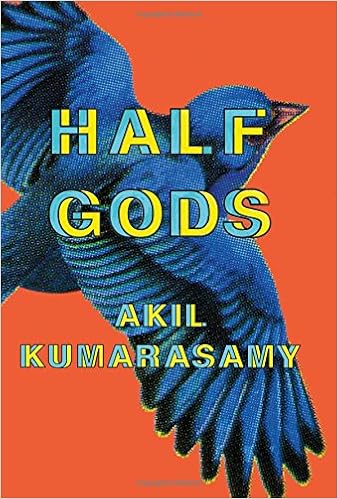
am discovering a litany of South Asian female writers, from the much-loved Jhumpa Lahiri and her Pulitzer-Prize winning collection of short stories, Interpreter of Maladies, and recently, the Fatima Farheen Mirza’s brilliant debut novel, A Place For Us. Being Indian myself, it is refreshing to see the emergence of these writers documenting their stories in gorgeous, intelligent prose. I am thrilled to announce Akil Kumarasamy with her debut collection of ten short stories entitled Half Gods among their ranks.

Kumarasamy’s ten stories tell the loosely interconnected lives of immigrants, people displaced by the civil war in Sri Lanka, a Chinese neighbor, and many others. Myriad viewpoints in character and perspective– bouncing between first, second, and third person– and an interesting cast of characters elucidates Kumarasamy’s deep wisdom in exploring the lives of many different kinds of people. You feel as though she knows more than she ought to know about subtle suffering, disorder, displacement– but there is a viscerality to the characters that makes them all real.

This is how I felt at Literati while Kumarasamy read a short story from her collection. The story she’d read was written in the second person, which gave it a sense of being fragmented; it felt like we knew a whole lot about the main character without ever learning their gender or name. It was a skilled use of the second person, as her character was an actor and the perspective amplified the effect of him in a mask. Kumarasamy’s language hones in on the physical details and nuances of the world around her, and looks at the world with almost godly eyes– as though consequences and actions are rendered as one. Her work is lyric– poetic– rich. Divinely so.

And yet, I felt occasionally that there were aesthetic niceties that strained the story. This is perhaps a matter of personal preference, and I have not read but two stories in the collection. At least during the reading, I felt sometimes disconnected from the character and story. I think this may be because I didn’t have the text of the story in front of me and I had to rely solely on oration– sometimes that can be tricky with stories rich in language and content.

Kumarasamy read one story at the reading. I wish she could have read more. I wanted to compare a second person story to one of her other stories, as I feel like a second person story is a category of its own.

When Akil Kumarasamy releases her next book, I await to read it– I’m interested in the projection of this writer’s career and the literary feats she will accomplish. She’s released a stunning debut, acclaimed by the New York Times, the New Yorker, USA Today, and I’m sure anything she has yet to make will stir the literary community.