REVIEW: Imogen Says Nothing

Imogen Says Nothing by Aditi Kapil is a spinoff story of the character Imogen in Shakespeare’s Much Ado About Nothing. She’s a character some have interpreted as a typo because she says nothing. However, Kapil turns this character, who serves no purpose in the original, into the main character of a “revisionist comedy in verse and prose” that SMTD describes on their website as a “feminist hijacking of Shakespeare that investigates the voices that have long been absent from the theatrical canon and the consequences of cutting them.” It highlights how women have historically been only seen as an image and deprived of their words. The play not only puts a big emphasis on the power of speech but the power of writing too. 

The premise is a bit confusing: Imogen is a bear disguised as a woman and has been living as a woman for a few years. She travels outside of her small village to the bigger cities and along the way gets dragged onto the stage in the middle of a performance of Much Ado About Nothing. In Elizabethan England, all female characters were played by men because only men were allowed to act. As a result, Imogen has to pretend to be a man playing a woman, and that woman is Imogen herself. In other words, she’s a bear disguised as a woman who pretends to be a man acting out a woman.

It has heavy themes of violence and animal abuse and there are explicit drinking and sex scenes. Furthermore, Imogen is constantly degraded for being female and fat; she even says that her only talent is “whoring”. When she is praised, it’s for her ability to make others laugh but it’s usually because she’s mocked for her background and intelligence. 

Nevertheless, it’s still a comedy and masks the darker content with humor and fun character dynamics. My favorite character was Nicholas Tooley; in the beginning, others always teased him because he was so innocent and pure, but in the end, he was so sassy and dramatic. It was also really funny when there were modern versions of objects on set. For example, for the alcohol they used White Claw, and when checking their contact information they would pull out their cell phones. 

Overall, I highly recommend watching it. It’s a play that’s hard to grasp but fascinating, especially the ending which was the best part. It took a sudden abstract twist that circled back to the underlying message with a single chilling line directed at the audience: “Exit man.” 

REVIEW: Natasha, Pierre & the Great Comet of 1812

In The Round is a student-run theater organization that produces two theatrical productions in an academic year. Last year, the organization produced Mart Crowley’s Boys in the Band and Stephen Stater’s Spring Awakening. This year, In The Round presents the ambitious and timely, Natasha, Pierre, & the Great Comet of 1812. 

NP&TGC is a 2012 electro-opera musical that was adapted from Leo Tolstoy’s War and Peace. It was written by Dave Malloy and won the Tony Award for Best Musical, Book, Score, and Orchestrations in 2012. It features vibrant, eclectic music with sudden shifts reflecting the turbulent situation between the characters and the state of 19th-century Russia. The music was extremely unique, with powerful, sweeping vocal moments and striking EDM-like dance scenes. I adored the creativity and thoughtfulness behind the score.

The actors maneuvered through this piece well. There are some incredibly difficult moments in this show that I commend the actors for working through and creating their own. The sustainably sourced costuming was another lovely addition that is appreciated in a time of dire need for increased sustainable options.

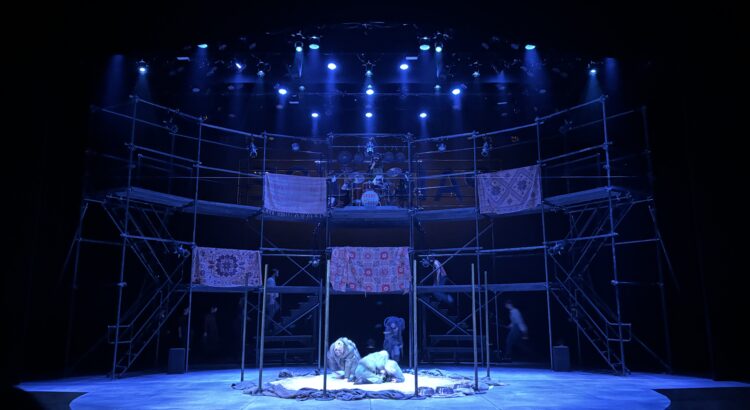
This production was performed in the Arthur Miller Theater, a thrust space. Some pictures of the staging/tableaux that were created in scenes were lost to me because of my stage-left seating. From my seat, some events that were happening in the plot were lost because of the dancers or levels the actors were creating. I wondered if my experience would have been different sitting in the upper mezzanine center. Pierre’s ‘home’ in the left-hand corner of the stage was visible to me, and his intentional manic scribblings throughout the musical were a compelling acting choice. Select moments between Anatole and Natasha were visible, and what I could see was beautiful, the two portrayed electric chemistry.

In The Round states that it is an organization “dedicated to queer stories and queer storytellers…we produce performances, relating the themes of our shows to themes of queer culture.” I admire that a theatrical organization is taking the initiative to amplify queer voices, but I seem to have missed the intention behind this production of NP&TGC specifically representing and amplifying an LGBTQ+-based story. There is evident relevance that anything could be a queer story, but I found myself longing for a more direct interpretation of the queerness in the show. I note that this is certainly a point up to interpretation by each audience member.

NP&TGC is an ambitious choice for any theater with its intense level of technical production, difficult musical excerpts, and involved direction. This gripping score is a vocal and emotional challenge and I commend everyone involved for creating this challenging piece of theater. 

Congratulations to everyone involved in Natasha, Pierre & the Great Comet of 1812. In the Round will be performing bare: A Pop Opera next semester March 7th-9th in the Arthur Miller Theater. Auditions will be early next semester. 


Image thanks to In The Round on Instagram. 

REVIEW: Impulse III: Triple Threat (hosted by: MEMCO, WCBN, & A/SQUARED)

Yay!! Another Memco event! This was their third Impulse event, and it was a collaboration with WCBN (the student radio) and A/Squared (a student fashion and culture magazine). There were two DJs from Detriot, Max Watts and Miguel Cisne, part of the Limited Network, a Hamtramck-based recording label that focuses on Detriot-based techno, echoing the pioneering of the Underground Resistance. The event was at Club Above again, which, as I’ve mentioned in my previous posts about Memco, is my favorite club off campus. There is always ample space for dancing, talking, laughing, playing pool, and more. 

Photography by: Noah Jackson

It is apparent the more I come to Memco events, the more comfortable I feel at them, or rather the less self aware I am. Triple Threat enticed a massive crowd of people to come, and it was easy to get lost in the mass of people. Usually, the thought of this scares me, but going with a group of close friends I feel comfortable with ultimately eases my fear. There weren’t any strobe lights this time, which I was mainly happy about, but I did wish there was more exciting lighting throughout the night–it seemed to stay the same the whole night. I will say if you go to Club Above, it is always fun to wear white because it is glow-in-the-dark there! 

I ended up spending most of the night on the platform with the DJs and speakers, which has taken me a while to build the courage to do so. I guess I felt especially comfortable that night, probably because I knew what to expect (other than the music). If you can’t tell, I am a creature of habit. It is also fun to go to Memco events to see people’s outfits, especially the kids from A/Squared, who have a particular interest in fashion. Although I am not a part of the club, I will say my friends and I love to dress up. It’s nice to look and feel good about yourself, especially as the weather gets colder and finals draw near.

I will say, hands down, my favorite part of the night was watching the crowd dance. Some parents in the back danced without a care in the world. It was sweet. Something about watching the parents dance reminded me of my parents. I sat there admiring their enjoyment in a space heavily dominated by college students. I wished my parents could find some sort of break from work to dance and enjoy themselves. Take themselves a little less seriously and let go of all the tension in their bodies by moving to some quick techno beats. I hope everyone can do this, take themselves less seriously, and dance. I promise when you let go and close your eyes, the music becomes stronger, and your body starts to take control over your brain. You find freedom in that moment, away from school or work, and I may be simplifying one’s problems, but I believe the sentiment remains. Try a Memco event and dance, and let me know how it goes!

REVIEW: Maxim Vengerov with Polina Osetinskaya

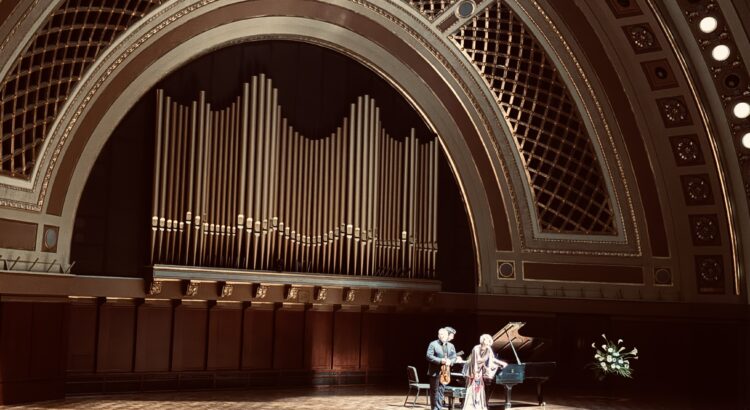
Sunday, November 26th, violinist Maxim Vengerov and pianist Polina Osetinskaya graced Hill Auditorium. It was a full house with a diverse audience, as both of them are world-renowned musicians in high demand. Maxim Vengerov is a Grammy award winner who began his career as a solo violinist when he was just five years old, also the age Polina Osetinskaya began her piano career. With repertoire from four different composers, the music expressed all kinds of emotion, a fitting ambiance for Sunday being the first day of snow and the last day of break.

They opened with Clara Schumann’s Three Romances for Violin and Piano, Op. 22, a bittersweet melody that the piano weaved together and the violin brought to life with a strong vibrato on every note. Vengerov and Osetinskaya balanced each other well by taking turns crescendoing or decrescendoing, neither ever overwhelming the other: it was literally the dynamic of a tug-of-war in love.

The next few pieces, in contrast, were striking and sprightful. Whenever there was pizzicato, a technique where the player strums the strings with their fingers, Vengerov would use his whole arm with flare. With every musical line, he played with a full bow that led to a few passionately broken bow hairs. In general, I was enamored by the skill he handles his bow. A lot of the pieces have spiccato, which is a technique where the bow bounces off of the string, and Vengerov transitions seamlessly between the spiccato and legato. The piano creates a similar dialogue by interchanging staccato (a technique of playing notes short but is fundamentally different from spiccato) and legato too.

Since it was only the two playing, the usually cramped stage looked bizarrely empty. People often talk about stage presence when it comes to dancers and singers, but this pair’s stage presence was enough to fill up the whole space. It’s always exciting whenever famous musicians come to town, and this was my second time seeing Vengerov at Hill Auditorium.

This was their concert program:

Clara Schumann
Three Romances for Violin and Piano, Op. 22

Johannes Brahms
F-A-E Sonata (Scherzo excerpt)

Robert Schumann
Violin Sonata No. 3 in a minor, WoO27

Sergei Prokofiev
Five Melodies for Violin and Piano, Op. 35bis
Violin Sonata No. 2 in D Major, Op. 94bis

 In addition, they included three encore pieces. 

It was a wonderful show and definitely something I recommend classical music lovers attend!

REVIEW: Complete Solo Violin Sonatas of Eugene Ysaÿe Presented by SMTD Violinists

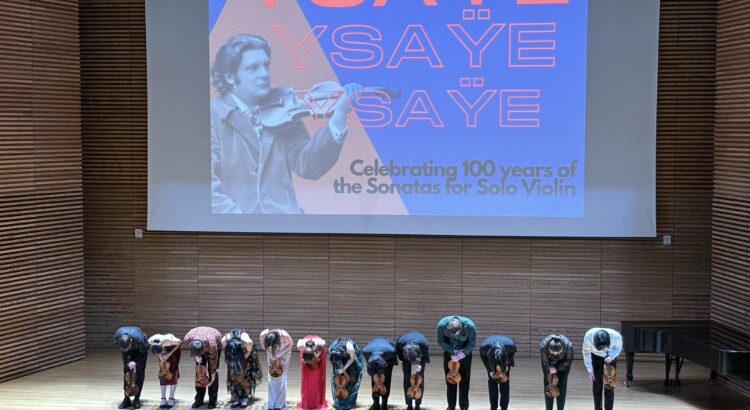
To celebrate the 100th Anniversary of Ysaÿe’s Six Sonatas for the violin, 13 students studying under Professors Danielle Belen, Aaron Berofsky, David Halen, and Fabiola Kim gave an outstanding performance of the complete set on Monday, November 20th in the Stamps Auditorium on North Campus.

The violin is most commonly seen in an orchestra or accompanied by a pianist. Ysaÿe’s sonatas, however, only showcase the violin. His work highlights the raw beauty and power a talented musician can bring out of such a small instrument. The music made full use of what the violin has to offer through double stops, chords, harmonics, and more, all techniques difficult to master because the slightest tilt of the bow or millimeter difference between the fingers can taint the sound. When Professor Belen and Professor Kim opened the event, they said this was a rare performance only made possible because of the talent that SMTD has.

It was my first time listening to Ysaÿe’s sonatas except for a brief video clip I saw of Maxim Vengerov playing a passage in Sonata No. 3 in D minor, “Ballade,” op.27. It’s a gorgeous movement that has a consistent melodic theme with different variations, but unlike Vengerov’s fierce interpretation, the student soloist Yuchen Cao had a much more gentle and relaxed approach, almost as if he were stroking the strings with his bow.

Sonata No. 2 in A minor, op. 27 had a few elements that pleasantly surprised me. In the II movement, Malinconia, the soloist uses a mute, a tool that string players put on the bridge of their instrument to create a fuzzier sound. Similarly, the III movement, Danse des Ombres, began with pizzicato, a technique where the player strums the strings with their fingers. Both were fun and interesting additions that contrasted the heavier or brighter music that violinists tend to emphasize in solo works.

The last act performed by Tianyu Lin simply blew me away. His technique, the vibrato, the intonation, and the tone, were perfect, making his double stops and chords beautifully ring and synchronize. The precision he had when scaling the fingerboard from its lowest to the highest range was flawless. I honestly feel like I was more enamored by his skill and talent than the music.

Symphonies and concertos are all lovely, but it was a nice change of pace to listen to a collection of Sonatas live. I’ve always been aware that the music department at UofM is top-tier, but this event let the individuals who make up the department shine.

REVIEW: Digital Engrams by Gabriela Ruiz

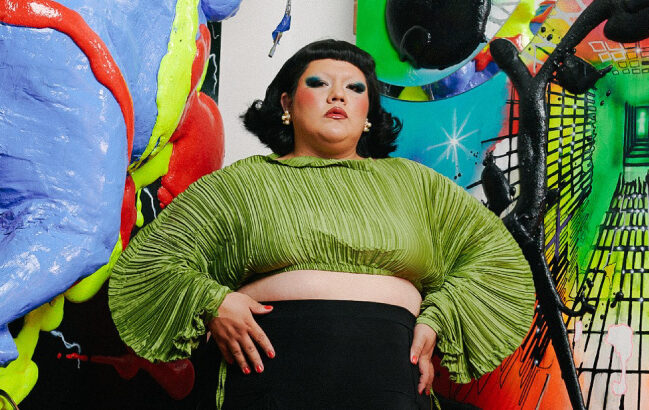
L.A. artist Gabriela Ruiz is a self-taught multimedia artist whose sculptural pieces blur the line between the virtual and the real. I watched Gabriela talk at the Stamps Distinguished Speaker Series earlier this month and I was immediately captivated by her distinctly Gen Z artistic voice. Ruiz is unafraid to confront questions that are still emerging in our culture, such as: what does identity look like for digital natives? Decorated in vibrant colors, lush textures, and a tangle of animated pixels, her art captures the experience of being online, particularly the struggle of navigating memories and identity amidst virtual chaos.

An engram is a trace of memory; a digital engram, then, is a memory stored in an artificial code. Digital Engrams is an exhibition tucked into the Institute for the Humanities Gallery, occupying one beautiful room. Red walls drench the space in color, contrasting against the bright greens and psychedelic lights of Ruiz’ geometric sculptures. Built into and around the sculptures are swirls, soft grassy forms, collages of screens, and interactive audio-visual tools, forming an immersive experience that teeters between the natural and unnatural. Not only is her work multimedia, but it is multidimensional— it is in two, three, and four dimensions, containing everything from time-based media to stationery sculptures. It’s a satisfying installation because of the sheer variety of forms Gabriela Ruiz incorporates into the space.


As I walked around the space, watching the screens’ surreal montages and cryptic messages, I felt immersed in the hypnotism and strangeness of Ruiz’ digital world. The colors, textures, and sounds were overstimulating in a way that was familiar, echoing the feeling of everything happening all at once in digital space. The decontextualized montages and projections lend the exhibition a feeling of absurdity and disorientation. Still, these feelings are overwhelmed by fascination; I resonate with the organic, grassy forms lying near the digital structures because I am always trying to reconcile my “organic” identity with my digital identity; I resonate with the confused chaos and ephemerality of the mosaics of screens, representing moments passed and immediately forgotten but always preserved in a web of data; really, I resonate with Ruiz’ ever-changing sense of belonging in a world of overstimulation and non-stop movement.

My only complaint about this exhibition is that it isn’t bigger— I would have loved to explore an even larger room, a maze full of abstract structures and glitchy footage, as if exploring the depths of Gabriela Ruiz’ mind. I personally believe it is hard to make art about the digital world without the vastness and clutter of it drowning out the meaning; Gabriela Ruiz, on the other hand, approaches the subject beautifully. Her art is abstracted enough to be open-ended, simple enough to be digestible, and just colorful enough to be entrancing without being nauseating. She finds the balance between the tangible and the digital, creating a physical map of a futuristic generational struggle.

Digital Engrams by Gabriela Ruiz is a free exhibition at the Institute for the Humanities Gallery at 202 S. Thayer. It can be seen through December 8th and is open 9-5 on weekdays.