REVIEW: The Rocky Horror Picture Show

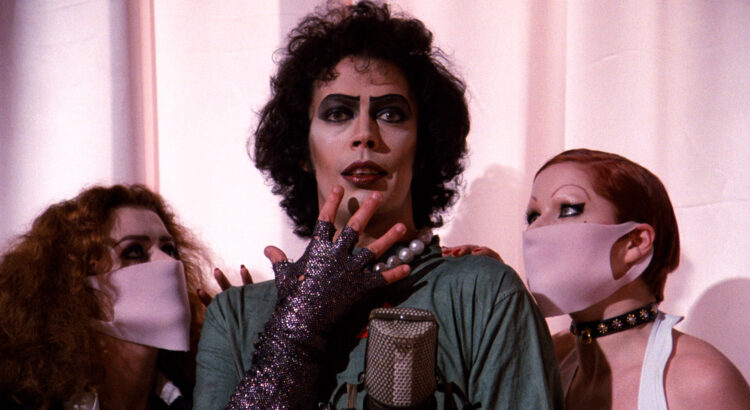
The Rocky Horror Picture Show is an internationally appreciated cult classic musical film, often performed around Halloween. The hit movie (and musical) held two performances this past weekend at our very own Michigan Theater. I was lucky enough to catch their annual performance on Saturday at 9:30, and it lived up to every expectation as an absolute riot from start to finish. It’s a lively and goofy movie with notable characters like the innocent Brad and Janet, thoughtless yet sincere Rocky, and the tremendously memorable transvestite, Frank-N-Furter. This performance is absolutely an 18+ experience, with many sexual innuendos, violence, intense language, and adult themes (which is no surprise if you know the show). The film has the longest-running release in film history and was even adapted again into a more modern TV film in 2016 on Fox. Forty-eight years later, the film still plays in theaters all around the country, often with a live amateur ‘shadow cast’ that mimes the actors on the big screen. There were shouts and roars from the costumed audience of classic lines to be accurately called out at certain points in the film. It is not your average ‘night at the movies’ at all…

The film was released in the fall of 1975 in the UK and USA. It was directed by the Australian director Jim Sharman, who was widely known for producing many kinds of experimental theater. He has a decorated list of theatrical directing credentials from across the world, with a few major films that hit the theaters through the 70s. The screenplay was adapted by Sharman and the UK’s own Richard O’Brien based on O’Brien’s original 1973 musical. The musical premiered that year in the UK, including the iconic Tim Curry, who reprised his role as Frank-N-Furter in the 1975 original movie. The first West End cast performance was dubbed a ‘creative and commercial success’. Initial reception to the film, however, was extremely negative, but it later became a hit as a ‘midnight movie’ that aired late into the evenings on television stations, and from there, a quintessential cult classic. 

The Rocky Horror Picture Show is understood to have been a great influence on countercultural and sexual liberation in the 1960s and even today. It was one of the first popular musicals that depicted fluid sexuality during a time of generational divisiveness and growing advocacy for LGBTQ+ rights. Today, this continues to be true as queer folks work to create more LGBTQ+ friendly space in the arts, and annual productions of Rocky Horror reinforce the necessary space yearly through this vessel. This precedent is set by the characters in the show: they are not confined by gender, and many different identities of performers take on the ‘shadow cast’ roles, keeping the show undoubtedly fresh. The “look” of each character does stay consistent, their costuming/hair and such, but many things can and have been adapted in various performances. Historically, the costuming of the show affected the development of many punk rock fashion trends, with colored hair, fishnet stockings, and colorfully flamboyant make-up. 

The ‘shadow cast’ of this production did a fantastic job of depicting the drama on screen. A ‘shadow cast’ is not something that is often seen in movie theater settings, so it was a lot of fun to experience. It was difficult to light the actors because the movie playing right behind the stage, so often it was hard to see. However, the energy of the acts was understood from the back of the house, and their exuberant costumes filled the space left by a lack of set. I commend these folks for their accurate and entertaining work as the ‘shadow cast’ of the film, and their commitment to the tradition of Rocky Horror! 

The Rocky Horror Picture Show is a must-see musical film and a hilariously memorable experience. I sincerely enjoyed the performances from the ‘shadow cast’ and seeing this movie for the first time in theaters. The actors and the crowd were absolute pandemonium, and I enjoyed my time from start to finish. The experience in theaters is a unique one, and I would urge folks interested to make an evening of it and enjoy the show. Rocky Horror is an annual occurrence at the Michigan Theater and sells out nearly every time, so be sure to get your tickets early. It’s a Halloween festivity not to be missed! 


Image from the film, thanks to IMDb.
REVIEW: Jay Peng Zhang and Terry Tsang

As part of the U-M Fall 2023 Festival of Asian Music, Terry Tsang and Jay Peng Zhang came to the Keene Theater in East Quad on Tuesday, October 24.

Terry Tsang is a choreographer primarily working in Hong Kong. I was expecting him to perform, but instead, he gave a presentation because his work centers around exploring the human body through nudity and human desires, a concept that was inspired by simply walking down the street. Tsang wanted to know if we could truly understand someone through their body alone and if the body speaks the truth, as verbal communication leaves room for dishonesty. He showed us a couple of videos of his choreographies that expressed his interpretation of what love means, incorporating the gestures of making love that gradually transformed into an animalistic representation of sex since animals are designed to survive through reproduction. The dancers were completely nude but wore strange and purposefully unsettling masks that completely hid their faces; in fact, during the Q&A session at the end, an audience member described the dancing as creepy.

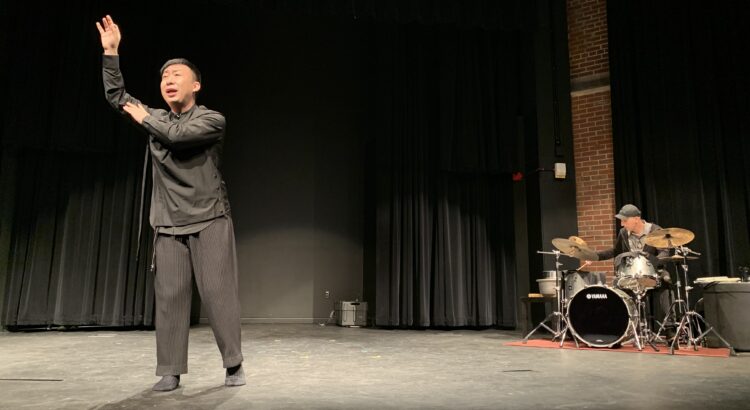
Jay Peng Zhang on the other hand did give a live performance and sang the folk songs of various ethnic groups in China, such as the Tujia ethnic group from the Western Hunan Province. His singing was accompanied by only one person, who played a drum set muted by cloth and other percussive items, like large pots; but rather than an accompaniment, the percussion sounded like a response to his singing and movements because of its continuous resonance instead of emphasized beats. Zhang sang with a powerful voice, and his breath control and crescendoes were incredible; however, he moved his fingers very daintily, creating a beautiful and interesting contrast.

Zhang explained how he didn’t want to give the audience a flashy performance but rather a meaningful and interactive experience to renew and rebuild old rituals, as over time they’ve lost their meaning “like artifacts in a museum,” performed only as a tourist attraction. To him, folk songs and their intended rituals don’t signify religion, but instead are a way to release stress and help keep our hearts peaceful and balanced.

The most memorable song Zhang sang was one traditionally sung by women left behind at home by their lovers who left to earn money. The girls would sing the song to a river because they believed the water would carry their emotions to another place, and when their lover saw the water, he could feel her love. Zhang asked the audience to accompany his singing by collectively becoming “a group of water” by enunciating syllables that represented flowing waves. The amazing part is how the audience naturally added dynamics to the space created through Zhang’s gentle dance.

REVIEW: The Shadow of a Gunman

4:00pm • Saturday, Oct. 21, 2023 • Power Center

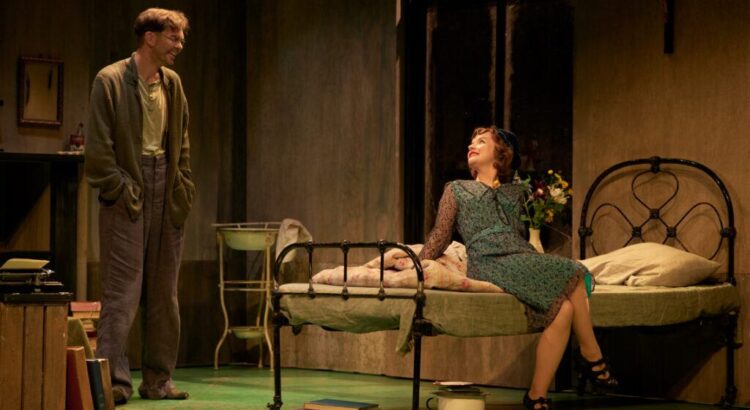
The Druid Theatre Company’s production of The Shadow of a Gunman, from Sean O’Casey’s Dublin Trilogy, explored themes of cowardice and courage, and of action and inaction. The story takes place in a tenement during the Irish War of Independence, following Donal Davoren, a poet, and Seamus Shields, a traveling salesman. The tenement’s residents believe Davoren is an IRA gunman on the run, a tale which he does not refute because of the aura of mystery and importance it grants him. The plot reaches a climax near the end of the play, when the tenement is raided by Black and Tans (a violent British police force), eventually revealing which characters are the true cowards. 

I appreciate the way O’Casey uses pointed moments of comedy in this play to make a statement about individuals’ feigned and real courage. Davoren and Shields both make a show of their ideological commitments and their willingness to act, but when their lives or values are actually threatened, they collapse into trembling heaps. Davoren gives a great monologue about the moral superiority of “the poet,” and that archetype’s commitment to higher philosophical strivings than the majority of laborers, but we see throughout the play that Davoren has little real commitment to anything. 

My favorite character in the play is Minnie Powell, one of the tenement’s residents and Davoren’s love interest. For most of the play, Minnie is treated almost as a prop. She is the object of Davoren’s interests, and her name is used as an invocation by the other residents, warning Davoren against “degrading” attachments. However, at the end of the play, Minnie is the one who assumes the responsibility of hiding incriminating evidence from the Black and Tans, believing it belongs to Davoren. Minnie is the one who is dragged down the stairs shouting “Up the Republic,” while Davoren and Shields cower in their room hoping she doesn’t reveal their involvement. Minnie’s death brings Davoren and Shields’ puff-chested braggadocio into tragic relief, completing O’Casey’s statement about the value of action over words. 

I think there is another interesting conversation to be had about whether O’Casey himself lives up to this statement in his legacy as a poet and playwright. I don’t necessarily have the background knowledge to answer that question, but I am fascinated by the dialogue between O’Casey’s works and his stated beliefs about the role of artists in conveying messages about society, politics, and human nature. O’Casey’s work focuses on the common people of Ireland, rather than the heroes and martyrs of the nation’s conflicts. Is there a sense of elitism inherent in using one’s position as an artist to criticize the common people for their lack of heroism? I’m not sure.


REVIEW: Splendid Sounds of Taiwan: Soloists of the National Chinese Orchestra of Taiwan

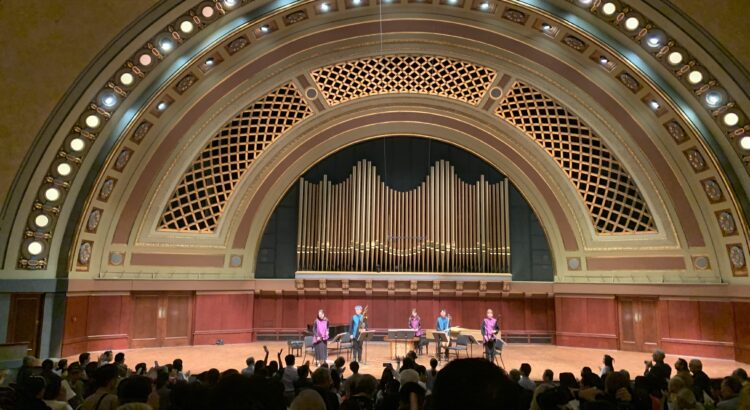
As part of the U-M Fall 2023 Festival of Asian Music, the National Chinese Orchestra of Taiwan came to Ann Arbor and hosted a variety of events from October 1st to 4th. On their last day, soloists of the ensemble performed at Hill Auditorium and showcased various traditional Eastern instruments including but not limited to the Yangqin (dulcimer) performed by Ming-Hui Lin; Dizi (flute) performed by Chen-Ling Liu; Sheng (reed organ) performed by Chi-Mi Chen; Erhu (two-string fiddle) performed by Yi-Fang Wu; and Gehu (four-string bass fiddle) performed by Ya-Tsing Hsu.

It’s difficult for me to describe each of the instruments, since it was my first time hearing them live. While the strings sounded muted, they were incredibly resonant and easily filled the large hall. The Dizi was sharp and piercing, whereas the Sheng blended beautifully in the background. My favorite was the Yangqin, which could produce a variety of clear and subtle textures. Though there was only one person playing each instrument, the music never felt lacking in dynamics and balance.

Their large selection of music shared a common theme of nature or dance. Each piece had a title that gave further insight into the intended imagery, sentiment, and context of the music. Furthermore, details of the historical background and origins of each piece were written in the concert programs. Reading the descriptions beforehand really added to my experience, because it gave me a visual aid to interpret as I listened.

For example, in the opening piece, Queen of Courtesans, each tempo change painted the different steps of a dance; the tremelo of The Butterfly Loves Flowers resembled a butterfly’s beating wings; and the grace notes decorating many of the other pieces acted as falling leaves and flowers.

The most impressive part of the program was the Skylark; the Skylark was a solo piece featuring an instrument called a koudi (similar to a picollo), which is so incredibly small I couldn’t even see it in the soloists hands. As implied by the title, it featured the melody of a skylark. The resemblance was simply uncanny to an actual bird.

Overall, it was a wonderful and unique experience to attend this concert. If given the opportunity, I highly recommend listening to music from other cultures.

REVIEW: Guys and Dolls

8:00pm • Saturday, Oct. 7, 2023 • Lydia Mendelssohn Theater

This Saturday’s performance of Guys and Dolls was one of the best musicals I have seen on campus. SMTD’s production staff, crew, and performers breathed life into the classic “Broadway fable” through their thoughtful and critical treatment of the 70-year-old subject matter, while remaining true to the musical’s original humor and optimism. 

First and foremost, the cast’s performance was exceptional. The actors embodied their characters with charisma and authenticity, making them relatable despite some of the more dated stereotypes. Their command over dialects transported us to the streets of New York, and their chemistry on stage gave the story’s romances real gravity that completely absorbed my attention. In particular, I was blown away by Alex Humphreys’ soprano (just like I was in last semester’s production of Rent!) in “I’ll Know” and literally all of her songs afterwards. 

I loved how the set and costume design expertly combined to craft a convincing world onstage, without visually overwhelming the talent of the actors. When the curtain rose at the beginning of the performance for “Runyonland,” the sparsity of the stage put the spotlight on the orchestra for a few well-deserved moments. An unexpected sense of excitement and anticipation overtook me as the curtain lifted a second time, revealing the blinking neon signs of Broadway and immersing me in the production’s vibrant atmosphere. 

Despite Guys and Dolls being a product of its time, based on the archetypes developed in Damon Runyon’s 1920s and ’30s stories about the New York underworld and Broadway, SMTD managed to navigate this delicate terrain with finesse. The show’s dramaturgs thoughtfully interpreted some of the more outdated themes in the show, making it relevant and engaging for a modern audience. I especially appreciated the incorporation of informational placards in the hallway, shedding light on the broader social context of the era. These additions offered audiences a deeper understanding of historical context like the LGBTQ+ scene in 1950s New York and the nascent Civil Rights Movement, adding layers of depth to the narrative we saw in the play.

In conclusion, SMTD’s Guys and Dolls was a resounding success on all fronts. The students’ dedication and talent elevated every aspect of the production, from the outstanding musical performances to the impeccable set and costume design. I was impressed by the production’s ability to breathe new life into a classic while addressing its historical context with sensitivity. 

If you haven’t yet seen Guys and Dolls, you still have the opportunity to buy tickets for this Thursday, Friday, or Saturday’s performances, and I urge you to do so! You might see me there as well!

REVIEW: Mesmerica

5:30pm • Saturday, Oct. 7, 2023 • Planetarium and Dome Theater

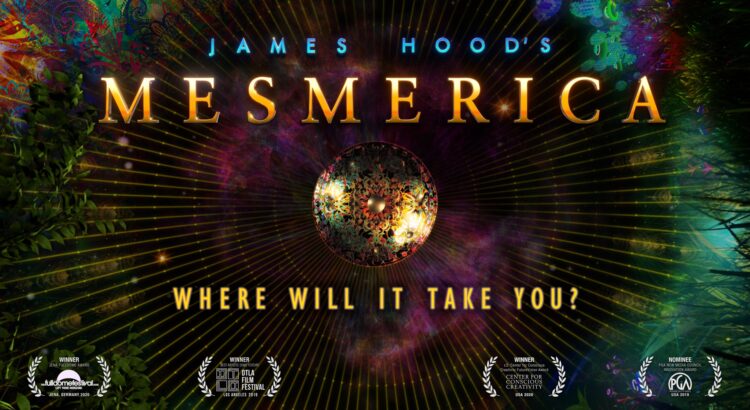
Settling into the Museum of Natural History’s Planetarium and Dome Theater to experience Mesmerica was like stepping through a portal. The show, imagined by James Hood, offered an immersive sensory experience that merged mesmerizing animations with Hood’s ethereal musical compositions. Mesmerica promised to transport viewers to a realm where we could let go of our worries and find a sense of joy in the present moment, and in many ways, it succeeded.

Designed for the unique physical allowances of a dome theater, Mesmerica enveloped the audience in a hallucinatory cocoon of visual and auditory art. The show was an hour-long journey filled with kaleidoscopic, abstract animations that danced across the dome overhead, perfectly synchronized with Hood’s ambient, new-agey music.

The visuals were a symphony of colors and shapes, constantly shifting and evolving, like a dreamscape brought to life. Each animation seemed to tell its own story, inviting viewers to lose themselves in its intricate details. In my favorite animation, a sprite-like blue star led viewers out of a dark nebula until we overlooked a great mandala wrought in bronze wires. We trailed behind as the star zoomed in and out of the wires, tracing lines of glittering dust that “activated” the mandala, which turned gold and pulsed with what looked like magic. It reminded me of attending fireworks shows with my cousins when we were little, where we imagined fairies being born out of every sparkling explosion. 

Mesmerica wasn’t without its quirks. In my personal opinion, there were some places where it took itself a tad too seriously. This feeling was particularly strong during Hood’s vocal interludes, which made the presentation feel like an overworked guided meditation. While the intention of promoting relaxation and mindfulness was clear, for me, it came across as a bit heavy-handed. 

Despite this minor caveat, Mesmerica definitely delivered on its promise of providing a brief vacation from the tedium of everyday life. The show served as an invigorating escape from my current, relentless world of midterms and deadlines.

In conclusion, Mesmerica was a uniquely immersive journey into the realms of art, music, and mindfulness. James Hood’s vision, combined with the collective creativity of artists from around the world, resulted in an imaginative and inspiring experience. While it may have risked taking the mindfulness concept to the level of tackiness at some points, the beauty of the animations and the soundscape created an enchanting atmosphere that was well worth the visit.