REVIEW: Renée Fleming, soprano, with Inon Barnatan, piano

7:30pm • Thursday, Sept. 28, 2023 • Hill Auditorium

Last night’s performance was a profoundly beautiful joining of nature and human artistry. In her musical program for this recital, Renée Fleming reminded us that our natural environment is humanity’s oldest muse, and it is in danger.

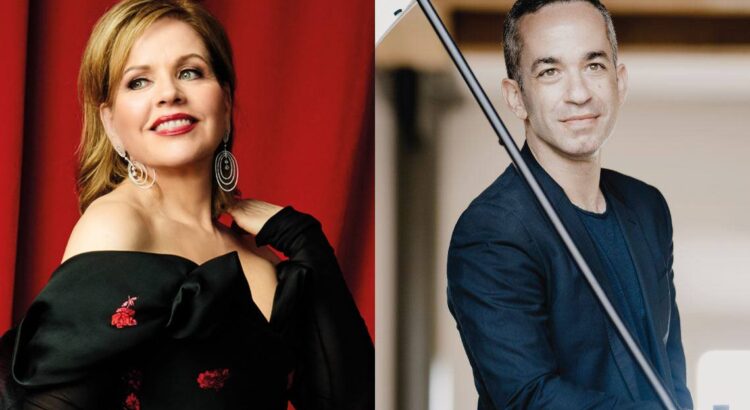
Fleming, a world-renowned soprano, is a five-time Grammy award-winner as well as a recipient of the National Medal of Arts. She was accompanied by Inon Barnatan, described as “One of the most admired pianists of his generation” by the New York Times, whose week-long residency at U-M includes two more performances on October 4th and 5th. The recital included the world premiere of “Voice of Nature,” a multimedia collaboration with National Geographic based on Fleming’s most recent work, “Voice of Nature: the Anthropocene.” “Voice of Nature” collected music from Fleming’s new album as well as from artists as varied as Björk and Howard Shore (The Lord of the Rings), all accompanied by a film created by National Geographic to represent the beauty of nature and the threat posed by global climate change.

“Voice of Nature” was a deeply poignant experience for me. In the 30-minute piece, imagery depicting the diversity and ingenuity of life on Earth was accompanied by poetic ruminations on life’s transience. The songs captured how nature has served as a backdrop for human love stories throughout time and reminded us that climate change threatened both. I was struck by the end of the piece in particular, where Fleming sang “Evening” by Kevin Puts, accompanied by images of shifting Aurora Borealis interspersed with gently spiraling views of the Milky Way. The solar winds buffeting the planet from millions of miles away, set within our solar system’s grand context, made me feel very small. The lyrics spoke to the space between hope and despair: “We know we are doomed, done for, damned, and still the light reaches us, falls on our shoulders even now, even here where the moon is hidden from us, even though the stars are so far away.”

The performance left me with much to reflect on. I was inspired by the power of music to evoke feelings of hope and commitment to life on Earth, which Fleming curated so thoughtfully in this program. For me, the call to action presented in Fleming’s work and in the accompanying film also exemplifies the spirit of arts as resistance, and I look forward to experiencing more work along this theme throughout this semester.


REVIEW: It Lives Inside

7:15pm • Tuesday, Sept. 26, 2023 • State Theater

In horror as a multi-disciplinary genre, the supernatural often serves as a metaphorical reflection of societal fears and anxieties. I don’t watch horror movies very often, but I found the trailer for It Lives Inside intriguing. From my outsider’s perspective, something I’ve noticed about horror is that it tends to be a very white- and male-dominated genre. In contrast, It Lives Inside centers on a community of Indian immigrants within white, small-town America, including teenage protagonist Samidha (Megan Suri, Never Have I Ever) and her family. I was drawn to the film’s exploration of racism, assimilation and community through the lens of horror. 

In It Lives Inside, Samidha is assimilating into (white) American society, distancing herself from her cultural traditions and from her family, community, and former best friend, Tamira (Mohana Krishnan). In contrast, Tamira is an outcast, living in perpetual fear of the thing trapped in a blackened mason jar she carries everywhere. When Samidha and Tamira fight, Samidha breaks the jar, releasing an evil spirit called the Pishach. The movie’s plot focuses on Samidha’s battle with the Pishach, a demon from Hindu mythology which feeds on human flesh. In this rendition, the Pishach feeds upon Samidha and Tamira’s anxieties and insecurities as second-generation immigrants until it can capture them and devour their souls.

One thing I love about It Lives Inside is how the movie emphasizes the necessity of community and solidarity in facing evil, real or supernatural. The Pishach alienates Tamira and Samidha from their families, friends, and supporters, preventing them from seeking help. However, it is when Samidha finally reaches out to her mother (Neeru Bajwa) and her teacher (Betty Gabriel, Get Out), she finds out that one cannot face the Pishach alone and survive–she needs help from her loved ones and community. It is only by reconnecting with her cultural traditions that Samidha can survive the evil forces threatening to consume her. 

Importantly, It Lives Inside manages to explore overarching issues of racism, assimilation, and community without making sweeping generalizations about an entire population. In an interview with writer-director Bishal Dutta, he describes how he hoped to “represent [his] culture in a loving kind of way without trying to make a statement about Indian Americans or the Indian population” (Fort Worth Report, 2023) which comes across beautifully in this film. Samidha and the other characters are portrayed as more than “types,” and while the film incorporates social realities like racism, it centers on the unique lives and relationships among its characters.

Overall, I enjoyed It Lives Inside both as entertainment and as a work fitting into a larger commentary on society. It wasn’t too scary for me, but it definitely kept me at the edge of my seat, and I would recommend it to anyone looking for a fresh movie to see in the coming weeks.

REVIEW: girlmuseum

On September 21st, from 4:30 to 7 p.m., the Stamps Gallery on Division St. hosted a student-led exhibition called “girlmuseum”.  The exhibition is part of a class led by Andrew Thompson called “Gallery As Site for Social Change”, in which students collaborated to make multimedia projects for a temporary gallery space. Although many Stamps classes are collaboration-based and place emphasis on the power of interweaving imaginations and different perspectives, it’s not common to see these collaborations outside of the Stamps building. This work was also advertised a bit better than other Stamps exhibitions I’ve seen, as I received emails from faculty members and gathered flyers that showed off the exhibition’s nostalgic and girlish themes.

girlmuseum was located in the atrium of the Stamps Gallery; the small glass room created an atmosphere of openness and warmth, as the evening light bathed the pieces in color and enhanced details like dazzling embellishments and silky textures. The first thing I noticed was the coherent theme connecting all the pieces, all contained in a manageable space, while each piece still retained its own individuality and personal message. All the multimedia pieces acted as artifacts from girlhood, showcasing mementos from the pains, joys, and imaginative flairs of femininity. Bubbly pop music from the 2000s played as you walked through the gallery, creating a multisensory experience, and pieces were draped across the ceiling and tucked into corners to create a highly engaging space.

Two pieces that represented shrines of some sort flanked the entryway, and I found myself absorbed in the objects they held. Hannah Montana and One Direction CDs spoke to the nostalgia of my earliest childhood obsessions, and handmade wallets and beaded necklaces brought me back to a time of uninhibited creation when arts and crafts were ruled by bright colors and exploration instead of self-scrutiny. Some objects are seemingly more humorous or abstract in meaning than others, like a packet of silica gel hanging next to a patterned headband, and some carry dark or mature connotations, like objects referring to pregnancy and sexuality. I found myself connected to all of it, weaving together vague memories and nostalgic girlhood to create a full understanding of this somewhat universal experience for femme-presenting people.

Other pieces were more focused on modern social commentary, but their structure was still undeniably playful. A silk slip dress was bedazzled with cursive letters that read “I am made & remade continuously”, investigating the turbulence of having a feminine identity; multiple sculptural pieces were made from combinations of children’s figurines, fabrics, and found items, presenting miniature scenes that appear playfully absurd yet speak to age-old or brand-new ideas of gender. A banner draped across the ceiling— requiring that you crane your neck to even realize its presence— contrasts against the frills and fun of everything else, covered in all-too-common sayings that degrade, underestimate, or deny the worth and strength of girls.

girlmuseum was a testament to girlhood in all its glory and its suffering— from its excesses of glitter and playful creation to its paralyzing self-doubt. I was amazed by how interconnected the pieces were, all different enough to contribute a new dimension to the overall theme. This exhibition made me so much more excited for future Stamps exhibitions, and I especially hope to see more collaborative exhibitions in the near future. I recommend checking out the Stamps Gallery on Division St. whenever you are able— regardless of what they’re showing, it is always incredible to see the diverse talent of students, faculty, and professional artists.

Welcome to [art]seen!

Our [art]seen writers cohort is comprised of University of Michigan students who review arts events on and near their campuses, sharing their thoughts and experiences on live music, film screenings, dance performances, theatre productions and art exhibitions.  Take a look back at some of our most memorable reviews of arts events this past year by clicking on the Year in Review(s) 2023 tag. See what our bloggers went to and read what they thought!

Editorial note:  [art]seen is designed to provide a space for student writers to express their opinions about events they’ve attended, with editorial independence. This forum is administered by the university’s Arts Initiative to foster a robust public conversation by students about the arts on and near campus. As such, the reviews published here do not and cannot reflect the thoughts and opinions of the Arts Initiative or the University of Michigan. 

Read More

REVIEW: Michelle Zauner in Conversation

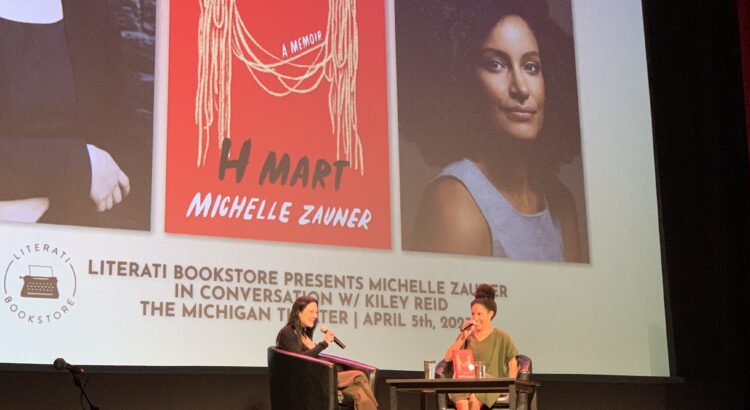
Michelle Zauner’s last stop for her book tour was yesterday night at the Michigan Theater. I arrived an hour early for the event, but the line was already so long that I couldn’t get a front-row seat… understandable because the tickets sold out within a week.

Michelle was interviewed by one of the University’s professors, Kiley Reid, and they touched on a variety of topics such as how the cover of Crying in H Mart was designed, how her book came to be published, what kind of scenes she wishes she could’ve included, and many more. I can’t capture all the details of their conversation, but here’s a quick summary of how Crying in H Mart came to be:

After her mother died, she found a ‘real’ job in New York advertising wallpapers. During that time Michelle found herself deeply engrossed in cooking Korean food. This experience inspired her to write an essay that she submitted to thousands of agencies. It was only after a year of rejections that an agent reached out to her, which was also around the same time her band, Japanese Breakfast, began to grow popular.

She prioritized her music career, but as she traveled around the world she strived to write 1,000 words a day during plane rides or as she waited backstage. Most of the book was written during her world tour for Japanese Breakfast. After reading her first draft, though, Michelle realized that her writing was so full of anger: anger at every person and anger at all her experiences, which wasn’t the kind of memoir Michelle wanted to write. Once she reached her last destination in South Korea however, the place where her mother grew up, she learned that there was more to write about outside her grief, and after continuously cutting down, editing, and revising her work, she had her final product: the first chapter titled Crying in H Mart.

After her interview with Kiley, there was also a Q&A session. Many people asked Michelle for advice on how to connect with their culture and progress their careers as a writer. She advised people to continuously interact with aspects of their heritage, whether it be learning history, taking language classes, or cooking food until it becomes a part of them. She also emphasized that to be a good writer, you have to write a lot of shit.

Overall, it was a super inspirational experience. It was also the first time I met an author, and Michelle was so humorous and down to earth. I initially thought the event would be a serious discussion due to the topic of the memoir, but it turned out to have a light-hearted atmosphere. There will also be a movie adaptation of the book!

I can’t wait to see what Michelle has planned for us in the future.

REVIEW: M-agination Film Festival

At the M-agination annual film festival last Thursday, student filmmakers, actors, directors, producers, photographers, and composers truly impressed. M-agination, a student-run organization, allows students to spearhead their own creative projects, producing 8 short films a semester, 16 total every year, that are showcased at an annual film festival held at the Michigan Theater. For student filmmakers, it was an incredible success and a culmination of everything they have accomplished over the year. For the audience – family, friends, and just interested students – it was an amazing viewing experience. 

M-agination left no parts of the human condition untouched. There was love. There was sorrow. There was partying. There was death. There were mobsters who believe in astrology. Although you could definitely tell that the short films were being run by students, I was awed at the creativity of some of the concepts. The audience certainly was too. After every joke, there was roaring laughter; after every sad scene, hushed murmurs. And with several people leaving after every short film finished, it was clear that some people were there to support friends who had been working on this project for a whole year. 

My favorite show of the night was a hilarious and truly touching depiction of a man after a breakup. Directed by the star actor, this unfortunate soul consults a rabbi (a 19 year old rabbi) for advice on how to turn his life around. After being dumped, he had posted a nihilistic tweet online – only to get more than 100,000 views. Realizing that social media was turning him into a pessimistic, likes-obsessed person, he deleted his twitter account. Denouncing religion itself, he sets off to form a new life. For a student creator, it’s a giant achievement to create a short film that’s funny, sad, and sincere all at once. 

If I had one piece of advice for M-agination student filmmakers: don’t shoot your movies in an echoey room. If you absolutely must, turn on subtitles. Other than that, congratulations on yet another year of making movies and taking names.