PREVIEW: Our Carnal Hearts

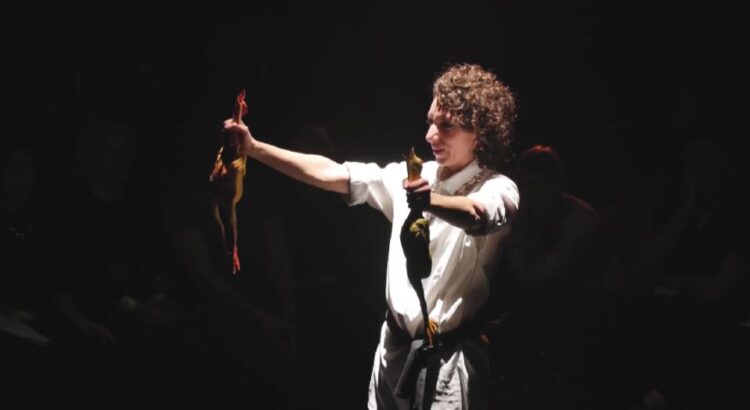
**featured image from the Our Carnal Hearts trailer on UMS.org

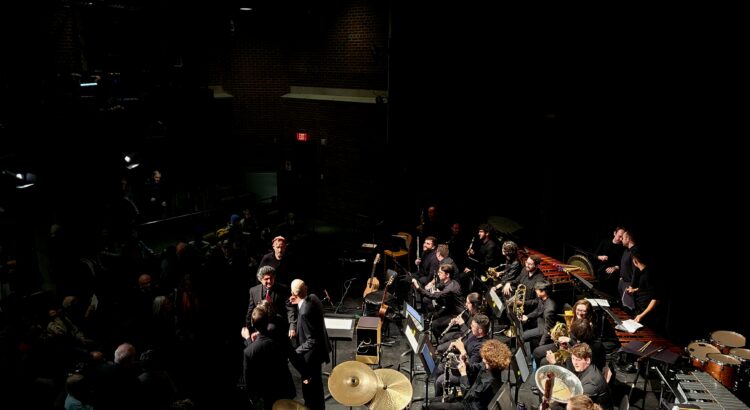
What: a comedy performance featuring Rachel Mars and four female singers honestly exploring envy across different areas of life

When: Friday, February 3, 8pm

Where: Arthur Miller Theater

Tickets: $12 for students, $25 for adults, available online or by phone at 734-764-2538

I don’t want to sound cheesy, but I really feel like laughter can be the best way to relax when I’m overwhelmed with the stress of everyday life. For that reason, I’m excited to attend Our Carnal Hearts this Friday night, what promises to be a hilarious and thought-provoking dive into the dark realities of human jealousy. The performance was created by British artist Rachel Mars, and based on the trailer I’m expecting music, comedy, and potential audience participation, all in the intimate setting of the Arthur Miller Theater. This is one of the final events in the University Musical Society’s No Safety Net Festival, and it is in conversation with Mars’ other performances and talks at the University this weekend, including Your Sexts Are Shit: Older Better Letters, another performance which will take place at the same place and same time on Saturday night. I look forward to sharing my notes on this show with you in the coming days.
REVIEW: FASA’s Philippine Culture Night

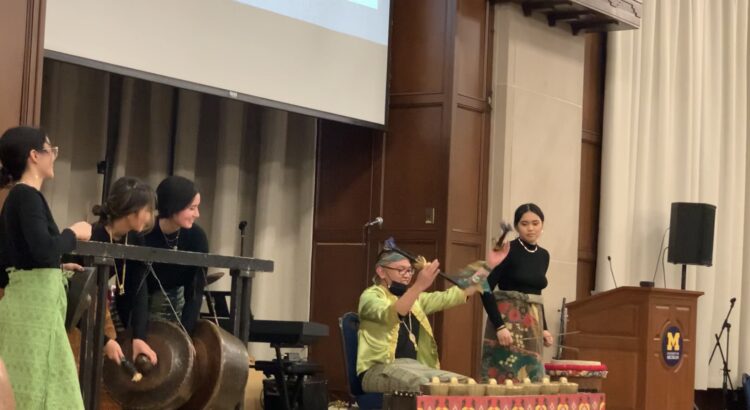
The featured image above is a performance on a musical instrument called a kulintang, and the weaving of the mallets represents the motion of weaving a basket.

Saturday night, the Michigan Union was bustling with activity for FASA’s long-awaited PCN. Everybody was elegantly dressed in long gowns and suits. The audience consisted of not only students, but friends, families, alumni, special keynote speakers, and even Filipino American student associations from Universities in Grand Rapids, Oakland County, and Dearborn.

FASA prepared multiple acts, such as various live singing performances (including a featured performance from FASOU, a student band from Oakland University), traditional instrumental music accompanied by dance, a poem reading, and many more.


A cover of “All I Ask” by Adele

This was the most memorable live music performance for me. The students covering the song showcased so much musical talent in their harmonies and synchrony with one another, and they’re not even an established music group. I don’t even see the same chemistry or skill in groups that focus on live singing.


The traditional music ensemble


The fan dance performed alongside the ensemble

What interested me the most about this dance is the lack of facial expressions on the dancers. Normally, facial expressions are a key focus in dance, because it’s the most blatant way to express emotional depth. In this case, the poker faces created a very elegant atmosphere.


Dance incorporating modern music with a cultural twist

This was another performance that really stood out to me. It was so much fun seeing how modern and cultural art can collaborate with each other. As they performed the traditional dance steps, students showcased goofy and joyful facial expressions in contrast to the fan dance performed just previously.


FASA’s band


A hip-hop dance to American and Philippine pop music to end the night


Unfortunately, there were serious sound issues at PCN. The mics often rang and that really took away from the experience. In addition, the technical difficulties dragged the event to become an hour longer due to frequent awkward pauses between and even in the middle of performances. Overall, it was an amazing, lively, and lovely event to attend. However, I’m not sure if I would come back to PCN next year because of how long it was. That doesn’t mean I wouldn’t consider going again, though, and I highly encourage anybody interested to attend the event next year!

REVIEW: Into the Labyrinth: A History of Physics From Galileo to Dark Matter

8:00pm • Friday, January 27, 2023 • Keene Theater

Into the Labyrinth was a mind-boggling musical experience, most of which shot straight over my head and toward the stars. The concert was a dynamic fusion of the history of physics, Argentinian folk music, jazz, experimental decaphonic guitar, sung poetry, and spoken word. The evening was structured chronologically, beginning with Galileo’s ponderings about the knowability of the universe, moving onward to Newton’s Laws of Motion, to Clausius’s definitions of thermodynamics, to the work Maxwell, Curie, Einstein, and other physicians who I didn’t learn about in 10th grade, to the physicians who pioneered the theory of quantum mechanics and electrodynamics. This brief history of physics was conveyed not only through direct quotations, but also through poetry and excerpts from Elfriede Jelinik’s play Kein Licht (“No Light”).

At the beginning of the program during a Q&A, Alberto Rojo, the work’s primary composer, explained how carefully he had chosen different styles of Argentinian folk music to represent the different eras of our understanding of physics. Again, most of this went over my head, because I have zero background knowledge on either subject. Instead, I related closely with Michael Gould, the work’s arranger, who in joking reference to the complexity of the piece said something like, “You just have to let it wash over you,” which I did.

My favorite movement was the last, which Rojo describes as “an open-ended appeal to continue the search for understanding.” The movement featured a “decaphonic” guitar that Rojo constructed as a way to explore different ways to divide up the musical scale. Typical Western music uses a seven-step scale, the one you’re familiar with if you’ve ever heard “Do-Re-Mi” from The Sound of Music. Rojo’s guitar took one interval of sound (the distance between Do and Do, if this makes any sense to you) and divided it into 10 equal parts, resulting in a sound that he described as “the music of a culture that doesn’t exist.” I loved how the idea of “discovering” an unfamiliar scale connected with the theme of scientific exploration and the unknown.

My overall impression of the concert was that of a wild experimental musical. I wish I could watch it a few more times over, to really dig into the details of the quotations and the music. I feel privileged to have been at its world premiere, and I hope Into the Labyrinth will see a successful future in front of further audiences.

REVIEW: Traces

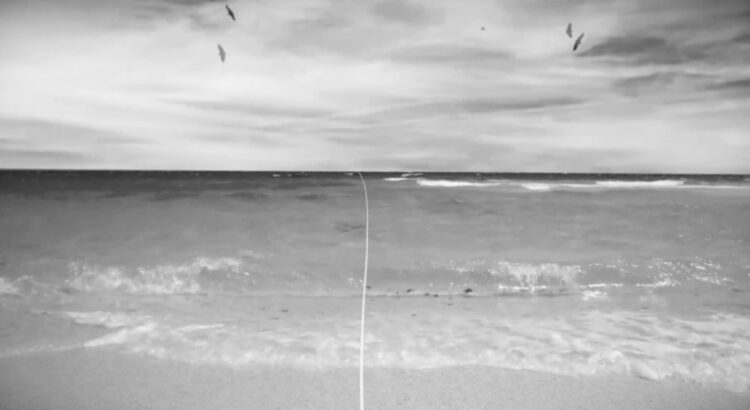
**featured image a screenshot from the final frame of “Gone” on Virtual Mutations, Camila Magrane

9:00am • Monday, January 30, 2023 • Institute for the Humanities Gallery

Traces captured many emotions and impressions in the small space of the Institute for the Humanities Gallery, and in the even smaller spaces of single Polaroid photos. The exhibition, created by Camila Magrane, involves a series of Polaroids and larger collages which visitors view through the lens of an augmented reality application called Virtual Mutations. It took a little while for the app to download, but the effect was impressive once I held my phone up to Magrane’s works. In some, platforms telescoped out of the scenes while footprints wove their way in and out of the frame; in another, crows appeared to flock out of the frame and surround the viewer. Overall, I was able to use the technology fairly seamlessly to access the whole experience–in some cases the image on my phone fell out of line with the actual frame, or I needed to move around in order to get the animations to begin, but once I began it was easy to navigate the exhibit.

“Gone”, Camila Magrane

One of the themes Magrane promised to explore in the works featured in Traces was the connection between the past and present, and my favorite example of this theme was in “Gone,” one of her larger collage pieces. Once accessed through Virtual Mutations, the viewer moves slowly through the window in the center, through which appears another window in another wall, creating an Escher-esque illusion. Literally tying together the different versions of the scene is a white rope, appearing in different arrangements with the other furniture and the fish that make up the scene. Eventually the window gives way to a shore, with the white rope leading out unendingly into the ocean. I felt that I was tracing the path of whoever had disappeared into the waves, watching the remnants of their life subsumed by successive tides.

“Tension”, Camila Magrane

The Polaroids in the exhibit added a different facet to the overall mood of the gallery. Each Polaroid, or small arrangement of Polaroids, was titled with an emotional or psychic state, like “Angst,” “Rapture,” “Tension,” or “Anticipation.” To me, these titles also served the theme of Magrane’s work by alluding to a Before and After, or the tension of the in-between. Viewed through Virtual Mutations, the animated Polaroids featured the repetitive movement of human forms–I felt like they activated my mirror neurons, nudging me towards a phantom experience of the emotions they portrayed.

Overall, Traces created a powerful and surreal space that nudged me to think more deeply about the relationship of technology with art. The convergence of antique technologies like Polaroid film and cutting-edge ones like virtual reality lent a sense of timelessness to Magrane’s work. I highly recommend the exhibit to anyone passing by the Institute for the Humanities Gallery as a bite-sized look into the future of interactive art.

REVIEW: Dopamine Dressing

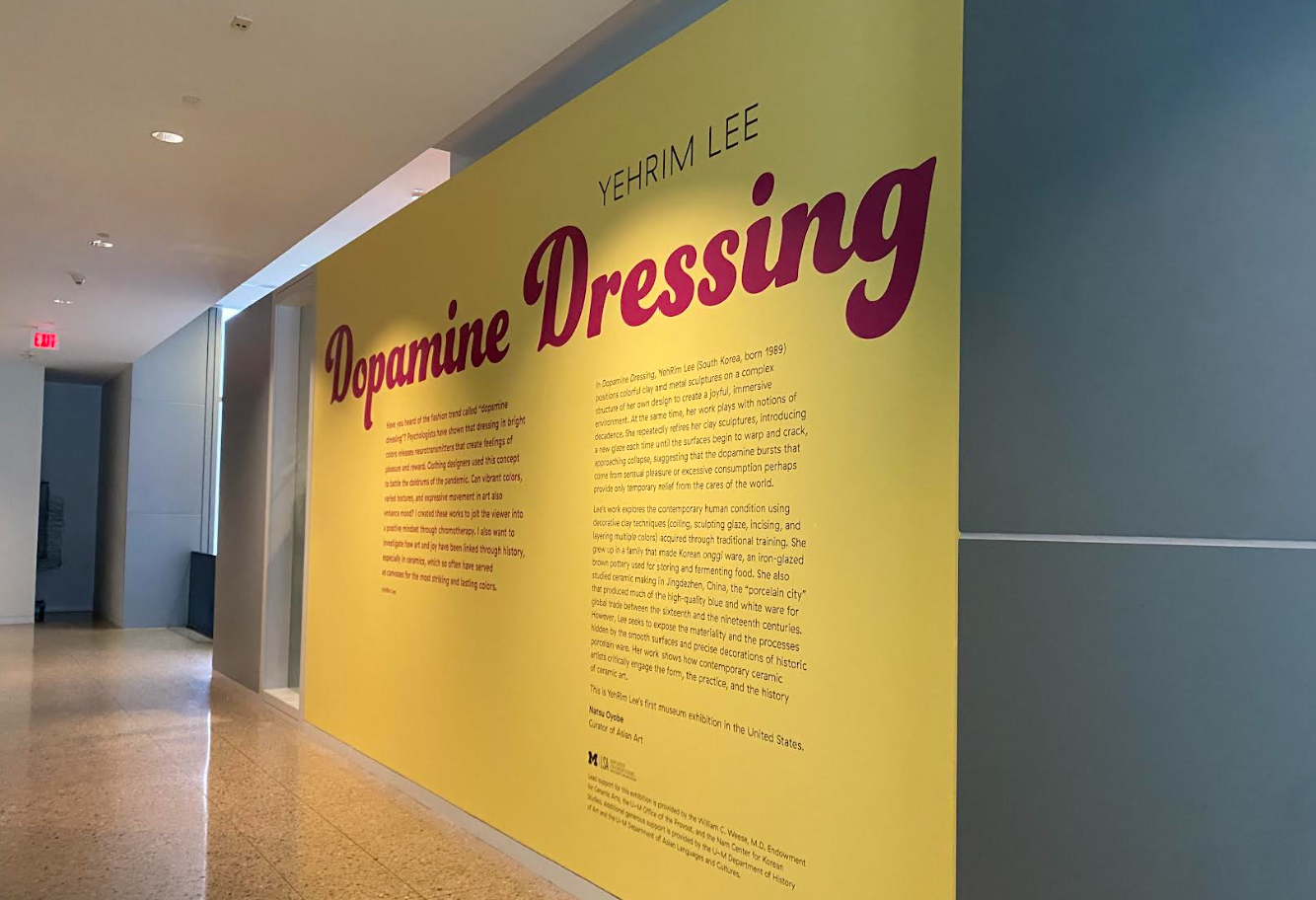
I am a sucker for bright colors and fun shapes, who isn’t? When I noticed Dopamine Dressing being set up through the windows of the UMMA, I knew that I was going to adore this exhibit. Artist YehRim Lee specializes in the use of ceramics and glazes, and the skill shines in her work that dives into the essence of Dopamine Dressing: the idea that bright colors and fun textures can act as a mood enhancer, triggering the release of neurotransmitters that create feelings of pleasure and reward. This idea that stemmed out of the COVID-19 pandemic shutdown is most commonly taken on in the fashion world, but Lee explores it in her sculptures as well. Dopamine Dressing is Lee’s first museum exhibition in the United States. 

The textures of Lee’s work stood out the most to me. The shapes of each sculpture were abstract and unique, being almost flower-like in appearance and blooming out of the bright pink walls of the space. Some pieces resembled snow, or frosting on a cake; others reminded me of fungi or coral. I had the strange feeling that the sculptures were some sort of candy to bite into…I felt as though I was looking at the world’s most intensely crafted gingerbread house. The work is often described as “decadent” and gives off all things over-indulgent! Lee’s method of refining her pieces with new layers of clay and multiple rounds of firing creates an interesting finish with many warps and cracks. Lee notes that this is to remind the audience that “dopamine bursts that come from sensual pleasure or excessive consumption perhaps provide only temporary relief from the cares of the world.” It gives the audience something to think about when walking through the exhibit; I like to think of it as beauty that can come from a temporary fix. 

Overall, I found the experience to be enjoyable and the indulgence of it all very refreshing, especially in this art medium. Days before visiting Dopamine Dressing, I coincidentally read J De Leon’s piece, “Calling Self-Indulgence,” a piece that focuses on the idea of self-indulgence as a form of self preservation that, in some cases, allows us to care for ourselves and others. I couldn’t help but think back to it as I walked through Lee’s work, allowing myself to slip into the extravagance of it all.

PREVIEW: Traces

What: a series of collages and Polaroids accompanied by animations seen through the augmented reality application Virtual Mutations, exploring the relationship between past and present

When: January 11-February 10, Monday-Friday, 9am-5pm

Where: Institute for the Humanities Gallery

Tickets: free and open to the public!

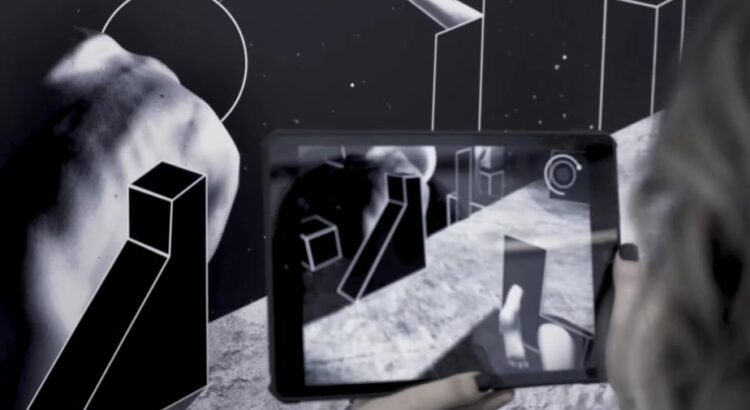
My mind is already bending after watching the trailer for this exhibition, linked below. Traces is a multimedia experience created by Camila Magrane, an artist trained in video game development who has experience working in photography, collage, animation and virtual and augmented reality. This particular exhibition draws from several of those disciplines, with collages and Polaroids in the physical world setting the stage for animations and clips in the virtual world, as experienced by the viewer from their device through the app Virtual Mutations. Each work is interactive, with elements in each piece only discoverable through the lens of augmented reality. The Institute for the Humanities Gallery webpage describes Magrane’s work as an exploration of the connection between past and present. I look forward to experiencing her art for myself so I can share more with you about how this is achieved. Stay tuned!


**featured image is a still from the trailer, 0:28